


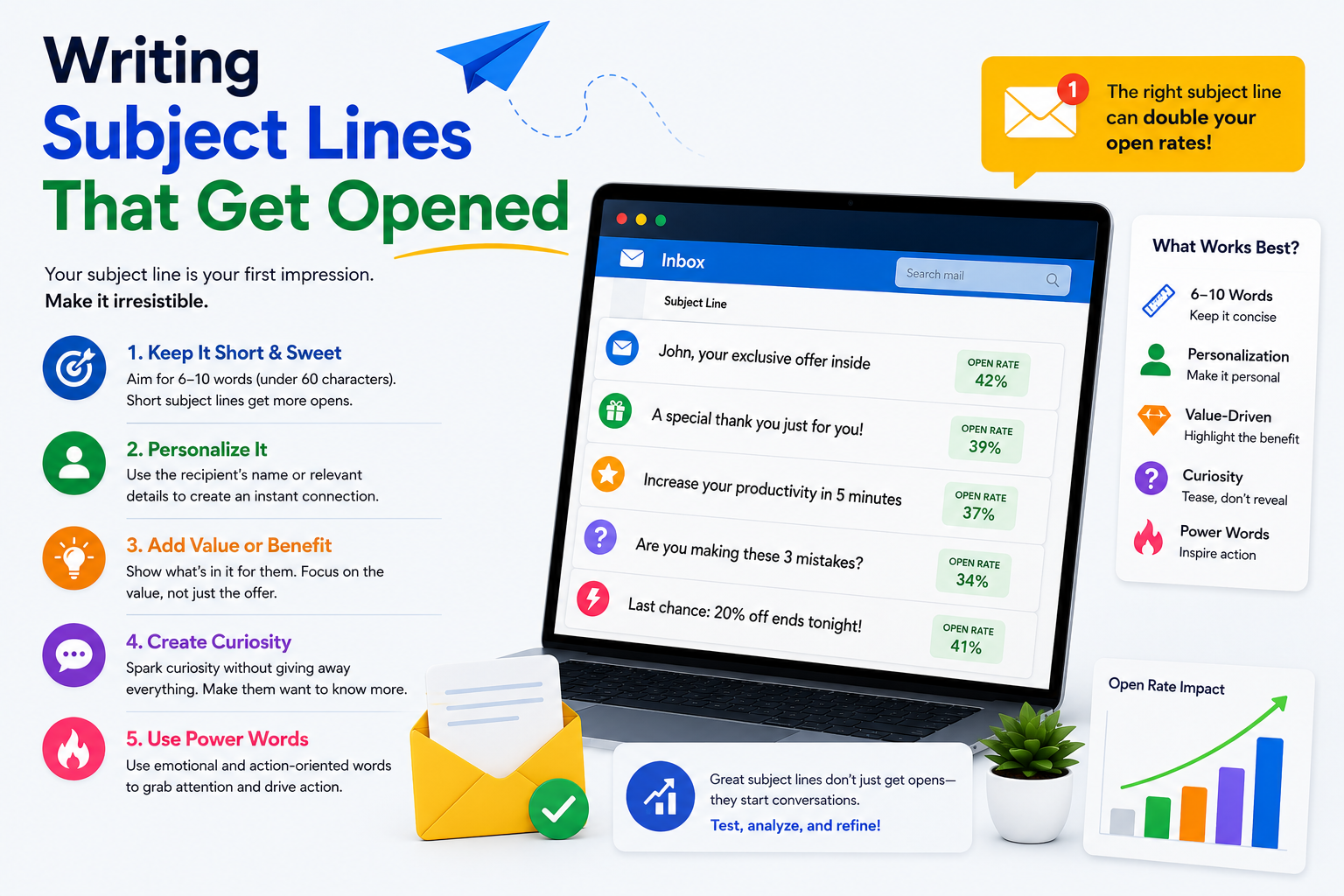
In today’s crowded digital inbox, getting someone to open your email is no small achievement. Most professionals receive dozens—sometimes hundreds—of emails every day, and only a fraction ever get opened. That means your subject line is no longer just a headline; it is your first impression, your hook, and often your only chance to earn attention.
For startups, enterprises, and decision-makers, mastering subject lines is not just a marketing skill—it is a business advantage. Whether you are nurturing leads, sharing product updates, or running campaigns, the difference between a 12% open rate and a 28% open rate often comes down to a few carefully chosen words.
This guide explores the science, psychology, and strategy behind writing subject lines that actually get opened, along with practical insights you can apply immediately.
Why Email Subject Lines Matter More Than Ever
Email remains one of the highest ROI marketing channels, consistently delivering an average return of $36 to $42 for every $1 spent, according to multiple industry benchmarks. However, that return depends heavily on whether your emails are opened in the first place.
The subject line is the gatekeeper.
Think of it this way: your email content could be exceptional, your offer could be irresistible, and your timing could be perfect—but none of it matters if the recipient never clicks.
Modern inboxes are also more competitive than ever. Gmail, Outlook, and Apple Mail now filter, categorize, and prioritize emails based on relevance signals. That means your subject line not only influences humans but also how algorithms treat your email.
Businesses that consistently optimize subject lines report significantly higher engagement rates, sometimes improving open rates by 20–30% with small adjustments in wording, tone, and structure.
The Psychology Behind High-Performing Subject Lines
To write subject lines that get opened, you need to understand human behavior. People do not open emails because they are informative—they open them because they are emotionally triggered or intellectually curious.
There are three core psychological triggers that consistently influence open rates:
1. Curiosity Gap
People are naturally drawn to incomplete information. A subject line that hints at value without revealing everything creates tension that encourages clicks.
For example:
“Most companies miss this simple growth mistake”
2. Urgency and Scarcity
When something feels time-sensitive or limited, people act faster. This is especially effective in B2B campaigns, product launches, and event marketing.
For example:
“Last chance to access Q2 pricing insights”
3. Personal Relevance
Emails that feel personally relevant are significantly more likely to be opened. This is where segmentation and personalization become critical.
For example:
“Marketing teams in SaaS: here’s what changed in 2026”
Understanding these psychological triggers helps transform subject lines from generic statements into attention-grabbing entry points.
Types of Subject Lines That Drive Higher Open Rates
Not all subject lines are created equal. Different formats work better depending on your audience, industry, and intent.
Here are some of the most effective types used by high-performing marketing teams:
- Curiosity-driven subject lines that spark interest
- Benefit-focused subject lines that highlight value
- Question-based subject lines that engage thinking
- Urgency-based subject lines that encourage immediate action
- Personalized subject lines that target specific roles or industries
Each format works best in different scenarios. For instance, SaaS companies often see strong results with curiosity-driven lines, while e-commerce brands benefit more from urgency-based messaging during promotions.
The key is not to rely on a single style but to rotate strategically based on campaign goals.
Personalization: The Real Driver of Modern Email Engagement
Personalization is no longer optional. It has become a baseline expectation in B2B and B2C communication.
Emails with personalized subject lines can improve open rates by up to 26%, according to industry research. But personalization is not just about inserting a first name—it goes much deeper.
For example, a SaaS company targeting enterprise CTOs might use a subject line like:
“CTOs: reducing infrastructure cost without slowing performance”
Meanwhile, a startup targeting early-stage founders might focus on:
“What early-stage startups are doing differently in 2026”
When personalization is done well, the email feels less like marketing and more like a direct conversation.
The Role of Curiosity and Clarity in Subject Line Writing
One of the most common mistakes marketers make is overcomplicating subject lines in an attempt to sound clever. In reality, clarity almost always beats cleverness.
A good subject line should balance two things: curiosity and clarity. If curiosity is too high and clarity is too low, the message feels misleading. If clarity is too high and curiosity is missing, the email feels boring.
The sweet spot lies in subtle intrigue.
For example:
Instead of: “Our revolutionary platform changes everything”
Use: “A simpler way to manage enterprise workflows”
Instead of: “You won’t believe this update”
Use: “A key update that improves reporting accuracy”
Clarity ensures trust, while curiosity drives action. The combination is what gets emails opened consistently.
Common Mistakes That Reduce Email Open Rates
Even experienced marketers make mistakes that significantly impact performance. These errors often go unnoticed but can quietly reduce engagement over time.
Here are some of the most common pitfalls:
- Writing subject lines that are too long and get cut off on mobile
- Using misleading clickbait that reduces trust
- Overusing promotional language like “Buy now” or “Free offer”
- Ignoring mobile optimization
- Sending the same subject line to all audience segments
Mobile optimization is especially important. More than 60% of emails are now opened on mobile devices, where subject lines are truncated after 40–60 characters. If your key message is at the end, it may never be seen.
Avoiding these mistakes alone can lead to noticeable improvements in open rates without changing your entire email strategy.
Testing and Optimizing Subject Lines for Better Results
Writing great subject lines is not a one-time effort—it is an ongoing optimization process. Even small changes in wording can lead to significant differences in performance.
A/B testing is one of the most effective methods for improving open rates. It allows you to compare two variations of a subject line and identify which performs better.
When testing subject lines, focus on:
- Tone variations (formal vs conversational)
- Length differences (short vs descriptive)
- Emotional triggers (curiosity vs urgency)
- Personalization elements (generic vs segmented)
Over time, these tests help you understand what resonates most with your audience.
Many marketing teams also track metrics beyond open rates, such as click-through rate and conversion rate, to ensure subject lines attract the right kind of engagement—not just clicks.
The Future of Email Subject Lines in a Digital-First World
As AI-driven inboxes become more advanced, subject lines will need to evolve. Email platforms are already using machine learning to categorize and prioritize messages based on engagement behavior.
This means subject lines that feel authentic, relevant, and human will outperform generic automation-heavy messaging.
We are also seeing a shift toward hyper-personalized communication, where subject lines dynamically adjust based on user behavior, purchase history, and intent signals.
In the coming years, the most successful businesses will be those that combine data-driven insights with human-centric storytelling.
Professional Conclusion
Writing subject lines that get opened is both an art and a science. It requires understanding human psychology, mastering clarity, and continuously optimizing based on real performance data.
For businesses, this is not just about improving email metrics—it is about improving communication effectiveness across the entire customer journey. A well-crafted subject line can increase engagement, strengthen brand trust, and ultimately drive revenue growth.
As inbox competition continues to rise, the ability to write compelling subject lines will remain one of the most valuable skills in digital marketing.
FAQ: Writing Subject Lines That Get Opened
1. What is the ideal length for an email subject line?
The most effective subject lines are usually between 30–50 characters, especially for mobile users. This ensures the full message is visible without being cut off.
2. Do emojis improve email open rates?
In some industries like retail and lifestyle, emojis can improve visibility. However, in B2B and enterprise communication, they should be used sparingly to maintain professionalism.
3. How important is personalization in subject lines?
Highly important. Personalized subject lines can increase open rates significantly when combined with proper segmentation and relevance.
4. What makes a subject line click-worthy but not spammy?
Clarity, relevance, and authenticity. Avoid misleading language or excessive promotional wording, as this can harm trust and deliverability.
5. How often should I test subject lines?
Ideally, every major campaign should include A/B testing to continuously refine performance and understand audience behavior.