


In today’s digital landscape, attracting visitors to your website is only half the battle. The real challenge begins when those visitors leave without taking action.
Research consistently shows that the vast majority of website visitors do not convert on their first visit. They browse products, compare solutions, read content, and then move on. For businesses investing heavily in digital marketing, this creates a significant opportunity—and a significant challenge.
This is where retargeting ads become one of the most powerful tools in modern marketing.
Whether you’re a startup trying to generate leads, an eCommerce brand recovering abandoned carts, or an enterprise nurturing high-value prospects through lengthy buying cycles, retargeting helps you reconnect with potential customers who have already shown interest in your business.
When implemented correctly, retargeting campaigns can dramatically improve conversion rates, increase customer engagement, and maximize advertising return on investment.
In this guide, we’ll explore how businesses can use retargeting ads effectively, avoid common mistakes, and create campaigns that drive measurable business results.
What Are Retargeting Ads?
Retargeting ads are digital advertisements shown to users who have previously interacted with your website, mobile app, social media profile, or digital content.
Instead of targeting completely new audiences, retargeting focuses on people who already know your brand.
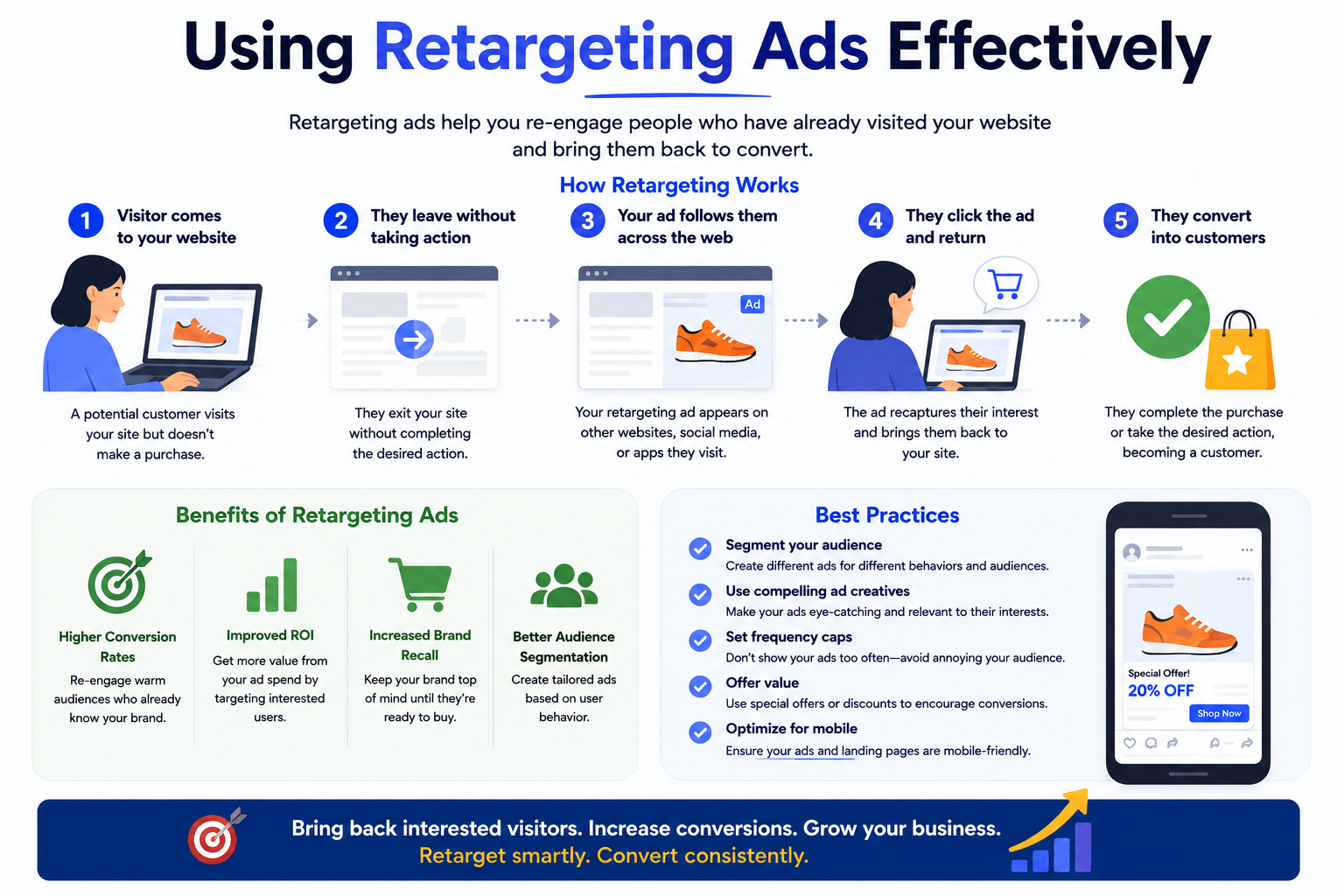
For example, imagine a visitor lands on your website, explores your software solutions, and leaves without requesting a demo. A few days later, they see your ad while browsing social media or reading industry news. That ad reminds them of your brand and encourages them to return.
This repeated exposure helps keep your company top-of-mind throughout the buyer’s journey.
Retargeting works because it targets warm prospects rather than cold audiences. These individuals have already demonstrated some level of interest, making them significantly more likely to convert.
Why Retargeting Matters More Than Ever
Customer journeys have become increasingly complex.
Today’s buyers rarely make decisions after a single interaction. They research competitors, read reviews, compare pricing, watch videos, and consult colleagues before making purchasing decisions.
For B2B organizations, buying cycles can last several months. For eCommerce businesses, customers often visit multiple times before completing a purchase.
This shift in buyer behavior has made retargeting a critical component of successful digital marketing strategies.
According to various industry studies, retargeted visitors are often more likely to convert than first-time visitors. Businesses that consistently stay visible during the consideration phase typically experience stronger conversion rates and improved marketing efficiency.
As customer acquisition costs continue to rise across platforms, maximizing the value of existing traffic has become a strategic priority for companies of all sizes.
How Retargeting Works
Retargeting relies on tracking technologies such as cookies, pixels, and audience data collected through advertising platforms.
When users visit your website, a tracking pixel records their interaction. This information allows advertising platforms to place those visitors into specific audience segments.
Businesses can then create customized advertisements that are displayed to those audiences across various channels, including:
- Search engines
- Social media platforms
- Display advertising networks
- Video platforms
- Mobile applications
The key advantage is personalization. Instead of showing generic advertisements, companies can present highly relevant messages based on user behavior.
Someone who viewed pricing pages should see different messaging than someone who only read a blog article.
The Different Types of Retargeting Campaigns
Not all retargeting campaigns serve the same purpose. Understanding the different approaches helps businesses align campaigns with specific marketing goals.
Website Visitor Retargeting
This is the most common form of retargeting.
Visitors who browse your website are added to audience segments based on their actions. You can then serve ads designed to bring them back and encourage conversion.
For example, a SaaS company might retarget visitors who explored product features but never booked a consultation.
Cart Abandonment Retargeting
Cart abandonment remains one of the biggest challenges for online retailers.
Many shoppers add products to their cart but leave before completing checkout. Retargeting campaigns remind these users about their unfinished purchase and often include incentives such as free shipping or limited-time discounts.
This strategy can significantly recover lost revenue.
Lead Nurturing Retargeting
B2B organizations frequently use retargeting to nurture leads over time.
A prospect who downloads an industry report may enter a retargeting sequence featuring case studies, testimonials, webinars, and product demonstrations.
The goal is to build trust and move prospects closer to a purchasing decision.
Customer Retargeting
Retargeting isn’t only for acquiring new customers.
Businesses can also target existing customers with upsell opportunities, cross-sell recommendations, product updates, and renewal reminders.
This approach supports customer retention while increasing lifetime value.
Building an Effective Retargeting Strategy
Many businesses launch retargeting campaigns without a clear strategy. As a result, they waste budget showing repetitive ads that fail to drive meaningful engagement.
Effective retargeting starts with audience segmentation.
Segment Your Audiences Carefully
Treating all website visitors the same is a common mistake.
Different visitors have different levels of buying intent.
Someone who spent ten minutes reviewing pricing information is much closer to making a purchase than someone who briefly visited a blog post.
Create audience groups based on actions such as:
- Homepage visitors
- Product page visitors
- Pricing page visitors
- Cart abandoners
- Existing customers
Each audience should receive messaging tailored to their specific stage in the buying journey.
Create Personalized Ad Experiences
Personalization is one of the biggest advantages of retargeting.
Instead of displaying generic advertisements, customize creative assets based on audience behavior.
For example, an enterprise software company could show customer success stories to prospects who viewed solution pages. An online retailer could feature products similar to those previously viewed by shoppers.
Relevant messaging increases engagement and improves campaign performance.
Use Sequential Messaging
One of the most effective retargeting strategies involves sequential advertising.
Rather than showing the same advertisement repeatedly, businesses can guide prospects through a series of messages.
The first ad might introduce brand benefits.
The second ad could highlight customer testimonials.
The third ad may offer a free consultation or product demo.
This creates a more natural buying journey while reducing ad fatigue.
Choosing the Right Platforms for Retargeting
Platform selection plays a major role in campaign success.
Different channels serve different purposes depending on your audience and objectives.
Google Display Network
Display advertising allows businesses to reach users across millions of websites and apps.
This broad reach makes it ideal for maintaining visibility throughout the customer journey.
Visual ads can reinforce brand awareness and encourage return visits.
Social Media Platforms
Social platforms provide advanced audience targeting capabilities.
Users often spend significant time on social networks, making these platforms highly effective for retargeting campaigns.
Video ads, carousel ads, and lead generation formats provide multiple ways to engage audiences.
Search Retargeting
Search retargeting focuses on users who have previously interacted with your brand and later continue researching related topics.
These campaigns capture prospects while purchase intent remains high.
For businesses operating in competitive markets, search retargeting can be especially valuable.
The Importance of Ad Creative
Even the best audience targeting cannot compensate for weak creative assets.
Retargeting ads must capture attention while delivering a compelling message.
Strong creative typically includes:
- Clear value propositions
- Relevant visuals
- Strong calls to action
- Consistent branding
- Mobile-friendly design
Businesses should continuously test different headlines, images, video formats, and offers to identify what resonates most effectively with target audiences.
A/B testing remains one of the most reliable ways to improve campaign performance over time.
Avoiding Ad Fatigue
One of the biggest mistakes companies make is overwhelming users with excessive ad frequency.
We’ve all experienced situations where the same advertisement follows us across the internet for weeks. Instead of increasing conversions, this often creates frustration.
Effective frequency management is essential.
Set limits on how often users see your advertisements within a given period.
Refresh creative assets regularly and rotate messaging to maintain engagement.
Retargeting should feel helpful and relevant—not intrusive.
Leveraging Dynamic Retargeting
Dynamic retargeting takes personalization to another level.
Rather than manually creating advertisements for different products or services, dynamic campaigns automatically generate ads based on user behavior.
For example, if a customer views a specific product category, the system displays ads featuring those exact products.
This approach is widely used in eCommerce because it delivers highly relevant experiences at scale.
However, dynamic retargeting can also benefit SaaS providers, educational institutions, travel companies, and financial service organizations.
The more relevant the advertisement, the greater the likelihood of conversion.
Measuring Retargeting Performance
Successful retargeting requires continuous monitoring and optimization.
Tracking performance metrics helps businesses identify what’s working and where improvements are needed.
Key performance indicators often include:
- Click-through rate (CTR)
- Conversion rate
- Cost per acquisition (CPA)
- Return on ad spend (ROAS)
- Customer lifetime value (CLV)
Rather than focusing solely on clicks, businesses should evaluate how retargeting contributes to overall revenue and customer acquisition goals.
A campaign with a lower click-through rate may still generate stronger revenue if it attracts higher-quality prospects.
Real-World Example of Effective Retargeting
Consider a B2B cybersecurity company selling enterprise security solutions.
The company invests heavily in content marketing and generates thousands of monthly website visitors. However, very few visitors request consultations during their first visit.
Instead of losing those opportunities, the company launches a retargeting campaign.
Visitors who download cybersecurity reports receive advertisements featuring industry case studies. Prospects who view pricing pages receive ads promoting free security assessments.
Over several weeks, prospects encounter relevant content tailored to their interests and stage in the buying cycle.
As trust increases, consultation requests rise significantly.
This example illustrates how retargeting supports complex sales processes by maintaining engagement over time.
Common Retargeting Mistakes to Avoid
Many businesses fail to achieve desired results because they overlook fundamental best practices.
The most common mistakes include targeting everyone with the same message, ignoring audience segmentation, showing ads too frequently, and failing to refresh creative assets.
Another frequent issue is focusing exclusively on short-term conversions.
Retargeting should support the entire customer journey, not just immediate sales.
Businesses that prioritize relevance, personalization, and long-term relationship building generally achieve stronger outcomes.
Additionally, neglecting analytics can limit campaign effectiveness. Continuous optimization is essential for maintaining performance as audience behaviors evolve.
The Future of Retargeting Advertising
Privacy regulations, cookie restrictions, and changing consumer expectations are reshaping digital advertising.
As third-party data becomes less accessible, businesses are increasingly relying on first-party data collected directly from customers and website visitors.
Companies that invest in customer data platforms, CRM integration, and consent-based marketing strategies will be better positioned for future success.
Artificial intelligence is also enhancing retargeting capabilities by improving audience segmentation, predictive analytics, and creative optimization.
The future of retargeting will be less about following users everywhere and more about delivering highly relevant, permission-based experiences.
Conclusion
Retargeting remains one of the most effective digital marketing strategies for turning interested visitors into paying customers.
While attracting new traffic is important, maximizing the value of existing traffic often delivers greater returns and lower acquisition costs. Businesses that use retargeting strategically can improve brand recall, increase conversions, and strengthen customer relationships throughout the buying journey.
Success depends on more than simply showing ads to past visitors. Effective retargeting requires audience segmentation, personalized messaging, creative testing, frequency management, and continuous optimization.
As competition for customer attention continues to intensify, organizations that master retargeting will gain a significant advantage in both customer acquisition and retention.
For startups, SMEs, enterprises, and digital-first organizations, retargeting is no longer an optional tactic—it is an essential component of a high-performing marketing strategy.
Frequently Asked Questions (FAQs)
What is the primary goal of retargeting ads?
The primary goal of retargeting ads is to re-engage users who have previously interacted with your brand and encourage them to complete a desired action, such as making a purchase, booking a demo, or submitting a lead form.
How long should a retargeting campaign run?
The ideal duration depends on your sales cycle. eCommerce businesses may run campaigns for a few weeks, while B2B organizations with longer decision-making processes may retarget prospects for several months.
Are retargeting ads effective for B2B companies?
Yes. Retargeting is highly effective for B2B organizations because purchasing decisions often involve multiple stakeholders and extended research periods. Consistent exposure helps keep your brand visible throughout the buying process.
What is the difference between retargeting and remarketing?
Retargeting typically refers to paid advertisements shown to previous website visitors, while remarketing often involves email campaigns targeting existing leads or customers. Many marketers use the terms interchangeably.
How can businesses improve retargeting campaign performance?
Businesses can improve results by segmenting audiences, personalizing ad creatives, limiting ad frequency, testing multiple messaging variations, and regularly analyzing campaign performance metrics.
Ready to Maximize Your Advertising ROI?
Retargeting can transform lost website visitors into loyal customers—but only when supported by the right strategy, technology, and execution.
Whether you’re a startup building brand awareness, an SME seeking higher conversion rates, or an enterprise optimizing complex customer journeys, partnering with an experienced digital marketing and technology team can accelerate results.
Choose a technology and marketing partner that understands data-driven advertising, audience behavior, automation, analytics, and customer experience optimization. With the right expertise, your retargeting campaigns can become a powerful growth engine that delivers measurable business outcomes and long-term competitive advantage.