


Email marketing continues to be one of the highest ROI digital channels in the world. While social media trends rise and fall, email remains stable, direct, and incredibly powerful. Studies consistently show that email marketing delivers an average ROI of $36–$42 for every $1 spent, making it a cornerstone of digital strategy for startups, SMEs, and global enterprises alike.
But here’s the real challenge: choosing the right email marketing platform.
With so many tools promising automation, personalization, AI-driven campaigns, and advanced analytics, decision-makers often struggle to identify what truly fits their business needs. The wrong platform can slow down growth, while the right one can transform customer engagement, lead nurturing, and revenue generation.
In this guide, we break down the top 5 email marketing platforms used by modern businesses in 2026. We compare them based on usability, scalability, automation, pricing structure, and real-world application so you can make a confident, informed decision.
Why Email Marketing Platforms Matter More Than Ever
Before diving into the comparison, it’s important to understand why these platforms are essential today.
Customer expectations have changed significantly. Businesses are no longer just sending newsletters—they are building automated journeys, personalized experiences, and behavior-driven campaigns.
Modern email marketing platforms help businesses:
- Automate customer journeys from lead capture to conversion
- Segment audiences based on behavior and demographics
- Deliver personalized content at scale
- Track engagement and revenue attribution
- Integrate seamlessly with CRM, eCommerce, and analytics tools
In fact, over 80% of marketers now rely on automation to improve campaign performance, and businesses using segmented email campaigns report significantly higher open and click-through rates compared to generic blasts.
With that context, let’s explore the top platforms shaping the industry today.
1. Mailchimp: The Most Popular All-in-One Platform for Beginners and SMEs
Mailchimp has long been the go-to email marketing platform for small businesses and startups. Known for its simplicity and intuitive interface, it remains one of the most widely used tools globally.
What makes Mailchimp stand out is its ease of entry. Even users with no marketing experience can quickly create campaigns using drag-and-drop builders, pre-designed templates, and basic automation workflows.
However, Mailchimp has evolved far beyond basic newsletters. It now offers customer journey automation, audience segmentation, landing pages, and basic CRM features.
Where Mailchimp Works Best
Mailchimp is ideal for small businesses, content creators, and early-stage startups that want a reliable, easy-to-use platform without overwhelming complexity. For example, a local D2C fashion brand can quickly launch seasonal campaigns, track engagement, and retarget customers who abandoned carts.
The platform’s ecosystem also integrates well with Shopify, WordPress, and major CRM systems, making it suitable for growing businesses.
Key Strengths
Mailchimp’s biggest strength lies in its accessibility. It reduces the learning curve and allows teams to get started quickly. However, as businesses scale, costs can rise significantly, especially when audience size grows.
For enterprises requiring deep automation or advanced personalization, Mailchimp may feel limited compared to more specialized platforms.
2. HubSpot Email Marketing: The Enterprise-Grade CRM Powerhouse
HubSpot is more than just an email marketing tool—it is a complete inbound marketing and CRM ecosystem. For businesses focused on long-term customer relationships and sales alignment, HubSpot provides unmatched capabilities.
Its email marketing module is deeply integrated with its CRM, allowing businesses to personalize communication based on every customer interaction.
Why Businesses Choose HubSpot
HubSpot excels in creating highly targeted, behavior-driven email campaigns. For example, a SaaS company can automatically send onboarding emails based on user activity, product usage, and lifecycle stage.
The platform also supports advanced segmentation, A/B testing, lead scoring, and revenue tracking, making it a favorite among B2B organizations.
Enterprise Use Case
A global consulting firm, for instance, can use HubSpot to nurture leads across multiple regions. Sales teams receive real-time insights into email engagement, allowing them to prioritize high-intent prospects.
Key Strengths
HubSpot’s biggest advantage is its unified system. Marketing, sales, and customer service tools are all connected, reducing data silos.
However, it comes with a higher price point, which can be challenging for small businesses.
3. Brevo (formerly Sendinblue): The Budget-Friendly Automation Leader
Brevo has positioned itself as a strong alternative for businesses looking for affordability without compromising essential features. It is particularly popular among SMEs and startups that want scalable automation at lower costs.
Unlike many competitors, Brevo offers pricing based on email volume rather than contact list size, making it highly cost-effective for growing databases.
Where Brevo Excels
Brevo offers email campaigns, SMS marketing, WhatsApp campaigns, automation workflows, and transactional emails—all under one platform. This makes it particularly useful for eCommerce businesses and service providers.
For example, an online electronics store can use Brevo to send order confirmations, shipping updates, and promotional offers within a single ecosystem.
Why It’s Gaining Popularity
Its affordability combined with multi-channel capabilities makes it a strong contender in emerging markets. Many startups choose Brevo because it allows them to scale without sudden cost spikes.
Key Strengths
Brevo is simple, flexible, and cost-efficient. However, its UI and advanced analytics may not be as refined as enterprise-focused tools.
4. ActiveCampaign: The Automation-First Marketing Platform
ActiveCampaign is widely recognized for its powerful automation engine. It sits at the intersection of email marketing, CRM, and customer experience automation.
What makes ActiveCampaign unique is its ability to build complex workflows that respond to user behavior in real time.
Ideal for Growth-Focused Businesses
ActiveCampaign is perfect for businesses that rely heavily on customer journeys. For example, an online coaching platform can create automated funnels where users receive tailored content based on course progress, engagement level, or purchase history.
Its machine learning capabilities also help optimize send times and improve engagement rates.
Advanced Capabilities
ActiveCampaign offers:
- Deep behavioral segmentation
- Dynamic content personalization
- Multi-step automation sequences
- Predictive sending and lead scoring
This makes it highly suitable for digital-first businesses that prioritize conversion optimization.
Key Strengths
The platform’s automation depth is unmatched in its category. However, it may feel slightly complex for beginners who are just starting with email marketing.
5. Klaviyo: The eCommerce Growth Engine
Klaviyo has become the leading email marketing platform for eCommerce businesses, especially those built on Shopify, WooCommerce, and BigCommerce.
It is designed specifically to turn customer data into revenue-driving campaigns.
Why eCommerce Brands Love Klaviyo
Klaviyo integrates deeply with online stores, tracking customer behavior such as browsing patterns, cart activity, and purchase history. This enables highly personalized messaging that directly influences sales.
For example, an online skincare brand can send targeted emails recommending products based on previous purchases or abandoned carts.
Data-Driven Marketing Advantage
Klaviyo’s strength lies in its data analytics. Businesses can measure revenue per email, customer lifetime value, and attribution with precision.
This level of insight helps brands optimize campaigns and improve ROI continuously.
Key Strengths
Klaviyo is extremely powerful for eCommerce growth. However, it may not be the best fit for non-retail businesses due to its strong eCommerce focus.
Head-to-Head Comparison: Which Platform Should You Choose?
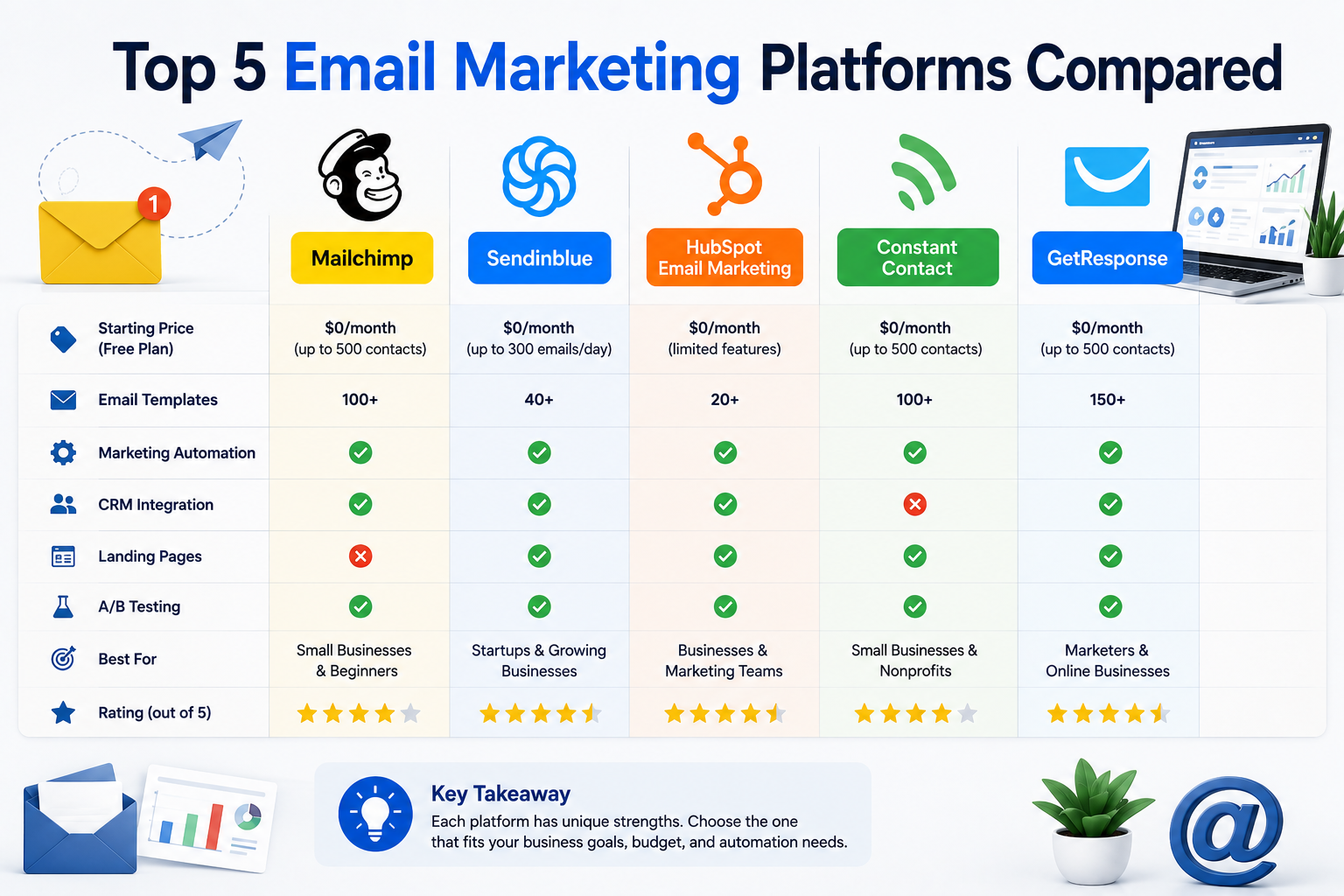
Each platform serves a different business need, and the best choice depends on your goals, budget, and technical maturity.
Mailchimp is ideal for simplicity and quick setup. HubSpot is best for enterprise-level CRM integration. Brevo offers affordability and flexibility. ActiveCampaign focuses on automation depth. Klaviyo dominates eCommerce personalization.
Instead of choosing the “best” platform universally, businesses should choose the one aligned with their growth stage and marketing complexity.
A startup might prioritize ease of use, while an enterprise may need advanced analytics and CRM integration. Similarly, an eCommerce brand will benefit more from behavioral tracking and product-based automation.
Key Trends Shaping Email Marketing in 2026
Email marketing is evolving rapidly, driven by AI, automation, and customer data platforms.
One major trend is hyper-personalization. Businesses are now using real-time behavioral data to tailor every email interaction. Another emerging trend is AI-driven content generation, where platforms automatically optimize subject lines and email copy for higher engagement.
Additionally, cross-channel marketing is becoming standard. Email is no longer isolated—it works alongside SMS, WhatsApp, push notifications, and social retargeting.
These trends are pushing businesses to adopt platforms that are not just email tools, but complete customer engagement ecosystems.
How to Choose the Right Email Marketing Platform
Choosing the right tool requires more than comparing features. Businesses should evaluate:
- Business size and growth stage
- Budget flexibility
- Integration with existing tech stack
- Level of automation required
- Type of customer journey complexity
A SaaS startup may prioritize automation and CRM integration, while a retail brand may focus on transactional emails and product recommendations.
The key is alignment, not popularity.
Final Thoughts: Turning Email Marketing into a Growth Engine
Email marketing is no longer just about sending newsletters—it is a strategic growth channel that drives revenue, builds loyalty, and enhances customer experience.
The platforms covered in this guide each bring unique strengths:
- Mailchimp for simplicity
- HubSpot for CRM-powered marketing
- Brevo for affordability
- ActiveCampaign for automation depth
- Klaviyo for eCommerce intelligence
The right choice depends on your business objectives and scalability needs.
In today’s competitive digital landscape, the real advantage comes not just from sending emails—but from sending the right message to the right customer at the right time.
Frequently Asked Questions (FAQ)
1. Which email marketing platform is best for beginners?
Mailchimp is generally the best choice for beginners due to its simple interface and easy onboarding process.
2. What is the most affordable email marketing tool?
Brevo is one of the most cost-effective platforms, especially for businesses with large contact lists.
3. Which platform is best for eCommerce businesses?
Klaviyo is widely considered the best option for eCommerce due to its deep integration with online stores and advanced behavioral tracking.
4. Can email marketing platforms integrate with CRM systems?
Yes, most modern platforms like HubSpot and ActiveCampaign offer built-in CRM or seamless integrations with third-party CRM tools.
5. Is email marketing still effective in 2026?
Absolutely. Email marketing continues to deliver one of the highest ROI rates among all digital marketing channels.