


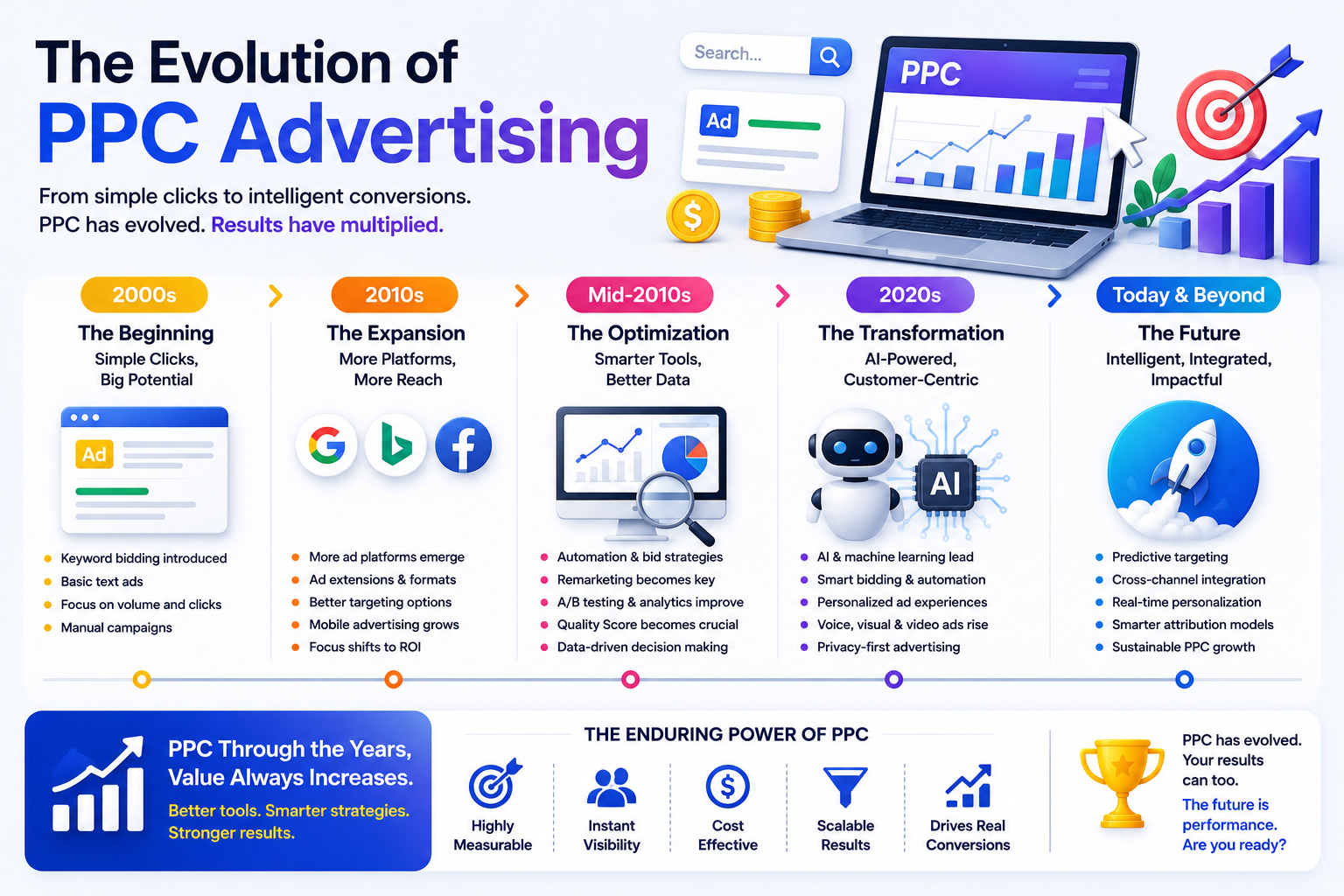
Pay-per-click (PPC) advertising has transformed dramatically over the past two decades. What started as a straightforward digital advertising model focused on bidding for keywords has evolved into a sophisticated ecosystem powered by artificial intelligence, machine learning, audience targeting, automation, and predictive analytics.
Today, PPC is no longer just about appearing at the top of search engine results. Businesses can reach customers across search engines, social media platforms, video streaming services, e-commerce marketplaces, and countless websites through highly personalized advertising experiences.
For startups, SMEs, enterprises, and growing organizations, understanding the evolution of PPC advertising is more than a history lesson. It provides valuable insight into where digital advertising is heading and how businesses can stay competitive in an increasingly crowded online marketplace.
In this article, we explore how PPC advertising evolved, the technologies that reshaped it, current trends driving performance, and what businesses should expect in the future.
The Early Days of PPC Advertising
The origins of PPC advertising can be traced back to the late 1990s when search engines began experimenting with paid listings. At the time, digital marketing was still in its infancy, and businesses were looking for measurable alternatives to traditional advertising channels.
The concept was revolutionary. Instead of paying for ad impressions, advertisers would only pay when users clicked on their advertisements.
This model introduced accountability into advertising spending. Companies could directly measure traffic, leads, and sales generated from their campaigns.
When Google launched Google AdWords in 2000, the PPC landscape changed forever. Businesses suddenly gained access to millions of potential customers actively searching for products and services online.
Unlike traditional advertising channels where businesses interrupted consumers with promotional messages, PPC allowed advertisers to reach users who were already demonstrating intent.
This shift fundamentally changed how companies approached customer acquisition.
The Rise of Keyword-Based Advertising
During the early 2000s, PPC campaigns were primarily driven by keywords.
Advertisers researched search terms related to their products or services and placed bids on those keywords. When users searched for those terms, ads appeared alongside organic search results.
Success depended heavily on keyword selection, bid management, and ad copy optimization.
For example, an online shoe retailer might bid on terms such as:
- Running shoes
- Athletic footwear
- Men’s sports shoes
- Women’s running sneakers
Businesses that identified high-converting keywords often achieved impressive returns on investment.
However, keyword targeting had limitations. Advertisers could target search intent but had little insight into the person behind the search. Campaign optimization remained largely manual, requiring constant monitoring and adjustments.
Despite these challenges, keyword-driven advertising established the foundation upon which modern PPC marketing was built.
Quality Score Changed the Game
As PPC competition increased, search engines sought ways to improve user experience.
Simply rewarding advertisers with the highest bids was no longer sustainable. Search engines needed to ensure users received relevant and valuable advertisements.
This led to the introduction of Quality Score.
Quality Score evaluated factors such as ad relevance, expected click-through rates, and landing page experience. Advertisers with highly relevant ads could often achieve better placements while paying lower costs per click.
This development shifted PPC strategy significantly.
Businesses could no longer rely solely on larger budgets. They needed to create better advertisements, improve website experiences, and align messaging with user intent.
As a result, digital marketers began focusing more heavily on customer journeys rather than simply winning keyword auctions.
The Expansion Beyond Search Engines
As internet usage expanded, PPC advertising moved beyond search engines.
Social media platforms recognized the enormous value of their user data and introduced sophisticated advertising solutions. Platforms like Facebook, Instagram, LinkedIn, and later TikTok transformed how advertisers reached audiences.
Instead of targeting only search behavior, advertisers could now target:
- Demographics
- Interests
- Professional roles
- Purchasing behaviors
- Online activities
This represented a major milestone in PPC evolution.
For example, a software company selling enterprise cybersecurity solutions no longer had to wait for decision-makers to search for cybersecurity products. They could proactively reach CTOs, IT managers, and executives based on professional attributes and business interests.
Audience targeting opened entirely new possibilities for lead generation and brand awareness campaigns.
Mobile Advertising Reshapes PPC Strategy
The widespread adoption of smartphones created another significant shift in PPC advertising.
Mobile traffic quickly surpassed desktop traffic in many industries. Consumers began researching products, comparing prices, reading reviews, and making purchases directly from mobile devices.
This change forced advertisers to rethink campaign structures.
Mobile-first advertising became essential. Landing pages needed faster loading speeds, responsive designs, and simplified user experiences.
Search engines and advertising platforms responded by introducing mobile-specific features such as click-to-call advertisements, location extensions, mobile bidding adjustments, and app promotion campaigns.
Businesses that adapted quickly gained a competitive advantage, while those relying on desktop-centric experiences often saw declining performance.
Today, mobile optimization remains one of the most important factors influencing PPC success.
The Emergence of Remarketing and Retargeting
One of the most influential developments in PPC history was the introduction of remarketing technology.
Most website visitors do not convert during their first interaction. Remarketing enabled advertisers to reconnect with those visitors after they left a website.
Imagine a customer browsing a laptop online but leaving without making a purchase. Through remarketing, that same customer could later encounter advertisements for the product while browsing news websites, watching videos, or using social media platforms.
This strategy dramatically improved conversion rates across industries.
Remarketing transformed PPC from a single interaction model into a continuous customer engagement process.
Businesses gained the ability to nurture prospects throughout the buying journey, increasing both conversion opportunities and return on ad spend.
The Impact of Artificial Intelligence and Automation
Perhaps the most transformative chapter in PPC evolution is the rise of artificial intelligence.
Modern advertising platforms process enormous amounts of data every second. Human marketers simply cannot analyze and optimize campaigns at the same speed.
Artificial intelligence now assists with:
- Automated bidding
- Audience discovery
- Ad placement optimization
- Predictive analytics
- Creative recommendations
Machine learning algorithms continuously evaluate performance signals and make adjustments in real time.
For example, Google’s Smart Bidding can analyze hundreds of contextual factors, including device type, location, time of day, browsing behavior, and historical conversion patterns before determining an optimal bid.
This level of automation allows businesses to scale campaigns more efficiently while reducing manual workload.
Rather than spending hours adjusting bids, marketers can focus on strategy, customer experience, and business growth initiatives.
The Rise of Performance Max and Omnichannel Campaigns
Today’s PPC environment is increasingly focused on omnichannel marketing.
Consumers interact with brands through multiple touchpoints before making purchasing decisions. A potential customer might discover a brand through YouTube, research it through Google Search, engage with social media content, and finally convert after seeing a remarketing advertisement.
Recognizing this reality, advertising platforms have introduced campaign types designed to operate across multiple channels simultaneously.
Google’s Performance Max campaigns are a prime example.
Instead of managing separate campaigns for search, display, video, shopping, and discovery networks, advertisers can leverage AI-driven campaigns that optimize across all available inventory.
This approach enables broader reach while simplifying campaign management.
Businesses benefit from more unified customer journeys and better attribution visibility.
Data Privacy and the Cookieless Future
While PPC technology continues to advance, the industry faces significant challenges related to privacy and data protection.
Consumers are increasingly concerned about how their information is collected and used online. Governments worldwide have responded with stricter privacy regulations.
The gradual decline of third-party cookies is forcing advertisers to rethink targeting strategies.
Businesses are now investing heavily in first-party data collection through:
- CRM systems
- Email marketing
- Loyalty programs
- Customer communities
The future of PPC will likely rely more heavily on consent-based data, contextual targeting, and AI-powered audience modeling.
Organizations that build strong direct relationships with customers will be better positioned to thrive in this evolving environment.
Video Advertising Becomes a PPC Powerhouse
Video content has emerged as one of the most effective advertising formats available today.
Consumers increasingly prefer visual content over traditional text-based communication. Platforms such as YouTube, Instagram Reels, TikTok, and connected television services have accelerated this trend.
PPC advertisers now use video campaigns to educate audiences, demonstrate products, build trust, and generate conversions.
A SaaS company, for instance, may use short product demonstrations to showcase software capabilities before directing viewers to a free trial.
Video advertising offers a unique combination of storytelling and performance marketing.
As bandwidth improves and video consumption continues growing, video-based PPC campaigns are expected to play an even larger role in digital advertising strategies.
The Growing Importance of Analytics and Attribution
Modern PPC success depends heavily on accurate measurement.
Businesses today require deeper visibility into how advertising contributes to revenue generation.
Advanced analytics platforms now provide detailed insights into customer behavior across multiple channels and devices.
Instead of measuring only clicks, marketers can evaluate:
- Customer lifetime value
- Multi-touch attribution
- Revenue contribution
- Lead quality
- Conversion pathways
This evolution has elevated PPC from a tactical marketing activity to a strategic business function.
Executives and decision-makers increasingly rely on PPC data to guide broader business decisions, making analytics an essential component of campaign management.
What the Future Holds for PPC Advertising
The next phase of PPC advertising will likely be defined by greater automation, deeper personalization, and stronger integration across marketing channels.
Artificial intelligence will continue improving audience targeting and campaign optimization. Voice search, visual search, and conversational AI may introduce entirely new advertising opportunities.
At the same time, businesses will need to balance personalization with privacy expectations.
Success will increasingly depend on understanding customer intent rather than relying solely on historical tracking data.
Organizations that embrace innovation while maintaining customer trust will gain a significant competitive advantage.
The future of PPC is not simply about generating clicks. It is about delivering the right message, to the right audience, at the right moment, through the right channel.
Conclusion
The evolution of PPC advertising reflects the broader transformation of digital marketing itself.
From simple keyword bidding systems to AI-powered omnichannel campaigns, PPC has become one of the most sophisticated and measurable forms of advertising available. Businesses now have access to unprecedented targeting capabilities, automation tools, and performance insights that were unimaginable just a decade ago.
However, technology alone does not guarantee success.
The organizations achieving the strongest results are those that combine advanced advertising platforms with strategic planning, customer-focused messaging, high-quality experiences, and data-driven decision-making.
As digital advertising continues evolving, businesses that stay informed and adapt to emerging trends will be best positioned to maximize ROI, improve customer acquisition, and drive sustainable growth.
Frequently Asked Questions
What is PPC advertising?
PPC (Pay-Per-Click) advertising is a digital marketing model where advertisers pay only when users click on their ads. It is commonly used on search engines, social media platforms, and display advertising networks.
Why has PPC become so important for businesses?
PPC offers measurable results, precise audience targeting, fast visibility, and scalable growth opportunities. It allows businesses to connect with potential customers at various stages of the buying journey.
How has AI changed PPC advertising?
Artificial intelligence automates bidding, targeting, audience discovery, and campaign optimization. It helps advertisers improve performance while reducing manual management efforts.
What is the biggest trend shaping PPC today?
Automation and AI-driven campaign management are currently the most influential trends. Omnichannel advertising and privacy-focused targeting strategies are also becoming increasingly important.
Is PPC suitable for startups and small businesses?
Yes. PPC provides flexible budgeting options and allows startups and SMEs to compete effectively by targeting specific audiences and measuring results accurately.
Ready to Future-Proof Your PPC Strategy?
The PPC landscape is evolving faster than ever. Whether you’re a startup seeking rapid growth, an SME looking to improve lead generation, or an enterprise optimizing large-scale advertising campaigns, partnering with the right digital marketing and technology experts can make all the difference.
Invest in a strategy that combines advanced automation, data-driven insights, compelling creative assets, and continuous optimization. The right technology partner can help your business maximize advertising ROI, improve customer acquisition, and stay ahead in an increasingly competitive digital marketplace.