


In today’s digital-first economy, every business is fighting for the same thing—attention. Whether you are a startup trying to get your first 1,000 customers or an enterprise scaling globally, social media has become the battlefield where brand visibility is won or lost.
But here’s the real question most business leaders struggle with:
Should you invest in social media advertising or focus on organic reach?
Both promise visibility. Both can drive engagement. Yet, they work in completely different ways. One is powered by algorithms and audience trust. The other is driven by budgets and targeting precision.
Understanding the difference is no longer optional—it directly impacts ROI, customer acquisition cost, and long-term brand positioning.
Let’s break it down in a practical, business-focused way.
Understanding Organic Reach in Social Media
Organic reach refers to the number of people who see your content without paid promotion. It includes followers, shares, comments, and algorithm-driven visibility.
In simple terms, it is the “earned visibility” of your brand.
Platforms like Instagram, LinkedIn, Facebook, and X (Twitter) prioritize content based on relevance, engagement, and user behavior. That means your content has to earn its visibility.
For example, a B2B SaaS startup posting insightful LinkedIn articles may gradually build authority and attract decision-makers without spending on ads. But this takes time, consistency, and strong content strategy.
Why businesses still invest in organic reach
Organic reach builds trust in a way paid ads cannot replicate. A Nielsen study found that 88% of consumers trust recommendations and content shared organically more than traditional ads. This is why brands still invest heavily in content marketing, SEO-driven social posts, and community engagement.
However, there’s a challenge—organic reach is shrinking across platforms. Facebook’s organic reach for pages has dropped to less than 5% in many industries, forcing businesses to rethink their strategy.
Understanding Social Media Advertising
Social media advertising is the paid distribution of content to targeted audiences on platforms like Facebook Ads, Instagram Ads, LinkedIn Ads, and YouTube Ads.
Unlike organic reach, advertising guarantees visibility—but not engagement.
You control who sees your content based on demographics, interests, job titles, behavior, and even purchase intent.
For example, a fintech company launching a new credit product can directly target salaried professionals aged 25–45 in metro cities with high credit scores. This precision is something organic reach cannot achieve.
According to recent industry reports, global social media ad spending is expected to surpass $400 billion, showing how heavily businesses are relying on paid channels for growth.
But here’s the catch—costs are rising. The average cost-per-click (CPC) on platforms like Meta and LinkedIn has increased significantly over the past few years due to competition.
Key Differences Between Organic Reach and Paid Advertising
Understanding the distinction between these two approaches is crucial for building a balanced strategy.
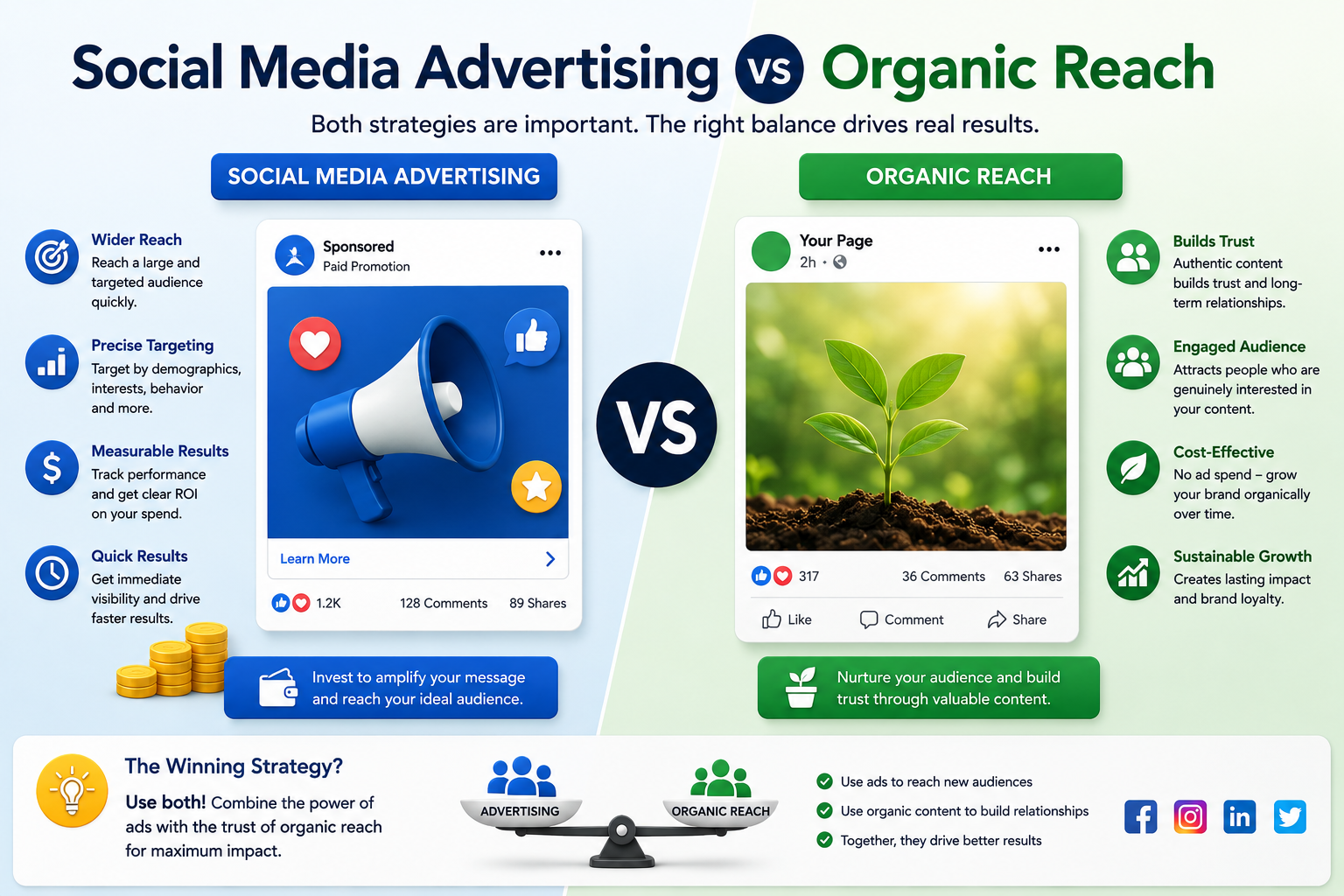
Organic reach focuses on long-term brand building, while advertising delivers immediate visibility and conversions. Organic content depends heavily on algorithms and engagement quality, whereas ads rely on budget and targeting precision.
Organic growth is slower but more sustainable. Paid campaigns are faster but temporary—once you stop spending, visibility drops instantly.
Both approaches serve different stages of the customer journey, and successful brands use them together instead of choosing one over the other.
Why Organic Reach Still Matters for Modern Businesses
Despite declining reach, organic marketing remains a powerful asset for businesses that want long-term digital authority.
Customers today don’t just buy products—they research brands. They check reviews, social presence, and content consistency before making decisions.
A strong organic presence helps businesses in multiple ways:
- It builds credibility and trust over time.
- It improves customer retention through consistent engagement.
- It supports SEO efforts by driving traffic from social platforms.
- It strengthens brand storytelling without constant ad spend.
- It creates a loyal community that engages voluntarily.
For instance, many D2C brands in India like skincare and fashion startups have scaled rapidly by building strong Instagram communities before investing heavily in ads.
Organic reach is essentially your brand’s reputation engine.
Why Social Media Advertising is a Growth Accelerator
If organic reach is the foundation, advertising is the accelerator.
Paid campaigns allow businesses to scale visibility instantly. This is especially useful for:
- New product launches
- Seasonal campaigns
- Lead generation for B2B companies
- E-commerce sales spikes
- Retargeting website visitors
One of the biggest advantages of social media advertising is predictability. You can control budget, audience size, impressions, and conversion metrics.
For example, an enterprise SaaS company running LinkedIn ads can generate highly qualified leads by targeting IT directors and CTOs in specific industries.
Another advantage is A/B testing. Businesses can experiment with creatives, messaging, and audiences in real time, optimizing campaigns for maximum ROI.
However, advertising requires expertise. Poor targeting or weak creatives can quickly burn budgets without delivering meaningful results.
The Reality: Algorithm Changes Are Reshaping Both Strategies
Social media platforms continuously evolve their algorithms to prioritize user experience over brand visibility.
This means:
- Organic reach is becoming more competitive
- Paid ads are becoming more expensive
- Content quality is now more important than frequency
- Engagement signals like saves, shares, and watch time matter more than likes
For example, Instagram now prioritizes Reels and short-form video content over static posts. Similarly, LinkedIn favors thought leadership content that sparks conversations.
Businesses that fail to adapt often see declining reach, even if their follower base is growing.
When Should Businesses Use Organic vs Paid?
Instead of choosing one, successful businesses understand when to use each strategy.
Organic reach is best suited for long-term brand building, storytelling, and nurturing audience relationships. It works well when the goal is trust, engagement, and authority building.
Social media advertising is ideal for short-term objectives like lead generation, product launches, and driving immediate conversions.
The smartest brands combine both strategically.
For example, a SaaS company may use organic LinkedIn content to build authority while simultaneously running paid campaigns to capture leads for demos.
A retail brand may use Instagram Reels to grow organically while running targeted ads to boost sales during festive seasons.
The Winning Strategy: Combining Organic + Paid Social Media
The real power lies in integration, not separation.
Businesses that combine organic and paid strategies often see significantly better results because both channels support each other.
Organic content helps improve ad performance by building trust before users see paid promotions. Meanwhile, ads amplify the reach of high-performing organic content.
Here’s what a balanced strategy typically looks like:
- Organic content builds awareness and trust
- Paid ads drive targeted traffic and conversions
- Retargeting campaigns convert warm audiences
- Analytics optimize both channels continuously
This synergy creates a full-funnel marketing system rather than isolated campaigns.
In fact, businesses using integrated social media strategies report up to 30–50% higher conversion rates compared to single-channel approaches.
Real-World Example: How Businesses Combine Both Approaches
Consider a mid-sized e-commerce fashion brand.
Initially, they focused on organic Instagram content—style reels, influencer collaborations, and user-generated content. This helped them build a loyal audience and reach 50,000 followers.
Once engagement stabilized, they introduced Instagram ads targeting users who had already interacted with their content.
Result? Their conversion rate increased significantly because users were already familiar with the brand.
This combination of familiarity (organic) and targeting (paid) created a powerful conversion loop.
Challenges Businesses Face in Both Approaches
While both strategies are powerful, they come with challenges.
Organic reach requires consistency, creativity, and patience. Many businesses struggle because results take time and algorithms are unpredictable.
Paid advertising requires budget control, technical expertise, and continuous optimization. Without proper management, costs can escalate quickly.
Additionally, content fatigue is becoming a real issue. Audiences are exposed to thousands of ads daily, making it harder for brands to stand out.
This is why creative storytelling and data-driven optimization are becoming essential for success.
Future Trends in Social Media Marketing
The future of social media marketing is shifting toward integration, automation, and personalization.
AI-driven content optimization is helping brands understand what type of content performs best. Short-form video continues to dominate engagement across platforms.
Privacy changes are also affecting targeting capabilities, pushing businesses to rely more on first-party data and organic engagement signals.
Businesses that adapt early will have a significant competitive advantage.
Conclusion: It’s Not a Choice, It’s a Balance
The debate between social media advertising and organic reach is not about choosing one over the other.
It’s about understanding how both work together to create sustainable digital growth.
Organic reach builds trust, authority, and long-term engagement. Social media advertising delivers speed, scale, and precision targeting.
In today’s competitive digital landscape, relying on just one approach is no longer enough.
The most successful businesses are those that integrate both into a unified strategy aligned with customer journey stages.
FAQs
1. Is organic reach enough for business growth?
Organic reach is valuable for long-term branding but is usually not enough alone for fast scaling or lead generation.
2. Are social media ads expensive for small businesses?
Costs vary, but with proper targeting and optimization, even small businesses can run cost-effective campaigns.
3. Which platform is best for advertising?
It depends on your audience. LinkedIn works best for B2B, while Instagram and Facebook are strong for B2C brands.
4. How long does organic growth take?
Typically, businesses start seeing meaningful organic traction in 3–6 months with consistent posting.
5. Can organic and paid strategies work together?
Yes, combining both strategies often delivers the highest ROI and stronger brand recall.