


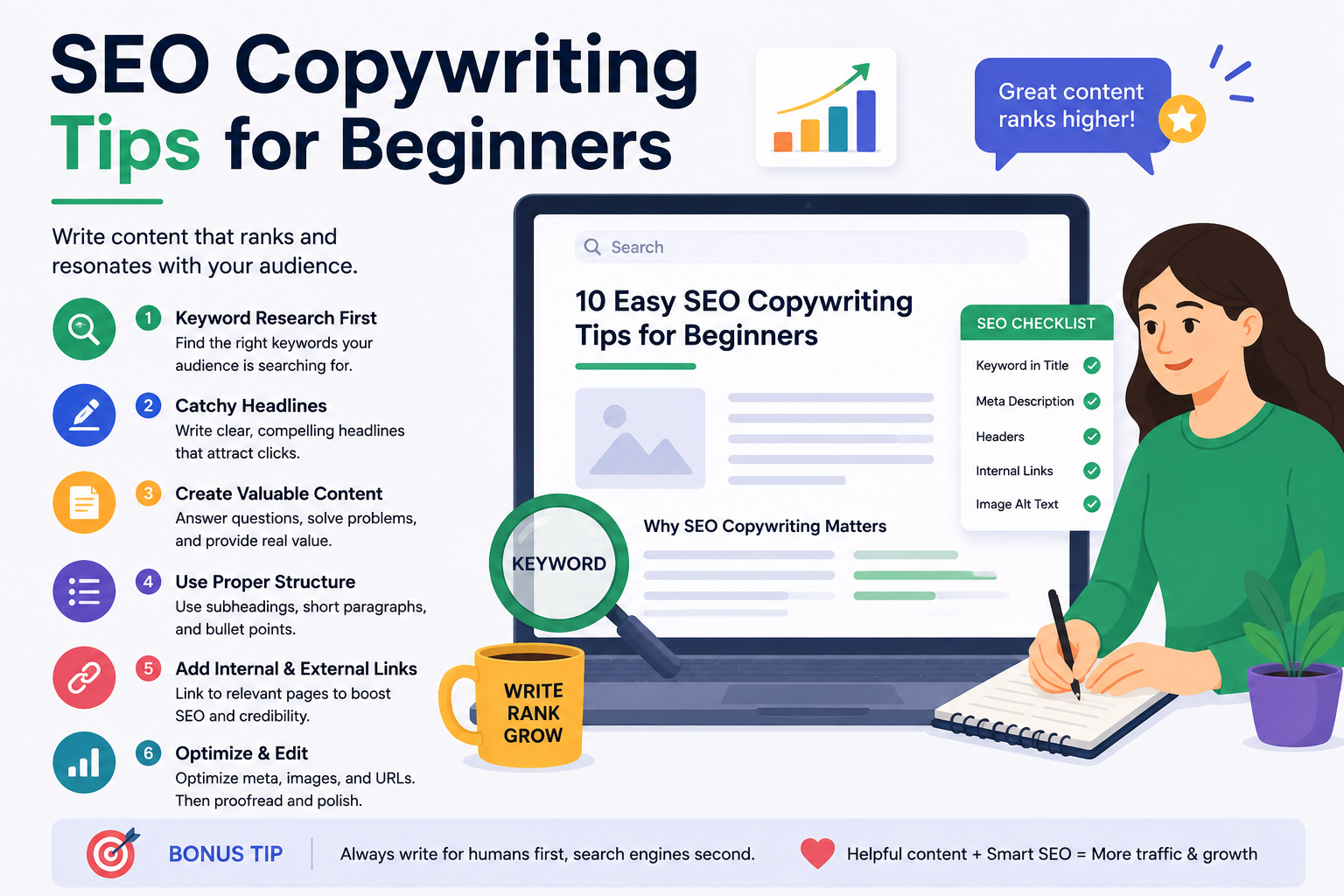
Creating content that both search engines and people love is one of the biggest challenges in digital marketing. Many businesses invest significant resources into website development, SEO campaigns, and advertising, only to discover that their content is not generating the traffic or conversions they expected.
The reason is simple: visibility alone is not enough. Your content must communicate value, answer user questions, and encourage action. This is where SEO copywriting becomes essential.
SEO copywriting is the process of creating content that ranks well in search engines while remaining engaging and persuasive for readers. It combines keyword research, content strategy, user intent, readability, and conversion-focused writing into a single approach.
For startups, SMEs, enterprises, founders, CTOs, and business leaders, mastering the basics of SEO copywriting can create long-term organic growth without relying entirely on paid advertising. As search engines continue prioritizing user experience and content quality, strong SEO copywriting has become a critical competitive advantage.
In this guide, you’ll learn practical SEO copywriting tips for beginners that can help improve rankings, attract qualified visitors, and turn readers into customers.
What Is SEO Copywriting?
SEO copywriting is the practice of writing content that is optimized for search engines while remaining useful and valuable for readers.
Unlike traditional copywriting, which focuses primarily on persuasion, SEO copywriting also considers how search engines evaluate content. The goal is to ensure that content appears in relevant search results while providing a positive user experience.
Effective SEO copywriting balances three key objectives:
Whether you’re writing blog posts, landing pages, service pages, or product descriptions, SEO copywriting helps connect your business with people actively searching for solutions.
Understand Search Intent Before Writing
One of the most common mistakes beginners make is focusing only on keywords.
Modern SEO is driven by search intent. Google aims to deliver results that best satisfy the user’s goal behind a search query.
For example, someone searching for “best CRM software for startups” is likely researching options before making a purchase decision. In contrast, someone searching for “buy CRM software” is much closer to converting.
Before writing any content, ask yourself:
What is the user trying to accomplish?
Understanding intent allows you to structure content that directly addresses the reader’s needs, increasing both engagement and rankings.
Businesses that align content with user intent often experience higher conversion rates because visitors find exactly what they were looking for.
Start With Smart Keyword Research
Keywords remain an important foundation of SEO copywriting. However, the goal is no longer to repeat the same phrase multiple times.
Instead, focus on understanding the language your audience uses when searching online.
Modern keyword research involves identifying:
For example, if your primary keyword is “SEO copywriting tips,” related terms might include content writing for SEO, search engine optimization writing, SEO content strategy, and keyword optimization.
Using these naturally throughout your content helps search engines understand context while improving readability.
Many successful businesses now build content clusters around related topics rather than targeting isolated keywords.
Create Content for Humans First
Search engine algorithms have become increasingly sophisticated.
Google’s systems now evaluate content quality, relevance, expertise, and user satisfaction more effectively than ever before.
As a result, writing solely for search engines often leads to poor performance.
The best SEO copywriting prioritizes human readers.
Use natural language. Explain concepts clearly. Answer questions thoroughly. Provide examples that help readers understand complex topics.
For example, a SaaS startup creating content about project management software should focus on solving business challenges rather than repeatedly inserting keywords.
Content that genuinely helps users tends to earn longer engagement, more shares, and stronger rankings over time.
Structure Content for Easy Reading
Online readers rarely consume content word for word.
Most users scan pages before deciding whether to continue reading.
This makes content structure incredibly important.
Short paragraphs, descriptive headings, and logical organization improve both readability and SEO performance.
A well-structured article allows search engines to understand content hierarchy while helping readers find information quickly.
Use H2 headings for major sections and H3 headings for supporting topics. Keep paragraphs concise and focused.
This approach improves user experience and reduces bounce rates.
Optimize Your Introduction
The introduction determines whether visitors stay on the page or leave.
Many beginners waste valuable space with generic opening statements.
Instead, identify the reader’s problem immediately and explain how the article will help solve it.
A strong introduction should:
For example, a business owner struggling with low website traffic wants practical solutions, not lengthy background information.
The faster you demonstrate value, the better your engagement metrics are likely to be.
Use Keywords Naturally
Keyword stuffing was once a common SEO tactic.
Today, it can harm readability and negatively impact user experience.
Instead of forcing keywords into every paragraph, use them naturally where they make sense.
Search engines now understand synonyms, context, and topic relationships. This means you can write naturally while still optimizing content effectively.
Imagine having a conversation with your audience. If a phrase sounds awkward when spoken aloud, it probably needs revision.
Natural keyword placement creates a smoother reading experience and improves content quality.
Focus on E-E-A-T Principles
Google emphasizes Experience, Expertise, Authoritativeness, and Trustworthiness, often referred to as E-E-A-T.
Businesses that demonstrate these qualities typically perform better in competitive search results.
One effective way to improve E-E-A-T is by sharing practical examples and real-world insights.
For instance, a digital marketing agency discussing SEO strategies should reference actual campaign experiences, lessons learned, and measurable outcomes.
Demonstrating expertise builds credibility with both users and search engines.
This is particularly important for businesses operating in competitive industries.
Add Real-World Examples
Readers connect with practical examples more than theoretical explanations.
Consider an e-commerce company launching a content marketing campaign.
Instead of simply discussing SEO best practices, show how optimized product descriptions increased organic traffic and improved conversions.
Examples help readers visualize results and understand how concepts apply in real business situations.
They also make content more memorable and engaging.
For startups and SMEs, case-study style storytelling can significantly improve audience trust.
Optimize Meta Titles and Descriptions
Meta titles and descriptions influence whether users click on your content in search results.
Although they may not directly determine rankings, they strongly impact click-through rates.
A strong meta title includes the target keyword and communicates a clear benefit.
A compelling meta description summarizes the content while encouraging users to learn more.
Think of these elements as your content’s advertisement within search results.
The better they perform, the more organic traffic you can attract.
Include Internal Links Strategically
Internal linking helps search engines understand relationships between pages on your website.
It also encourages users to explore additional content.
For example, a blog post about SEO copywriting could link to related articles covering keyword research, content marketing, technical SEO, or website optimization.
Strategic internal links improve navigation, distribute authority across pages, and increase session duration.
This contributes to a stronger overall SEO strategy.
Keep Content Fresh and Updated
SEO is not a one-time activity.
Search trends, algorithms, technologies, and customer expectations evolve continuously.
Updating existing content can often produce better results than creating entirely new articles.
Review your content regularly and update:
Fresh content signals relevance and can help maintain strong search visibility over time.
Many high-performing websites achieve significant traffic growth through content updates alone.
The Growing Importance of SEO Copywriting
The digital marketplace is becoming more competitive every year.
Studies consistently show that most online experiences begin with a search engine. At the same time, businesses are investing heavily in content marketing to capture organic traffic and reduce customer acquisition costs.
This trend means that simply publishing content is no longer enough.
Companies must create content that stands out through quality, relevance, and strategic optimization.
SEO copywriting sits at the intersection of marketing, search visibility, and customer experience.
Organizations that develop strong SEO copywriting capabilities are often better positioned to generate sustainable traffic, build authority, and support long-term growth.
Common SEO Copywriting Mistakes Beginners Should Avoid
Many new content creators unknowingly limit their results by making avoidable mistakes.
Common issues include targeting the wrong keywords, writing without understanding search intent, neglecting content structure, and focusing excessively on rankings instead of readers.
Another frequent mistake is publishing thin content that fails to provide meaningful value.
Search engines increasingly reward comprehensive, helpful content that addresses user needs in depth.
By focusing on quality and user experience, businesses can avoid these pitfalls and create stronger long-term SEO performance.
Conclusion
SEO copywriting is one of the most valuable skills in modern digital marketing. It enables businesses to attract qualified traffic, improve search visibility, and convert visitors into customers without relying entirely on paid advertising.
For beginners, the key is to focus on understanding audience needs, creating valuable content, optimizing strategically, and maintaining a strong user experience throughout the writing process.
As search engines continue evolving, businesses that prioritize high-quality SEO copywriting will gain a significant competitive advantage.
Whether you’re a startup looking to build brand awareness, an SME seeking sustainable growth, or an enterprise scaling digital initiatives, investing in SEO copywriting can deliver measurable long-term results.
Frequently Asked Questions
What is SEO copywriting?
SEO copywriting is the process of creating content that is optimized for search engines while remaining engaging and useful for human readers.
Is SEO copywriting different from content writing?
Yes. Content writing focuses primarily on delivering information, while SEO copywriting combines content creation with search optimization strategies to improve visibility and rankings.
How many keywords should I use in an article?
There is no fixed number. Focus on using primary and related keywords naturally throughout the content rather than targeting a specific keyword density.
Why is search intent important in SEO copywriting?
Search intent helps ensure that content matches what users are looking for, increasing engagement, rankings, and conversion opportunities.
Can SEO copywriting improve conversions?
Absolutely. Effective SEO copywriting attracts qualified visitors and guides them toward meaningful actions such as inquiries, purchases, or consultations.
Ready to Strengthen Your Digital Presence?
Successful SEO copywriting requires more than keywords. It demands strategy, audience understanding, technical expertise, and consistent optimization. If your business is looking to improve search visibility, generate qualified leads, and accelerate digital growth, partnering with an experienced technology and digital marketing team can make a significant difference.
Choose a technology partner that understands SEO, content strategy, digital transformation, and business growth objectives. The right expertise can help turn your website into a powerful engine for long-term success.