


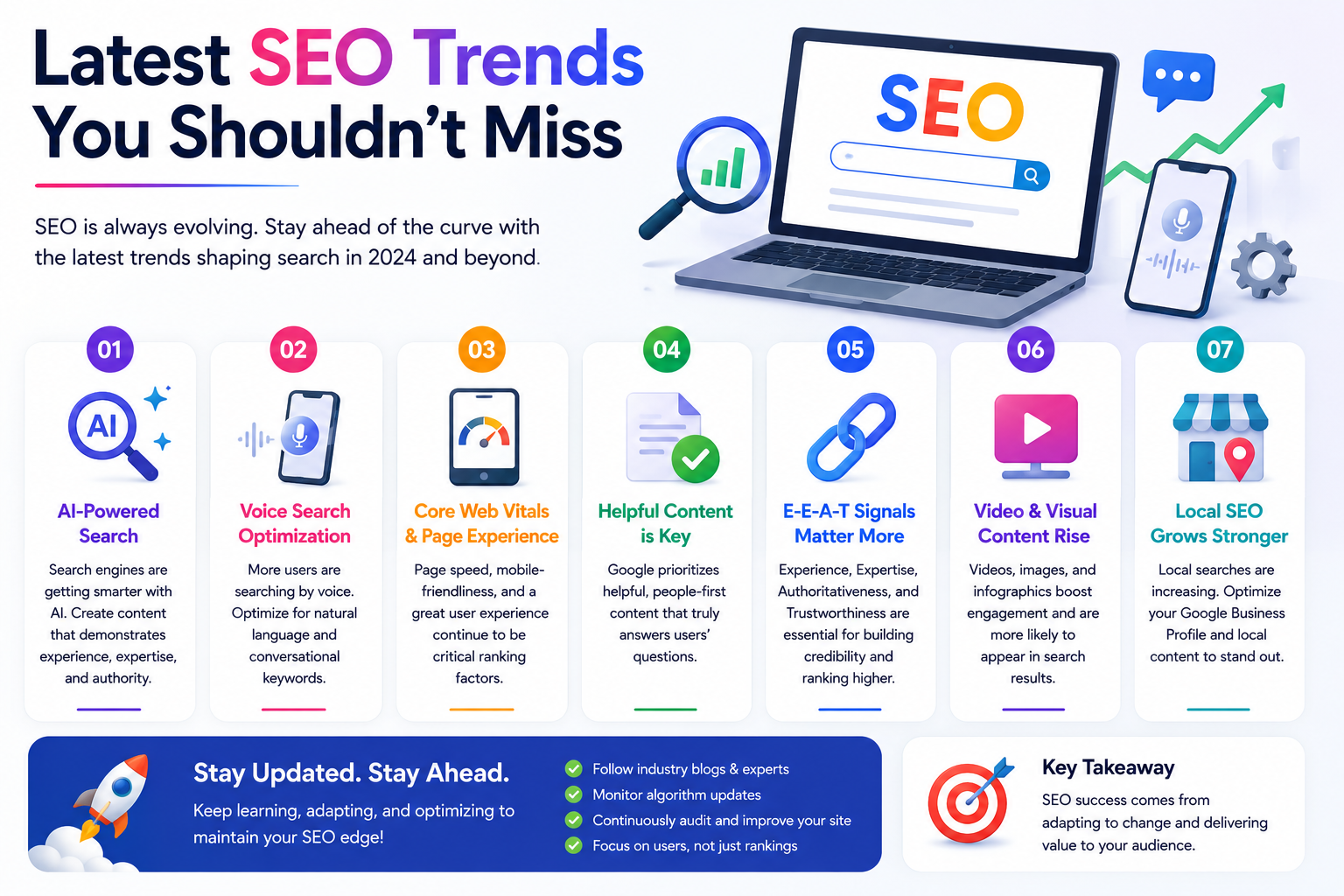
Search engine optimization has changed dramatically over the last few years. What worked a few years ago may no longer deliver the same results today. Search engines have become smarter, users have become more demanding, and artificial intelligence is reshaping how people discover information online.
For businesses, startups, and enterprises, staying updated with the latest SEO trends is no longer optional. It is a critical part of maintaining online visibility, generating qualified leads, and staying ahead of competitors. Companies that adapt early often gain significant advantages, while those that ignore emerging trends risk losing valuable traffic and market share.
The modern SEO landscape extends far beyond keywords and backlinks. Today, success depends on creating exceptional user experiences, producing trustworthy content, optimizing for AI-driven search experiences, and leveraging data to understand user intent.
In this article, we’ll explore the latest SEO trends businesses should focus on and explain how these developments can influence digital growth strategies in 2026 and beyond.
Why SEO Trends Matter More Than Ever
Search engines process billions of searches every day. At the same time, user behavior continues to evolve as people increasingly rely on mobile devices, voice assistants, AI-powered tools, and personalized search experiences.
According to industry research, organic search remains one of the highest-performing digital marketing channels, driving a significant share of website traffic and conversions across industries. Businesses that consistently invest in SEO often experience lower customer acquisition costs compared to paid advertising.
However, SEO is not static. Search algorithms are constantly updated to deliver better results to users. Staying aligned with emerging trends helps businesses maintain rankings, improve visibility, and capitalize on new opportunities before competitors do.
Let’s examine the key SEO trends shaping the future of search.
AI-Powered Search Is Transforming SEO
Artificial intelligence is arguably the biggest force influencing SEO today.
Search engines now use advanced AI models to better understand user intent, context, and content quality. Instead of simply matching keywords, search engines evaluate whether content genuinely answers a user’s question.
The rise of AI-generated search summaries and conversational search experiences is changing how users interact with search results. People increasingly receive direct answers within search interfaces rather than clicking through multiple websites.
For businesses, this means content must go beyond basic optimization. Websites need to provide comprehensive, authoritative, and genuinely useful information that adds value beyond what AI summaries can deliver.
Companies that publish detailed guides, expert insights, case studies, original research, and practical solutions are more likely to maintain visibility in AI-driven search environments.
What Businesses Should Do
Focus on creating content that demonstrates expertise, answers complex questions, and provides unique perspectives. Original insights are becoming more valuable than ever because generic content is easier for AI systems to replicate.
E-E-A-T Continues to Influence Rankings
One of the most important concepts in modern SEO is E-E-A-T, which stands for Experience, Expertise, Authoritativeness, and Trustworthiness.
Search engines increasingly prioritize content created by credible sources. This is especially important for industries involving finance, healthcare, technology, legal services, and business consulting.
Companies that showcase real-world experience and industry expertise often outperform competitors relying on generic content strategies.
For example, a cybersecurity company publishing insights from its security experts is likely to earn more trust than a website publishing generic information with no identifiable expertise behind it.
Building E-E-A-T involves demonstrating industry knowledge, highlighting author credentials, earning reputable backlinks, publishing accurate information, and maintaining transparency across digital properties.
As search engines become more sophisticated, trust signals will continue to play a larger role in determining rankings.
Search Intent Is More Important Than Keywords Alone
Keyword research remains essential, but modern SEO focuses heavily on understanding user intent.
A user searching for “best CRM software” has a different goal than someone searching for “how CRM software works.” One is evaluating solutions, while the other is seeking information.
Successful SEO strategies align content with the specific intent behind search queries.
Businesses should create content that supports every stage of the buyer journey:
- Awareness-stage content for education
- Consideration-stage content for evaluation
- Decision-stage content for conversion
- Post-purchase content for retention and support
When content matches user intent effectively, engagement metrics improve, bounce rates decrease, and conversion rates often increase.
High-Quality Content Remains the Foundation of SEO
Despite all the technological changes happening in search, content remains the cornerstone of SEO success.
However, content quality standards have risen significantly.
Search engines are increasingly capable of identifying shallow, repetitive, or low-value content. Simply publishing large volumes of articles is no longer an effective strategy.
Instead, businesses should prioritize depth, accuracy, relevance, and usefulness.
A well-researched 2,000-word article that thoroughly addresses a topic can often outperform multiple shorter articles with limited value.
Real-world examples, expert opinions, original research, customer success stories, and actionable recommendations all contribute to stronger content performance.
The goal is to become the most helpful resource available for a particular topic.
User Experience Signals Are Gaining Importance
User experience has become a critical SEO factor.
Search engines want to recommend websites that provide positive experiences for users. If visitors struggle to navigate a site, encounter slow loading times, or leave immediately after arriving, rankings may suffer over time.
Several user experience factors deserve attention:
- Fast page loading speeds
- Mobile-friendly design
- Easy navigation
- Clear site architecture
- Accessible content
- Secure browsing experiences
Businesses investing in website optimization often see benefits beyond SEO, including higher engagement, improved conversion rates, and stronger customer satisfaction.
For example, an e-commerce company that reduces page load times by even a few seconds can significantly improve both search performance and sales outcomes.
Mobile-First Optimization Is Non-Negotiable
Mobile devices now account for the majority of web traffic globally.
Search engines primarily evaluate the mobile version of websites when determining rankings. As a result, mobile optimization has become a fundamental requirement rather than an optional enhancement.
A mobile-friendly website should offer:
- Responsive design across all devices
- Fast loading performance
- Readable text without zooming
- Easy-to-click buttons and navigation
- Streamlined user journeys
Businesses that neglect mobile optimization risk losing both rankings and customers.
As mobile usage continues to grow worldwide, mobile-first strategies will remain a central component of successful SEO campaigns.
Voice Search and Conversational Queries Are Expanding
Voice search continues to influence how people search for information online.
Users speaking into smartphones, smart speakers, and virtual assistants often use natural language rather than traditional keyword phrases.
For example, someone typing might search for:
“best project management software”
But through voice search they may ask:
“What is the best project management software for a small business?”
This shift toward conversational search requires businesses to optimize content for natural language queries and question-based searches.
Strategies for Voice Search Optimization
Creating FAQ sections, targeting long-tail keywords, and providing direct answers to common questions can improve visibility for conversational searches.
Businesses that understand how people naturally speak can gain an advantage as voice-driven search adoption continues to grow.
Video Content Is Becoming an SEO Powerhouse
Video has become one of the most influential forms of online content.
Users increasingly prefer watching videos rather than reading lengthy explanations. Search engines recognize this behavior and frequently display video results for relevant searches.
Companies that integrate video into their content strategy often benefit from increased engagement, longer session durations, and improved brand visibility.
Video content can support SEO efforts through:
- Product demonstrations
- Educational tutorials
- Customer testimonials
- Industry insights
- Thought leadership content
A software company, for example, can create tutorial videos explaining platform features while simultaneously improving visibility across search engines and video platforms.
Technical SEO Is More Important Than Most Businesses Realize
Technical SEO provides the foundation that allows search engines to crawl, understand, and index website content effectively.
Even outstanding content can struggle to rank if technical issues prevent proper indexing or negatively impact user experience.
Key technical SEO areas include:
- Website architecture
- XML sitemaps
- Structured data
- Core Web Vitals
- Crawlability
- HTTPS security
- Indexing optimization
Many businesses focus heavily on content creation while overlooking technical performance. The most successful SEO strategies combine both elements effectively.
Regular technical audits can uncover issues that may be limiting search visibility and website performance.
Local SEO Continues to Drive Business Growth
For businesses serving specific geographic markets, local SEO remains one of the most valuable digital marketing investments.
Searches that include local intent continue to increase as consumers seek nearby products, services, and solutions.
Optimizing local SEO involves maintaining accurate business information, managing reviews, improving local listings, and creating location-specific content.
A professional services firm, restaurant, healthcare provider, or retail business can generate highly qualified leads through strong local search visibility.
As mobile searches grow, local SEO will continue playing a critical role in customer acquisition strategies.
Zero-Click Searches Are Changing Traffic Patterns
An increasing number of searches now end without users clicking on a website.
Search engines often display answers directly within search results through featured snippets, knowledge panels, AI summaries, and other enhanced search features.
While this may reduce some website traffic, it also creates new visibility opportunities.
Businesses should optimize content to appear in these prominent search positions by providing concise, authoritative answers to common questions.
Visibility itself can build brand awareness and authority, even when users do not immediately click through.
Companies that adapt their content strategies to accommodate zero-click environments are better positioned for long-term success.
First-Party Data Is Becoming More Valuable
As privacy regulations evolve and third-party tracking becomes more restricted, businesses are placing greater emphasis on collecting and utilizing first-party data.
First-party data comes directly from customers through website interactions, subscriptions, purchases, and engagement activities.
This information helps businesses better understand customer behavior and create more personalized experiences.
SEO strategies increasingly intersect with broader digital marketing initiatives that leverage first-party data for audience insights and content optimization.
Organizations that build strong data strategies today will have greater flexibility and competitive advantages in the future.
The Growing Role of Semantic SEO
Search engines are becoming increasingly effective at understanding relationships between topics, concepts, and entities.
Rather than focusing on exact keyword matches, semantic SEO helps search engines understand broader context and topical relevance.
Businesses can strengthen semantic SEO by creating comprehensive content clusters that cover related subjects in depth.
For example, a company specializing in cloud computing should not only create content about cloud services but also related topics such as cybersecurity, data management, scalability, infrastructure, and digital transformation.
This approach establishes topical authority and improves overall search visibility.
Measuring SEO Success Beyond Rankings
Modern SEO success cannot be measured solely through keyword rankings.
Businesses should evaluate performance using a broader set of metrics, including:
- Organic traffic growth
- Conversion rates
- Lead generation
- Customer acquisition costs
- User engagement metrics
- Revenue attribution
The ultimate objective of SEO is not simply visibility but business growth.
Organizations that align SEO initiatives with measurable business outcomes are more likely to secure executive support and achieve sustainable results.
Conclusion
SEO continues to evolve at an extraordinary pace. Artificial intelligence, user experience, content quality, semantic search, voice interactions, and technical optimization are reshaping the digital landscape.
For startups, SMEs, enterprises, and digital transformation leaders, the opportunity is clear. Businesses that adapt to these trends early can strengthen their online presence, attract qualified prospects, and build long-term competitive advantages.
The future of SEO belongs to organizations that focus on delivering genuine value to users while embracing technological innovation. Instead of chasing algorithm updates, successful companies prioritize creating exceptional experiences that align with both user expectations and search engine goals.
As search continues to evolve, staying informed and proactive will be the key to sustainable digital growth.
Frequently Asked Questions (FAQs)
What is the biggest SEO trend in 2026?
AI-powered search experiences are currently the most significant SEO trend. Search engines increasingly use artificial intelligence to understand user intent, evaluate content quality, and generate direct answers.
Is SEO still important for businesses?
Yes. SEO remains one of the most effective long-term digital marketing strategies for generating organic traffic, increasing visibility, and attracting qualified leads.
How does E-E-A-T affect SEO rankings?
E-E-A-T helps search engines evaluate the credibility and trustworthiness of content. Websites demonstrating experience, expertise, authority, and trust often perform better in search results.
Why is user experience important for SEO?
Search engines prioritize websites that provide positive user experiences. Fast loading speeds, mobile responsiveness, easy navigation, and engaging content all contribute to better rankings.
How can businesses prepare for future SEO changes?
Businesses should focus on creating high-quality content, improving technical performance, building authority, optimizing for AI-driven search, and continuously monitoring industry developments.
Ready to Future-Proof Your SEO Strategy?
SEO is no longer just about rankings—it is about creating digital experiences that drive measurable business outcomes. Whether you’re a startup scaling rapidly, an enterprise modernizing digital operations, or a business seeking sustainable growth, partnering with the right technology and digital marketing experts can make all the difference.
Invest in a strategic SEO approach that combines AI readiness, technical excellence, content authority, and user-focused optimization. The organizations that adapt today will be the ones leading their industries tomorrow.