


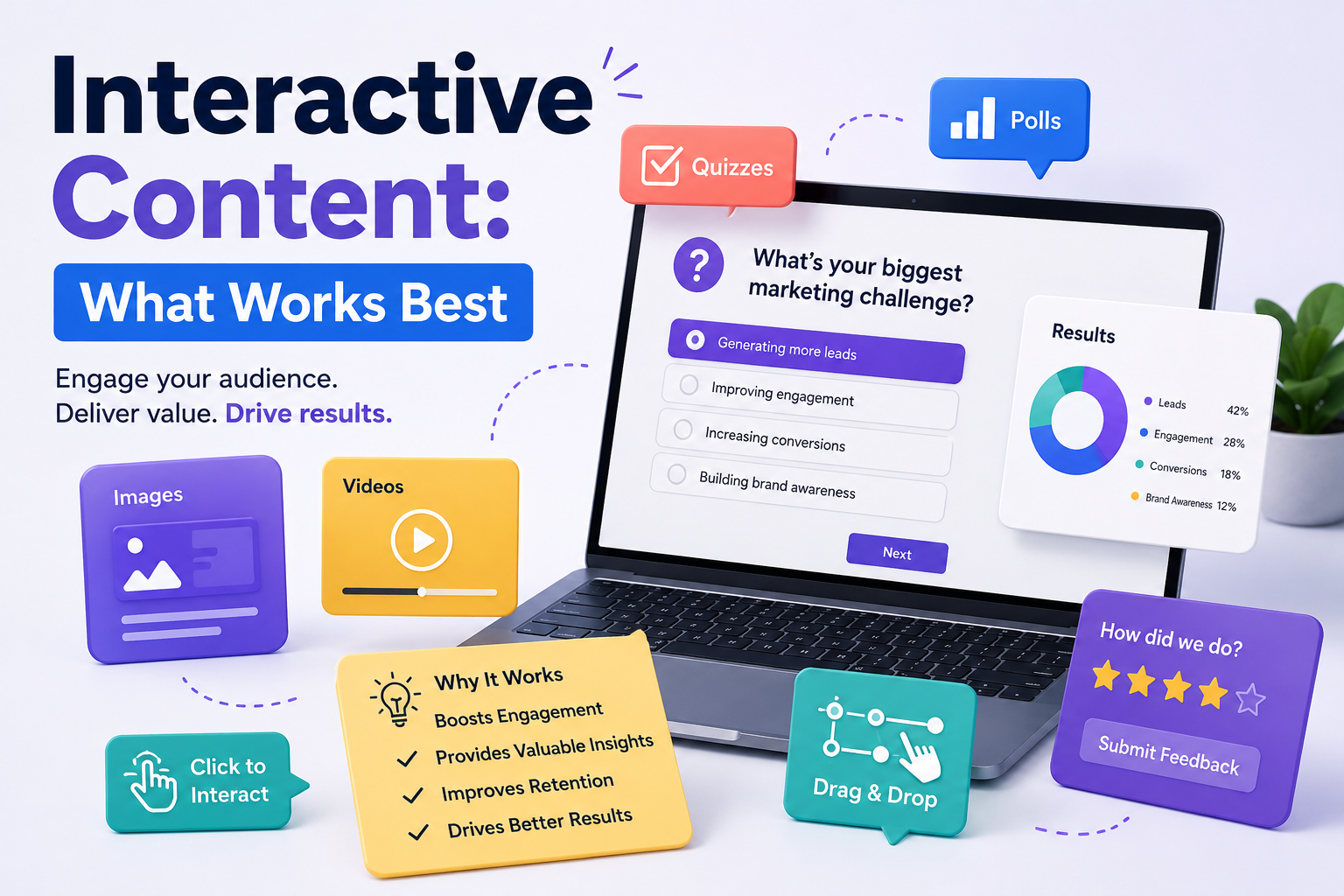
In today’s digital-first business environment, attention is the new currency. Brands are no longer competing just on products or pricing—they are competing for engagement. And engagement today is defined by one powerful shift: interactive content.
Unlike static blogs, PDFs, or traditional landing pages, interactive content invites users to participate instead of passively consuming information. Whether it’s a quiz that helps a buyer choose the right solution, a calculator that estimates ROI, or an interactive infographic that explains a complex concept, this form of content changes how audiences connect with brands.
For startups, SMEs, enterprises, and digital leaders, interactive content is not just a marketing trend. It has become a practical tool for improving lead quality, boosting conversions, and delivering personalized user experiences at scale.
Let’s explore what interactive content really means, why it works so well, and which formats deliver the strongest business results.
Why Interactive Content Is Becoming a Business Essential
The internet is overloaded with content. Every day, decision-makers are exposed to endless blogs, whitepapers, emails, and advertisements. But most of this content is consumed passively and forgotten quickly.
Interactive content changes this dynamic by requiring participation. That participation leads to deeper cognitive engagement, which naturally improves recall and conversion.
Studies across the digital marketing industry consistently show that interactive content generates significantly higher engagement rates compared to static content. More importantly, businesses using interactive experiences often see improved lead qualification because users voluntarily share information during the interaction.
From a business perspective, this means fewer wasted leads and more meaningful customer conversations.
Another reason for its rising importance is personalization. Modern buyers expect tailored experiences. Interactive tools allow companies to deliver personalized results instantly without requiring manual sales intervention.
What Makes Interactive Content So Effective
The effectiveness of interactive content is not accidental. It is rooted in behavioral psychology and user experience design.
When users click, calculate, choose, or respond, they become part of the experience. This sense of participation creates emotional investment. And emotional investment increases conversion probability.
There are three core reasons why interactive content works so well:
First, it increases attention span. Instead of skimming, users actively engage with the content.
Second, it creates immediate value. A quiz result, score, or recommendation feels personalized and useful.
Third, it improves data collection. Businesses gain insights into user intent without feeling intrusive.
For decision-makers, this combination of engagement, personalization, and data is extremely powerful in shaping digital strategy.
Types of Interactive Content That Deliver the Best Results
Not all interactive content performs equally. Some formats consistently outperform others depending on the industry and goal. Let’s explore the most effective ones used by modern businesses.
Quizzes and Assessments
Quizzes remain one of the most widely used interactive formats because they are simple yet powerful. They allow users to learn something about themselves or their needs while giving businesses valuable segmentation data.
For example, a SaaS company offering marketing tools might use a “Find the Right Marketing Stack” quiz. Based on user responses, the system can recommend tailored solutions. This not only improves user experience but also shortens the sales cycle.
What makes quizzes effective is their psychological appeal. People naturally enjoy discovering insights about themselves, especially when the results feel personalized.
Interactive Calculators
Calculators are particularly effective in B2B environments where purchase decisions involve cost justification. ROI calculators, pricing estimators, and savings calculators help users visualize value instantly.
For instance, a cloud service provider may offer a “Cost Savings Calculator” that shows how much a business could save by switching infrastructure. This transforms abstract benefits into tangible numbers.
Decision-makers trust data. When they can see projected outcomes in real time, hesitation decreases significantly.
Interactive Infographics
Static infographics are already popular, but interactive versions take them to another level. Instead of presenting all information at once, users can explore sections, hover over data points, and reveal insights progressively.
This format works particularly well for complex topics like supply chain processes, cybersecurity frameworks, or digital transformation journeys.
Interactive infographics help break down complexity without overwhelming the audience. They are especially valuable for enterprises communicating technical concepts to non-technical stakeholders.
Product Recommendation Tools
One of the most powerful applications of interactive content is guided product recommendation systems. These tools act like digital consultants, helping users find the right product or service based on their needs.
E-commerce brands, SaaS companies, and service providers use this approach to reduce friction in the buying journey. Instead of browsing dozens of options, users answer a few questions and receive tailored recommendations.
This approach not only improves conversion rates but also reduces bounce rates significantly.
Interactive Videos
Video content is already dominant in digital marketing, but interactivity adds a new layer of engagement. Interactive videos allow users to choose paths, answer questions, or click on embedded elements within the video.
This is particularly useful in onboarding, training, and product demonstrations. Instead of watching a passive tutorial, users actively engage with the content, making the learning process more effective.
How Interactive Content Improves Lead Generation
One of the biggest advantages of interactive content is its impact on lead generation quality.
Traditional lead forms often feel intrusive. Users hesitate to share information without receiving immediate value in return. Interactive content reverses this equation.
When users take a quiz or use a calculator, they willingly provide information in exchange for insights. This creates a natural value exchange.
For example, a financial advisory firm might offer an investment planning assessment. In the process, users share details about income, goals, and risk tolerance. This data becomes highly valuable for personalized follow-ups.
The key difference here is intent. Interactive content captures intent signals more accurately than static forms because users are actively engaged while providing information.
Real-World Business Applications of Interactive Content
Across industries, businesses are leveraging interactive content in creative ways to drive measurable outcomes.
In the SaaS industry, companies use onboarding assessments to understand user maturity levels and guide them toward the right product features. This reduces churn and improves adoption rates.
In healthcare, interactive symptom checkers help users understand possible conditions before consulting a professional. This improves accessibility and patient engagement.
In education, interactive learning modules replace traditional static content, allowing students to learn at their own pace with real-time feedback.
In e-commerce, virtual try-on tools and style quizzes help customers make confident purchase decisions, reducing return rates.
What all these examples share is a focus on personalization and guided experiences. Businesses are no longer just presenting information—they are creating journeys.
Challenges in Implementing Interactive Content
Despite its advantages, implementing interactive content is not without challenges.
The first challenge is complexity. Unlike static content, interactive experiences require planning, design, and technical integration.
The second challenge is performance optimization. Poorly designed interactive elements can slow down websites and negatively impact user experience.
The third challenge is content relevance. If the interaction does not provide meaningful value, users will abandon it quickly.
Finally, measurement can be more complex compared to traditional content. Businesses must track not just clicks, but engagement depth and completion rates.
However, these challenges can be overcome with the right strategy and technology stack.
How Businesses Can Successfully Implement Interactive Content
Success with interactive content depends on aligning it with business goals rather than using it as a standalone tactic.
Start by identifying key user pain points. Interactive content should solve a problem, not just entertain.
Focus on simplicity. The best interactive experiences are intuitive and require minimal effort from users.
Ensure mobile optimization since a large portion of users engage through mobile devices.
Integrate results directly into CRM and marketing automation systems so that data can be used effectively.
Most importantly, test and iterate continuously. User behavior will guide improvements over time.
The Future of Interactive Content
As digital ecosystems become more competitive, interactive content will play an even more central role in marketing and customer experience strategies.
Advancements in artificial intelligence, real-time personalization, and automation will make interactive experiences more intelligent and adaptive.
Businesses will increasingly move toward dynamic content ecosystems where every user sees a personalized version of a website or campaign based on their behavior.
This shift will blur the line between marketing, product experience, and customer support, creating a unified digital journey.
Conclusion
Interactive content is no longer optional for businesses that want to stand out in a crowded digital landscape. It represents a shift from passive communication to active engagement, from generic messaging to personalized experiences.
Whether through quizzes, calculators, recommendation tools, or interactive videos, the goal remains the same: to create meaningful interactions that drive business outcomes.
For startups looking to scale, enterprises optimizing customer experience, or SMEs aiming to improve conversions, interactive content offers a proven pathway to stronger engagement and higher ROI.
The real opportunity lies not just in adopting interactive content, but in using it strategically across the entire customer journey.
FAQ: Interactive Content
What is interactive content in digital marketing?
Interactive content is any type of content that requires user participation, such as quizzes, calculators, polls, or interactive videos, designed to increase engagement and personalization.
Why is interactive content important for businesses?
It helps businesses improve engagement, generate better-quality leads, and deliver personalized user experiences that increase conversion rates.
Which industries benefit most from interactive content?
Industries like SaaS, e-commerce, education, healthcare, and finance benefit significantly due to their need for personalization and decision support.
Is interactive content expensive to create?
It depends on complexity. Simple quizzes or calculators are cost-effective, while advanced interactive platforms may require more investment in design and development.
How can businesses get started with interactive content?
Start by identifying user pain points, choose a suitable format like quizzes or calculators, and integrate the experience into your existing marketing funnel.