


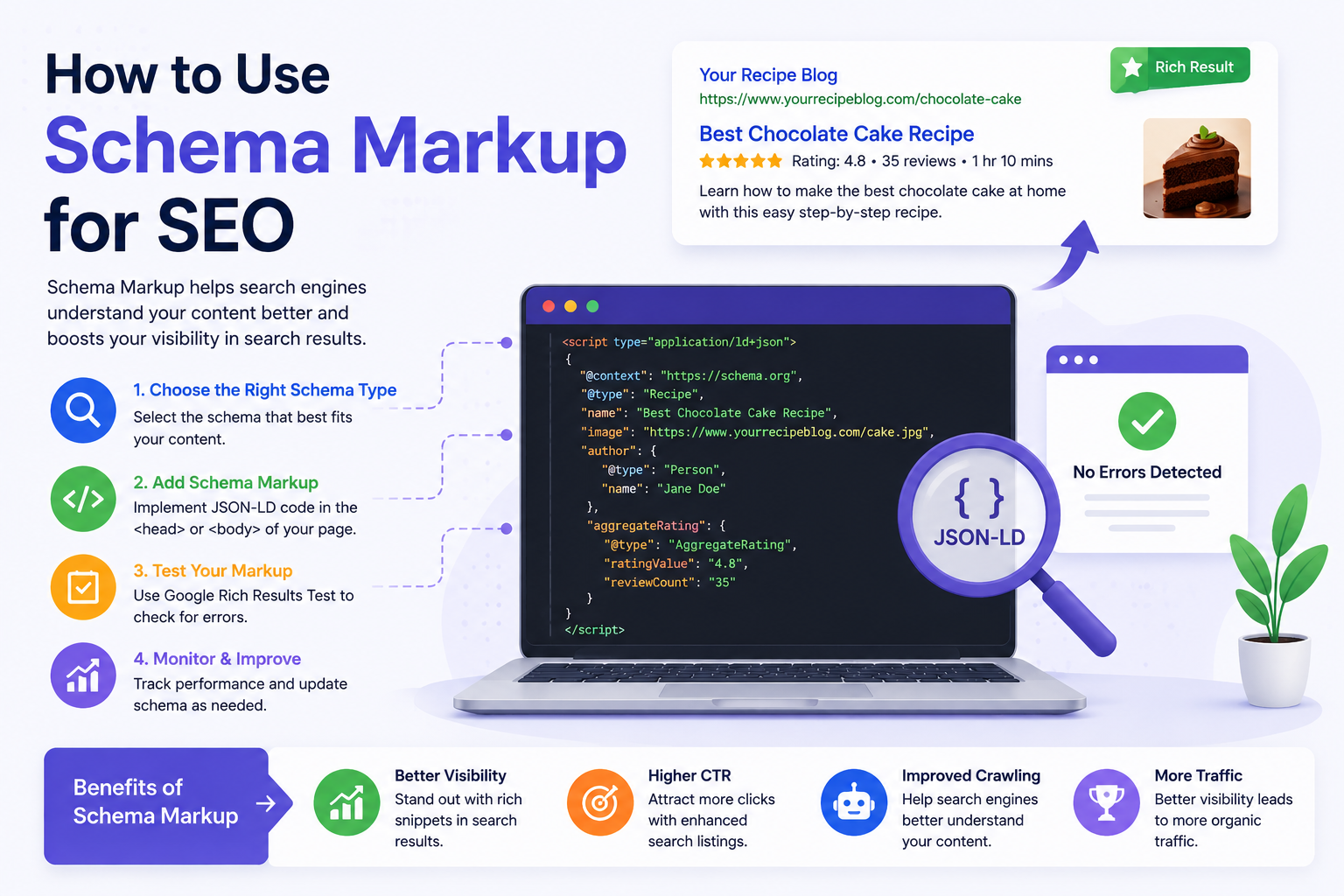
Search engine optimization has evolved far beyond keywords and backlinks. Today, search engines aim to understand content the same way humans do. They want to know whether a page represents a product, a business, an event, a review, a service, or a frequently asked question.
This is where schema markup becomes one of the most powerful yet underutilized SEO tools available.
While many businesses invest heavily in content creation and technical SEO, they often overlook structured data. As a result, search engines may not fully understand the context of their content, limiting visibility in search results.
Schema markup helps bridge that gap. It provides additional information about your website content in a format that search engines can easily interpret. When implemented correctly, schema can improve how your pages appear in search results, increase click-through rates, and strengthen your overall SEO strategy.
Whether you are a startup building online visibility, an SME looking to generate more leads, or an enterprise managing thousands of web pages, understanding schema markup can provide a significant competitive advantage.
What Is Schema Markup?
Schema markup is a form of structured data added to a website’s code to help search engines better understand the content on a page.
Rather than forcing search engines to guess what information represents, schema explicitly labels different elements. For example, it can identify a business name, product price, customer review, event date, author, recipe, or service offering.
Schema markup is based on a standardized vocabulary developed through Schema.org, a collaborative initiative supported by major search engines.
When search engines understand your content more clearly, they can display enhanced search results known as rich results or rich snippets.
Instead of a standard search listing, users may see additional information such as ratings, pricing, FAQs, business details, event dates, and other valuable content directly in search results.
Why Schema Markup Matters for SEO
One of the biggest challenges in SEO is helping search engines understand the meaning behind your content.
A page may contain excellent information, but without structured context, search engines may struggle to interpret its purpose accurately.
Schema markup provides that context.
According to multiple industry studies, pages with rich results often achieve higher click-through rates compared to standard search listings. Enhanced search appearances naturally attract more attention and provide users with valuable information before they even visit the website.
For businesses, this can translate into:
Although schema markup itself is not considered a direct ranking factor, it supports SEO performance by improving how search engines process and display content.
How Schema Markup Works
Think of schema markup as a translation layer between your website and search engines.
Imagine a webpage featuring a product. Humans can instantly recognize the product name, description, price, and reviews. Search engines, however, rely on code and context.
Schema markup labels each element clearly.
Instead of simply seeing text on a page, search engines can identify:
-
The exact product name
-
Current pricing
-
Availability status
-
Customer ratings
-
Brand information
This structured approach allows search engines to present more informative search results.
Most modern websites implement schema using JSON-LD, which is Google’s preferred structured data format. JSON-LD is easier to manage, scalable, and less likely to interfere with website functionality.
Types of Schema Markup Businesses Should Use
Not every schema type applies to every website. The most effective strategy is selecting schema categories that align with your business model and content strategy.
Organization Schema
Organization schema helps search engines understand company information.
It can include details such as business name, logo, contact information, social profiles, and company descriptions.
For startups and growing businesses, this schema helps establish credibility and improve brand recognition across search engines.
Local Business Schema
For businesses targeting local customers, local business schema is particularly valuable.
It provides information such as:
Local schema can strengthen local SEO efforts and improve visibility in location-based searches.
Product Schema
E-commerce websites benefit significantly from product schema.
By providing structured information about products, businesses can display pricing, stock availability, product ratings, and review information directly within search results.
This helps potential buyers make informed decisions before visiting the website.
FAQ Schema
FAQ schema allows businesses to highlight frequently asked questions directly in search results.
This type of schema can increase search visibility while addressing common customer concerns immediately.
Companies in technology, healthcare, finance, education, and professional services often use FAQ schema to improve user engagement.
Article Schema
Content-driven websites and businesses investing in content marketing should implement article schema.
It helps search engines understand publishing details, author information, headlines, and publication dates.
This is particularly beneficial for blogs, news sites, and thought leadership content.
Service Schema
Service schema is ideal for agencies, consultants, software providers, and professional service companies.
It helps search engines identify specific services offered by a business, improving relevance for service-related searches.
Real-World Example of Schema Markup Success
Consider an online electronics retailer competing in a crowded market.
Without schema markup, their search listing displays only a title and meta description.
After implementing product schema, search results begin showing product ratings, prices, and stock availability.
When users compare search results, the enhanced listing naturally attracts more attention because it provides useful information immediately.
The result is often higher click-through rates and increased organic traffic without changing rankings significantly.
Similarly, a local law firm implementing local business schema may see improved visibility for local searches because search engines can better understand its geographic relevance and business details.
These examples demonstrate why schema markup has become an essential component of modern SEO strategies.
How to Implement Schema Markup on Your Website
Adding schema markup may sound technical, but modern tools have simplified the process considerably.
The implementation process generally involves identifying relevant schema types, generating structured data, adding the code to website pages, and validating the markup.
For businesses using content management systems such as WordPress, many SEO plugins offer built-in schema functionality.
For custom websites, developers can manually add JSON-LD code to relevant pages.
The most important step is ensuring that structured data accurately reflects the visible content on the page. Search engines may ignore or penalize misleading structured data.
Common Schema Markup Mistakes to Avoid
Many organizations implement schema incorrectly, limiting its effectiveness.
One common mistake is adding schema markup that does not match page content. Search engines prioritize accuracy and consistency.
Another issue occurs when businesses implement generic schema while ignoring more specific options that better describe their content.
Incomplete structured data can also reduce performance. If a schema type supports multiple recommended fields, providing comprehensive information typically yields better results.
Businesses should also regularly review schema implementations as websites evolve. New products, services, locations, and content updates may require corresponding structured data adjustments.
Measuring the Impact of Schema Markup
Like any SEO initiative, schema implementation should be measured and monitored.
Organizations can evaluate performance through search analytics platforms and webmaster tools.
Key metrics to monitor include:
While schema markup may not produce overnight results, consistent implementation often contributes to long-term SEO improvements.
Businesses that combine structured data with strong content, technical SEO, and quality user experiences generally achieve the best outcomes.
Schema Markup and the Future of Search
Search engines are increasingly focused on understanding content context rather than simply matching keywords.
Artificial intelligence, machine learning, voice search, and conversational search experiences all depend heavily on structured information.
Schema markup helps websites prepare for this future.
As search engines become more sophisticated, businesses that provide clear, structured content signals will likely gain advantages in discoverability and relevance.
Voice assistants, AI-powered search engines, and emerging search experiences rely heavily on structured data to deliver accurate responses.
For organizations investing in digital transformation, schema markup should be viewed not merely as an SEO tactic but as part of a broader search intelligence strategy.
Why Startups and Enterprises Should Prioritize Schema Markup
Many businesses focus on visible SEO tactics such as content production and backlink acquisition because they produce obvious results.
Schema markup works differently.
It operates behind the scenes, helping search engines interpret content more accurately and present it more effectively.
For startups, schema can improve visibility without requiring massive marketing budgets.
For SMEs, it can create differentiation in competitive markets.
For enterprises managing extensive digital ecosystems, schema improves scalability, consistency, and search performance across large numbers of pages.
As search competition continues to increase, structured data becomes an increasingly valuable advantage.
Conclusion
Schema markup is one of the most practical ways to help search engines understand your website content while enhancing how your pages appear in search results.
Although it may not directly increase rankings, it supports critical SEO objectives such as visibility, click-through rates, user engagement, and content understanding.
Businesses that invest in structured data today position themselves for stronger organic performance tomorrow.
Whether you operate an e-commerce store, SaaS company, local business, enterprise website, or content platform, schema markup should be a fundamental component of your SEO strategy.
The organizations that succeed in modern search are not only creating valuable content—they are making that content easier for search engines to understand.
Frequently Asked Questions
What is schema markup in SEO?
Schema markup is structured data added to website pages that helps search engines understand content more accurately and display enhanced search results.
Does schema markup improve Google rankings?
Schema markup is not a direct ranking factor, but it can improve visibility, increase click-through rates, and support overall SEO performance.
Which schema type is best for business websites?
The most effective schema depends on the business. Common options include Organization Schema, Local Business Schema, Product Schema, Service Schema, FAQ Schema, and Article Schema.
Is schema markup difficult to implement?
Not necessarily. Many CMS platforms and SEO plugins provide tools that simplify schema implementation. Custom websites may require developer support.
How can I check if my schema markup works correctly?
Structured data can be validated using schema testing and search engine validation tools. Regular monitoring helps ensure accuracy and compliance.
Ready to Strengthen Your SEO Strategy?
Implementing schema markup correctly requires both technical expertise and a deep understanding of search engine best practices. Businesses that combine structured data with technical SEO, content optimization, and digital innovation are often best positioned for long-term growth.
If your organization is planning a website upgrade, SEO improvement initiative, or broader digital transformation project, partnering with an experienced technology and SEO solutions provider can help you maximize search visibility, improve user experiences, and build a stronger online presence that delivers measurable business results.