


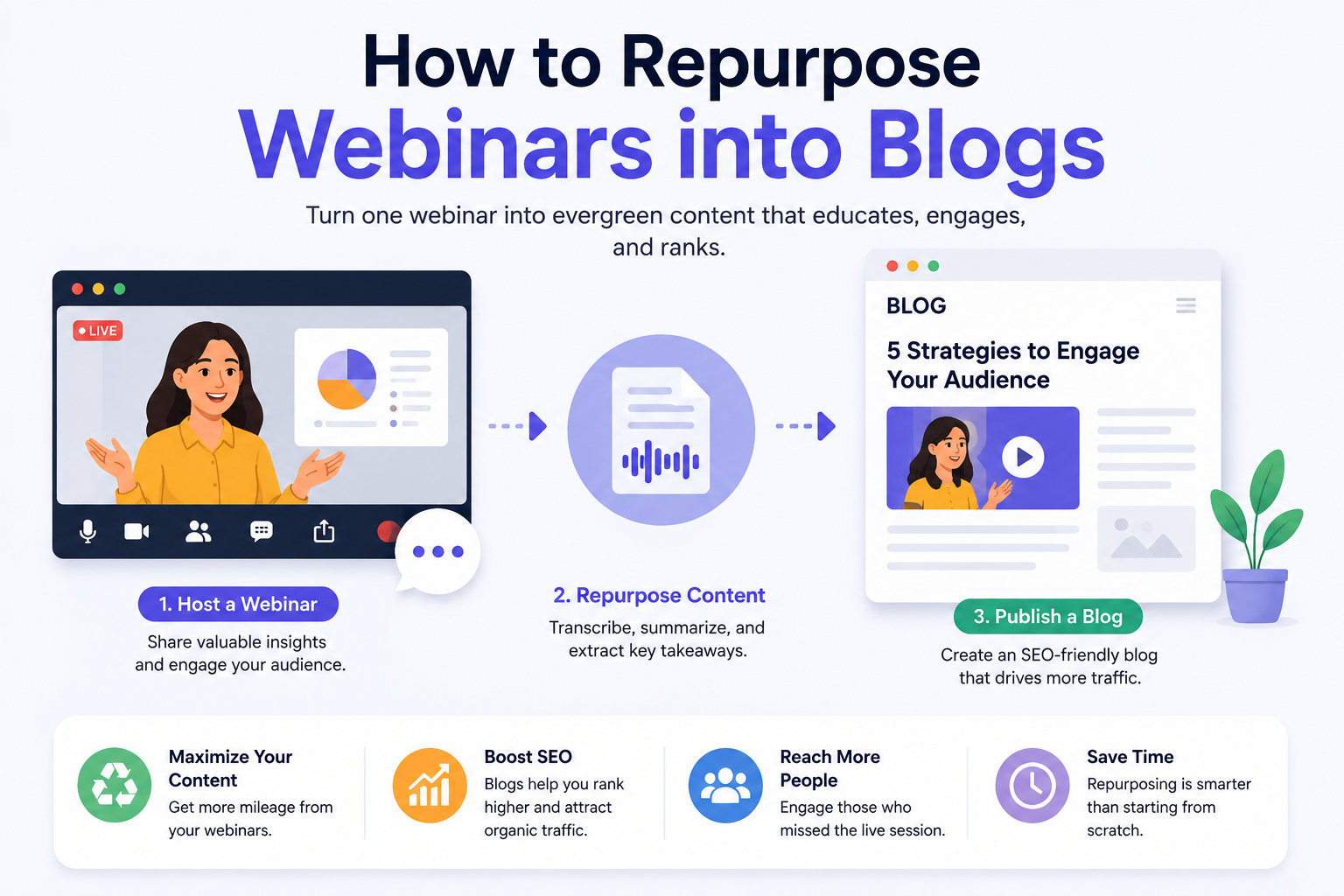
Creating high-quality content consistently is one of the biggest challenges businesses face today. Whether you’re a startup trying to build brand awareness or an enterprise looking to strengthen thought leadership, producing fresh content requires significant time, effort, and resources.
At the same time, many companies invest heavily in webinars. They spend weeks planning presentations, inviting industry experts, creating slides, promoting events, and engaging attendees. Yet once the webinar ends, the content often sits unused in a recording library.
This is where content repurposing becomes a powerful strategy.
Instead of treating a webinar as a one-time event, businesses can transform it into multiple content assets, with blogs being one of the most valuable formats. A well-written blog extends the lifespan of webinar content, improves search engine visibility, attracts new audiences, and generates ongoing leads long after the live session is over.
As content marketing continues to evolve, businesses are realizing that repurposing existing assets is often more efficient than constantly creating content from scratch. According to industry research, organizations that consistently repurpose content often achieve greater content ROI while reducing production costs and improving marketing efficiency.
In this guide, we’ll explore how to repurpose webinars into blogs effectively, helping your business maximize every webinar investment while strengthening your SEO and content marketing strategy.
Why Webinar-to-Blog Repurposing Matters
Webinars contain a wealth of valuable information. They often feature expert insights, industry trends, customer questions, case studies, and actionable recommendations.
When this information remains locked inside a video recording, its reach becomes limited. Many potential customers prefer reading rather than watching an hour-long webinar. Others may discover your business through search engines instead of webinar promotions.
Converting webinars into blogs helps bridge this gap.
A blog allows businesses to present key insights in a format that is easy to scan, share, and optimize for search engines. It also enables marketing teams to extract maximum value from content that already exists.
For organizations pursuing digital transformation initiatives, webinar repurposing creates a sustainable content workflow. Instead of continuously generating new ideas, teams can build entire content campaigns around a single webinar event.
This approach saves time while increasing content output and marketing efficiency.
The SEO Benefits of Turning Webinars into Blogs
One of the biggest advantages of webinar repurposing is search engine optimization.
Webinars themselves are not always easy for search engines to understand. While video content offers tremendous engagement opportunities, search engines primarily rely on text-based content for indexing and ranking.
A blog solves this challenge by converting spoken insights into searchable content.
When optimized properly, webinar-based blogs can rank for industry keywords, attract organic traffic, and drive qualified leads over time.
Businesses can naturally incorporate relevant search terms, answer common customer questions, and create comprehensive content that aligns with user search intent.
Additionally, blogs generated from webinars often cover highly relevant and timely topics. Since webinars typically address current industry challenges, they provide strong foundations for content that resonates with both audiences and search engines.
Start with a Full Webinar Transcript
The first step in transforming a webinar into a blog is obtaining an accurate transcript.
A transcript serves as the foundation for content creation. It captures every discussion point, question, answer, and insight shared during the session.
However, simply publishing a transcript is not enough.
Webinars are designed for listening, while blogs are designed for reading. Spoken language often includes repetition, filler words, conversational detours, and audience interactions that don’t translate well into written content.
The goal is to extract valuable information from the transcript and reorganize it into a structured article.
As you review the transcript, identify major themes, key takeaways, expert insights, and audience questions that can form the basis of your blog.
This process helps uncover the most valuable content while eliminating unnecessary sections.
Identify the Core Topic and Search Intent
Not every webinar should become a single blog post.
Some webinars cover multiple topics and may generate several articles instead of one.
Before writing, determine the primary topic your target audience is searching for online.
For example, imagine a webinar discussing cloud migration strategies. The session may include conversations about security, implementation challenges, cost management, and compliance requirements.
Instead of attempting to cover everything in one article, you could create focused blog posts around individual themes.
This approach improves SEO performance because each article targets a specific keyword cluster and user intent.
Understanding what readers are searching for helps shape the content structure and ensures the final article delivers meaningful value.
Transform Webinar Conversations into a Structured Blog
One common mistake businesses make is trying to preserve the webinar format within the blog.
A webinar follows a conversational flow, while a blog requires a logical structure.
Readers expect clear sections, concise explanations, and smooth transitions between ideas.
Start by creating an outline based on the webinar’s main discussion points. Organize information into sections that guide readers through the topic step by step.
Use descriptive headings and subheadings that improve readability while supporting SEO objectives.
The goal is to make the content feel like a professionally written article rather than a converted transcript.
This restructuring process significantly improves user experience and encourages readers to stay engaged longer.
Expand Key Insights with Additional Context
Webinars often move quickly through complex topics because presenters have limited time.
Blogs provide an opportunity to expand those discussions.
When converting webinar content into written form, add relevant context, examples, explanations, and supporting information.
For instance, if a webinar speaker briefly mentions the importance of automation, the blog can explore how automation impacts productivity, operational efficiency, and customer experience.
Adding depth helps create more comprehensive content while increasing the article’s value for readers.
Search engines also tend to favor content that thoroughly addresses a topic rather than offering surface-level information.
This makes expansion an important part of the repurposing process.
Incorporate Real-World Examples
Readers connect more strongly with practical examples than theoretical concepts.
Many webinars naturally include customer stories, implementation experiences, and industry examples. These elements should be highlighted within the blog.
Imagine a SaaS company hosting a webinar about customer onboarding.
During the discussion, a speaker explains how onboarding improvements reduced customer churn and increased product adoption rates. This insight can become a compelling case study section within the blog.
Real-world examples make content more relatable and demonstrate how strategies work in practice.
They also help establish credibility and trust with potential customers.
Turn Audience Questions into Valuable Content Sections
One of the most overlooked webinar assets is the Q&A session.
Audience questions reveal genuine concerns, challenges, and interests.
These questions often mirror the exact searches potential customers are typing into Google.
Instead of ignoring this section, integrate relevant questions into the blog as dedicated subsections.
By answering audience questions in detail, businesses can create content that directly addresses customer pain points.
This strategy improves user engagement and increases opportunities to rank for long-tail keywords.
In many cases, the Q&A portion generates some of the most valuable content within the entire webinar.
Optimize the Blog for SEO
Once the content structure is complete, focus on optimization.
SEO should feel natural rather than forced. The objective is to help search engines understand the content while maintaining readability for human audiences.
Pay attention to the following elements:
Modern SEO success depends on relevance, quality, and user experience. A well-organized blog that answers reader questions comprehensively is more likely to perform well in search results.
Create Multiple Content Assets from One Webinar
A single webinar can generate far more than one blog.
Many organizations maximize content ROI by creating an entire content ecosystem around each webinar.
For example:
This approach allows businesses to extend the lifespan of webinar content for months while maintaining a consistent publishing schedule.
Instead of creating new content from scratch every week, marketing teams can strategically repurpose existing assets into multiple formats.
Enhance Engagement with Visual Content
Blogs become more effective when supported by visuals.
Since webinars already include presentation slides, charts, statistics, and diagrams, businesses can reuse these assets within blog articles.
Visual elements help explain complex concepts and improve content engagement.
Readers often absorb information faster when supported by images, infographics, or data visualizations.
Incorporating webinar visuals also reinforces key messages and creates a richer content experience.
This can contribute to improved dwell time and stronger user engagement metrics.
Measure Performance and Refine Your Strategy
Repurposing webinars into blogs should be treated as an ongoing process rather than a one-time activity.
After publishing, monitor key performance indicators such as organic traffic, keyword rankings, engagement rates, lead generation, and conversion performance.
Understanding which webinar-derived blogs perform best helps identify future content opportunities.
Businesses can then refine their webinar topics, content structures, and SEO strategies based on actual audience behavior.
Over time, this creates a scalable content marketing system that continuously generates value from existing knowledge and expertise.
Common Mistakes to Avoid
While webinar repurposing offers significant benefits, certain mistakes can reduce effectiveness.
The most common issue is publishing transcripts without editing. Raw transcripts rarely provide a positive reading experience and often fail to perform well in search results.
Another mistake is focusing too heavily on promotional messaging. Readers visit blogs seeking information and solutions, not sales pitches.
Businesses should also avoid neglecting SEO optimization or failing to update content with additional context and examples.
The most successful webinar-based blogs are informative, structured, reader-focused, and optimized for discoverability.
The Future of Webinar Content Repurposing
As content demand continues to increase, businesses are placing greater emphasis on efficiency and scalability.
Webinars represent a valuable source of expertise, thought leadership, and industry knowledge. Repurposing this content into blogs aligns perfectly with modern content marketing strategies.
Artificial intelligence, content automation tools, and advanced transcription technologies are making the process faster than ever. However, human expertise remains essential for creating engaging narratives, refining messaging, and ensuring content quality.
Organizations that embrace webinar repurposing today will be better positioned to maintain consistent content production while maximizing marketing ROI.
Conclusion
Webinars are far more than live events. They are valuable content assets capable of generating long-term business value when repurposed strategically.
By transforming webinar recordings into SEO-friendly blogs, businesses can increase content output, improve search visibility, extend audience reach, and generate more leads from existing investments.
The key lies in moving beyond simple transcription. Successful webinar-to-blog conversion involves restructuring information, expanding insights, incorporating examples, optimizing for search engines, and focusing on audience needs.
For startups, SMEs, enterprises, and digital-first organizations, this approach offers a practical way to maximize content resources while building authority in competitive markets.
As content marketing becomes increasingly important for business growth, webinar repurposing is no longer just a smart tactic—it is becoming an essential strategy for sustainable success.
Frequently Asked Questions
How long should a webinar-based blog be?
The ideal length depends on the topic and audience. For SEO purposes, comprehensive blogs between 1,500 and 2,500 words often perform well because they provide sufficient depth and keyword coverage.
Can one webinar generate multiple blog posts?
Yes. A single webinar frequently covers several topics, making it possible to create multiple focused articles that target different keywords and audience interests.
Do webinar transcripts help with SEO?
Transcripts provide valuable source material, but they should be edited and restructured into reader-friendly content. Publishing raw transcripts alone typically delivers limited SEO benefits.
What is the biggest advantage of repurposing webinars into blogs?
The primary advantage is maximizing content ROI. Businesses can extend the lifespan of webinar content while improving search visibility and attracting new audiences.
How often should businesses repurpose webinar content?
Ideally, every webinar should become part of a broader content strategy. Organizations that consistently repurpose webinar content often achieve greater marketing efficiency and stronger long-term content performance.
Ready to Maximize the Value of Your Webinar Content?
Your webinars contain valuable insights that shouldn’t disappear after the live session ends. By converting webinars into strategic, SEO-driven blog content, businesses can generate more traffic, strengthen thought leadership, and create lasting marketing assets.
If your organization is looking to scale content production, improve digital visibility, and accelerate growth, partnering with an experienced technology and digital marketing team can make all the difference. Choose a technology partner that understands content strategy, SEO, automation, and digital transformation to help turn every webinar into measurable business results.