


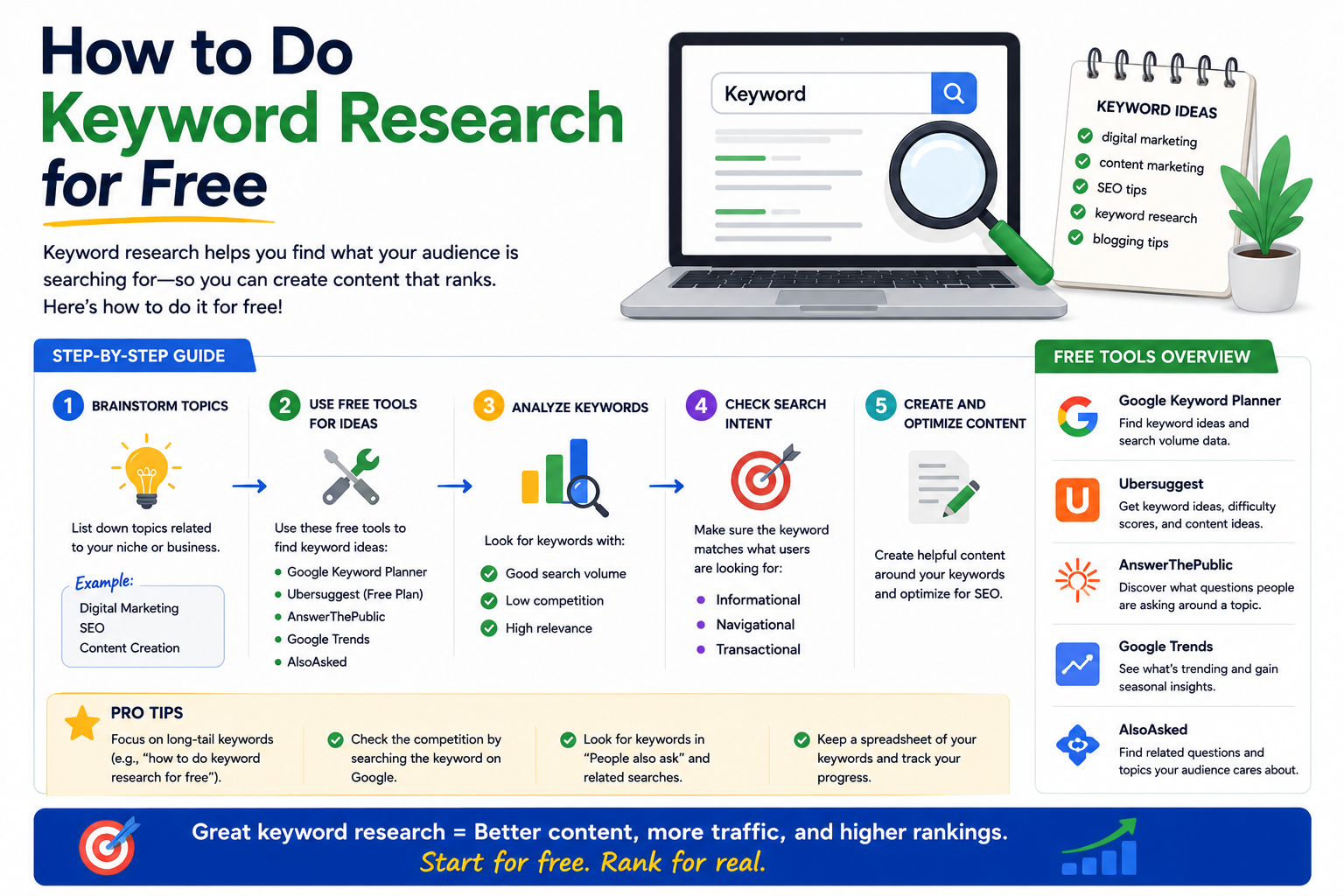
Every successful SEO strategy begins with one critical activity: keyword research.
Whether you’re a startup trying to build brand awareness, an SME looking to generate qualified leads, or an enterprise aiming to dominate search rankings, understanding what your audience is searching for is the foundation of digital success.
Many businesses assume they need expensive SEO software to uncover valuable keywords. While premium platforms certainly provide advanced insights, the reality is that you can perform highly effective keyword research without spending a single dollar.
In fact, some of the world’s most successful content marketers started with free keyword research methods before investing in enterprise-level SEO tools.
According to industry studies, organic search drives more than 50% of website traffic for many businesses. That means the keywords you target can directly influence your visibility, website visits, lead generation, and revenue.
The good news is that free keyword research is more accessible than ever. Search engines themselves provide valuable data, and several free tools can help businesses identify opportunities, understand user intent, and create content that ranks.
This guide will show you exactly how to do keyword research for free while building a strong foundation for long-term SEO growth.
What Is Keyword Research?
Keyword research is the process of identifying the words and phrases people type into search engines when looking for information, products, or services.
These search terms reveal what potential customers want, what problems they are trying to solve, and how they search online.
These insights allow businesses to create content that matches actual search demand rather than relying on assumptions.
The closer your content aligns with user searches, the greater your chances of attracting qualified traffic.
Why Keyword Research Matters for SEO
Search engines aim to provide users with the most relevant answers to their queries.
If your website content addresses topics that people actively search for, your chances of appearing in search results increase significantly.
Without keyword research, content creation often becomes guesswork. Businesses may publish dozens of articles that fail to generate meaningful traffic simply because they target topics nobody is searching for.
Start with Understanding Search Intent
Before collecting keywords, it’s important to understand search intent.
Search intent refers to the reason behind a search query.
A user searching for “what is cloud migration” has a different goal than someone searching for “cloud migration consulting company.”
The first user wants information. The second is likely evaluating service providers.
Modern SEO success depends on matching content with intent rather than simply targeting high-volume keywords.
Generally, search intent falls into four categories:
- Informational searches
- Navigational searches
- Commercial investigation searches
- Transactional searches
Businesses should create content for each stage of the buyer journey to maximize visibility and conversions.
Use Google Search for Free Keyword Ideas
One of the most powerful keyword research tools is Google itself.
When you begin typing a search query, Google Autocomplete suggests popular searches based on real user behavior.
For example, if you type:
“Digital transformation”
Google may suggest:
- Digital transformation strategy
- Digital transformation examples
- Digital transformation roadmap
- Digital transformation consulting
Each suggestion represents actual search demand.
Similarly, the “People Also Ask” section provides valuable insights into related questions users want answered.
If your business offers digital transformation services, these questions can become future blog topics, landing pages, or FAQ sections.
The “Related Searches” area at the bottom of search results is another goldmine for discovering additional keyword opportunities.
Many SEO professionals still use these free Google features daily because they reflect real user behavior.
Leverage Google Keyword Planner
Google Keyword Planner remains one of the best free resources available.
Although originally designed for advertisers, it provides valuable keyword data for SEO purposes.
The tool helps businesses discover:
- Keyword ideas
- Monthly search volumes
- Competition levels
- Related keyword opportunities
- Seasonal trends
For example, a cybersecurity company may discover that “cybersecurity audit services” receives more searches than “IT security assessment.”
This insight can influence content strategy and website optimization.
While free accounts may see volume ranges instead of exact figures, the data remains useful for identifying keyword opportunities.
Analyze Your Competitors
Competitor research is one of the fastest ways to discover keywords that already drive traffic in your industry.
The logic is simple.
If competitors are ranking for certain keywords, those keywords have likely proven valuable.
Start by identifying businesses that rank highly for your target services.
Review:
- Their blog topics
- Service pages
- FAQs
- Resource centers
- Case studies
Look for recurring themes and keyword patterns.
For example, a SaaS company may notice competitors consistently publishing content around “workflow automation,” “AI productivity tools,” and “business process optimization.”
These recurring topics indicate areas of strong search interest.
Competitor analysis helps businesses avoid starting from scratch while uncovering proven content opportunities.
Use Google Trends to Spot Market Opportunities
Keyword popularity changes over time.
Google Trends helps businesses understand whether interest in a topic is increasing, decreasing, or remaining stable.
This is particularly valuable for technology companies, startups, and rapidly evolving industries.
Consider how terms like artificial intelligence, machine learning, and generative AI have grown dramatically in search volume over recent years.
Businesses that identified these trends early gained significant SEO advantages.
Google Trends can also reveal seasonal patterns.
For example, searches related to budgeting software often increase toward year-end planning periods, while certain retail searches spike during holiday seasons.
Publishing content before demand peaks can help secure rankings ahead of competitors.
Explore Online Communities and Forums
Some of the best keyword ideas come directly from customer conversations.
Platforms such as Reddit, Quora, LinkedIn groups, and industry forums reveal the exact language people use when discussing challenges and seeking solutions.
Pay attention to:
- Frequently asked questions
- Recurring pain points
- Popular discussion topics
- Industry terminology
- Customer concerns
A cloud consulting company may discover that users frequently ask about cloud migration costs, implementation timelines, or security risks.
Each question represents potential content and keyword opportunities.
These insights often uncover long-tail keywords that traditional tools may overlook.
Focus on Long-Tail Keywords
Many businesses make the mistake of targeting only broad, highly competitive keywords.
For example, ranking for “software development” is extremely difficult because countless companies compete for the term.
Instead, focus on long-tail keywords.
Long-tail keywords are more specific search phrases containing three or more words.
While individual search volumes may be lower, these keywords often attract highly qualified visitors.
They also tend to convert better because they reflect clearer user intent.
For startups and SMEs with limited SEO resources, long-tail keywords offer some of the best opportunities for growth.
Organize Keywords into Topic Clusters
Modern SEO increasingly favors topical authority rather than isolated keywords.
Instead of creating unrelated content pieces, businesses should organize keywords into topic clusters.
Imagine a company offering cloud services.
This structure helps search engines understand your expertise on a subject.
As a result, rankings often improve across multiple related keywords.
Topic clustering also creates a better user experience by helping visitors find relevant information more easily.
Evaluate Keyword Difficulty Without Paid Tools
While premium SEO platforms provide keyword difficulty scores, free methods can still help evaluate competitiveness.
Search your target keyword and examine the first page results.
If the first page contains globally recognized brands and highly authoritative domains, ranking may require significant effort.
However, if smaller businesses and niche websites appear, opportunities may exist for newer companies.
Manual analysis remains one of the most effective ways to assess keyword competition.
Build a Practical Keyword Strategy
Collecting keywords is only the first step.
The real value comes from turning research into action.
Not every keyword deserves equal attention.
For example, a digital transformation consultancy may prioritize keywords that attract decision-makers rather than general informational traffic.
The goal is not simply more traffic.
The goal is attracting the right audience.
When keyword selection aligns with business objectives, SEO becomes a powerful growth engine rather than a vanity metric.
Common Keyword Research Mistakes to Avoid
Even with free tools, businesses can achieve excellent results by avoiding common mistakes.
One major mistake is targeting keywords solely based on search volume. High-volume keywords often come with intense competition and may not generate qualified leads.
Another common issue is ignoring search intent. Ranking for irrelevant keywords can increase traffic while producing few conversions.
Many businesses also fail to update their keyword strategy. Search behavior evolves constantly, especially in technology-driven industries.
Finally, some companies create content around isolated keywords instead of building topical authority through comprehensive content ecosystems.
Avoiding these mistakes can significantly improve SEO outcomes.
The Future of Keyword Research
As search engines become more sophisticated, keyword research is evolving.
Search algorithms increasingly understand context, intent, and semantic relationships.
This means businesses should focus less on exact-match keyword repetition and more on comprehensive topic coverage.
AI-powered search experiences are also changing how users interact with search engines.
However, the fundamental principle remains the same:
Understanding what your audience wants and creating valuable content around those needs.
Businesses that consistently align content with customer intent will continue to succeed regardless of algorithm updates.
Conclusion
Keyword research is one of the most important investments a business can make in its digital marketing strategy.
The good news is that you do not need expensive software to get started.
By using Google Search, Google Keyword Planner, Google Trends, competitor analysis, online communities, and strategic content planning, businesses can uncover valuable keyword opportunities at no cost.
The most successful organizations understand that keyword research is not just about rankings. It is about understanding customers, solving their problems, and creating content that connects with their needs.
When approached strategically, free keyword research can drive meaningful traffic, improve visibility, generate qualified leads, and support long-term business growth.
As competition continues to increase online, businesses that master keyword research will be better positioned to attract, engage, and convert their ideal customers.
Frequently Asked Questions (FAQs)
How can I do keyword research for free?
You can perform keyword research for free using Google Search Autocomplete, Google Keyword Planner, Google Trends, competitor analysis, and online communities such as Reddit and Quora.
Is Google Keyword Planner free?
Yes. Google Keyword Planner is free to use with a Google Ads account and provides keyword ideas, search volume estimates, and competition insights.
What are long-tail keywords?
Long-tail keywords are specific search phrases that typically contain three or more words. They often have lower competition and higher conversion potential than broad keywords.
How often should I conduct keyword research?
Businesses should review and update keyword research regularly, ideally every quarter, to align with changing search trends, customer behavior, and market conditions.
Can small businesses compete with large companies using SEO?
Yes. By targeting niche topics, long-tail keywords, and specific customer needs, small businesses can successfully compete against larger organizations in search results.