


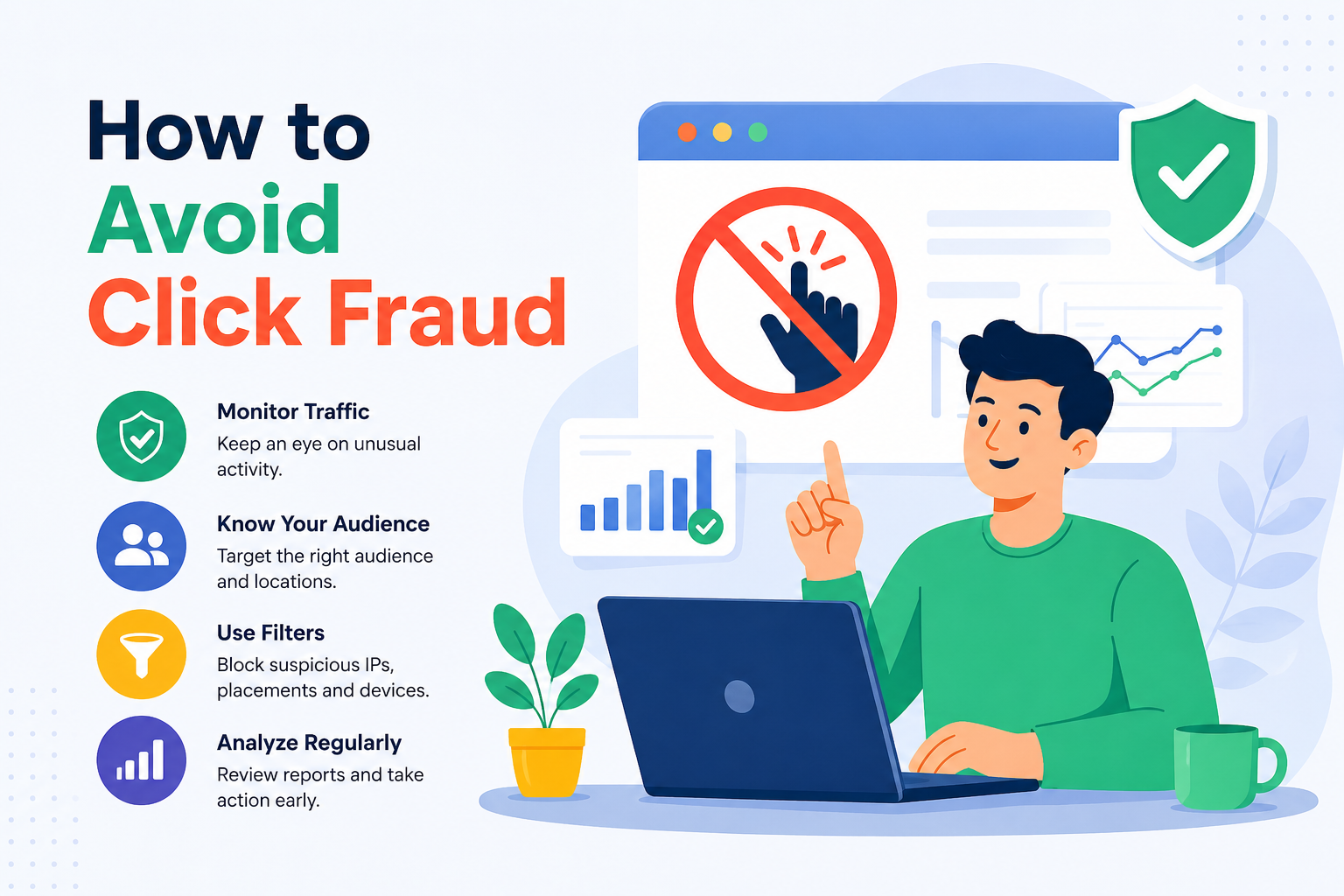
Digital advertising has transformed the way businesses attract customers. Whether you’re a startup launching your first marketing campaign or an enterprise investing thousands of dollars into paid advertising, pay-per-click (PPC) advertising remains one of the fastest ways to generate leads and sales.
However, there is a hidden challenge that many advertisers underestimate: click fraud.
Every invalid click on your ad can drain your advertising budget, distort campaign data, reduce return on investment, and impact decision-making. As online advertising spending continues to grow worldwide, click fraud has become a serious concern for businesses of all sizes.
Understanding how to avoid click fraud is no longer optional. It is a critical component of running profitable advertising campaigns.
In this guide, we’ll explore what click fraud is, why it happens, how it affects businesses, and most importantly, the practical steps you can take to protect your advertising investments.
What Is Click Fraud?
Click fraud occurs when someone intentionally clicks on an online advertisement without any genuine interest in the product or service being promoted.
The goal is usually to generate artificial clicks that cost advertisers money while providing no real business value. These fraudulent clicks can come from individuals, competitors, automated bots, click farms, or malicious software.
For businesses running campaigns on platforms like Google Ads, Microsoft Ads, or social media advertising networks, every invalid click represents wasted spending.
While advertising platforms have sophisticated systems to identify suspicious activity, not all fraudulent clicks are detected immediately. This makes proactive click fraud prevention essential for advertisers.
Why Click Fraud Is a Growing Problem
The digital advertising industry continues to expand rapidly. Global digital advertising spending now reaches hundreds of billions of dollars annually, creating significant opportunities for fraudsters.
As more businesses allocate larger budgets toward PPC campaigns, fraudulent actors become increasingly motivated to exploit advertising systems.
Several factors contribute to the rise of click fraud:
For businesses operating in competitive markets, even a small percentage of fraudulent clicks can translate into substantial financial losses over time.
Understanding the Different Types of Click Fraud
Not all click fraud looks the same. Understanding the various forms helps businesses develop stronger protection strategies.
Competitor Click Fraud
One of the most common forms occurs when competitors repeatedly click on your advertisements to exhaust your daily budget.
Imagine a local law firm spending heavily on Google Ads. A competing firm may attempt to reduce visibility by generating repeated clicks on those ads. Once the budget is depleted, legitimate prospects can no longer see the advertisements.
This tactic can significantly impact lead generation and revenue opportunities.
Bot Traffic
Automated software programs can generate thousands of clicks within a short period.
Modern bots have become increasingly sophisticated. Some imitate human browsing behavior, making detection more difficult. They may use rotating IP addresses, random browsing patterns, and realistic session durations to avoid triggering fraud detection systems.
Click Farms
Click farms employ large groups of people who manually click advertisements for payment.
Because actual humans perform the clicks, traditional automated fraud detection systems may struggle to identify suspicious activity immediately.
The traffic often appears legitimate on the surface but rarely converts into meaningful business outcomes.
Publisher Fraud
In display advertising ecosystems, website owners may attempt to generate artificial ad clicks on their own properties to increase advertising revenue.
Although advertising networks actively monitor for such behavior, it remains a concern for advertisers running broad display campaigns.
How Click Fraud Impacts Your Business
Many organizations underestimate the true cost of fraudulent clicks.
The obvious consequence is wasted advertising spend. Every invalid click consumes budget that could have been allocated toward genuine prospects.
However, the impact extends much further.
Fraudulent traffic can distort campaign analytics, making it difficult to understand actual user behavior. Marketing teams may incorrectly optimize campaigns based on misleading data, leading to poor strategic decisions.
Additionally, click fraud can reduce campaign efficiency by lowering conversion rates and increasing acquisition costs. This often creates the false impression that campaigns are underperforming when the real issue is invalid traffic.
For startups and small businesses with limited marketing budgets, these effects can be particularly damaging.
Key Warning Signs of Click Fraud
Identifying suspicious activity early can prevent significant financial losses.
While no single indicator confirms fraud, several warning signs should prompt further investigation.
Businesses should regularly review campaign analytics and website behavior data to identify unusual patterns before they become costly problems.
How to Avoid Click Fraud Effectively
Preventing click fraud requires a combination of monitoring, technology, and strategic campaign management.
Let’s examine the most effective methods.
Monitor Traffic Sources Closely
The first step is understanding where your traffic originates.
Analytics platforms provide valuable insights into visitor behavior, geographic locations, devices, referral sources, and engagement metrics.
If a specific region generates a high number of clicks but produces no conversions, it may warrant investigation. Similarly, abnormal spikes in traffic from unfamiliar locations could indicate fraudulent activity.
Regular traffic audits help identify suspicious patterns before they cause significant budget losses.
Use IP Exclusions
Most major advertising platforms allow advertisers to exclude specific IP addresses.
If repeated invalid activity originates from certain addresses, blocking them can reduce future fraudulent clicks.
While this method is not foolproof—particularly against advanced bots using rotating IPs—it remains a useful layer of protection.
Businesses running local campaigns often find IP exclusions especially effective when dealing with known sources of invalid traffic.
Leverage Geographic Targeting
Not every region represents a valuable audience for your business.
By narrowing geographic targeting, companies can reduce exposure to fraudulent traffic from locations that rarely generate customers.
For example, a software company focused exclusively on North American customers may not need advertising visibility in regions where conversions historically do not occur.
More precise targeting improves both campaign efficiency and fraud prevention.
Analyze Conversion Quality Instead of Click Volume
Many advertisers focus heavily on clicks.
However, clicks alone do not generate revenue. Conversions do.
Organizations should prioritize metrics such as qualified leads, sales opportunities, customer acquisition costs, and revenue generated.
When evaluating campaigns through a conversion-focused lens, fraudulent traffic becomes easier to identify because it rarely contributes meaningful business outcomes.
Implement Click Fraud Detection Software
Dedicated click fraud prevention solutions have become increasingly sophisticated.
These platforms use machine learning, behavioral analysis, device fingerprinting, and traffic monitoring to identify suspicious activity in real time.
Many businesses running large PPC budgets rely on specialized tools to automatically block invalid traffic before it impacts campaign performance.
For companies spending thousands of dollars each month on paid advertising, the investment often pays for itself through recovered advertising efficiency.
Best Practices for Google Ads Fraud Prevention
Google invests heavily in invalid traffic detection, but advertisers should still take proactive measures.
Several best practices can significantly improve protection.
First, regularly review campaign reports for unusual traffic patterns. Second, monitor geographic performance closely. Third, use audience targeting to reach more qualified users. Finally, maintain strong conversion tracking to identify discrepancies between clicks and actual customer actions.
Businesses that actively manage campaigns generally experience better fraud protection than those relying solely on platform safeguards.
The Role of Artificial Intelligence in Click Fraud Detection
Artificial intelligence is transforming how businesses combat click fraud.
Traditional detection methods often relied on predefined rules. Modern AI-powered systems analyze massive datasets to identify subtle patterns that humans may overlook.
Machine learning algorithms can evaluate user behavior, browsing patterns, device characteristics, and interaction histories in real time.
As fraudsters continue developing more advanced techniques, AI-driven detection solutions are becoming increasingly important for maintaining advertising integrity.
This trend is expected to accelerate as digital advertising ecosystems become more complex.
Building a Long-Term Click Fraud Prevention Strategy
Effective fraud prevention is not a one-time task.
Businesses should establish ongoing processes that include continuous monitoring, regular reporting, campaign optimization, and technology evaluation.
A sustainable strategy typically combines platform safeguards, internal oversight, and specialized fraud prevention tools.
Organizations that treat click fraud prevention as an ongoing business process often achieve stronger advertising performance and more predictable marketing outcomes.
Rather than reacting after problems occur, successful companies focus on proactive risk management.
Real-World Example of Click Fraud Prevention
Consider a SaaS company investing heavily in search advertising.
The marketing team noticed a dramatic increase in clicks over a two-week period. Initially, this appeared positive. However, lead volume remained unchanged.
After investigating analytics data, they discovered most clicks originated from regions outside their target market. Session durations were only a few seconds, and bounce rates exceeded normal levels.
The company implemented tighter geographic targeting, excluded suspicious IP addresses, and deployed click fraud detection software.
Within a month, advertising costs decreased while conversion rates improved significantly.
This example highlights an important lesson: more clicks do not always mean better results. Quality traffic consistently outperforms high traffic volume.
The Future of Click Fraud Prevention
As digital advertising continues evolving, fraud prevention technologies will become increasingly sophisticated.
Advertising platforms are investing heavily in AI-driven detection systems, behavioral analytics, and real-time threat intelligence. At the same time, businesses are becoming more aware of the financial risks associated with invalid traffic.
Future fraud prevention strategies will likely emphasize automation, predictive analytics, and cross-platform monitoring.
Organizations that stay informed and adopt modern protection measures will be better positioned to maximize advertising ROI.
Conclusion
Click fraud remains one of the most significant challenges facing digital advertisers today. Whether caused by competitors, bots, click farms, or other malicious actors, fraudulent clicks can waste advertising budgets and distort performance data.
Fortunately, businesses are not powerless.
By monitoring traffic sources, implementing geographic targeting, using IP exclusions, focusing on conversion quality, and leveraging advanced fraud detection tools, organizations can dramatically reduce their exposure to invalid traffic.
The most successful advertisers recognize that protecting advertising investments is just as important as generating traffic. A proactive approach to click fraud prevention helps ensure marketing budgets are spent attracting real customers rather than funding fraudulent activity.
As competition in digital advertising continues to increase, businesses that prioritize click fraud prevention will gain a measurable advantage in campaign performance, profitability, and long-term growth.
Frequently Asked Questions
What is click fraud in PPC advertising?
Click fraud occurs when advertisements are clicked without genuine purchase intent. The objective is typically to waste advertising budgets, manipulate campaign performance, or generate fraudulent publisher revenue.
Can Google Ads detect click fraud?
Google Ads uses advanced systems to identify invalid traffic and automatically filter many fraudulent clicks. However, not every suspicious click is detected immediately, which is why additional monitoring is recommended.
How do I know if my ads are experiencing click fraud?
Common indicators include sudden traffic spikes, high click-through rates with low conversions, unusual geographic activity, short session durations, and rising advertising costs without corresponding business results.
Is click fraud illegal?
In many situations, click fraud may violate advertising platform policies and could potentially lead to legal consequences depending on the circumstances and jurisdiction involved.
Are click fraud prevention tools worth the investment?
For businesses managing substantial PPC budgets, click fraud prevention software can provide significant value by reducing wasted spend, improving campaign accuracy, and enhancing return on advertising investment.
Ready to Protect Your Advertising Budget?
Click fraud can quietly erode marketing performance and reduce ROI. Partnering with an experienced digital marketing and technology team can help you identify threats, optimize campaign performance, and implement advanced fraud prevention strategies.
Whether you’re a startup scaling rapidly or an enterprise managing large advertising budgets, choosing the right technology partner ensures your marketing investments generate real business growth rather than wasted clicks.