


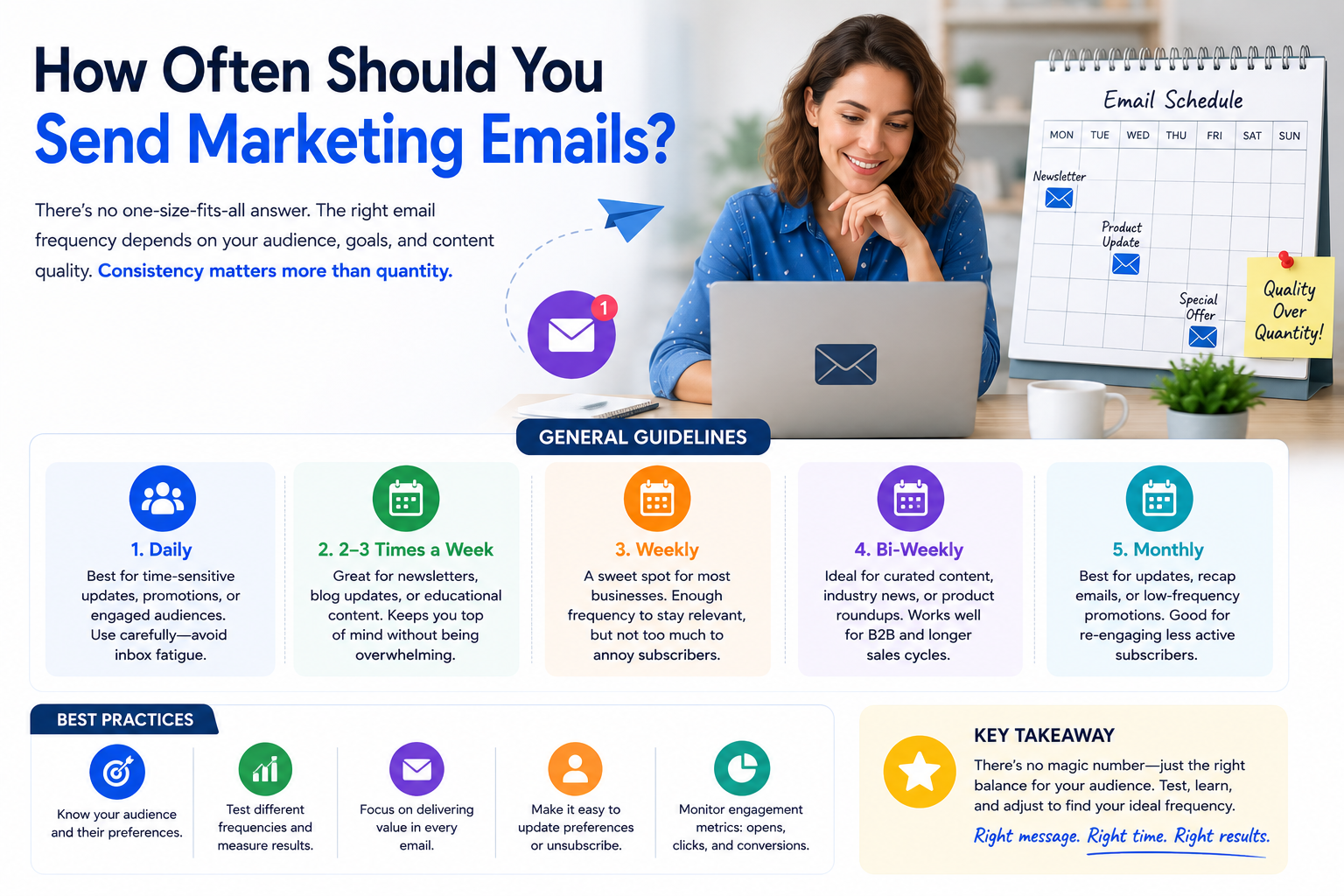
Email marketing remains one of the most effective digital marketing channels available today. Despite the rise of social media platforms, messaging apps, and AI-powered customer engagement tools, email continues to deliver impressive returns for businesses across industries.
However, one question consistently challenges marketers, business owners, and growth teams:
How often should you send marketing emails?
Send too many emails, and subscribers may become frustrated, leading to higher unsubscribe rates and reduced engagement. Send too few, and your audience may forget about your brand altogether, causing missed sales opportunities and weaker customer relationships.
Finding the right balance is not about following a universal rule. The ideal email frequency depends on your audience, industry, goals, content quality, and customer journey.
In this guide, we’ll explore how often businesses should send marketing emails, what factors influence email frequency, common mistakes to avoid, and how organizations can develop a strategy that maximizes engagement while protecting their brand reputation.
Why Email Frequency Matters More Than Ever
Email marketing is no longer simply about sending promotional messages. Modern customers expect personalized, relevant, and timely communication.
According to multiple industry studies, email continues to generate one of the highest returns on investment among digital marketing channels. However, engagement rates are closely tied to how frequently brands communicate with subscribers.
When frequency is optimized, businesses can:
On the other hand, excessive communication often leads to email fatigue. Recipients begin ignoring messages, deleting them without opening, or unsubscribing entirely.
The challenge is not simply sending more emails. It is sending the right emails at the right time.
Is There an Ideal Email Marketing Frequency?
The short answer is no.
There is no single frequency that works for every business.
A global ecommerce retailer, a SaaS startup, a financial institution, and a healthcare provider all have different customer expectations and buying cycles. What works for one organization may be ineffective for another.
That said, industry benchmarks provide a useful starting point.
Many successful companies send between one and three marketing emails per week. This range often provides enough communication to stay visible without overwhelming subscribers.
However, frequency should always be guided by audience behavior rather than arbitrary numbers.
If engagement remains strong and unsubscribe rates stay low, increasing frequency may be beneficial. If open rates decline significantly, it may be time to reduce email volume.
Understanding Audience Expectations
Before deciding how frequently to send emails, businesses must understand what subscribers expect when they join the mailing list.
Consider why someone subscribed in the first place.
A B2B decision-maker downloading a technology whitepaper expects educational insights and industry expertise. An ecommerce shopper signing up for discounts may expect regular promotional updates.
The key is aligning email frequency with subscriber expectations.
For example, a software company offering digital transformation solutions might send weekly educational content covering cloud adoption, cybersecurity trends, and technology innovation. Subscribers often appreciate this consistent flow of valuable information.
Conversely, sending daily promotional emails to the same audience could quickly reduce engagement.
The better businesses understand subscriber intent, the easier it becomes to establish an effective communication schedule.
Recommended Email Frequency by Business Type
Different industries naturally support different email schedules.
Ecommerce and Retail Brands
Retail businesses often communicate more frequently because purchasing decisions happen quickly.
Promotions, flash sales, seasonal campaigns, product launches, and abandoned cart reminders create multiple opportunities for engagement.
Many ecommerce companies successfully send several emails each week without causing subscriber fatigue, provided the content remains relevant and personalized.
SaaS and Technology Companies
Software businesses typically focus on longer sales cycles and relationship building.
Weekly or bi-weekly communication often works well because subscribers are looking for educational resources, product updates, case studies, and industry insights rather than constant sales messaging.
B2B Organizations
B2B buyers generally require more information before making purchasing decisions.
A thoughtful weekly email newsletter often delivers better results than daily promotions. Consistent educational content helps build trust and authority over time.
Professional Services Firms
Consulting firms, legal practices, financial advisors, and agencies often benefit from sending emails once or twice per month.
Their audiences value expertise and insights but may not require constant communication.
The Importance of Email Quality Over Quantity
One of the biggest misconceptions in email marketing is that higher frequency automatically leads to better results.
In reality, quality consistently outperforms quantity.
A single highly relevant email can generate more engagement than multiple generic campaigns.
Consider two scenarios.
Company A sends five promotional emails each week with nearly identical messaging.
Company B sends one carefully crafted email featuring useful insights, customer success stories, and a compelling offer.
Over time, Company B often develops stronger engagement because subscribers perceive greater value.
Before increasing email frequency, businesses should first ask:
If the answer is no, frequency is probably not the problem.
Signs You’re Sending Too Many Emails
Many organizations unintentionally overwhelm subscribers.
While short-term campaigns may generate temporary increases in visibility, excessive communication can damage long-term relationships.
Several warning signs indicate email frequency may be too high.
Monitoring these metrics helps businesses identify frequency-related issues before they become significant problems.
Modern email platforms provide detailed analytics that make it easier to track audience response and adjust accordingly.
Signs You’re Not Sending Enough Emails
Sending too few emails can also create challenges.
When communication becomes infrequent, subscribers may forget why they joined your list. This weakens brand recognition and reduces future engagement.
Businesses that communicate too rarely often experience lower open rates because recipients no longer recognize the sender.
Common indicators of insufficient communication include declining brand awareness, reduced website traffic from email campaigns, and lower customer engagement levels.
Consistency is often more important than frequency itself.
A predictable monthly newsletter can outperform sporadic campaigns that arrive without any schedule.
How Segmentation Changes Email Frequency
One of the most effective ways to optimize email frequency is through audience segmentation.
Not every subscriber should receive the same number of emails.
A highly engaged customer who frequently opens messages may welcome additional communication. A less active subscriber may prefer fewer updates.
Effective segmentation can be based on:
Segmentation allows organizations to increase communication with interested audiences while reducing unnecessary emails for less engaged subscribers.
This creates a better customer experience and improves campaign performance.
Using Customer Journey Stages to Determine Frequency
Email frequency should evolve throughout the customer journey.
A prospect evaluating solutions often requires more educational content than an existing customer who already understands the product.
For example, a SaaS company might communicate more frequently during onboarding to help new users achieve success quickly.
Once customers become familiar with the platform, communication can shift toward periodic updates, feature announcements, and advanced resources.
Aligning frequency with customer needs creates a more personalized experience while improving retention and satisfaction.
Testing Your Ideal Email Schedule
The most reliable way to determine optimal email frequency is through testing.
Rather than relying solely on industry averages, businesses should conduct controlled experiments and analyze performance data.
A startup might test one email per week against two emails per week.
An ecommerce brand could compare three campaigns weekly against five campaigns weekly.
Over time, performance metrics reveal which schedule delivers stronger engagement and conversion rates.
Important metrics to monitor include:
- Open rate
- Click-through rate
- Conversion rate
- Unsubscribe rate
- Revenue per email
Data-driven decision-making consistently produces better outcomes than assumptions.
The Role of Automation in Email Frequency
Marketing automation has transformed how businesses manage email communication.
Instead of relying exclusively on scheduled campaigns, organizations can deliver messages based on customer actions and behaviors.
For example, automated emails may be triggered when a customer:
- Downloads a resource
- Abandons a shopping cart
- Registers for an event
- Completes a purchase
- Requests product information
Because these emails are behavior-driven, they often feel more relevant than standard promotional campaigns.
Automation helps businesses maintain engagement without unnecessarily increasing bulk email frequency.
Common Email Frequency Mistakes Businesses Make
Many organizations struggle with frequency because they focus on internal objectives rather than subscriber preferences.
One common mistake is increasing email volume solely to meet marketing targets.
Another is sending every campaign to the entire database regardless of relevance.
Businesses also frequently overlook engagement signals. When subscribers stop interacting with emails, continuing to increase frequency rarely solves the problem.
Instead, companies should prioritize relevance, segmentation, personalization, and customer experience.
The most successful email strategies focus on delivering value consistently rather than maximizing message volume.
Building a Sustainable Long-Term Email Strategy
Email marketing success is rarely achieved through short-term tactics.
A sustainable strategy balances communication frequency with audience expectations and business goals.
Companies that consistently provide useful information, educational resources, industry insights, and relevant offers tend to build stronger subscriber relationships over time.
Rather than asking, “How many emails can we send?” successful organizations ask, “How much value can we provide?”
This shift in mindset often leads to better engagement, stronger customer loyalty, and improved marketing performance.
Conclusion
So, how often should you send marketing emails?
For most businesses, one to three emails per week serves as a practical starting point. However, the optimal frequency ultimately depends on your audience, industry, content quality, customer journey, and engagement data.
There is no universal formula that guarantees success.
Businesses that listen to their audience, monitor performance metrics, segment subscribers effectively, and prioritize valuable content will consistently outperform those that rely on excessive email volume.
The goal is not simply to appear in the inbox more often. The goal is to remain relevant, trusted, and helpful whenever your audience hears from you.
As email marketing continues to evolve, organizations that combine strategic frequency with personalization and automation will be best positioned to drive engagement, conversions, and long-term business growth.
Frequently Asked Questions
How many marketing emails should a business send each week?
Most businesses see strong results with one to three emails per week. The ideal frequency depends on audience preferences, industry requirements, and content quality.
Can sending too many emails hurt marketing performance?
Yes. Excessive email frequency can increase unsubscribe rates, spam complaints, and subscriber fatigue, ultimately reducing overall campaign effectiveness.
Should B2B companies send fewer emails than ecommerce businesses?
In many cases, yes. B2B sales cycles are typically longer and more research-driven, making weekly or bi-weekly communication more effective than daily promotional campaigns.
How do I know if my email frequency is too high?
Watch for declining open rates, lower click-through rates, increased unsubscribe rates, and spam complaints. These indicators often suggest subscribers are receiving too many emails.
Does email segmentation improve frequency management?
Absolutely. Segmentation allows businesses to send different amounts of communication based on customer interests, behavior, and engagement levels, resulting in better overall performance.
Ready to Improve Your Email Marketing Strategy?
Choosing the right email frequency is only one piece of a successful digital marketing strategy. To maximize engagement, conversions, customer retention, and long-term business growth, organizations need the right technology, automation tools, analytics, and strategic expertise.
Whether you’re a startup building your first email campaign, an SME scaling customer acquisition, or an enterprise accelerating digital transformation, partnering with an experienced technology and marketing solutions provider can help you create data-driven email strategies that deliver measurable business results.
Invest in smarter communication, better customer experiences, and scalable marketing systems that grow alongside your business.