


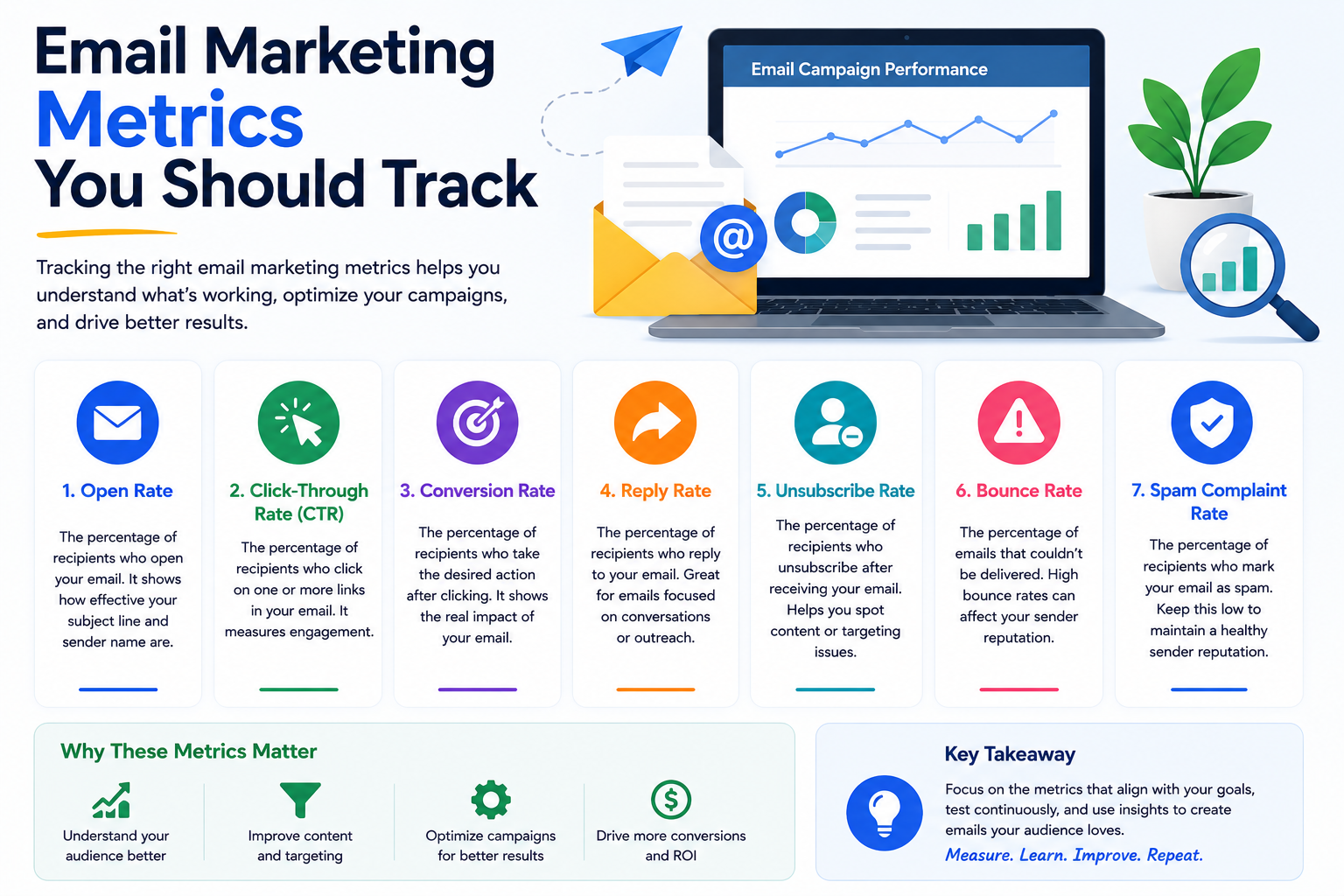
Email marketing continues to be one of the most effective digital marketing channels available to businesses today. While social media algorithms change frequently and paid advertising costs continue to rise, email remains a direct and reliable way to connect with customers.
However, sending emails alone is not enough. The real value of email marketing comes from understanding how your campaigns perform and using that information to make smarter decisions. Many businesses focus heavily on creating attractive email designs and compelling content but fail to monitor the metrics that truly indicate success.
Imagine investing time, budget, and resources into an email campaign without knowing whether recipients opened the email, clicked the links, or completed a purchase. Without tracking key performance indicators, it becomes difficult to improve results or justify marketing investments.
According to industry studies, email marketing consistently delivers one of the highest returns on investment among digital channels. Yet the businesses that achieve the best results are those that closely monitor performance data and continuously optimize their campaigns.
In this guide, we will explore the most important email marketing metrics every startup, SME, enterprise, founder, and decision-maker should track. Understanding these metrics will help you improve engagement, increase conversions, and maximize your marketing ROI.
Why Email Marketing Metrics Matter
Email marketing metrics provide valuable insights into customer behavior. They reveal how subscribers interact with your content, what motivates them to take action, and where opportunities for improvement exist.
For example, if thousands of people receive your email but only a small percentage open it, the issue may be with your subject line. If recipients open the email but fail to click any links, the content or call-to-action may need improvement.
Data-driven marketing decisions consistently outperform assumptions. By tracking the right metrics, businesses can identify patterns, optimize campaigns, and improve customer experiences over time.
Organizations undergoing digital transformation increasingly rely on analytics to guide marketing strategies. Email marketing should be no exception.
Open Rate: Understanding Initial Engagement
Open rate measures the percentage of recipients who open your email after receiving it. It is often the first indicator of campaign effectiveness.
A strong open rate suggests that your subject line, sender reputation, and audience targeting are working effectively. A low open rate may indicate that subscribers are not finding your emails relevant or compelling enough to open.
Several factors influence open rates. Subject line quality plays a major role. Personalization can also increase engagement, as recipients are more likely to open emails that feel relevant to their interests.
Businesses often test multiple subject lines through A/B testing to identify which versions generate the highest engagement.
How Open Rates Help Businesses
While open rates should not be the only metric you track, they provide valuable insight into the initial success of your campaigns.
Click-Through Rate (CTR): Measuring Content Effectiveness
Once a subscriber opens an email, the next important action is clicking a link. This is where click-through rate becomes essential.
CTR measures the percentage of recipients who clicked a link within your email. It indicates how compelling your content, offers, and calls-to-action are.
For example, an eCommerce company launching a seasonal promotion may observe high open rates but low click rates. This suggests that the email attracted attention but failed to persuade readers to take action.
A strong CTR often reflects:
Businesses that regularly monitor CTR gain deeper insights into customer interests and engagement patterns.
Click-to-Open Rate (CTOR): Going Beyond Opens
Many marketers focus on open rates and CTR separately, but Click-to-Open Rate offers a more detailed perspective.
CTOR measures the percentage of people who clicked after opening the email. Unlike CTR, which considers all recipients, CTOR evaluates engagement among those who actually viewed the message.
This metric helps determine whether your email content successfully motivated action once readers opened it.
For example, if an email achieves a high open rate but a low CTOR, the issue likely lies within the email content rather than the subject line.
Monitoring CTOR allows marketing teams to refine messaging, improve layouts, and optimize calls-to-action.
Conversion Rate: The Metric That Drives Revenue
While opens and clicks indicate engagement, conversion rate measures actual business outcomes.
A conversion occurs when a recipient completes a desired action after clicking an email link. Depending on your objectives, conversions may include:
Conversion rate directly connects email marketing activities to business goals.
Consider a SaaS startup promoting a free software trial. The campaign’s success is not determined by open rates alone. What truly matters is how many subscribers sign up for the trial.
By tracking conversion rates, organizations gain a clearer understanding of campaign effectiveness and revenue impact.
Bounce Rate: Protecting Deliverability
Bounce rate refers to the percentage of emails that fail to reach recipients’ inboxes.
There are two types of email bounces:
A soft bounce occurs when delivery issues are temporary, such as a full inbox or server problem.
A hard bounce occurs when the email address is invalid, nonexistent, or permanently unavailable.
High bounce rates can negatively affect sender reputation and email deliverability. Internet service providers may interpret excessive bounces as a sign of poor email list management.
Regularly cleaning subscriber lists helps maintain healthy deliverability rates and ensures marketing messages reach intended recipients.
Businesses with large databases should conduct routine email validation and remove inactive or invalid addresses.
Unsubscribe Rate: Understanding Audience Satisfaction
Every email campaign will experience some unsubscribes. The goal is not necessarily to eliminate them completely but to understand why they occur.
The unsubscribe rate measures the percentage of recipients who choose to leave your mailing list after receiving an email.
A sudden increase in unsubscribes may indicate:
For example, if a business begins sending daily promotional emails to an audience accustomed to weekly updates, subscriber fatigue may develop quickly.
Monitoring unsubscribe trends helps organizations maintain positive customer relationships and improve content relevance.
Spam Complaint Rate: A Critical Reputation Indicator
Spam complaints occur when recipients mark an email as unwanted.
Even a small number of complaints can damage sender reputation and reduce future deliverability.
This metric deserves close attention because email providers prioritize user experience. If recipients frequently report your emails as spam, inbox placement may decline significantly.
Businesses can reduce spam complaints by obtaining proper consent, maintaining transparent subscription practices, and delivering valuable content consistently.
Quality should always take priority over quantity.
Email List Growth Rate
A healthy email marketing program requires continuous audience growth.
Email list growth rate measures how quickly your subscriber base expands over time after accounting for new subscribers, unsubscribes, and bounced addresses.
Growing lists often indicate successful lead generation efforts and increasing brand awareness.
However, businesses should avoid focusing solely on list size. A smaller, engaged audience often generates better results than a large, inactive database.
Effective list growth strategies include valuable content offers, webinars, newsletters, and customer loyalty programs.
Revenue Per Email
For businesses focused on profitability, revenue per email provides exceptional insight.
This metric calculates the average revenue generated from each email sent.
Instead of simply tracking opens or clicks, revenue per email reveals the actual financial contribution of email marketing efforts.
For example, two campaigns may achieve similar engagement levels, yet one generates significantly higher revenue because of stronger offers or better audience targeting.
Tracking revenue per email helps marketing teams identify the campaigns that create the greatest business value.
Return on Investment (ROI)
ROI remains one of the most important metrics for executives, founders, and business owners.
It measures the revenue generated relative to the cost of running email marketing campaigns.
Email marketing consistently ranks among the highest ROI channels in digital marketing because operational costs are generally lower than paid advertising channels.
Calculating ROI helps organizations justify marketing budgets, evaluate campaign performance, and allocate resources effectively.
A positive ROI demonstrates that email marketing contributes directly to business growth rather than simply increasing engagement metrics.
Engagement Over Time
Many businesses focus on individual campaign performance while overlooking long-term engagement trends.
Tracking engagement over time helps identify patterns such as:
- Seasonal engagement fluctuations
- Subscriber lifecycle behavior
- Content preferences
- Audience fatigue indicators
Understanding these trends allows organizations to develop more effective long-term email strategies.
For example, a B2B company may discover that decision-makers engage more frequently with educational content than promotional offers. This insight can shape future campaign planning.
Real-World Example: Using Metrics to Improve Performance
Imagine an online software company struggling with declining email performance.
Initially, the marketing team focused only on open rates. Their subject lines performed well, achieving impressive engagement levels. However, sales remained stagnant.
After analyzing additional metrics, they discovered that click-through rates and conversion rates were significantly lower than expected. The issue was not attracting attention; it was persuading users to act.
The company redesigned its email content, simplified calls-to-action, improved landing pages, and introduced audience segmentation.
Within a few months, conversion rates increased substantially, resulting in higher revenue without increasing email volume.
This example highlights why businesses should evaluate multiple metrics together rather than relying on a single performance indicator.
How Often Should You Review Email Marketing Metrics?
The frequency of analysis depends on campaign volume and business goals.
Daily monitoring may be appropriate for large enterprises running high-volume campaigns. Smaller businesses may benefit from weekly and monthly reviews.
A balanced approach often includes:
- Daily monitoring for deliverability issues
- Weekly campaign performance reviews
- Monthly trend analysis
- Quarterly strategic assessments
Regular reviews help organizations identify opportunities before small problems become major performance challenges.
Choosing the Right Metrics for Your Business Goals
Not every metric carries the same importance for every organization.
An eCommerce brand may prioritize revenue per email and conversion rates. A SaaS company may focus on trial sign-ups and lead generation. A media company may place greater emphasis on engagement metrics.
The key is aligning email marketing metrics with broader business objectives.
When marketing teams connect performance data to organizational goals, decision-making becomes more strategic and measurable.
Conclusion
Email marketing success is not determined solely by how many emails you send. It is determined by how effectively you measure, analyze, and improve performance over time.
Metrics such as open rates, click-through rates, conversion rates, bounce rates, unsubscribe rates, ROI, and revenue per email provide valuable insights into customer behavior and campaign effectiveness.
Businesses that consistently track these metrics gain a competitive advantage. They can optimize content, improve customer experiences, increase engagement, and drive measurable revenue growth.
Whether you are a startup building your first subscriber list or an enterprise managing millions of contacts, understanding email marketing performance data is essential for long-term success.
The most successful organizations treat email marketing as an ongoing optimization process rather than a one-time campaign activity.
Frequently Asked Questions
What is the most important email marketing metric?
Conversion rate is often considered the most important metric because it directly measures whether recipients complete desired business actions such as purchases, registrations, or inquiries.
What is a good email open rate?
Open rates vary by industry, audience, and campaign type. Rather than comparing against a universal benchmark, businesses should focus on improving their own historical performance over time.
Why is click-through rate important?
Click-through rate measures how effectively email content encourages subscribers to engage further. It helps marketers evaluate content relevance and call-to-action effectiveness.
How can businesses improve email marketing ROI?
Businesses can improve ROI through audience segmentation, personalization, automation, A/B testing, optimized landing pages, and continuous performance analysis.
How often should email marketing metrics be reviewed?
Most businesses benefit from weekly performance reviews and monthly trend analysis. High-volume organizations may monitor critical metrics daily.
Ready to Maximize Your Email Marketing Performance?
Tracking email marketing metrics is only the first step. Turning insights into measurable business growth requires the right technology, strategy, and expertise.
Whether you’re a startup, SME, or enterprise pursuing digital transformation, partnering with an experienced technology and marketing solutions provider can help you build data-driven campaigns, improve customer engagement, increase conversions, and maximize ROI.
Choose a technology partner that understands analytics, automation, customer experience, and business growth—because the right data is only valuable when it drives meaningful results.