


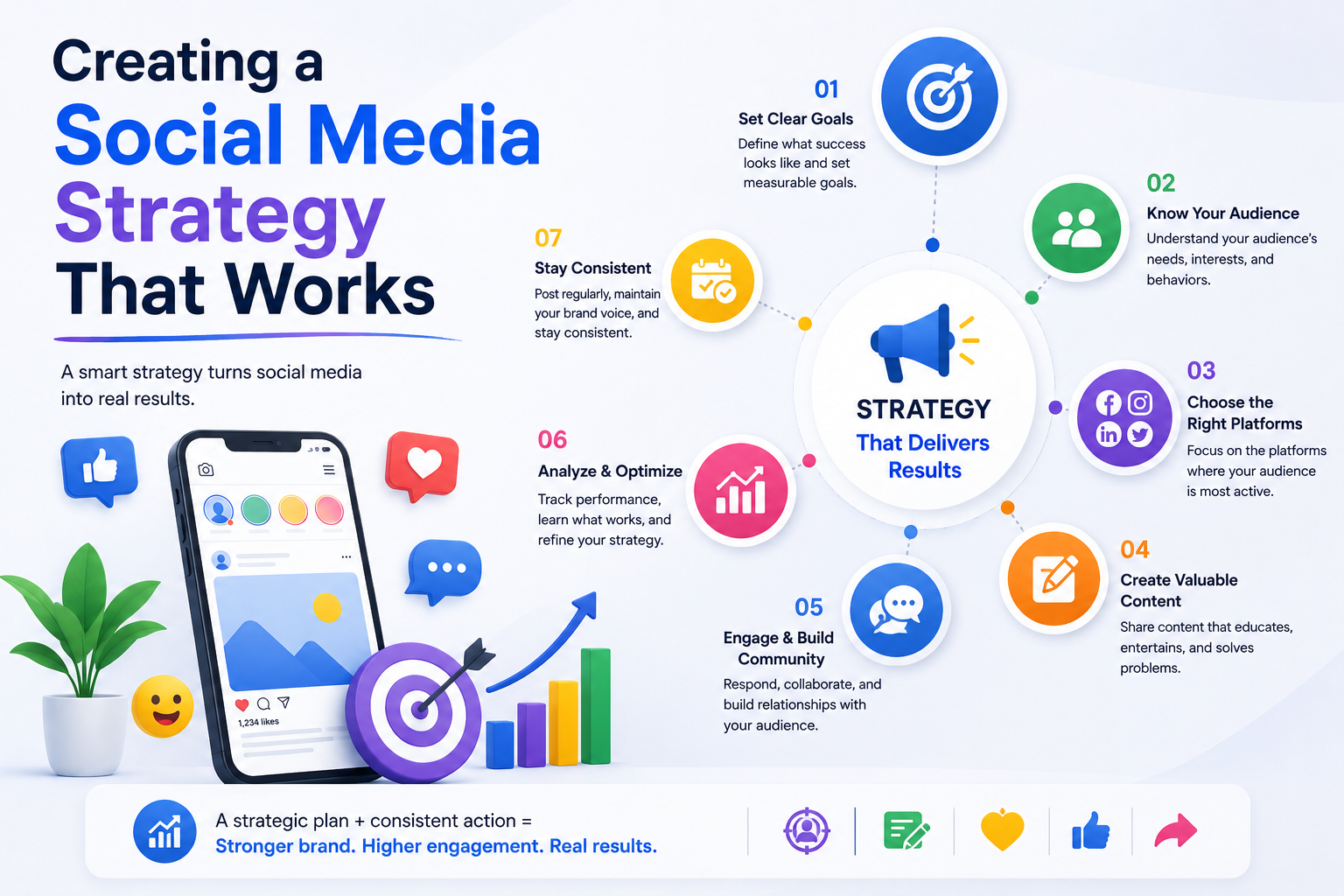
In today’s digital-first world, social media is no longer just a marketing channel—it is a business growth engine. Whether you’re a startup looking to build brand awareness, an SME trying to generate leads, or an enterprise focused on customer engagement, social media has become an essential part of the modern business landscape.
Yet despite investing significant time and resources into platforms like LinkedIn, Instagram, Facebook, X, and YouTube, many organizations struggle to achieve meaningful results. They post regularly, follow trends, and even run paid campaigns, but fail to generate consistent engagement, quality leads, or measurable business outcomes.
The problem is rarely the platform itself. More often, it is the absence of a well-defined social media strategy.
A successful social media strategy goes beyond posting content. It aligns social media activities with business objectives, customer behavior, brand positioning, and measurable performance indicators. It transforms social media from a daily task into a predictable growth channel.
This guide explores how businesses can create a social media strategy that delivers real results and supports long-term growth.
Why a Social Media Strategy Matters More Than Ever
Social media usage continues to rise globally, with billions of active users spending hours every day across multiple platforms. For businesses, this presents a tremendous opportunity to connect with customers where they already spend their time.
However, increased opportunities have also created increased competition. Every industry now competes for attention in crowded newsfeeds filled with brands, influencers, creators, and advertisements.
Without a clear strategy, businesses often experience common challenges:
-
Inconsistent content performance
-
Low engagement rates
-
Poor lead generation
-
Weak brand recognition
-
Difficulty measuring ROI
A strategic approach helps organizations focus their efforts, allocate budgets effectively, and achieve measurable outcomes rather than simply chasing likes and followers.
Start With Clear Business Goals
Every successful social media strategy begins with a simple question:
What are you trying to achieve?
Many companies make the mistake of focusing on vanity metrics such as followers or impressions without connecting them to broader business objectives.
Instead, social media goals should support organizational priorities.
For example, a startup entering a competitive market may prioritize brand awareness. An established SaaS company might focus on lead generation. An enterprise organization may use social media to strengthen customer relationships and improve retention.
Common business goals include:
-
Increasing brand awareness
-
Generating qualified leads
-
Driving website traffic
-
Improving customer engagement
-
Supporting recruitment efforts
-
Building customer loyalty
When goals are clearly defined, every content piece, campaign, and performance metric becomes easier to evaluate.
Understand Your Audience Before Creating Content
One of the biggest reasons social media strategies fail is that businesses focus too much on what they want to say rather than what their audience wants to hear.
Successful brands invest time in understanding their customers’ challenges, motivations, interests, and online behavior.
A B2B technology company targeting CTOs and enterprise leaders will require a very different content strategy compared to a retail fashion brand targeting younger consumers.
The more accurately you understand your audience, the more relevant and impactful your content becomes.
Choose the Right Platforms Instead of Being Everywhere
One of the most common misconceptions in social media marketing is that brands need to maintain a presence on every platform.
In reality, spreading resources across too many channels often reduces effectiveness.
A focused strategy usually produces better results than attempting to manage multiple platforms without sufficient resources.
LinkedIn for Professional Networking and B2B Growth
LinkedIn continues to be one of the most effective platforms for B2B organizations, technology companies, consulting firms, and professional service providers.
Decision-makers, executives, investors, and industry professionals actively engage with thought leadership content, making LinkedIn ideal for building authority and generating business opportunities.
Instagram for Visual Brand Building
Instagram remains highly effective for brands that rely on visual storytelling. Industries such as hospitality, fashion, fitness, lifestyle, and consumer products often achieve strong engagement through high-quality visual content.
Facebook for Community Engagement
Despite the growth of newer platforms, Facebook remains valuable for community building, local business marketing, and targeted advertising campaigns.
YouTube for Long-Term Visibility
Video continues to dominate digital consumption trends. YouTube allows businesses to create educational, informative, and evergreen content that continues generating traffic and leads for years.
The goal is not to be present everywhere. The goal is to be effective where your audience spends their time.
Build a Content Strategy That Provides Value
Content is the foundation of every successful social media strategy.
Unfortunately, many businesses treat social media as a promotional channel and continuously push products, services, and sales messages.
Modern audiences expect more.
People follow brands because they provide value, entertainment, education, inspiration, or useful insights.
A balanced content strategy typically includes several content categories:
-
Educational content
-
Industry insights
-
Customer success stories
-
Behind-the-scenes content
-
Promotional campaigns
For example, a cybersecurity company might publish threat awareness tips, industry trend analyses, client success stories, company culture updates, and product announcements.
This variety keeps audiences engaged while strengthening brand credibility.
Create a Consistent Brand Voice
Consistency plays a critical role in building trust.
When audiences interact with your brand across multiple channels, they should experience the same personality, messaging style, and tone.
Whether your brand voice is professional, innovative, approachable, or authoritative, consistency helps strengthen recognition and reinforces your market position.
Consider some of the world’s most successful brands. Their messaging remains recognizable regardless of platform, audience segment, or campaign objective.
Consistency builds familiarity, and familiarity builds trust.
Use Video as a Core Part of Your Strategy
The dominance of video content continues to reshape social media marketing.
Short-form videos, educational tutorials, product demonstrations, expert interviews, and customer testimonials consistently outperform many traditional content formats.
Businesses that integrate video into their strategy often benefit from:
-
Higher engagement rates
-
Increased audience retention
-
Better brand recall
-
Greater organic reach
A software company, for example, might create quick product walkthroughs, feature updates, and customer success videos. These assets can simplify complex topics while improving audience understanding.
The key is not necessarily high-budget production. Authenticity and relevance often outperform expensive production quality.
Develop a Publishing Schedule
Consistency is one of the strongest predictors of social media success.
Many organizations post heavily for a few weeks and then disappear for extended periods. This inconsistency makes it difficult to build audience momentum.
A content calendar helps maintain regular publishing schedules while aligning content with business objectives, industry events, product launches, and seasonal opportunities.
Planning content in advance also improves quality control and reduces last-minute pressure on marketing teams.
The goal is sustainable consistency rather than overwhelming volume.
Leverage Employee Advocacy
One of the most underutilized opportunities in social media marketing is employee advocacy.
Employees often have significantly higher trust levels among their professional networks than corporate accounts.
When team members share company insights, industry expertise, achievements, and thought leadership content, brands can dramatically expand their reach and credibility.
Technology companies, consulting firms, and professional service organizations frequently generate substantial engagement through employee-driven content initiatives.
This approach humanizes the brand while strengthening professional relationships.
Combine Organic and Paid Social Media Efforts
Organic reach remains important, but relying exclusively on organic visibility can limit growth.
Paid social media advertising provides opportunities to reach highly targeted audiences and accelerate results.
The most effective strategies typically combine both approaches.
Organic content builds credibility, trust, and community engagement over time.
Paid campaigns amplify reach, support lead generation, promote key initiatives, and accelerate audience growth.
For example, a business might use organic content to establish thought leadership while using targeted advertising to promote webinars, product launches, or lead-generation campaigns.
Together, these efforts create a stronger overall marketing ecosystem.
Measure the Metrics That Actually Matter
Many businesses focus on metrics that look impressive but provide little business value.
Follower counts and post impressions may indicate visibility, but they do not necessarily reflect meaningful business outcomes.
Instead, organizations should track metrics aligned with their goals.
Important performance indicators may include:
-
Website traffic from social media
-
Lead generation volume
-
Conversion rates
-
Engagement rates
-
Customer acquisition cost
-
Return on advertising spend
Regular performance analysis helps businesses identify successful content formats, optimize campaigns, and improve resource allocation.
Data-driven decision-making is what separates successful social media programs from ineffective ones.
Learn From Real-World Business Success Stories
Many successful companies have demonstrated the power of strategic social media execution.
Software companies frequently use LinkedIn to establish executive thought leadership and generate enterprise leads.
Direct-to-consumer brands leverage Instagram and short-form video content to drive product discovery and engagement.
Global enterprises use social media not only for marketing but also for customer service, recruitment, employer branding, and stakeholder communication.
The common thread is strategic alignment.
These organizations do not post randomly. Every activity supports a clearly defined business objective.
That principle applies equally to startups, SMEs, and large enterprises.
Common Mistakes That Undermine Social Media Success
Even well-funded businesses can struggle if they make strategic mistakes.
Some of the most common issues include inconsistent posting, unclear objectives, excessive self-promotion, ignoring audience feedback, and failing to analyze performance data.
Another frequent mistake is copying competitors without understanding whether those tactics align with specific business goals.
Effective social media strategies are customized to the organization’s audience, industry, resources, and objectives.
There is no universal formula.
The best strategy is the one that supports your unique business goals.
The Future of Social Media Strategy
Social media continues to evolve rapidly.
Artificial intelligence, personalization, social commerce, creator partnerships, and advanced audience targeting are transforming how brands connect with customers.
Businesses that embrace data-driven decision-making, authentic engagement, and customer-centric content will be better positioned to succeed in this changing environment.
The future belongs to organizations that treat social media as a strategic business function rather than simply a marketing activity.
Those that adapt quickly will gain significant competitive advantages.
Conclusion
Creating a social media strategy that works requires far more than posting content on a regular schedule. It demands a clear understanding of business objectives, audience behavior, platform selection, content planning, performance measurement, and continuous optimization.
Organizations that approach social media strategically are more likely to build stronger brands, generate qualified leads, foster customer loyalty, and achieve sustainable growth.
Whether you’re a startup seeking market visibility, an SME pursuing expansion, or an enterprise driving digital transformation, a well-executed social media strategy can become one of your most valuable business assets.
Success is not about being the loudest voice online. It is about delivering the right message to the right audience at the right time and consistently creating value.
Frequently Asked Questions (FAQs)
What is a social media strategy?
A social media strategy is a structured plan that outlines how a business will use social media platforms to achieve specific goals such as brand awareness, lead generation, customer engagement, and sales growth.
How often should businesses post on social media?
The ideal posting frequency depends on the platform, audience, and available resources. Consistency is generally more important than posting volume.
Which social media platform is best for B2B companies?
LinkedIn is often considered the most effective platform for B2B marketing because it provides direct access to decision-makers, executives, and professional audiences.
How can businesses measure social media ROI?
Businesses can measure ROI through metrics such as lead generation, conversion rates, website traffic, customer acquisition costs, and revenue generated from social media campaigns.
Should companies invest in paid social media advertising?
Yes. Paid advertising can significantly enhance audience reach, lead generation, and campaign performance when combined with a strong organic content strategy.
Ready to Build a High-Performing Social Media Strategy?
A successful social media presence requires more than creativity—it requires strategic planning, data-driven execution, and continuous optimization. Partnering with the right digital marketing and technology experts can help your business create impactful campaigns, maximize ROI, and stay ahead of changing market trends.
Whether you’re launching a new brand, scaling your operations, or accelerating your digital transformation journey, now is the time to invest in a social media strategy designed for measurable business growth. Choose a trusted technology and digital marketing partner that understands your goals and can turn social engagement into real business results.