


Content marketing has become one of the most powerful tools for businesses looking to attract customers, build authority, and generate long-term growth. Yet many companies struggle with consistency. One week they publish multiple blog posts and social media updates, and the next week their marketing channels go silent.
This inconsistency often leads to missed opportunities, reduced audience engagement, and weaker brand visibility. The solution is simple but highly effective: a well-structured content calendar.
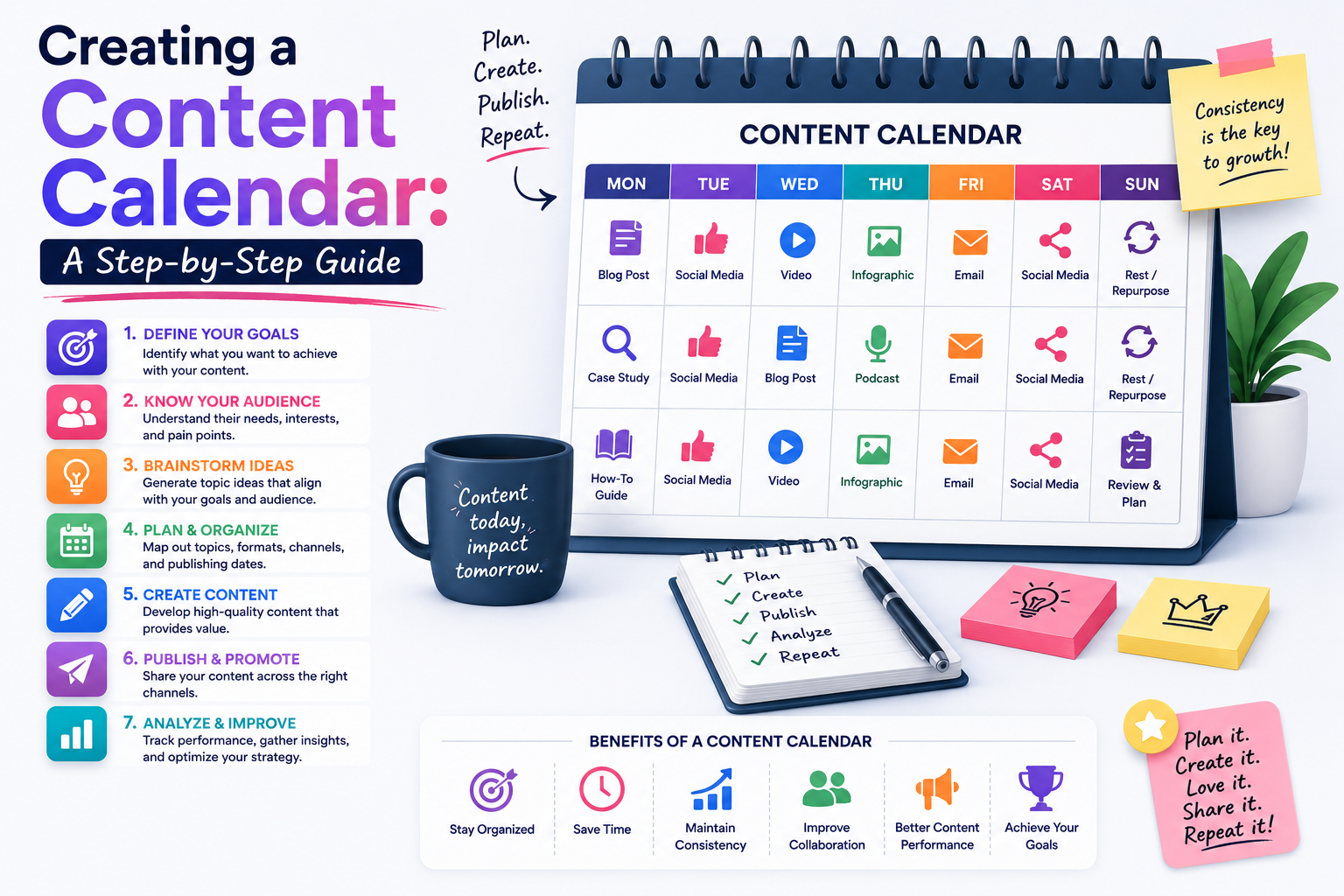
A content calendar is more than just a schedule. It acts as a strategic roadmap that aligns marketing efforts with business objectives, audience interests, industry trends, and sales goals. Whether you’re a startup trying to build brand awareness, an SME aiming to generate leads, or an enterprise managing multiple campaigns, a content calendar can transform the way your marketing team operates.
According to industry research, businesses that consistently publish relevant content generate significantly more traffic and leads than those that publish irregularly. Consistency helps improve search engine rankings, builds audience trust, and creates a predictable workflow for marketing teams.
In this guide, you’ll learn exactly how to create a content calendar step by step, ensuring your content strategy remains organized, scalable, and results-driven.
Why a Content Calendar Matters
Many organizations invest heavily in content creation but overlook planning. Without a structured approach, teams often face challenges such as duplicate content, missed deadlines, inconsistent messaging, and poor campaign performance.
A content calendar solves these problems by providing visibility into upcoming content initiatives. It allows teams to coordinate blog articles, social media posts, email campaigns, videos, webinars, and promotional activities from a single planning framework.
More importantly, it helps businesses connect content efforts directly to marketing and revenue goals. Instead of creating content randomly, every piece serves a clear purpose within the broader strategy.
For growing businesses, this level of organization becomes increasingly important as marketing channels expand and customer expectations evolve.
Step 1: Define Your Content Goals
Before creating a calendar, determine what you want your content to achieve.
Different business objectives require different content strategies. A startup focused on brand awareness will create content differently than an enterprise focused on customer retention.
Consider questions such as:
-
Are you trying to increase website traffic?
-
Do you want to generate more qualified leads?
-
Is customer education your primary objective?
-
Are you focused on improving customer retention and loyalty?
When goals are clearly defined, it becomes easier to decide which content topics, formats, and publishing schedules will deliver the best results.
For example, a SaaS company seeking lead generation may prioritize educational blog posts, case studies, and downloadable resources. Meanwhile, an eCommerce brand may focus on product-focused content, user-generated content, and seasonal campaigns.
Clear objectives create the foundation for an effective content calendar.
Step 2: Understand Your Target Audience
A content calendar should be built around audience needs rather than internal assumptions.
The most successful brands invest time in understanding customer behavior, challenges, interests, and purchasing motivations. This understanding allows marketers to create content that genuinely resonates with their audience.
Start by analyzing existing customer data, website analytics, social media engagement, and sales feedback. Look for recurring questions, common pain points, and frequently discussed topics.
For instance, if your audience consists of CTOs evaluating digital transformation solutions, your content should focus on technology trends, implementation strategies, cybersecurity considerations, and ROI discussions.
Audience research ensures every content piece addresses a real need, increasing engagement and conversion potential.
Step 3: Perform a Content Audit
Before planning future content, evaluate what already exists.
Many organizations discover valuable content assets hidden within their websites, email campaigns, presentations, webinars, and social media channels. Reviewing existing content helps identify opportunities for updates, repurposing, and optimization.
A content audit typically reveals:
-
High-performing content worth updating
-
Underperforming content needing improvement
-
Content gaps that require new topics
-
Opportunities to target additional keywords
For example, a company may find that a blog article published two years ago still attracts substantial traffic. Instead of creating a completely new article, updating that content can deliver faster SEO gains while requiring fewer resources.
This process ensures your content calendar builds upon proven successes rather than starting from scratch.
Step 4: Identify Core Content Themes
Once goals and audience insights are established, define your primary content pillars.
Content pillars are broad topics that align with your expertise and audience interests. They provide structure for ongoing content creation and help maintain consistency across channels.
For example, a digital transformation consultancy may organize content around themes such as cloud computing, cybersecurity, automation, enterprise software, and innovation strategy.
By focusing on a limited number of strategic themes, businesses can develop authority in specific areas while avoiding fragmented messaging.
This approach also supports SEO by allowing multiple content pieces to reinforce topical relevance around important keywords.
Step 5: Research Keywords and Search Intent
SEO should play a central role in content calendar planning.
Modern search engine optimization is no longer about stuffing keywords into articles. Instead, it focuses on understanding user intent and delivering valuable content that answers specific questions.
Keyword research helps identify what potential customers are actively searching for online. These insights can guide topic selection and publishing priorities.
Look for a mix of:
-
Informational keywords
-
Commercial-intent keywords
-
Industry-specific keywords
-
Long-tail search phrases
For example, instead of targeting only “content marketing,” a business may create content around related searches such as “how to create a content calendar,” “content planning strategy,” or “content marketing workflow.”
This broader approach increases opportunities to attract qualified organic traffic.
Step 6: Choose Your Content Types
A successful content calendar includes a variety of formats designed to engage audiences at different stages of the buyer journey.
While blog articles remain a foundational content asset, businesses increasingly benefit from incorporating additional formats that match changing consumer preferences.
Educational articles can build awareness, while case studies demonstrate expertise. Videos simplify complex topics, webinars provide deeper engagement, and email newsletters nurture customer relationships.
The key is selecting formats that align with both audience behavior and available resources.
Rather than trying to produce every content type, focus on creating high-quality content consistently across a manageable number of channels.
Step 7: Establish a Realistic Publishing Schedule
One of the biggest mistakes businesses make is creating an overly ambitious publishing plan.
Consistency always outperforms intensity.
Publishing three high-quality articles per month consistently is often more effective than publishing ten articles one month and none the next.
Consider your team’s capacity, budget, approval processes, and content production timelines. Build a schedule that can be maintained over the long term.
A practical publishing frequency might include weekly blog content, regular social media updates, monthly newsletters, and quarterly webinars.
The goal is creating a sustainable system rather than chasing unrealistic publishing targets.
Step 8: Map Content to Important Business Dates
An effective content calendar aligns with business milestones, industry events, seasonal opportunities, and marketing campaigns.
Planning ahead allows teams to prepare content before critical dates rather than scrambling at the last minute.
Relevant events may include product launches, conferences, holiday seasons, annual sales campaigns, industry awareness days, and company announcements.
For example, a cybersecurity company should begin planning Cybersecurity Awareness Month content several weeks before October. Early preparation ensures stronger execution and better audience engagement.
Strategic timing often determines whether content performs exceptionally well or gets overlooked.
Step 9: Assign Ownership and Workflow Responsibilities
Even the best content calendar can fail if responsibilities are unclear.
Every content piece should have designated owners responsible for planning, creation, editing, approval, publishing, and promotion.
Clear accountability reduces confusion and prevents delays.
Larger organizations often involve multiple stakeholders, including marketing managers, content writers, designers, SEO specialists, legal reviewers, and department leaders. A documented workflow helps ensure everyone understands their role in the process.
This structured approach becomes especially valuable as content operations scale.
Step 10: Track Performance and Optimize Continuously
Creating a content calendar is not a one-time exercise.
The most successful businesses continuously evaluate performance and refine their strategy based on data.
Monitor key metrics such as website traffic, search rankings, engagement rates, lead generation, conversion rates, and content shares.
When analyzing results, look beyond vanity metrics. A blog post generating fewer views may still be highly valuable if it produces qualified leads or influences purchasing decisions.
Regular performance reviews help identify successful content patterns and reveal opportunities for improvement.
Over time, this data-driven approach makes your content calendar increasingly effective.
A Real-World Example of Content Calendar Success
Consider a B2B software company struggling to generate consistent inbound leads.
Initially, the company published content sporadically with no clear strategy. Blog posts covered random topics, social media activity was inconsistent, and campaign planning happened at the last minute.
After implementing a structured content calendar, the company aligned content around customer pain points, established monthly themes, integrated keyword research, and coordinated content across channels.
Within several months, the business experienced increased organic traffic, stronger audience engagement, and improved lead generation. More importantly, marketing efforts became predictable and scalable.
This example illustrates how planning often matters just as much as content creation itself.
Common Mistakes to Avoid
While building a content calendar, many organizations encounter similar challenges.
One common mistake is focusing solely on content quantity rather than quality. Publishing more content does not automatically produce better results.
Another issue is ignoring analytics. Without performance data, businesses miss valuable optimization opportunities.
Many teams also fail to leave room for flexibility. Industry developments, breaking news, and market changes may require adjustments to planned content.
Finally, some organizations create content calendars that are overly complicated. Simplicity often improves adoption and execution.
The best content calendars balance structure with adaptability.
The Future of Content Calendar Planning
Content marketing continues to evolve rapidly. Artificial intelligence, predictive analytics, personalization technologies, and automation platforms are changing how businesses plan and distribute content.
Today’s leading organizations are increasingly using data-driven insights to forecast audience interests and optimize publishing schedules.
At the same time, search engines continue prioritizing helpful, authoritative, and user-focused content. This means strategic planning will become even more important in the years ahead.
Businesses that invest in structured content operations today will be better positioned to compete in an increasingly crowded digital landscape.
Conclusion
A content calendar is one of the most valuable tools in modern marketing. It brings structure to content creation, improves consistency, strengthens SEO performance, and helps businesses align marketing activities with strategic goals.
Rather than reacting to content needs as they arise, organizations can proactively plan campaigns, allocate resources efficiently, and create meaningful customer experiences.
Whether you’re a startup building visibility, an SME seeking growth, or an enterprise managing complex marketing initiatives, a well-designed content calendar provides the framework needed for long-term success.
The key is starting with clear goals, understanding your audience, planning strategically, and continuously optimizing based on performance data.
When executed effectively, a content calendar becomes more than a scheduling tool—it becomes a competitive advantage.
Frequently Asked Questions
What is a content calendar?
A content calendar is a planning tool that organizes upcoming content activities, including blogs, social media posts, videos, email campaigns, and marketing initiatives. It helps businesses maintain consistency and align content with strategic objectives.
How far in advance should content be planned?
Most businesses benefit from planning content at least one to three months ahead. Larger organizations often plan quarterly or annual content strategies while maintaining flexibility for emerging opportunities.
What tools can be used to create a content calendar?
Businesses commonly use spreadsheets, project management platforms, content marketing software, and collaboration tools to manage content calendars. The best solution depends on team size and workflow complexity.
How often should a content calendar be updated?
A content calendar should be reviewed regularly, typically on a weekly or monthly basis. Performance insights, market changes, and business priorities may require adjustments throughout the year.
Does a content calendar improve SEO?
Yes. A content calendar supports SEO by ensuring consistent publishing, strategic keyword targeting, topic clustering, and alignment with audience search intent. These factors contribute to stronger search visibility over time.
Ready to Build a Smarter Content Strategy?
Creating a content calendar is only the first step. The real impact comes from combining strategic planning, SEO expertise, content creation, marketing automation, and technology-driven execution.
If your organization wants to accelerate growth, improve digital visibility, and create a scalable content marketing engine, partnering with the right technology and digital transformation expert can make all the difference.
Choose a technology partner that understands your business goals, leverages modern marketing strategies, and helps transform content into measurable business results. The right partnership can turn a simple content calendar into a powerful driver of long-term growth, customer engagement, and competitive advantage.