


Email marketing remains one of the most effective digital marketing channels available today. Despite the growth of social media, messaging apps, and emerging communication platforms, email continues to deliver one of the highest returns on investment for businesses worldwide.
However, there is one major challenge that marketers, startups, and enterprises face: getting emails into the inbox.
You can spend hours crafting the perfect campaign, designing attractive templates, and creating compelling offers, but if your emails land in the spam folder, your efforts may never reach your audience.
Modern email providers such as Gmail, Outlook, and Yahoo use sophisticated filtering systems to protect users from unwanted messages. While these filters help improve user experience, they also create obstacles for legitimate businesses that are not following email marketing best practices.
Understanding how spam filters work and how to avoid triggering them is essential for any organization that wants to maximize email performance, improve customer engagement, and protect its sender reputation.
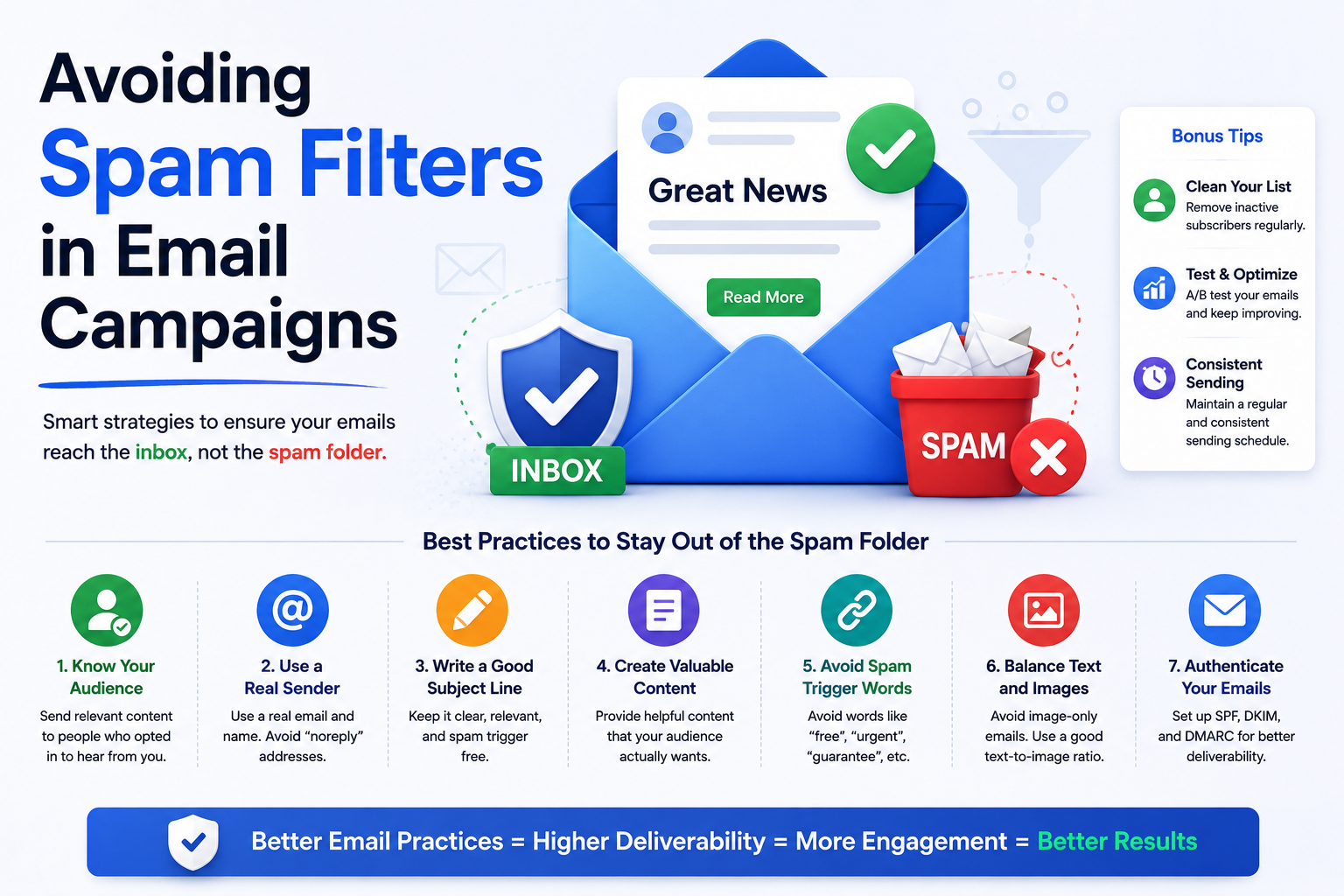
In this guide, we’ll explore practical strategies that help businesses improve email deliverability and ensure campaigns consistently reach subscriber inboxes.
Why Spam Filters Matter More Than Ever
Email spam has become a massive global issue. Billions of spam emails are sent every day, forcing email providers to continually improve their filtering algorithms.
As a result, inbox providers evaluate much more than email content. They assess sender reputation, engagement rates, authentication records, sending behavior, subscriber interactions, and numerous technical signals before deciding whether an email belongs in the inbox.
For businesses, this means that avoiding spam filters is no longer just a technical concern. It is a critical component of marketing success.
A poor deliverability rate can lead to:
-
Lower open rates and click-through rates
-
Reduced campaign ROI
-
Damaged brand reputation
-
Lost sales and customer opportunities
On the other hand, organizations that maintain strong email deliverability often see higher engagement, stronger customer relationships, and more consistent revenue growth from email marketing.
Understanding How Spam Filters Work
Before learning how to avoid spam filters, it is important to understand what they actually analyze.
Most modern spam filters use a combination of artificial intelligence, machine learning, and behavioral analysis. Instead of relying on a single trigger word or rule, they examine multiple factors simultaneously.
The filtering process typically evaluates sender identity, domain reputation, email structure, subscriber engagement, authentication records, and message content.
For example, if a company suddenly sends thousands of emails from a new domain without proper authentication, the system may view that activity as suspicious. Similarly, if recipients consistently ignore, delete, or mark emails as spam, future campaigns may face inbox placement issues.
The goal is not simply to avoid spam keywords. The real objective is building trust with both email providers and subscribers.
Build a High-Quality Email List
One of the biggest causes of spam issues is poor list quality.
Many businesses make the mistake of purchasing email databases or collecting contacts without proper consent. While this may appear to accelerate audience growth, it often leads to low engagement and high complaint rates.
Email providers pay close attention to recipient behavior. If people did not voluntarily subscribe, they are less likely to open messages and more likely to report them as spam.
Instead of focusing solely on list size, successful companies prioritize list quality.
A healthy email list consists of people who genuinely want to hear from your business. These subscribers engage with content, click links, and contribute positively to your sender reputation.
Companies that use double opt-in subscription processes often achieve better deliverability because subscribers actively confirm their interest before receiving communications.
Authenticate Your Email Domain
Email authentication has become one of the most important factors in deliverability.
Authentication protocols verify that your emails are genuinely coming from your organization and not from someone attempting to impersonate your brand.
The three most important authentication standards include:
-
SPF (Sender Policy Framework)
-
DKIM (DomainKeys Identified Mail)
-
DMARC (Domain-based Message Authentication, Reporting, and Conformance)
These protocols work together to establish trust between your sending domain and inbox providers.
Without proper authentication, even legitimate marketing campaigns can struggle to reach inboxes. For startups and growing businesses, setting up authentication should be considered a foundational step before launching large-scale email campaigns.
Maintain a Strong Sender Reputation
Your sender reputation functions much like a credit score for email marketing.
Internet Service Providers continuously evaluate sender behavior and assign reputation scores based on various performance indicators.
A strong sender reputation increases inbox placement rates, while a poor reputation can cause emails to be filtered or blocked entirely.
Several factors influence reputation, including bounce rates, spam complaints, engagement levels, unsubscribe rates, and sending consistency.
Businesses often damage their reputation by suddenly increasing email volume. For example, a startup that usually sends 500 emails per week but abruptly sends 50,000 emails in one day may trigger suspicion from mailbox providers.
Gradual growth and consistent sending patterns are far more effective for long-term deliverability.
Avoid Overly Promotional Language
Years ago, spam filters heavily relied on specific words and phrases. While today’s systems are much more advanced, excessively promotional language can still contribute to spam scores.
Emails packed with aggressive sales messaging often appear less trustworthy to both subscribers and filtering algorithms.
Instead of focusing on exaggerated claims, businesses should prioritize value-driven communication.
Consider the difference between these approaches:
“BUY NOW! LIMITED TIME OFFER! ACT FAST!”
versus
“Discover how our solution can help improve operational efficiency.”
The second example sounds professional, informative, and customer-focused.
Modern email marketing succeeds when it educates, informs, and solves problems rather than constantly pushing sales messages.
Create Valuable and Relevant Content
Content relevance plays a significant role in deliverability.
When subscribers consistently engage with your emails, providers interpret those interactions as positive signals. This increases the likelihood that future messages will reach the inbox.
Businesses that segment audiences and personalize communications typically outperform those that send identical messages to every contact.
For example, an e-commerce company may send product recommendations based on previous purchases. A software company might deliver educational content tailored to a customer’s stage in the buying journey.
Relevant content improves engagement, which ultimately strengthens sender reputation.
The most successful email campaigns focus on helping customers achieve goals, solve challenges, or gain useful insights.
Optimize Email Design and Structure
Poorly designed emails can trigger spam concerns.
Many organizations unknowingly create messages that appear suspicious because they contain excessive images, broken formatting, or confusing layouts.
A professional email should maintain a balance between text and visual elements.
Some best practices include:
-
Using mobile-friendly responsive designs
-
Including sufficient text alongside images
-
Adding clear calls to action
-
Avoiding large image-only emails
-
Ensuring all links function correctly
Clean formatting improves readability while reducing the risk of spam classification.
Additionally, since a significant percentage of emails are opened on mobile devices, responsive design is now a necessity rather than a luxury.
Monitor Engagement Metrics Closely
Email marketing success extends beyond delivery rates.
Engagement metrics provide valuable insights into how recipients interact with campaigns and help identify potential deliverability issues before they become serious problems.
Key metrics worth monitoring include open rates, click-through rates, bounce rates, unsubscribe rates, and spam complaints.
A sudden decline in engagement often indicates that subscribers are losing interest or that emails are no longer reaching inboxes effectively.
Businesses that regularly analyze performance data can make proactive improvements and maintain healthy deliverability over time.
Keep Your Email List Clean
Even high-quality email lists degrade over time.
People change jobs, abandon email accounts, or lose interest in receiving communications. Continuing to send messages to inactive subscribers can negatively impact sender reputation.
Regular list hygiene helps maintain strong engagement levels and improves overall campaign performance.
A healthy list maintenance process should include:
-
Removing invalid email addresses
-
Identifying inactive subscribers
-
Re-engaging dormant contacts
-
Eliminating hard bounces
Although removing subscribers may seem counterproductive, a smaller engaged audience is significantly more valuable than a large inactive one.
Be Consistent With Sending Frequency
Consistency is one of the most overlooked aspects of email deliverability.
When businesses send emails unpredictably, recipients may forget they subscribed, leading to higher complaint rates.
For example, if a customer receives weekly newsletters for six months and then hears nothing for four months before suddenly receiving multiple promotional emails, they may perceive the communication as spam.
Establishing a predictable sending schedule helps build familiarity and trust.
Whether your organization sends weekly updates, monthly newsletters, or event-based communications, consistency creates a better experience for subscribers and email providers alike.
Use Personalization Responsibly
Personalization has become a cornerstone of successful email marketing.
Subscribers increasingly expect communications tailored to their interests, preferences, and behaviors.
However, effective personalization goes beyond simply inserting a first name into a subject line.
Businesses should focus on delivering relevant content based on customer needs and interactions.
For instance, a SaaS provider might send onboarding resources to new users while offering advanced tutorials to experienced customers. This type of contextual relevance improves engagement and reduces the likelihood of spam complaints.
When personalization enhances customer value, deliverability often improves as a natural result.
Learn From Real-World Business Success
Many leading companies have dramatically improved email performance by focusing on deliverability fundamentals rather than short-term marketing tactics.
A growing B2B software company, for example, may experience declining open rates despite increasing email volume. After auditing their email program, they often discover issues such as poor list hygiene, weak authentication, and excessive promotional content.
By implementing authentication protocols, cleaning subscriber databases, and improving content relevance, businesses frequently see significant improvements in inbox placement and engagement.
These examples demonstrate an important lesson: successful email marketing is built on trust, consistency, and subscriber value.
The Future of Email Deliverability
Email marketing continues to evolve as privacy regulations, artificial intelligence, and consumer expectations reshape digital communication.
Inbox providers are becoming increasingly sophisticated at identifying sender quality and user intent.
Businesses that prioritize ethical marketing practices, permission-based communications, and subscriber experience will continue to thrive.
Rather than searching for shortcuts to bypass spam filters, organizations should focus on building authentic relationships with their audiences.
This long-term approach creates sustainable success and protects brand reputation in an increasingly competitive digital environment.
Conclusion
Avoiding spam filters is not about tricking algorithms or finding loopholes. It is about earning trust.
When businesses build permission-based email lists, authenticate domains, maintain strong sender reputations, create valuable content, and monitor engagement carefully, they dramatically improve their chances of reaching the inbox.
Email marketing remains one of the most powerful channels for customer acquisition, retention, and revenue growth. However, success depends on more than writing compelling messages. Deliverability must be treated as a strategic priority.
Organizations that invest in email best practices today will benefit from stronger customer relationships, higher engagement rates, and better marketing results in the years ahead.
Frequently Asked Questions (FAQs)
What is the most common reason emails go to spam?
The most common causes include poor sender reputation, lack of authentication, purchased email lists, high spam complaint rates, and low subscriber engagement.
Does using certain words automatically trigger spam filters?
Not necessarily. Modern spam filters analyze multiple signals rather than relying solely on keywords. However, excessive promotional language can still contribute to spam classification.
How important is email authentication?
Email authentication is extremely important. Implementing SPF, DKIM, and DMARC helps verify sender identity and improves inbox placement rates.
Should businesses remove inactive subscribers?
Yes. Regularly removing or re-engaging inactive contacts improves list quality, strengthens sender reputation, and enhances deliverability.
How often should companies clean their email lists?
Most organizations should review and clean email lists every three to six months, depending on sending volume and subscriber activity.
Ready to Improve Your Email Marketing Results?
Email deliverability is too important to leave to chance. Whether you’re a startup building your first email program, an SME scaling customer engagement, or an enterprise optimizing global campaigns, partnering with the right technology and digital marketing experts can make a significant difference.
Choose a trusted technology partner that understands email infrastructure, marketing automation, customer engagement strategies, and deliverability best practices. With the right expertise, your business can achieve higher inbox placement, stronger customer relationships, and measurable growth from every email campaign.