


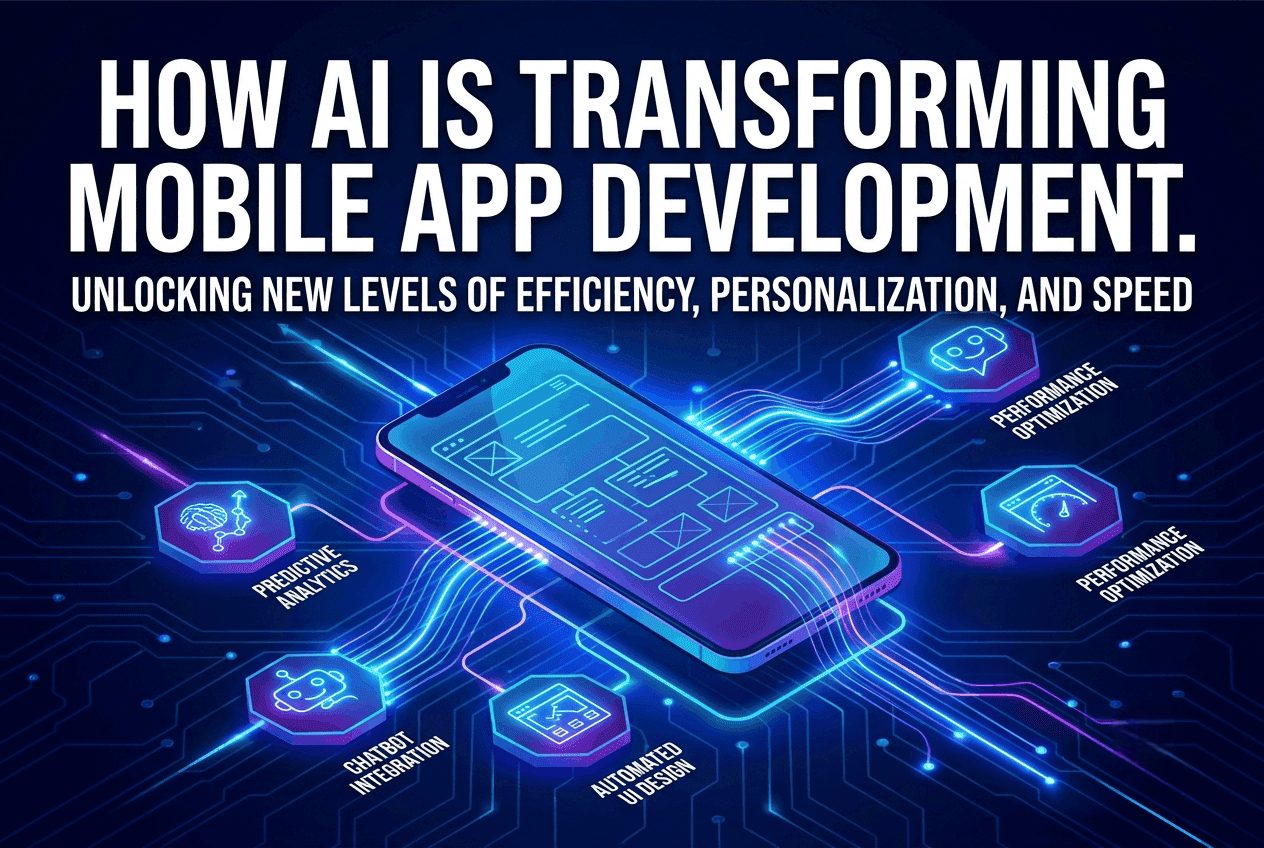
Mobile applications have become one of the most important ways for businesses to connect with customers. Whether people are shopping online, ordering food, managing finances, learning new skills, or booking travel, mobile apps have become a daily necessity. As customer expectations continue to grow, businesses are looking for smarter ways to build applications that are faster, more secure, and capable of delivering personalized experiences. This is where Artificial Intelligence (AI) is making a significant impact by changing the way mobile apps are designed, developed, tested, and maintained.
AI is no longer limited to futuristic concepts or large technology companies. Today, businesses of all sizes are integrating AI into their mobile applications to improve user engagement, automate repetitive tasks, and provide intelligent recommendations. Developers are also using AI-powered tools to write code faster, detect software bugs earlier, and optimize app performance. These improvements help companies reduce development costs while delivering better products to users.
As AI technologies continue to evolve, mobile app development is becoming more efficient and customer-focused than ever before. Organizations across industries are discovering new opportunities to create intelligent applications that understand user behavior, learn from data, and continuously improve over time. This blog explores how AI is transforming mobile app development, the benefits it offers, the challenges businesses should understand, and what the future holds for AI-powered mobile applications.
The Growing Role of AI in Modern Mobile App Development
Artificial Intelligence has become an essential part of modern software development because it allows applications to perform tasks that once required human intelligence. Instead of simply following fixed instructions, AI-powered applications can analyze data, recognize patterns, make predictions, and improve their performance based on user interactions. This makes mobile applications much smarter and more responsive to customer needs.
Developers now use AI throughout the entire mobile app development process rather than only adding AI features after development is complete. From planning and coding to testing, deployment, and maintenance, AI tools help improve productivity and reduce manual effort. This enables development teams to focus on creativity and innovation instead of spending valuable time on repetitive tasks.
Businesses are also using AI to understand customer preferences more accurately. Mobile applications collect valuable information about user behavior, including browsing habits, purchasing patterns, and engagement history. AI analyzes this information to help businesses make better decisions, improve customer experiences, and increase user satisfaction through personalized services.
As customer expectations continue to rise, companies that invest in AI-powered mobile applications gain a competitive advantage. Intelligent applications provide faster responses, more accurate recommendations, and smoother user experiences that encourage customers to remain engaged for longer periods.
How AI Makes Mobile Apps Smarter and More Personalized
One of the biggest advantages of AI is its ability to create highly personalized user experiences. Modern consumers expect mobile applications to understand their preferences and deliver relevant content without requiring constant manual input. AI makes this possible by continuously learning from user interactions.
Streaming platforms provide an excellent example of AI personalization. Instead of showing identical content to every user, AI recommends movies, music, or videos based on previous viewing history and individual preferences. Similar techniques are used by shopping applications to recommend products that customers are more likely to purchase.
Personalization also improves customer engagement by reducing the time users spend searching for information. AI automatically highlights products, services, or features that match each user’s interests. This creates a smoother experience while increasing customer satisfaction and conversion rates.
Businesses benefit from personalization because customers are more likely to remain loyal when applications feel relevant to their needs. AI-driven personalization increases engagement, improves customer retention, and helps businesses generate higher revenue through targeted recommendations.
AI-Powered Chatbots and Virtual Assistants
Customer support has changed dramatically with the introduction of AI-powered chatbots and virtual assistants. Instead of waiting for human representatives, users can receive immediate answers to common questions at any time of the day. This improves customer satisfaction while reducing operational costs.
Modern AI chatbots understand natural language rather than relying only on predefined responses. They can answer product questions, process orders, schedule appointments, provide technical assistance, and even guide customers through complicated processes. Their ability to learn from previous conversations makes them increasingly effective over time.
Virtual assistants integrated into mobile applications also improve user convenience. Customers can search for products using voice commands, receive reminders, complete transactions, or control smart devices directly from their smartphones. These features create a seamless and interactive user experience.
For businesses, AI-powered support systems reduce workload on customer service teams while ensuring faster response times. Human agents can then focus on complex customer issues that require personal attention, creating a more balanced and efficient support process.
Faster and More Efficient Mobile App Development
AI is transforming not only the final product but also the development process itself. Developers now use AI-assisted coding tools that suggest code, identify programming errors, recommend improvements, and automate repetitive coding tasks. This allows software teams to work faster while maintaining high quality.
AI also simplifies project management by predicting development timelines, identifying potential risks, and recommending better resource allocation. These insights help businesses complete projects more efficiently while reducing unexpected delays and budget overruns.
Automated documentation generated by AI further improves collaboration between developers, designers, testers, and project managers. Clear documentation makes future maintenance easier and reduces misunderstandings during development.
By reducing repetitive work, AI enables developers to spend more time designing innovative features that provide real value to users instead of focusing on routine technical tasks.
Intelligent Testing and Quality Assurance
Testing is one of the most time-consuming stages of mobile app development. AI has transformed this process by automating many testing activities while improving accuracy and speed. Instead of manually checking every feature, AI can quickly identify defects across different devices and operating systems.
AI-powered testing tools continuously analyze application behavior to detect crashes, performance issues, security weaknesses, and user interface inconsistencies. These tools learn from previous testing cycles and become more effective with every software update.
Predictive testing is another important advancement. AI identifies areas of the application that are most likely to experience problems based on historical data. Developers can then prioritize testing where it matters most, reducing development time while improving software quality.
Businesses benefit from faster releases because automated testing shortens development cycles without compromising reliability. Customers receive stable applications with fewer bugs, leading to higher ratings and stronger brand reputation.
Better User Experience Through AI
User experience plays a major role in the success of any mobile application. AI helps developers create interfaces that are easier to use, more intuitive, and better suited to individual customer preferences. Applications become smarter by learning how users interact with different features.
AI can analyze customer behavior to determine which screens receive the most attention, where users abandon tasks, and which navigation paths create confusion. These insights help designers improve layouts and simplify user journeys.
Voice recognition, image recognition, predictive search, and intelligent recommendations also contribute to better usability. Users can complete tasks more quickly because AI reduces unnecessary steps and provides relevant suggestions automatically.
A positive user experience encourages customers to spend more time using the application, leave positive reviews, and recommend the app to others. These improvements directly contribute to business growth and long-term customer loyalty.
Key Benefits of AI in Mobile App Development
Businesses adopting AI-powered mobile development enjoy several important advantages:
- Faster software development with AI-assisted coding.
- Personalized customer experiences that increase engagement.
- Smarter chatbots providing round-the-clock customer support.
- Automated testing that improves software quality.
- Better business insights through intelligent data analysis.
These benefits allow businesses to reduce operational costs while delivering more competitive digital products. AI helps companies respond quickly to changing customer expectations without sacrificing quality or innovation.
AI Improves Mobile App Security
Security has become one of the biggest concerns in mobile app development as cyber threats continue to increase. AI strengthens application security by continuously monitoring user behavior and identifying suspicious activities before they become serious problems.
Unlike traditional security systems that rely mainly on predefined rules, AI detects unusual login attempts, abnormal transaction patterns, and unexpected user behavior. It can immediately alert administrators or automatically block suspicious activities.
AI also supports biometric authentication methods such as facial recognition, fingerprint verification, and voice identification. These technologies provide stronger protection while offering a smoother login experience for legitimate users.
Businesses handling financial transactions, healthcare records, or personal customer information benefit greatly from AI-powered security because it helps reduce fraud, protect sensitive data, and build customer trust.
Predictive Analytics and Business Intelligence
AI allows mobile applications to do much more than simply collect information. It transforms raw data into valuable business insights through predictive analytics. This enables companies to make informed decisions based on customer behavior and market trends.
Retail applications can predict future purchasing patterns, helping businesses manage inventory more efficiently. Financial applications analyze spending habits to provide budgeting recommendations. Healthcare applications identify health trends and encourage preventive care.
Marketing teams also use predictive analytics to improve campaign performance. AI identifies customer segments most likely to respond to promotions, enabling businesses to create more effective marketing strategies.
By making data-driven decisions, organizations improve operational efficiency while offering products and services that better match customer expectations.
Industries Benefiting from AI-Powered Mobile Applications
Many industries are already experiencing significant improvements through AI-driven mobile applications.
Healthcare organizations use AI to support appointment scheduling, symptom analysis, patient monitoring, and medical record management. Doctors receive valuable insights while patients enjoy more convenient healthcare services.
Retail businesses leverage AI for personalized shopping experiences, inventory management, product recommendations, and customer support. These features increase sales while improving customer satisfaction.
Banking and finance companies use AI to detect fraud, automate customer support, provide financial advice, and improve transaction security. Mobile banking has become safer and more convenient because of intelligent automation.
Education platforms integrate AI to recommend personalized learning paths, assess student progress, and deliver customized educational content that supports different learning styles.
Common Mistakes Businesses Should Avoid
Although AI offers tremendous opportunities, businesses should avoid several common mistakes when implementing AI in mobile applications.
- Adding AI features without solving a real customer problem.
- Collecting excessive user data without clear privacy policies.
- Ignoring regular AI model updates and maintenance.
- Expecting AI to replace human decision-making completely.
- Choosing AI tools without considering long-term business goals.
Successful AI implementation begins with understanding customer needs and selecting technologies that genuinely improve user experiences rather than adding unnecessary complexity.
The Future of AI in Mobile App Development
Artificial Intelligence will continue reshaping mobile app development over the coming years. Future applications will become even more intelligent, offering highly personalized experiences based on real-time behavior and contextual information. Mobile apps will increasingly predict customer needs before users even make requests.
Generative AI is expected to assist developers with complete application design, interface generation, automated documentation, and advanced coding support. This will significantly reduce development time while making high-quality application development accessible to more businesses.
AI-powered augmented reality, wearable technology integration, autonomous assistants, and edge computing will further expand the capabilities of mobile applications. Businesses will discover entirely new ways to interact with customers through immersive and intelligent digital experiences.
Organizations that begin investing in AI today will be better positioned to adapt to future technological changes. By combining human creativity with AI-driven automation, companies can build innovative mobile applications that deliver long-term value for both businesses and customers.
Conclusion
Artificial Intelligence is transforming every stage of mobile app development, from planning and coding to testing, deployment, security, and customer engagement. It enables businesses to develop smarter applications faster while delivering personalized experiences that meet modern customer expectations. AI is no longer an optional feature but an important competitive advantage for organizations that want to succeed in the digital marketplace.
As AI technologies continue to advance, mobile applications will become increasingly intelligent, efficient, and customer-focused. Businesses that embrace AI responsibly and strategically will improve operational efficiency, strengthen customer relationships, and create innovative digital products that remain relevant in an increasingly competitive world. Investing in AI-powered mobile app development today is an investment in future business growth and long-term success.