


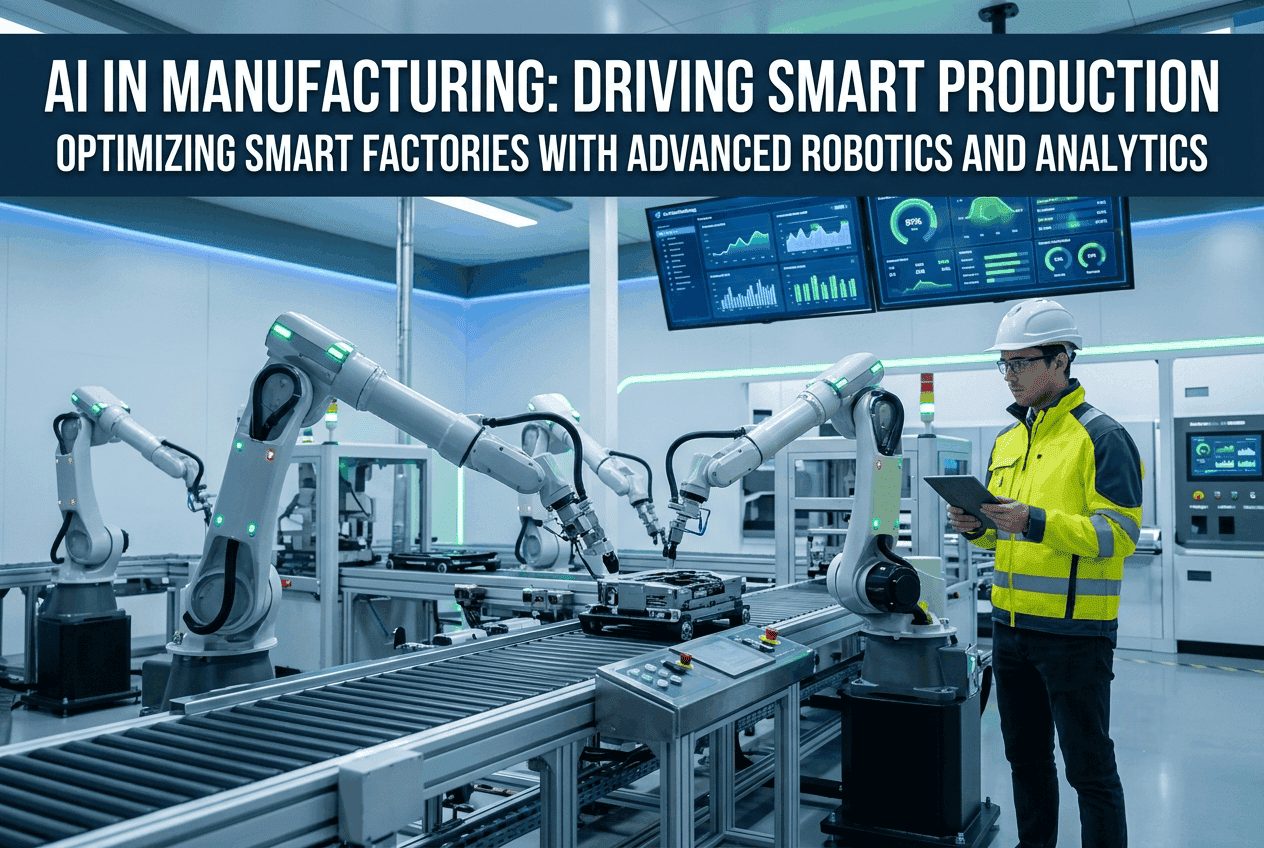
Manufacturing has always been one of the most important industries in the global economy. From producing everyday household products to building automobiles and industrial machinery, manufacturers continuously look for ways to improve quality, reduce costs, and deliver products faster. In recent years, Artificial Intelligence (AI) has emerged as one of the biggest technological innovations helping manufacturers achieve these goals. Businesses of all sizes are now exploring AI-powered solutions to modernize their operations and remain competitive in an increasingly demanding market.
Unlike traditional automation, AI goes beyond simply following pre-programmed instructions. It can learn from data, identify patterns, predict outcomes, and even make recommendations that improve production processes. This ability allows manufacturers to make smarter decisions while reducing manual effort and minimizing costly mistakes. AI also helps businesses respond more quickly to changing customer demands and market conditions.
Today, AI is becoming an essential part of smart manufacturing. From predictive maintenance and quality inspection to inventory management and production planning, AI is changing how factories operate every day. Companies that invest in AI technologies are discovering new opportunities to improve efficiency, increase productivity, and create more reliable manufacturing systems for the future.
Understanding AI in Modern Manufacturing
Artificial Intelligence in manufacturing refers to the use of intelligent software, machine learning, computer vision, and data analytics to improve industrial operations. Instead of relying solely on human observation or fixed automation systems, AI analyzes large amounts of production data to identify trends, detect problems, and recommend better ways of working. This creates a smarter production environment where decisions are based on real-time information rather than assumptions.
Modern manufacturing generates enormous amounts of data through machines, sensors, production lines, and quality inspections. AI systems process this information much faster than humans, allowing businesses to discover valuable insights that would otherwise remain hidden. These insights help improve efficiency, reduce downtime, and optimize the use of available resources.
One of the biggest advantages of AI is its ability to continuously improve through learning. As AI systems receive more production data, they become more accurate in identifying patterns and predicting future events. This continuous improvement helps manufacturers increase operational performance without constantly redesigning their systems.
Manufacturers across industries such as automotive, electronics, pharmaceuticals, aerospace, food processing, and consumer goods are adopting AI at different levels. Whether it is a large multinational company or a medium-sized factory, AI offers practical solutions that can be scaled according to business needs and production capacity.
Why AI Has Become Essential for Manufacturing
Manufacturing has become increasingly competitive due to rising customer expectations, global competition, labor shortages, and higher production costs. Businesses need smarter ways to produce better products while controlling expenses. AI provides the intelligence needed to solve many of these challenges effectively.
Factories often experience production delays because of equipment failures, inaccurate forecasting, quality defects, or inefficient scheduling. AI helps identify these issues before they become serious problems, allowing businesses to take preventive action rather than reacting after losses occur. This proactive approach significantly improves operational stability.
Customer demand also changes rapidly in today’s market. AI helps manufacturers analyze purchasing trends, seasonal demand, and customer preferences to adjust production schedules accordingly. This reduces overproduction, minimizes inventory costs, and improves customer satisfaction through faster delivery.
In addition, AI supports better decision-making across every department. Production managers, maintenance teams, supply chain specialists, and business executives all benefit from AI-generated insights that improve planning and resource allocation while reducing uncertainty.
Key Applications of AI in Smart Manufacturing
Artificial Intelligence supports multiple manufacturing activities that were traditionally managed manually or through simple automation. These applications work together to create connected and intelligent production environments where information flows smoothly across departments.
Some of the most valuable AI applications include:
- Predictive maintenance for machinery and equipment.
- Automated quality inspection using computer vision.
- Smart production scheduling and planning.
- Inventory optimization and warehouse management.
- Demand forecasting and supply chain optimization.
Each of these applications contributes to greater efficiency, lower operational costs, and improved customer satisfaction while supporting long-term business growth.
Predictive Maintenance Reduces Unexpected Downtime
Unexpected machine failures are among the most expensive problems manufacturers face. Production interruptions not only reduce output but can also delay customer deliveries and increase repair costs. Traditional maintenance schedules often rely on fixed timelines that may not accurately reflect equipment conditions.
AI-powered predictive maintenance continuously monitors equipment using sensors that collect temperature, vibration, pressure, and operational data. Machine learning algorithms analyze this information to detect early warning signs of possible failures before breakdowns occur.
Maintenance teams receive alerts when equipment shows unusual behavior, allowing repairs to be scheduled during planned maintenance periods instead of emergency shutdowns. This approach reduces downtime, extends equipment lifespan, and improves overall production reliability.
Many automotive manufacturers already use predictive maintenance to monitor robotic assembly lines. By identifying worn components early, they avoid unexpected production delays and maintain consistent manufacturing performance throughout the year.
AI Improves Product Quality and Inspection
Maintaining consistent product quality is essential for customer satisfaction and brand reputation. Traditional inspection methods depend heavily on human observation, which can become less reliable during repetitive tasks or high-volume production.
AI-powered computer vision systems use cameras and image recognition algorithms to inspect products in real time. These systems identify scratches, cracks, missing parts, incorrect labeling, color variations, and dimensional defects with remarkable accuracy.
Unlike manual inspections, AI systems operate continuously without fatigue, ensuring every product receives the same level of attention. Defective products can be removed immediately before reaching customers, reducing warranty claims and improving product reliability.
Food manufacturers, electronics companies, and pharmaceutical producers increasingly rely on AI inspection systems because they help maintain strict quality standards while supporting higher production speeds.
Smarter Production Planning Through AI
Production planning requires balancing customer demand, machine availability, workforce scheduling, raw materials, and delivery deadlines. Managing all these variables manually can be difficult, especially for large manufacturing facilities.
AI analyzes historical production data alongside current business conditions to create optimized production schedules. It considers multiple factors simultaneously and recommends the most efficient production sequence for available resources.
When unexpected events occur, such as delayed material deliveries or equipment maintenance, AI quickly updates schedules with minimal disruption. This flexibility allows manufacturers to respond faster to changing circumstances while maintaining production efficiency.
Better planning also reduces unnecessary overtime, improves equipment utilization, and minimizes production bottlenecks, leading to smoother factory operations and better financial performance.
Supply Chain Optimization with Artificial Intelligence
Manufacturing success depends heavily on an efficient supply chain. Delays in raw materials or inaccurate inventory levels can disrupt production and increase operational costs. AI provides better visibility across the entire supply chain.
By analyzing supplier performance, transportation schedules, weather conditions, customer demand, and market trends, AI predicts potential supply chain risks before they affect manufacturing operations. Businesses can prepare alternative sourcing strategies when necessary.
AI also helps optimize inventory levels by forecasting future demand more accurately. Instead of holding excessive stock or facing shortages, manufacturers maintain balanced inventory that supports production while reducing storage costs.
During global supply chain disruptions, many companies used AI forecasting tools to improve purchasing decisions and maintain stable production despite uncertain market conditions.
How AI Supports Workforce Productivity
There is often concern that AI will replace human workers, but in most manufacturing environments AI is designed to support employees rather than replace them completely. AI handles repetitive, time-consuming tasks, allowing workers to focus on more valuable responsibilities.
Factory employees use AI-generated insights to make better decisions, troubleshoot equipment, improve product quality, and manage production more efficiently. Human expertise remains essential for strategic thinking, creative problem-solving, and customer-focused decision-making.
AI also improves workplace safety by monitoring hazardous environments and identifying potential risks before accidents occur. Workers receive alerts about unsafe equipment conditions or dangerous operational changes.
Training also becomes easier with AI-powered guidance systems that help new employees learn manufacturing procedures more quickly while reducing operational errors during onboarding.
Key Factors for Successful AI Adoption
Organizations that successfully implement AI usually follow a structured approach rather than adopting technology simply because it is popular.
Important success factors include:
- Define clear business objectives before implementing AI.
- Ensure high-quality production data is available.
- Train employees to work alongside AI technologies.
- Start with smaller pilot projects before large-scale deployment.
- Continuously monitor and improve AI performance.
Businesses that align AI investments with measurable operational goals typically achieve better financial returns and faster adoption across departments.
Common Mistakes Businesses Should Avoid
Many AI projects fail because organizations underestimate the preparation required for successful implementation. Avoiding common mistakes significantly increases the likelihood of achieving long-term success.
Common challenges include:
- Investing in AI without identifying a specific business problem.
- Ignoring poor data quality during implementation.
- Expecting immediate results without continuous improvement.
- Failing to involve employees throughout the adoption process.
- Choosing overly complex solutions that exceed business needs.
By addressing these issues early, manufacturers create a stronger foundation for sustainable AI-driven growth.
Real-World Examples of AI in Manufacturing
Many global manufacturers already demonstrate the practical value of AI. Automotive companies use intelligent robots and predictive maintenance to improve assembly line performance while reducing production delays. Electronics manufacturers rely on AI vision systems to inspect tiny components that are difficult for human inspectors to evaluate consistently.
Food processing companies use AI to monitor product quality, optimize packaging, and reduce food waste throughout production. Pharmaceutical manufacturers employ AI to improve quality assurance while maintaining strict regulatory compliance during medicine production.
Small and medium-sized manufacturers are also benefiting from AI. Cloud-based AI platforms have reduced implementation costs, making advanced manufacturing technologies accessible even for businesses with limited budgets. This wider accessibility allows more companies to compete using smarter production methods without investing in expensive infrastructure.
These examples show that AI is no longer limited to large corporations. Organizations across different industries are successfully using intelligent technologies to improve productivity, reduce costs, and deliver better products to customers.
The Future of AI in Manufacturing
The future of manufacturing will become increasingly intelligent as AI technologies continue to evolve. Factories will use connected machines, advanced robotics, digital twins, and real-time analytics to create highly efficient production environments capable of adapting automatically to changing business conditions.
Generative AI will assist engineers in designing better products, improving manufacturing processes, and generating optimized production strategies. Combined with Industrial Internet of Things (IIoT) devices, AI will create highly connected factories where machines communicate seamlessly with one another.
Sustainability will also become a major focus. AI will help manufacturers reduce energy consumption, minimize waste, optimize resource utilization, and support environmentally responsible production practices. Businesses will improve both operational performance and environmental impact simultaneously.
As AI becomes more affordable and user-friendly, manufacturers of every size will have opportunities to adopt intelligent technologies. Companies that embrace digital transformation today will be better prepared for future competition and changing customer expectations.
Conclusion
Artificial Intelligence is transforming manufacturing by making production smarter, faster, and more efficient. From predictive maintenance and automated quality inspection to supply chain optimization and intelligent production planning, AI helps manufacturers solve everyday challenges while improving business performance. Organizations that implement AI strategically can reduce costs, increase productivity, and deliver higher-quality products with greater consistency.
The future of manufacturing belongs to businesses that combine human expertise with intelligent technology. AI is not simply another automation tool—it is becoming a valuable business partner that supports smarter decision-making, continuous improvement, and long-term growth. Manufacturers that begin their AI journey today will be well positioned to lead tomorrow’s competitive industrial landscape.