


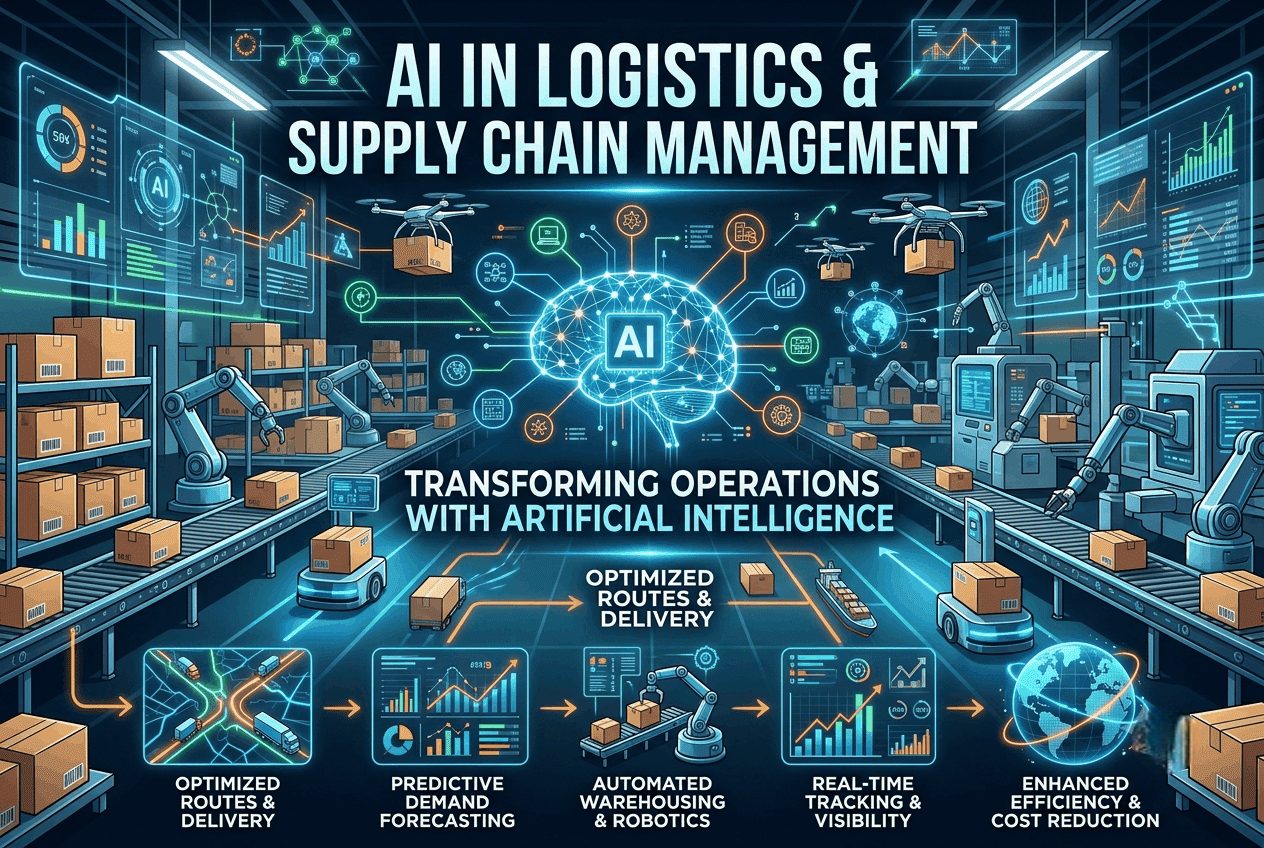
The logistics and supply chain industry has become more complex than ever before. Businesses today are expected to deliver products faster, reduce operational costs, maintain accurate inventory, and provide excellent customer service. At the same time, global markets, changing customer demands, and unexpected disruptions have made supply chain management increasingly challenging. This is where Artificial Intelligence (AI) is helping organizations improve efficiency and make smarter business decisions.
AI in logistics and supply chain management is changing the way companies plan, manage, and deliver products. Instead of relying only on manual processes and historical data, businesses can now use AI to analyze large amounts of information, predict future demand, optimize transportation routes, and automate repetitive tasks. This allows companies to respond quickly to market changes while improving overall productivity.
From manufacturers and warehouses to retailers and transportation providers, AI is becoming an essential part of modern supply chain operations. Businesses of all sizes are adopting AI-powered solutions to reduce delays, improve inventory management, and create more reliable supply chains. As technology continues to advance, AI will play an even greater role in helping companies remain competitive in an increasingly demanding marketplace.
Understanding AI in Logistics and Supply Chain Management
Artificial Intelligence refers to computer systems that can perform tasks requiring human intelligence, such as learning from data, recognizing patterns, making predictions, and supporting decision-making. In logistics and supply chain management, AI helps organizations process massive amounts of operational data much faster than traditional systems.
Modern supply chains generate information from multiple sources, including warehouses, transportation vehicles, suppliers, customers, inventory systems, and online sales platforms. AI combines this information and provides valuable insights that help businesses improve planning, reduce waste, and increase operational efficiency.
Unlike traditional software that follows fixed rules, AI continuously learns from new data. As market conditions change, AI systems adapt their recommendations, making supply chain operations more flexible and responsive. This continuous learning capability makes AI especially valuable in today’s fast-changing business environment.
The primary goal of AI is not to replace human workers but to support better decision-making. Supply chain managers can use AI-generated insights to make faster and more informed choices while focusing on strategic business growth instead of repetitive operational tasks.
Why AI Matters in Modern Supply Chains
Customer expectations have changed significantly over the past decade. Consumers now expect faster deliveries, accurate order tracking, competitive pricing, and consistent product availability. Meeting these expectations without advanced technology has become increasingly difficult.
AI helps businesses improve every stage of the supply chain, from forecasting demand to delivering products to customers. By identifying patterns that humans may overlook, AI enables organizations to anticipate potential issues before they become costly problems.
Global events such as transportation delays, natural disasters, supplier shortages, and changing market demands can disrupt supply chains with little warning. AI helps businesses prepare for these uncertainties by providing predictive insights and recommending alternative solutions before disruptions affect customers.
Companies that successfully integrate AI into their logistics operations often experience lower operating costs, improved customer satisfaction, better inventory management, and stronger competitive advantages in their industries.
How AI Improves Demand Forecasting
One of the biggest challenges in supply chain management is accurately predicting customer demand. Ordering too much inventory increases storage costs, while ordering too little can result in stock shortages and lost sales.
AI improves demand forecasting by analyzing historical sales, seasonal trends, customer purchasing behavior, weather conditions, economic indicators, promotional campaigns, and market changes simultaneously. This comprehensive analysis produces more accurate demand predictions than traditional forecasting methods.
Retail companies often experience demand spikes during holiday seasons or promotional events. AI can identify these patterns early, allowing businesses to prepare sufficient inventory and staffing levels before customer demand increases.
More accurate forecasting helps companies reduce inventory waste, minimize storage expenses, improve production planning, and maintain higher customer satisfaction by ensuring products remain available when customers need them.
AI-Powered Inventory Management
Inventory management is one of the most critical aspects of logistics. Maintaining the right inventory levels directly affects profitability, customer service, and warehouse efficiency.
AI continuously monitors inventory levels across multiple warehouses and distribution centers. When stock reaches predefined levels, AI can automatically recommend replenishment or place purchase orders based on predicted demand.
Businesses with thousands of products often struggle to manually monitor inventory performance. AI identifies slow-moving products, fast-selling items, seasonal trends, and inventory risks much more efficiently than manual analysis.
Improved inventory management reduces unnecessary storage costs, minimizes product shortages, decreases excess inventory, and helps businesses use warehouse space more effectively.
Smarter Warehouse Operations with AI
Warehouses have evolved from simple storage facilities into highly automated distribution centers. AI plays an important role in improving warehouse efficiency through intelligent automation and optimized workflows.
AI helps determine the best storage locations for products based on demand frequency, product size, shipping schedules, and warehouse layout. Frequently ordered items are positioned closer to packing stations, reducing travel time for warehouse workers.
Many modern warehouses use AI-powered robots to transport goods, organize inventory, and assist employees with picking and packing operations. These robots work alongside human employees, improving productivity while reducing physical workload.
AI also improves warehouse safety by monitoring equipment performance, identifying maintenance needs, and reducing operational errors that could delay shipments or increase costs.
Route Optimization and Transportation Planning
Transportation represents one of the largest expenses in supply chain management. Fuel costs, traffic congestion, delivery schedules, and vehicle utilization all affect operational efficiency.
AI analyzes traffic conditions, weather forecasts, road closures, fuel prices, delivery priorities, and driver availability to recommend the most efficient delivery routes. This reduces travel time and transportation expenses.
Delivery companies using AI route optimization can complete more deliveries with fewer vehicles while maintaining on-time performance. Customers also benefit from more accurate delivery estimates and improved tracking information.
Efficient transportation planning reduces fuel consumption, lowers carbon emissions, minimizes delivery delays, and improves overall fleet utilization.
AI in Supplier Management
Strong supplier relationships are essential for maintaining reliable supply chains. AI helps businesses evaluate supplier performance using data from deliveries, quality reports, pricing history, and contract compliance.
AI identifies suppliers with consistent performance while highlighting vendors that frequently experience delays or quality issues. This helps procurement teams make better sourcing decisions.
Businesses can also use AI to identify alternative suppliers before shortages occur. During periods of supply disruption, AI recommends backup suppliers based on cost, reliability, and geographic location.
Improved supplier management reduces procurement risks while strengthening long-term business relationships and maintaining production continuity.
Predictive Maintenance for Logistics Equipment
Logistics operations rely heavily on trucks, forklifts, conveyor systems, and warehouse equipment. Unexpected equipment failures can delay deliveries and increase operational costs.
AI continuously monitors equipment performance using sensor data. It identifies early signs of wear, overheating, vibration, or reduced efficiency before equipment fails completely.
Maintenance teams receive alerts that allow repairs to be scheduled during planned maintenance periods rather than after costly breakdowns occur.
Predictive maintenance reduces downtime, extends equipment lifespan, lowers repair costs, and improves overall operational reliability.
AI and Real-Time Supply Chain Visibility
Supply chain visibility allows businesses to monitor products from manufacturing to final delivery. AI enhances visibility by collecting and analyzing data from transportation systems, warehouses, suppliers, and inventory platforms.
Managers receive real-time updates on shipment locations, warehouse inventory, supplier performance, and delivery progress through centralized dashboards powered by AI.
If shipments are delayed, AI automatically identifies the cause and recommends corrective actions. Businesses can notify customers proactively instead of responding after problems arise.
Greater visibility improves operational transparency, strengthens customer trust, and enables faster responses to changing business conditions.
Improving Customer Experience Through AI
Customer satisfaction depends heavily on timely deliveries, accurate order fulfillment, and clear communication throughout the purchasing process.
AI-powered customer service systems provide shipment tracking, estimated delivery times, and instant responses to common customer inquiries without requiring human intervention.
When delivery issues occur, AI helps customer service representatives access relevant information quickly, allowing them to resolve customer concerns more efficiently.
A better customer experience leads to stronger customer loyalty, increased repeat purchases, and improved brand reputation in highly competitive markets.
Benefits of AI in Logistics and Supply Chain Management
Businesses adopting AI across their logistics operations experience significant improvements in both efficiency and profitability.
Some of the major benefits include:
- Improved demand forecasting and inventory accuracy
- Lower transportation and warehouse operating costs
- Faster and more reliable deliveries
- Better supplier performance management
- Increased operational visibility
- Higher customer satisfaction
- Reduced manual errors
- Improved business decision-making
These advantages enable organizations to build more resilient and competitive supply chain operations.
Real-World Applications Across Industries
Retail companies use AI to forecast customer demand, manage seasonal inventory, and improve order fulfillment. This helps ensure products remain available while reducing excess stock during slower sales periods.
Manufacturing companies use AI to coordinate production schedules with supplier deliveries and customer orders. Better synchronization reduces production delays while improving resource utilization.
Healthcare organizations rely on AI to manage medical supply inventories, ensuring critical equipment and medicines remain available when needed. Accurate forecasting also helps reduce waste from expired products.
E-commerce businesses use AI extensively for warehouse automation, delivery route optimization, fraud detection, and personalized customer communication, enabling them to process thousands of daily orders efficiently.
Common Mistakes Businesses Should Avoid
Many organizations invest in AI without preparing their existing supply chain processes. Poor-quality data often produces inaccurate AI recommendations, limiting the technology’s effectiveness.
Some businesses expect immediate results after implementing AI. Successful adoption requires continuous learning, employee training, and gradual integration into existing operations rather than complete replacement of current systems.
Ignoring employee involvement can also reduce implementation success. Staff members should understand how AI supports their work rather than viewing it as a replacement for their expertise.
Another common mistake is focusing only on automation instead of overall business improvement. AI should solve real operational challenges that align with long-term business objectives.
Key Factors for Successful AI Implementation
Organizations should begin by identifying specific business challenges where AI can create measurable value. Starting with focused projects allows businesses to gain experience before expanding AI across the supply chain.
High-quality data is essential for AI success. Businesses should invest in accurate data collection, standardized processes, and reliable system integration before implementing advanced AI solutions.
Employee training plays an important role in AI adoption. Teams should understand how to interpret AI recommendations and combine them with their industry experience for better decision-making.
Continuous performance monitoring ensures AI systems remain accurate as market conditions evolve. Regular evaluation allows organizations to improve AI models and maximize long-term business value.
The Future of AI in Logistics and Supply Chain Management
AI will continue transforming logistics through greater automation, smarter decision-making, and stronger collaboration across global supply chains.
Future AI systems will become even better at predicting disruptions before they occur. Businesses will receive earlier warnings about supplier risks, transportation issues, weather disruptions, and changing customer demand, allowing proactive planning.
Autonomous delivery vehicles, AI-powered drones, intelligent warehouses, and digital supply chain twins will become increasingly common as technology continues to mature. These innovations will further improve efficiency while reducing operational costs.
Sustainability will also become a major focus. AI will help companies reduce fuel consumption, optimize transportation routes, minimize waste, and improve energy efficiency, supporting both environmental goals and business profitability.
Conclusion
Artificial Intelligence is rapidly becoming one of the most valuable technologies in logistics and supply chain management. From demand forecasting and inventory optimization to warehouse automation and transportation planning, AI helps businesses operate more efficiently while improving customer satisfaction. Companies that embrace AI can reduce costs, improve visibility, and respond more effectively to changing market conditions.
As global supply chains continue to evolve, AI will become an essential tool for organizations seeking long-term growth and resilience. Businesses that invest in high-quality data, employee training, and well-planned AI implementation strategies will be better positioned to build smarter, faster, and more reliable supply chains that meet the demands of the future.