


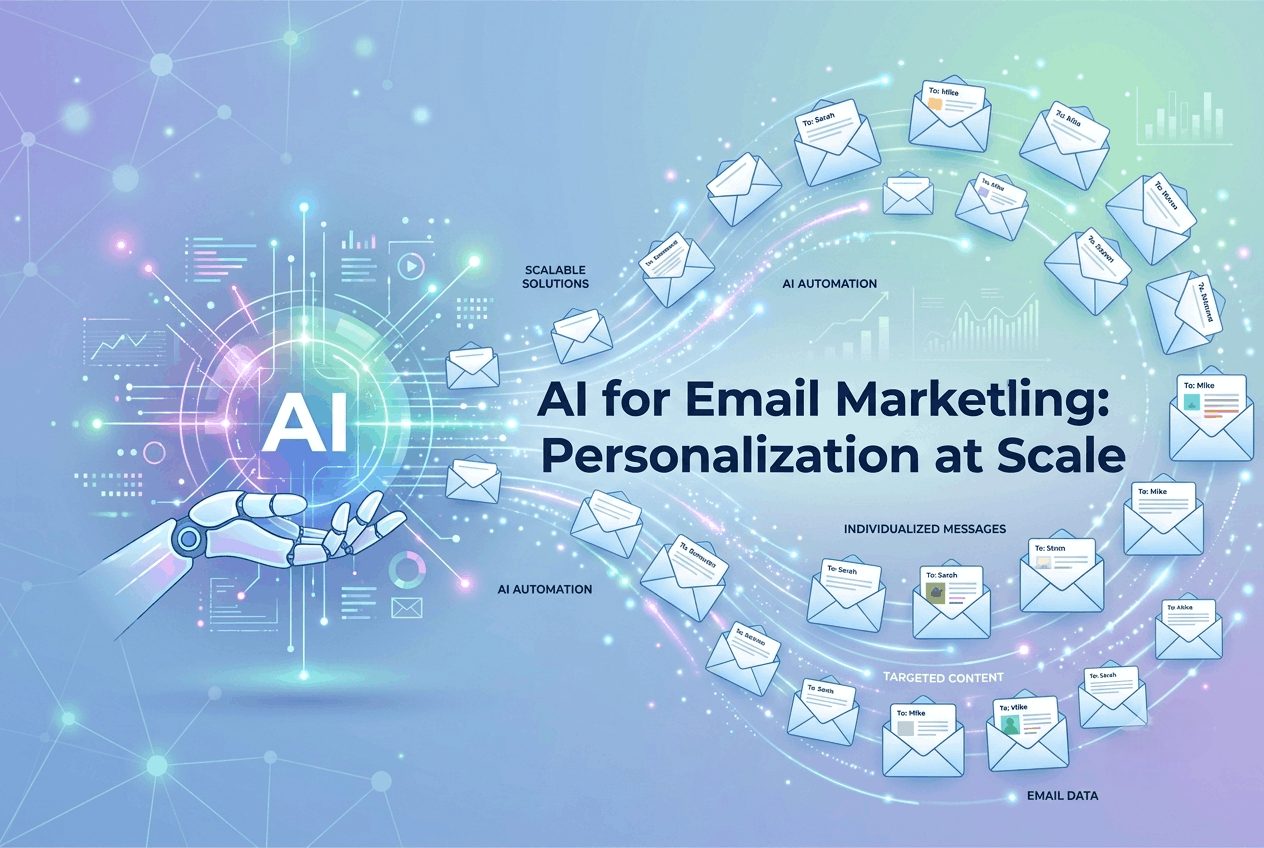
Email marketing has remained one of the most effective digital marketing channels for businesses of all sizes. Despite the rise of social media, messaging apps, and other communication platforms, email continues to deliver excellent returns because it allows businesses to communicate directly with their audience. However, customer expectations have changed significantly over the years. Modern consumers expect every email to feel relevant, timely, and tailored to their individual interests rather than being part of a generic campaign sent to thousands of people at once.
Artificial Intelligence (AI) is helping businesses meet these growing expectations by making email marketing smarter and more efficient. Instead of relying on manual audience segmentation and fixed email schedules, AI analyzes customer behavior, preferences, purchase history, and engagement patterns to create highly personalized experiences. Businesses can now send the right message to the right customer at exactly the right time without increasing their marketing workload.
This ability to deliver individualized experiences to thousands or even millions of customers is known as personalization at scale. Rather than treating every subscriber the same, AI enables marketers to understand each customer’s unique journey and communicate accordingly. As competition continues to increase across industries, AI-powered email marketing is becoming an essential strategy for improving customer relationships, increasing conversions, and maximizing marketing return on investment.
Why Traditional Email Marketing Is No Longer Enough
Traditional email marketing usually involves creating one email and sending it to an entire mailing list. While this method was effective years ago, it often fails to capture customer attention today. People receive dozens of promotional emails every day, making it difficult for generic messages to stand out in crowded inboxes. Businesses that continue using one-size-fits-all campaigns often experience lower open rates, fewer clicks, and declining customer engagement.
Another challenge with traditional email marketing is limited audience segmentation. Marketers may divide subscribers into broad categories based on age, location, or previous purchases, but these segments rarely reflect real customer behavior. Two customers in the same demographic group may have completely different interests, shopping habits, and buying intentions, making broad segmentation less effective than personalized communication.
Manual campaign management also requires significant time and effort. Marketing teams often spend hours analyzing reports, creating audience lists, scheduling emails, and optimizing campaigns. As subscriber lists continue to grow, managing every campaign manually becomes increasingly difficult without sacrificing quality or consistency.
Artificial Intelligence solves many of these limitations by continuously learning from customer interactions. Instead of depending on fixed rules, AI adapts to changing customer behavior in real time, helping businesses create more relevant campaigns while reducing manual work. This allows marketing teams to focus on strategy and creativity instead of repetitive operational tasks.
Understanding AI in Email Marketing
Artificial Intelligence refers to computer systems that can analyze data, recognize patterns, make predictions, and automate decisions that would normally require human intelligence. In email marketing, AI uses customer information to determine what content should be sent, when it should be delivered, and which subscribers are most likely to respond positively.
Every interaction a customer has with a business generates valuable information. Website visits, product searches, purchases, abandoned carts, email opens, click-through rates, and browsing behavior all provide insights into customer interests. AI collects and processes these signals to build detailed customer profiles that become more accurate over time.
Instead of simply grouping subscribers into a few categories, AI creates dynamic customer segments that automatically update as behavior changes. Someone who frequently browses sports equipment will begin receiving different recommendations than someone interested in office supplies, even if both originally belonged to the same customer segment.
The result is a highly responsive marketing system that continuously improves itself. As AI learns which emails receive the highest engagement, it refines future campaigns to increase customer satisfaction, improve conversions, and strengthen long-term relationships.
How AI Makes Personalization Possible at Scale
One of the biggest advantages of AI is its ability to personalize thousands of emails simultaneously. Without AI, creating unique content for every subscriber would require enormous time and resources. AI automates this entire process while maintaining high levels of personalization.
Instead of inserting only the customer’s first name into an email, AI personalizes multiple elements of the message. Product recommendations, promotional offers, subject lines, images, content blocks, and call-to-action buttons can all be customized based on individual customer behavior and preferences.
For example, an online clothing retailer can automatically recommend winter jackets to customers living in colder regions while promoting summer collections to customers in warmer climates. Similarly, a customer who recently purchased running shoes may receive recommendations for athletic clothing rather than unrelated products.
This level of personalization creates a much more engaging customer experience because every email feels relevant. Customers are more likely to open emails, interact with the content, and make purchases when they receive recommendations that genuinely match their interests.
Key Benefits of AI for Email Marketing
Artificial Intelligence provides measurable benefits that extend beyond simple automation. Businesses using AI-powered email marketing often achieve stronger customer engagement while improving overall marketing efficiency.
Some of the most valuable benefits include:
- Higher email open rates through AI-generated subject lines.
- Improved click-through rates with personalized recommendations.
- Better customer segmentation based on real behavior.
- Increased sales through predictive product suggestions.
- Reduced manual workload by automating repetitive marketing tasks.
Beyond these immediate improvements, AI also helps businesses build stronger customer relationships. Instead of overwhelming subscribers with irrelevant promotions, marketers can provide valuable information that aligns with each customer’s interests and purchasing journey.
Marketing teams also gain access to more accurate performance insights. AI identifies patterns that humans may overlook, helping businesses understand why certain campaigns succeed while others perform poorly. These insights support continuous improvement and smarter decision-making.
As businesses continue collecting more customer data, AI becomes increasingly effective. The more information it processes, the better it understands customer preferences, allowing personalization strategies to become more accurate over time.
AI-Powered Customer Segmentation
Customer segmentation has always been an important part of successful email marketing, but AI takes it to an entirely new level. Traditional segmentation relies on fixed customer attributes, while AI continuously updates audience groups based on changing behaviors and interactions.
Instead of creating a “frequent buyers” segment once every few months, AI automatically identifies customers whose purchasing habits have recently changed. Someone becoming more active may move into a high-value segment, while inactive subscribers can receive re-engagement campaigns without manual intervention.
AI also discovers hidden patterns within customer data that marketers might never notice manually. It can identify relationships between browsing habits, purchasing frequency, preferred products, and email engagement to build highly accurate customer profiles.
These intelligent audience segments allow businesses to deliver increasingly relevant content, improving customer satisfaction while maximizing the effectiveness of every email campaign.
Predictive Analytics and Smarter Email Campaigns
One of AI’s most valuable capabilities is predictive analytics. Rather than simply reporting what happened in previous campaigns, AI predicts what customers are likely to do next based on historical data and behavioral trends.
For example, AI can identify customers who are likely to make another purchase within the next week. Instead of waiting for the customer to return naturally, businesses can send personalized offers or product recommendations that encourage immediate action.
Predictive analytics also helps identify customers who may stop engaging with emails. AI can recognize declining interaction patterns and automatically trigger retention campaigns before customers unsubscribe or become inactive.
These predictive insights help businesses become proactive instead of reactive. Rather than responding after engagement declines, marketers can anticipate customer needs and deliver timely communication that strengthens loyalty and increases long-term revenue.
AI-Generated Email Content That Connects with Customers
Creating engaging email content consistently can be one of the biggest challenges for marketing teams. Artificial Intelligence helps simplify this process by generating subject lines, email copy, product recommendations, and calls to action based on customer behavior and campaign objectives. Rather than replacing human creativity, AI acts as an assistant that helps marketers produce high-quality content more efficiently.
One of the most valuable applications of AI is subject line optimization. Since the subject line determines whether an email gets opened, AI analyzes previous campaign performance to predict which wording is likely to attract more attention. It can suggest different versions based on tone, urgency, curiosity, or customer interests, allowing marketers to choose the option most likely to improve open rates.
AI can also personalize the main body of the email. Instead of sending identical content to every subscriber, it dynamically changes product recommendations, promotional offers, and featured articles according to individual preferences. A customer interested in home décor may receive furniture recommendations, while another customer who frequently shops for electronics will see the latest gadgets.
This personalized approach creates a better customer experience because every message feels relevant. Customers are far more likely to engage with emails that address their interests rather than receiving generic promotional messages that may not match their needs.
Smart Email Automation Beyond Basic Workflows
Traditional email automation typically relies on fixed workflows, such as sending a welcome email after someone subscribes or a reminder after an abandoned cart. While these automations remain useful, AI takes automation much further by making decisions based on real-time customer behavior instead of simple triggers.
For example, AI can monitor how customers interact with a website, emails, and products over several weeks. If someone frequently views a specific product category but never completes a purchase, AI can automatically send educational content, customer reviews, or a limited-time discount designed to encourage a buying decision.
AI also adapts customer journeys as behavior changes. A subscriber who becomes highly engaged may receive premium offers and loyalty rewards, while someone whose engagement decreases can automatically enter a reactivation campaign. This flexibility ensures every customer receives communication that reflects their current relationship with the business.
The result is a smarter marketing system that continuously adjusts without requiring marketers to manually update every workflow. Businesses save time while delivering more meaningful customer experiences that improve both engagement and conversions.
Finding the Perfect Time to Send Every Email
Timing plays a major role in email marketing success. Even an excellent email may perform poorly if it arrives when customers are busy or unlikely to check their inbox. Sending every campaign at the same time ignores the fact that people have different schedules, habits, and time zones.
Artificial Intelligence analyzes each subscriber’s previous email activity to determine when they are most likely to open and interact with messages. Some customers may consistently engage early in the morning, while others check emails during lunch breaks or in the evening after work.
Instead of selecting one universal delivery time, AI schedules emails individually for every subscriber. This approach increases the likelihood that each message appears near the top of the inbox when the customer is actively checking email.
Businesses often see improvements in open rates, click-through rates, and overall campaign performance because emails reach customers when they are most receptive. Better timing also reduces the chances of messages being ignored or buried beneath newer emails.
Using AI to Improve Customer Retention
Acquiring new customers is important, but retaining existing customers is often more profitable. AI helps businesses strengthen customer relationships by recognizing changes in engagement and responding before customers lose interest.
For example, if a customer who previously opened every email suddenly stops interacting, AI can detect the decline and automatically launch a retention campaign. This campaign may include exclusive offers, personalized recommendations, or helpful content designed to rebuild engagement.
AI can also identify loyal customers who deserve recognition. Frequent buyers may receive early access to new products, loyalty rewards, birthday offers, or personalized appreciation messages. These thoughtful interactions encourage long-term customer relationships and increase lifetime value.
By understanding customer behavior at every stage of the journey, businesses can communicate more effectively and reduce customer churn. Instead of waiting until customers unsubscribe, AI helps marketers maintain stronger relationships through timely and relevant communication.
Real-World Applications of AI in Email Marketing
Businesses across many industries are already using AI to improve email marketing performance. E-commerce companies rely on AI to recommend products based on browsing history and previous purchases. This personalized approach encourages repeat purchases while introducing customers to products they are genuinely interested in.
Travel companies use AI to recommend destinations, hotel packages, or travel experiences based on previous bookings and search behavior. Customers receive highly relevant offers instead of general travel promotions, making the communication feel more valuable.
Financial institutions use AI-powered email campaigns to educate customers about services that match their financial goals. Someone researching home loans may receive mortgage-related resources, while another customer interested in investments receives educational content about wealth management.
Healthcare providers also benefit from AI by sending appointment reminders, wellness tips, and personalized health information based on patient preferences. Although privacy regulations must always be followed, AI helps deliver timely communication that improves the overall customer experience.
Best Practices for Successful AI Email Marketing
Using AI effectively requires more than simply purchasing new software. Businesses should develop a clear strategy that combines technology with customer-focused marketing practices.
Some important best practices include:
- Start with clean and accurate customer data.
- Focus on delivering genuine value rather than excessive promotions.
- Regularly test subject lines, email content, and personalization strategies.
- Monitor campaign performance and refine AI recommendations over time.
- Respect customer privacy and follow all applicable data protection regulations.
Businesses should also remember that AI supports marketers rather than replacing them. Human creativity remains essential for developing compelling campaigns, understanding customer emotions, and maintaining a consistent brand voice.
The most successful organizations combine AI-driven insights with experienced marketing professionals who understand customer needs. This partnership produces campaigns that are both efficient and authentic.
Key Factors for Successful AI Email Marketing
Several factors determine whether AI-powered email marketing delivers strong business results. Technology alone cannot guarantee success if the overall marketing strategy lacks direction or customer focus.
High-quality customer data forms the foundation of every successful AI system. Inaccurate, outdated, or incomplete information reduces personalization accuracy and limits campaign performance. Businesses should regularly update customer records and remove duplicate or inactive contacts.
Clear marketing objectives also play an important role. Whether the goal is increasing sales, improving customer retention, generating leads, or strengthening brand loyalty, AI performs best when it supports well-defined business outcomes.
Regular testing and continuous improvement are equally important. Customer preferences change over time, and AI models become more effective when marketers consistently analyze campaign performance and adjust their strategies accordingly.
Finally, transparency builds customer trust. Businesses should clearly explain how customer data is collected and used while providing subscribers with control over their communication preferences.
Common Mistakes Businesses Should Avoid
Many businesses expect AI to solve every marketing challenge automatically. While AI provides powerful capabilities, it still depends on thoughtful planning, quality data, and ongoing human oversight.
One common mistake is relying entirely on automation. Sending too many automated emails without considering customer experience can make communication feel repetitive or impersonal. AI should enhance relationships rather than overwhelm subscribers.
Another frequent mistake is collecting large amounts of customer data without using it effectively. Businesses should focus on meaningful insights instead of simply gathering information that never influences marketing decisions.
Ignoring testing is another problem. Even AI-generated campaigns should be reviewed regularly to ensure personalization remains accurate and relevant. Customer behavior evolves continuously, making ongoing optimization essential.
Finally, businesses should avoid sacrificing authenticity for automation. Customers still appreciate genuine communication, helpful information, and a recognizable brand voice. AI should strengthen these qualities rather than replace them.
The Future of AI in Email Marketing
The future of AI in email marketing promises even greater personalization and automation. As AI technologies continue evolving, businesses will be able to understand customer intent with greater accuracy and deliver increasingly relevant experiences throughout the customer journey.
Future AI systems may generate complete email campaigns automatically while adapting content in real time based on customer interactions. Emails could change product recommendations, pricing offers, or educational resources the moment a customer opens the message, creating a truly dynamic experience.
Predictive analytics will also become more advanced. Instead of simply forecasting future purchases, AI may identify customer goals, anticipate changing preferences, and recommend solutions before customers actively search for them. This proactive communication can strengthen trust and improve long-term loyalty.
Despite these technological advances, successful email marketing will continue to depend on understanding people. Businesses that combine AI capabilities with empathy, creativity, and customer-first thinking will be best positioned to build meaningful relationships in an increasingly competitive marketplace.
Conclusion
Artificial Intelligence is transforming email marketing by making personalization possible at a scale that traditional methods could never achieve. From intelligent customer segmentation and predictive analytics to automated content creation and optimized send times, AI helps businesses deliver relevant, engaging, and timely communication while reducing manual effort. These capabilities not only improve campaign performance but also strengthen customer relationships and increase long-term business growth.
As customer expectations continue to evolve, businesses that embrace AI-powered email marketing will gain a significant competitive advantage. By combining high-quality data, thoughtful strategy, continuous testing, and genuine customer care, organizations can create email campaigns that feel personal rather than automated. AI is no longer just an emerging technology—it has become a practical tool that enables businesses to connect with customers more effectively, improve marketing efficiency, and achieve better results in today’s digital marketplace.