


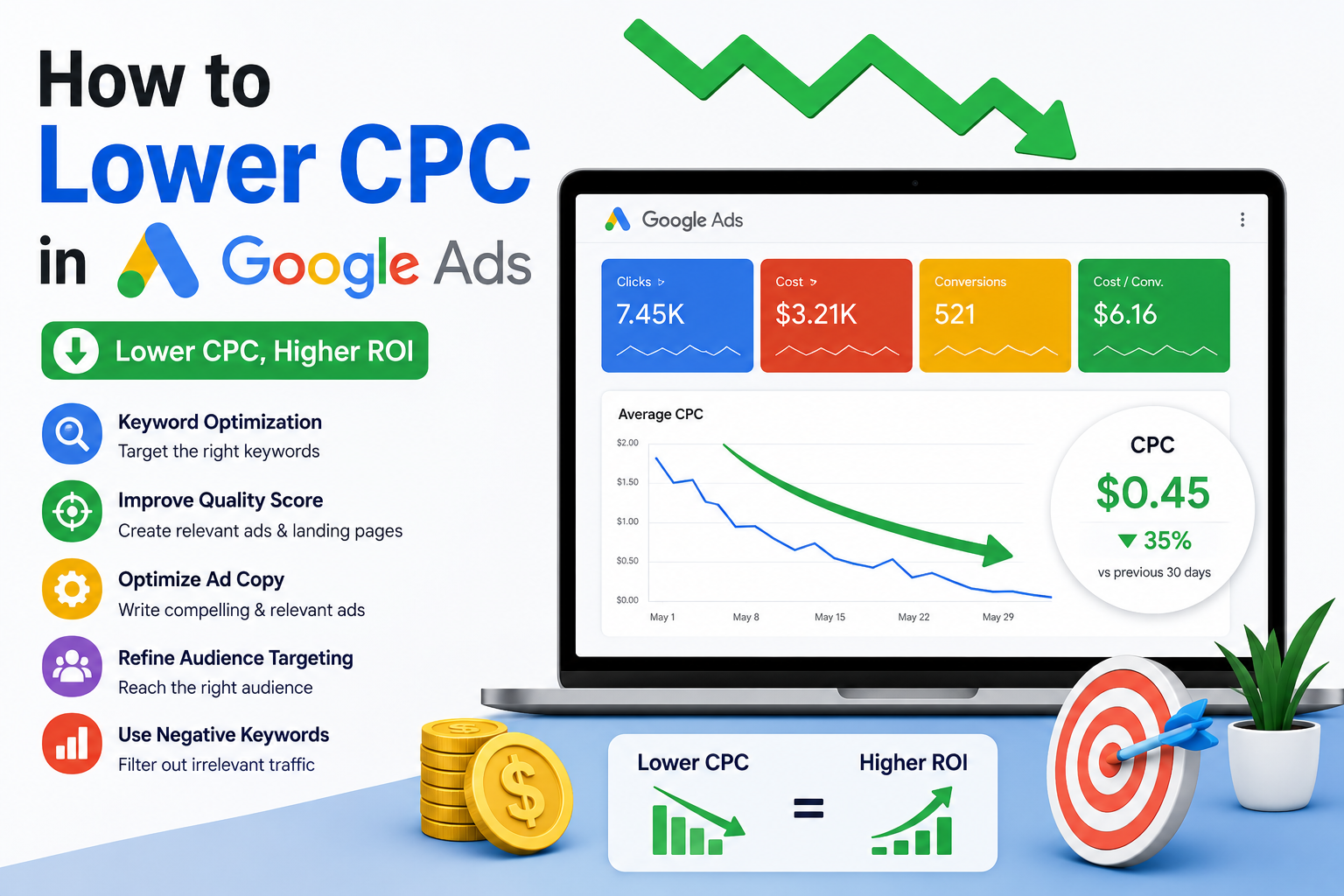
Running Google Ads today is no longer just about getting clicks—it’s about getting the right clicks at the right price. With rising competition across nearly every industry, businesses are increasingly noticing that their Cost Per Click (CPC) keeps climbing even when their budgets remain the same.
For startups trying to scale quickly, SMEs aiming for profitability, and enterprises managing large-scale digital campaigns, high CPC can quietly eat into margins and reduce overall marketing efficiency. According to industry benchmarks, average CPC across Google Ads can range anywhere from $1 to $10 depending on industry, while highly competitive sectors like legal or finance can go even higher. That means even small inefficiencies can translate into significant wasted spend.
The good news is that lowering CPC is not about cutting budgets or reducing visibility. It’s about improving how Google perceives your ads, how users engage with them, and how relevant your entire funnel is—from keyword to landing page.
In this guide, we’ll break down exactly how to lower CPC in Google Ads using practical, modern, and performance-driven strategies that actually work in 2026 and beyond.
Understanding CPC in Google Ads
Before optimizing costs, it’s important to understand what CPC actually represents.
Cost Per Click (CPC) is the amount you pay each time someone clicks on your ad. However, what most advertisers overlook is that CPC is not fixed—it is determined through a real-time auction system.
Google evaluates multiple factors before deciding how much you pay, including:
-
Your Quality Score
-
Your ad relevance
-
Expected click-through rate (CTR)
-
Competition for the keyword
-
Landing page experience
This means two businesses bidding on the same keyword can pay completely different amounts depending on how well their campaigns are structured.
So, lowering CPC is less about bidding lower and more about improving relevance and performance signals.
Why Your CPC Might Be High
High CPC is usually a symptom of deeper issues within your campaign structure. Many advertisers assume increasing bids is the only way to compete, but that often makes the problem worse.
One of the biggest reasons is poor Quality Score. When Google sees that your ad is not relevant or engaging, it charges you more for the same position.
Another major factor is keyword competition. In industries like insurance, SaaS, or real estate, advertisers aggressively compete for the same high-intent keywords, pushing CPC upward.
Landing page experience also plays a hidden but powerful role. Even if your ad gets clicks, if users leave quickly, Google interprets this as low relevance and increases your CPC over time.
Finally, weak ad copy and low CTR can signal poor engagement, which directly affects how much you pay per click.
Understanding these root causes is essential before applying optimization strategies.
How to Lower CPC in Google Ads Effectively
Lowering CPC requires a combination of structural improvements, smarter targeting, and continuous optimization. Below are the most effective approaches used by high-performing marketing teams.
1. Improve Quality Score for Lower CPC
Quality Score is one of the most powerful levers in Google Ads. It directly influences how much you pay per click and your ad position.
A higher Quality Score means Google considers your ad highly relevant, and rewards you with lower CPCs.
Improving it involves aligning three key elements: keyword relevance, ad copy relevance, and landing page experience. When these three components work together, Google rewards your campaign with better efficiency and lower costs.
Businesses often see CPC reductions of 20–40% simply by improving Quality Score without increasing budgets.
2. Refine Keyword Strategy for Better Efficiency
Keyword selection plays a major role in controlling CPC. Many advertisers overspend because they target overly broad or highly competitive keywords without filtering intent properly.
A smarter keyword strategy focuses on intent rather than volume. Instead of chasing generic terms, successful campaigns prioritize long-tail and high-intent keywords that signal buying behavior.
For example, instead of targeting “CRM software,” a more efficient keyword would be “CRM software for small sales teams in India.” The competition is lower, and the conversion intent is higher.
A refined keyword strategy typically includes:
-
Focusing on long-tail keywords with clear intent
-
Removing irrelevant or low-performing search terms regularly
-
Structuring campaigns by tightly themed ad groups
-
Avoiding broad match unless supported by strong negative keywords
This approach helps reduce wasted spend and naturally lowers CPC over time.
3. Increase CTR Through Better Ad Copy
Click-through rate (CTR) is one of the strongest indicators of ad relevance. When more users click your ad compared to impressions, Google rewards you with a lower CPC.
Improving CTR is not about flashy language—it’s about clarity, relevance, and alignment with search intent.
Your ad copy should clearly communicate value within seconds. Users should immediately understand what you are offering and why it matters to them.
High-performing ads often include strong value propositions, emotional triggers, and clear solutions to user problems. For instance, instead of saying “Best Software Solutions,” a more effective version would be “Reduce Operational Costs by 30% with Smart Automation Tools.”
When CTR improves, CPC naturally decreases because Google sees your ad as more useful to users.
4. Optimize Landing Pages for Higher Relevance
Many businesses underestimate the impact of landing pages on CPC. Google evaluates post-click experience just as much as the ad itself.
If users land on a page that is slow, irrelevant, or confusing, bounce rates increase—and CPC eventually rises.
A high-performing landing page should load quickly, match the ad message, and guide users toward a clear action.
Key improvements include better page speed, consistent messaging between ads and pages, and simplified conversion paths.
Even small improvements in landing page experience can significantly reduce CPC while improving conversion rates at the same time.
5. Use Smart Bidding Strategies Wisely
Automated bidding strategies like Target CPA or Maximize Conversions can help optimize CPC when used correctly. However, they require clean data and well-structured campaigns.
Smart bidding works best when Google has enough conversion signals to optimize effectively. If your campaign is new or poorly structured, automation may actually increase costs initially.
A balanced approach is to start with manual bidding, gather performance data, and then transition into smart bidding once enough conversions are recorded.
This ensures that the algorithm works in your favor instead of blindly spending budget.
6. Strengthen Ad Group Structure for Relevance
Campaign structure plays a subtle but important role in CPC reduction. Poorly organized ad groups often lead to irrelevant ads being shown for unrelated searches.
When keywords are tightly grouped into specific themes, ads become more relevant, improving both CTR and Quality Score.
For example, instead of mixing all software-related keywords in one group, separating “CRM tools,” “ERP software,” and “automation tools” creates stronger relevance signals.
This structural clarity helps Google better understand your ads, which ultimately lowers CPC.
7. Leverage Negative Keywords to Cut Waste
One of the most overlooked CPC optimization techniques is negative keyword management.
Without proper exclusions, your ads may appear for irrelevant searches, leading to wasted clicks and inflated costs.
Regularly reviewing search term reports helps identify irrelevant queries that should be excluded.
Over time, this improves targeting accuracy, reduces unnecessary spend, and lowers average CPC significantly.
Real-World Example: Reducing CPC for a SaaS Company
A mid-sized SaaS company offering project management tools was struggling with a CPC of nearly $6.50 per click in a competitive market.
Their campaigns were broadly structured, with generic keywords and inconsistent landing pages. CTR was low, and Quality Scores hovered around 4–5.
After restructuring their campaigns, refining keywords into long-tail segments, and improving landing page messaging, they achieved a major shift.
Within two months, their CPC dropped to $3.10 while conversion rates increased by 28%. The key wasn’t reducing bids—it was improving relevance across the entire funnel.
This demonstrates how strategic optimization can significantly reduce costs without sacrificing visibility.
Common Mistakes That Increase CPC
Many advertisers unintentionally increase their CPC due to avoidable mistakes.
One major issue is targeting overly broad keywords without intent filtering. This leads to high competition and low conversion rates.
Another common mistake is ignoring Quality Score altogether. Businesses often focus only on bids, forgetting that relevance matters more than budget size.
Poor landing page experience is also a silent CPC killer. Slow pages or irrelevant content increase bounce rates and signal poor user experience.
Finally, failing to optimize ads regularly leads to performance decay over time. Google Ads requires continuous monitoring and refinement to remain cost-efficient.
FAQs on Lowering CPC in Google Ads
1. What is a good CPC in Google Ads?
A good CPC varies by industry, but generally ranges between $1 to $2 for many mid-competition sectors. Highly competitive industries may have higher averages.
2. Does improving Quality Score reduce CPC?
Yes, improving Quality Score is one of the most effective ways to reduce CPC because it improves ad relevance and lowers auction costs.
3. How long does it take to lower CPC?
Depending on campaign size and optimization level, noticeable CPC improvements can occur within 2–6 weeks.
4. Can automation tools reduce CPC?
Yes, smart bidding tools can help reduce CPC when enough conversion data is available and campaigns are properly structured.
5. Why is my CPC increasing over time?
CPC can increase due to rising competition, declining Quality Score, or poor campaign optimization.
Conclusion
Lowering CPC in Google Ads is not about cutting corners or reducing reach—it’s about improving efficiency across your entire advertising ecosystem. When your keywords are precise, your ads are compelling, your landing pages are relevant, and your structure is clean, Google rewards you with lower costs and better visibility.
In today’s competitive digital landscape, businesses that focus on optimization rather than just spending gain a significant advantage. Even small improvements in Quality Score, CTR, and landing page experience can lead to substantial savings over time.
Ultimately, success in Google Ads comes from continuous refinement, not one-time setup.
If your business is struggling with high CPC or inefficient ad performance, partnering with an experienced digital transformation or PPC optimization team can help you unlock better ROI, scalable growth, and long-term efficiency.