


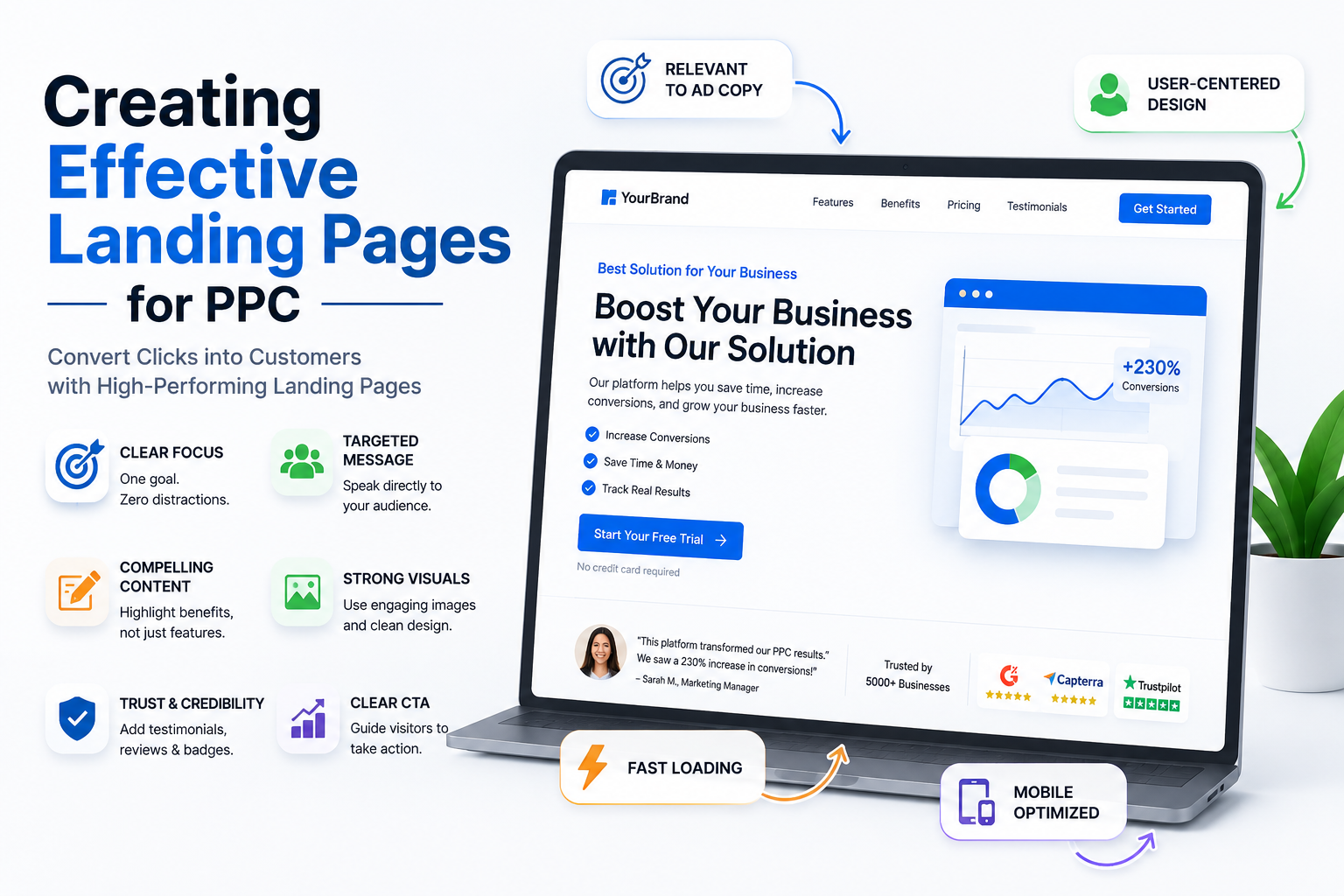
In today’s competitive digital advertising landscape, running PPC campaigns without optimized landing pages is like pouring water into a leaky bucket. You may drive traffic, but without a well-structured landing page, most of that traffic will never convert.
Businesses across industries are investing heavily in paid advertising. In fact, global digital ad spending is projected to exceed $700 billion in the coming years, with PPC accounting for a significant share of performance-driven marketing budgets. Yet, conversion rates remain inconsistent for many brands—not because ads fail, but because landing pages fail to deliver a seamless post-click experience.
This is where the real opportunity lies.
Creating effective landing pages for PPC is not just a design exercise; it is a strategic blend of psychology, messaging, user experience, and technical performance. When done right, it can dramatically reduce cost per acquisition (CPA) and maximize return on ad spend (ROAS).
Let’s explore how businesses can build landing pages that actually convert.
Understanding the Role of Landing Pages in PPC Success
A PPC landing page is not a regular webpage. It is a highly focused destination designed to convert visitors who click on an ad. Unlike homepages, which serve multiple purposes, landing pages have a single goal—conversion.
Whether the objective is lead generation, product purchase, demo booking, or consultation sign-ups, the landing page must align perfectly with the ad that brought the user there.
A common mistake businesses make is sending paid traffic to generic pages. This creates friction, increases bounce rates, and wastes ad spend.
For example, a SaaS company running Google Ads for “CRM software for startups” should never redirect users to a general homepage. Instead, a dedicated landing page tailored to startup pain points—like affordability, scalability, and ease of onboarding—will significantly improve conversions.
Crafting a Strong Message That Matches User Intent
The success of a landing page begins with message alignment. When users click an ad, they already have intent. Your landing page must immediately confirm that they are in the right place.
The headline should mirror the ad copy as closely as possible. This creates continuity and builds trust within seconds.
A strong PPC landing page typically communicates:
- What the product or service is
- Who it is for
- What problem it solves
- Why it is better than alternatives
However, instead of overwhelming users with information, the message should be simple and direct. The first few seconds determine whether a visitor stays or leaves.
Companies like Shopify and HubSpot excel at this. Their landing pages are built around clarity, not complexity. They focus on outcomes rather than features, which resonates more strongly with business decision-makers.
Designing for Conversion, Not Just Aesthetics
Design plays a crucial role in PPC landing page performance, but it should never overpower functionality.
A visually appealing page that confuses users will always underperform compared to a simple, intuitive one.
The goal is to guide users naturally toward the conversion point.
Whitespace, typography, color contrast, and visual hierarchy all influence user behavior. For instance, placing a CTA above the fold ensures immediate visibility, while supporting visuals reinforce trust.
Modern businesses are increasingly adopting minimalistic design principles. Studies show that clean, distraction-free landing pages can increase conversion rates by up to 30%, especially in high-intent PPC traffic.
A great example is Airbnb’s host landing page, which uses simplicity and storytelling to guide users toward signing up without unnecessary distractions.
Building Trust Through Content and Proof
In PPC advertising, traffic is often cold or semi-warm. This means trust must be established quickly.
One of the most effective ways to build credibility is through social proof and real-world validation. Instead of telling users that your solution works, show them evidence.
This can include customer testimonials, case study highlights, client logos, or performance metrics.
For example, a digital marketing agency might showcase how they reduced CPA by 45% for an e-commerce client or increased lead volume by 3x within six months.
Trust-building elements significantly reduce hesitation and help users feel confident about taking action.
Optimizing Page Speed and Mobile Experience
Speed is no longer optional in PPC landing page optimization. A delay of even one second in page load time can reduce conversions by up to 7%, according to multiple performance studies.
Since most PPC traffic comes from mobile devices, mobile optimization is equally important. A page that looks great on desktop but breaks on mobile is a conversion killer.
Responsive design, compressed images, and clean code structure all contribute to faster loading times.
Google’s Core Web Vitals also play a role in quality score, meaning faster landing pages can indirectly reduce your cost per click as well.
Creating a Clear and Compelling Call-to-Action
Your call-to-action (CTA) is the most important element on your landing page. It should be clear, action-oriented, and strategically placed.
Instead of generic phrases like “Submit” or “Click Here,” use value-driven CTAs such as “Get Your Free Demo,” “Start Growing Today,” or “Book a Consultation.”
Placement matters just as much as wording. A well-designed landing page typically includes multiple CTA touchpoints without overwhelming the user journey.
However, overuse can create friction. The goal is to guide, not pressure.
Aligning Landing Pages with PPC Campaign Structure
A successful PPC strategy is not just about creating one landing page—it is about creating a system of pages aligned with different campaign intents.
For example:
- Search ads require intent-driven landing pages
- Display ads often need awareness-focused pages
- Remarketing campaigns should focus on persuasion and urgency
This alignment ensures consistency from ad click to conversion, reducing drop-offs significantly.
Businesses that structure their landing pages according to campaign types often see higher conversion efficiency and lower acquisition costs.
Real-World Example: E-Commerce PPC Landing Page Success
Consider an online fashion retailer running Google Ads for “summer dresses for women.”
Instead of sending users to a general clothing category page, they create a dedicated landing page featuring:
- A curated collection of summer dresses
- Seasonal discounts
- Customer reviews
- Fast checkout options
Within weeks, they notice a significant increase in conversion rate and a drop in cart abandonment.
This simple shift—from generic to focused landing page—transforms PPC performance.
Common Mistakes Businesses Should Avoid
Even experienced marketers often make avoidable mistakes when designing PPC landing pages.
One of the most common issues is message mismatch between ads and landing pages. When users feel disconnected after clicking an ad, they leave immediately.
Another frequent problem is excessive form fields. Long forms discourage users and reduce conversion rates, especially in mobile environments.
Overloading pages with unnecessary information, animations, or competing CTAs also reduces clarity and focus.
The most successful landing pages are not the ones with the most content—they are the ones with the most clarity.
The Future of PPC Landing Pages
The evolution of PPC landing pages is closely tied to AI, personalization, and automation.
Modern tools now allow dynamic landing pages that adapt based on user behavior, location, and intent. This means two users clicking the same ad may see slightly different landing page experiences tailored to their needs.
Personalization is expected to become a standard requirement rather than a competitive advantage.
Additionally, AI-driven testing will continue to optimize layouts, CTAs, and content in real time, improving conversion rates without manual intervention.
Businesses that adopt these technologies early will gain a significant edge in PPC performance.
FAQ: Creating Effective Landing Pages for PPC
1. What makes a PPC landing page effective?
An effective PPC landing page aligns with ad intent, delivers a clear message, loads quickly, and focuses on a single conversion goal without distractions.
2. How long should a landing page be?
There is no fixed length. It should be long enough to address user concerns but short enough to maintain attention and drive action.
3. Do landing pages affect Google Ads quality score?
Yes, landing page experience is a major factor in Quality Score. Better pages can lower CPC and improve ad ranking.
4. Should every PPC campaign have a separate landing page?
Ideally, yes. Different campaigns target different intents, so tailored landing pages perform significantly better than generic ones.
5. What is the biggest mistake in landing page design?
The biggest mistake is lack of message alignment between ads and landing pages, which leads to high bounce rates and wasted ad spend.
Conclusion
Creating effective landing pages for PPC is not just a marketing task—it is a revenue-driving strategy. Businesses that invest in clarity, speed, trust, and alignment consistently outperform competitors who rely solely on ad spend.
In a digital ecosystem where competition is rising and attention spans are shrinking, your landing page is often the deciding factor between a lost click and a loyal customer.
If your business is investing in PPC but not seeing strong conversion results, the issue is rarely the ads—it is usually the landing experience.