


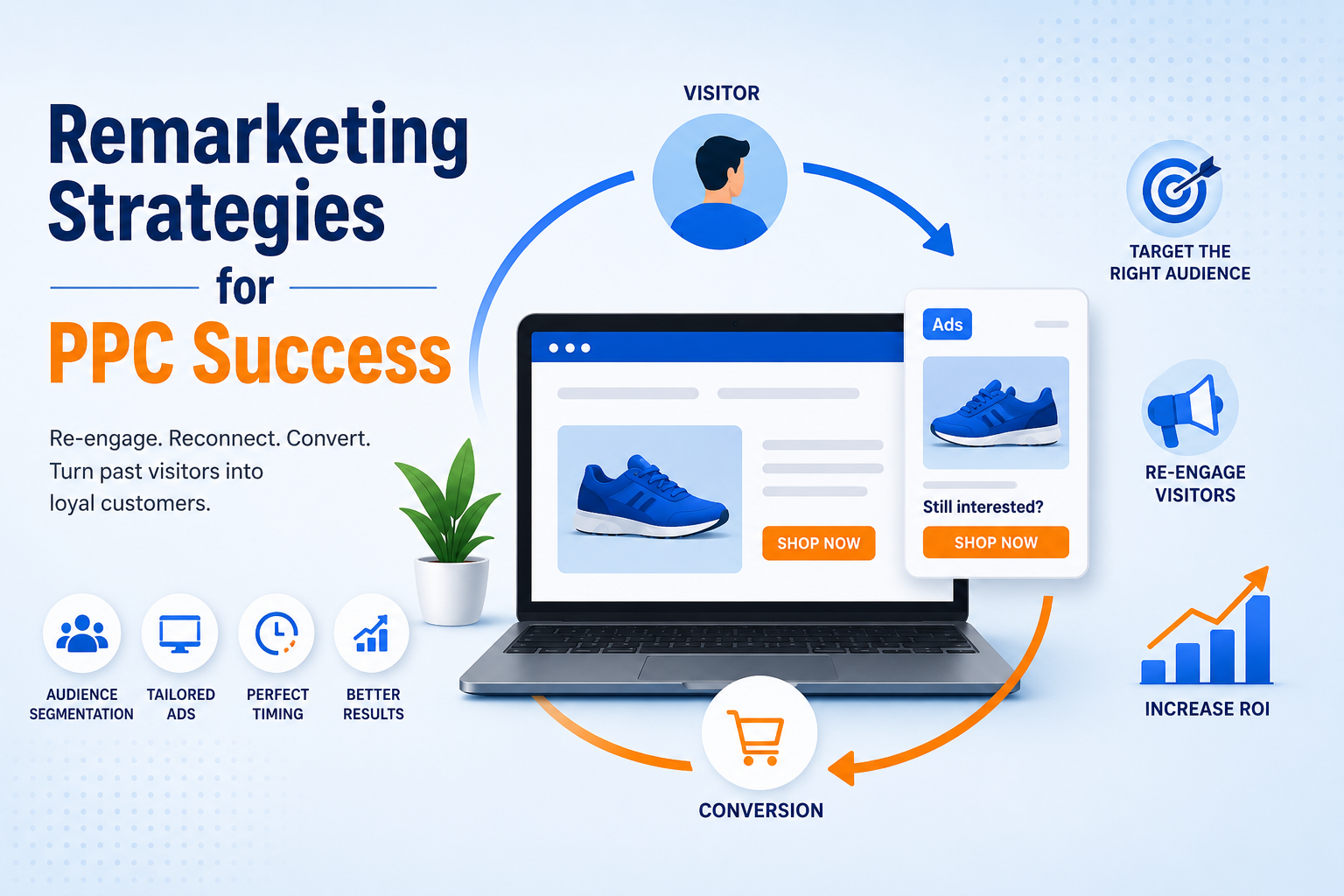
In today’s highly competitive digital landscape, most businesses don’t lose customers because of poor products—they lose them because attention is fleeting. A user visits your website, browses your services, maybe even adds a product to the cart, and then disappears. No purchase. No enquiry. Just silence.
But here’s the good news: that silence is not the end of the journey.
This is where remarketing in PPC (Pay-Per-Click advertising) becomes a game-changer. It allows businesses to re-engage users who have already shown interest and gently guide them back into the conversion funnel. Studies across ad platforms consistently show that remarketing campaigns can increase conversion rates significantly—often 2x to 3x higher compared to standard display campaigns.
For startups, SMEs, and large enterprises alike, remarketing is not just a marketing tactic. It’s a revenue recovery strategy.
Understanding Remarketing in PPC: Why It Matters More Than Ever
Remarketing, sometimes called retargeting, is a digital advertising strategy that targets users who have previously interacted with your website, app, or digital content but did not complete a desired action.
Instead of focusing only on cold traffic, remarketing focuses on warm audiences—people who already know your brand.
Modern customer journeys are rarely linear. A potential buyer might:
- Visit your website after searching on Google
- Compare your pricing with competitors
- Leave without taking action
- Return days later through a social media ad or search campaign
Remarketing ensures your brand stays visible throughout this journey.
With rising digital ad costs and increasing competition across Google Ads and social platforms, remarketing helps businesses improve ROI without constantly increasing ad spend.
How Remarketing Strengthens PPC Performance
Remarketing works because it leverages familiarity. Users are far more likely to convert when they recognize a brand.
Instead of convincing someone from scratch, you’re reinforcing an already formed interest.
Here’s what makes remarketing powerful for PPC campaigns:
It reduces wasted ad spend by focusing only on users who already engaged with your brand. It improves conversion rates because the audience is warmer and more qualified. It shortens the decision-making cycle since users are repeatedly exposed to your message. And it enhances overall brand recall, which plays a crucial role in competitive markets.
In fact, digital marketing benchmarks suggest that remarketing ads can lead to a 70% increase in conversion probability when compared to first-time visitor campaigns.
Key Remarketing Strategies for PPC Success
To build a high-performing remarketing campaign, businesses need more than just basic retargeting ads. They need structured strategies aligned with user intent, behavior, and timing.
Let’s explore the most effective approaches used by successful brands.
Audience Segmentation: The Foundation of Smart Remarketing
Not all visitors behave the same way, and treating them equally is one of the biggest mistakes in PPC advertising.
A well-structured remarketing strategy starts with audience segmentation. Instead of targeting everyone who visits your website, you divide users based on their behavior.
For example, someone who visited your pricing page has much higher purchase intent than someone who only read a blog post. Similarly, users who abandoned a checkout page are closer to conversion than those exploring general product pages.
By segmenting audiences, businesses can create tailored messaging that speaks directly to user intent.
A SaaS company, for instance, might show different ads to:
- Users who signed up for a free trial but didn’t upgrade
- Users who visited the pricing page multiple times
- Users who only engaged with educational content
This level of personalization ensures higher engagement and stronger conversion outcomes.
Dynamic Remarketing: Personalization at Scale
One of the most powerful advancements in PPC advertising is dynamic remarketing.
Instead of showing generic ads, dynamic remarketing automatically displays products, services, or pages that users previously interacted with.
Imagine an e-commerce visitor browsing multiple laptops on your website. Instead of showing a random banner, they later see an ad featuring the exact laptop models they viewed—along with pricing and discounts.
This type of personalized advertising significantly increases click-through rates because it feels relevant and timely.
Enterprises and large retailers especially benefit from dynamic remarketing because it allows them to scale personalization without manually creating thousands of ad variations.
Cross-Channel Remarketing: Meeting Users Everywhere
Today’s users don’t stick to a single platform. They browse Google, scroll Instagram, watch YouTube, and read industry blogs—all within a few hours.
That’s why cross-channel remarketing has become essential.
Instead of limiting your ads to one platform, you strategically re-engage users across multiple touchpoints.
A potential customer might first see your search ad, then later encounter a display banner, and eventually convert after watching a video ad explaining your service benefits.
This repeated exposure builds trust and strengthens brand familiarity.
Companies that adopt cross-channel remarketing often see better engagement because their messaging feels consistent and omnipresent, rather than isolated.
Timing and Frequency: Striking the Right Balance
Remarketing is powerful, but it can quickly become counterproductive if not managed properly.
Showing the same ad too frequently can lead to “ad fatigue,” where users start ignoring or even developing negative feelings toward the brand. On the other hand, showing ads too infrequently reduces recall effectiveness.
The key lies in controlled frequency and timing.
For example, an e-commerce brand might show ads more aggressively within the first 3–7 days of user interaction, when purchase intent is still fresh. For high-value B2B services, the remarketing window might extend to 30–60 days due to longer decision cycles.
Smart bidding strategies and frequency caps help maintain this balance, ensuring visibility without overwhelming the audience.
Leveraging Search Remarketing Lists (RLSA)
Search Remarketing Lists for Ads (RLSA) is one of the most underrated PPC strategies.
It allows advertisers to customize search campaigns specifically for users who have previously visited their website.
Instead of bidding on broad keywords for all users, businesses can increase bids or adjust messaging when a returning user searches again.
For example, if someone previously visited your enterprise software page and later searches “best CRM software for enterprises,” your ad can appear with a stronger message, such as a discount or personalized offer.
This approach ensures higher intent targeting and better budget efficiency since you’re focusing on users already familiar with your brand.
The Role of Creative Messaging in Remarketing Success
Even the most advanced targeting strategy will fail without compelling creative messaging.
Remarketing ads should not feel repetitive or generic. Instead, they should evolve based on user behavior.
A visitor who abandoned a cart may respond well to urgency-driven messaging, while a user who only read blog content might need educational reinforcement before conversion.
The tone of your ads should be simple, clear, and action-oriented. Avoid overwhelming users with too much information. Instead, focus on one strong value proposition per ad.
Businesses that continuously test ad creatives often achieve significantly higher click-through rates compared to those that rely on static messaging.
Real-World Example: How E-Commerce Brands Scale Revenue with Remarketing
Consider a mid-sized fashion e-commerce brand struggling with high cart abandonment rates. Despite strong traffic, conversions were low.
By implementing a structured remarketing strategy, the brand segmented users into cart abandoners, product viewers, and past customers.
Cart abandoners were shown time-sensitive discount ads. Product viewers received dynamic ads showcasing the same items with customer reviews. Past customers were targeted with new collection launches.
Within three months, the brand saw a notable improvement in return on ad spend and a significant reduction in abandoned carts.
This example highlights how remarketing is not just about visibility—it is about strategic re-engagement.
Data-Driven Optimization: The Secret Behind Long-Term PPC Success
Successful remarketing campaigns are never static. They evolve continuously based on performance data.
Marketers track metrics like click-through rates, conversion rates, cost per acquisition, and return on ad spend to refine targeting and messaging.
A/B testing plays a crucial role here. Small changes in ad copy, visuals, or audience segmentation can lead to significant performance improvements over time.
The most successful brands treat remarketing as an ongoing optimization process rather than a one-time setup.
Common Mistakes Businesses Should Avoid
Many businesses fail to unlock the full potential of remarketing due to avoidable mistakes.
One common issue is targeting all website visitors with the same message, which leads to poor engagement. Another is ignoring frequency control, which results in ad fatigue.
Some companies also fail to refresh creatives regularly, causing users to lose interest quickly. Others focus too heavily on short-term conversions and ignore long-term brand building.
Avoiding these pitfalls ensures that remarketing remains effective and sustainable.
Future of Remarketing in PPC
The future of remarketing is becoming more intelligent, automated, and privacy-focused.
With the rise of AI-driven ad platforms and cookie restrictions, businesses are shifting toward first-party data and predictive targeting.
Machine learning now plays a major role in identifying high-intent users and optimizing ad delivery in real time.
As digital ecosystems continue to evolve, remarketing will become even more personalized, contextual, and integrated across channels.
FAQ: Remarketing Strategies for PPC Success
What is remarketing in PPC?
Remarketing in PPC is a strategy that targets users who previously visited your website or interacted with your brand but did not convert.
Is remarketing effective for small businesses?
Yes, remarketing is highly effective for small businesses as it focuses on warm leads, improving conversions without significantly increasing ad spend.
How long should a remarketing campaign run?
It depends on your industry. E-commerce campaigns may run for 7–30 days, while B2B campaigns can extend to 60 days or more.
Which platforms are best for remarketing?
Google Ads, Meta Ads (Facebook and Instagram), and YouTube are among the most effective platforms for remarketing campaigns.
Does remarketing increase ROI?
Yes, remarketing typically improves ROI by targeting users who are already familiar with your brand, resulting in higher conversion rates.