


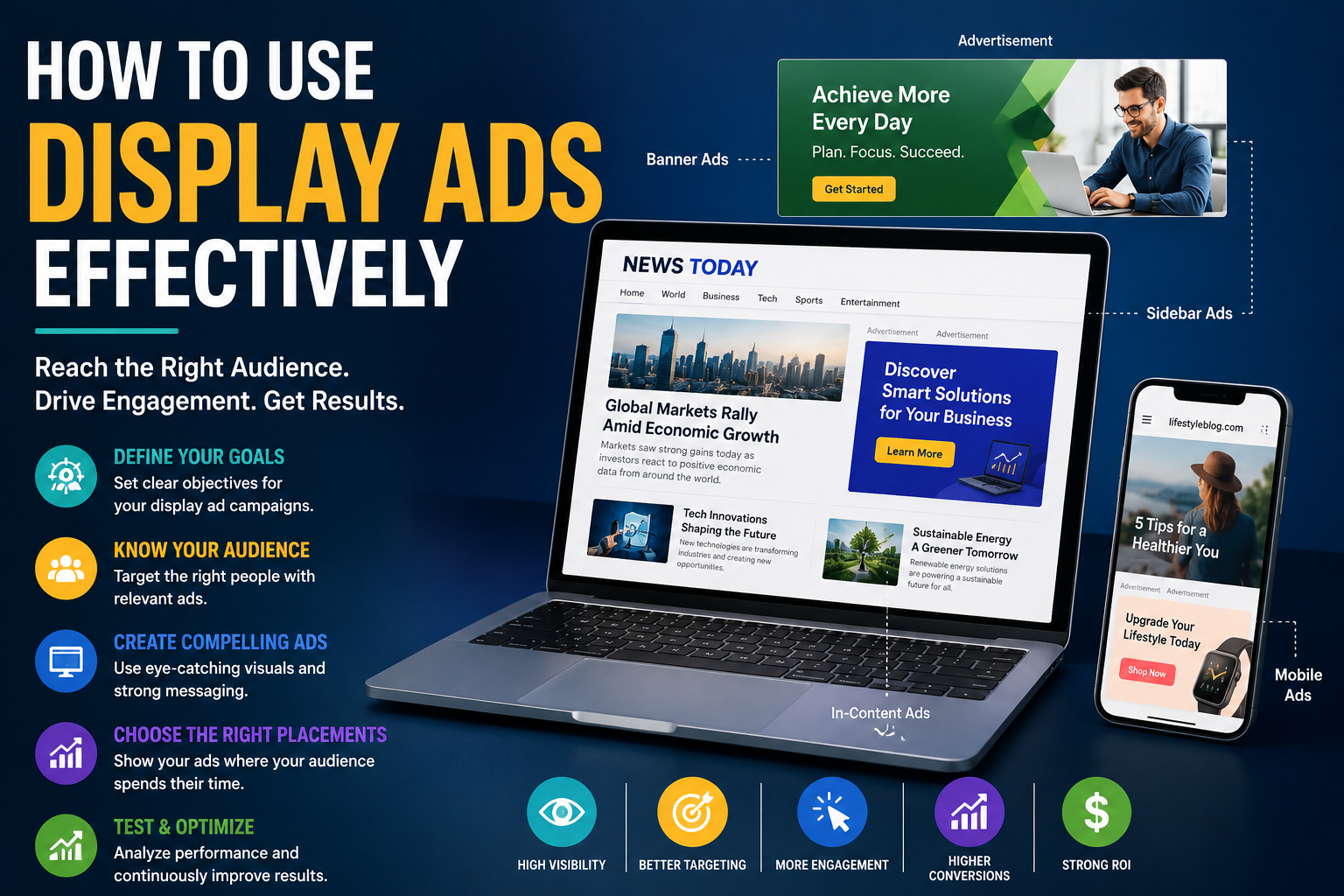
Display advertising has become one of the most powerful tools in digital marketing, especially for businesses that want to build awareness quickly and stay visible across the web. From startup founders trying to establish a brand to enterprises scaling global campaigns, display ads offer a combination of reach, targeting precision, and measurable performance that few channels can match.
Yet, despite their potential, many businesses struggle to use display ads effectively. Some spend heavily without seeing returns, while others fail to move beyond basic banner placements. The difference is not the platform—it’s the strategy behind it.
In this guide, we’ll break down how display ads actually work today, what makes campaigns successful, and how businesses can use them to drive meaningful results in a competitive digital landscape.
Understanding Display Advertising in Today’s Digital Ecosystem
Display ads are visual advertisements that appear across websites, mobile apps, and platforms within advertising networks like Google Display Network or programmatic exchanges. They can include banners, responsive ads, rich media, and even interactive creatives.
Unlike search ads, which target intent-driven users, display ads focus more on creating awareness and influencing users before they even begin searching. This makes them especially powerful for brand building and remarketing.
According to industry reports, display advertising continues to account for a significant share of digital ad spend globally, with programmatic display alone representing over 70% of digital display transactions in many markets. This shift shows how automation and AI-driven targeting have transformed how ads are delivered and optimized.
For businesses, this means one thing: display ads are no longer just “banner ads on websites.” They are intelligent, data-driven marketing assets.
Why Display Ads Still Matter for Modern Businesses
In a world dominated by social media and search engines, display advertising might seem old-fashioned. But the reality is quite the opposite.
Display ads play a crucial role in multi-channel marketing strategies because they support both upper-funnel awareness and lower-funnel conversions. They help businesses stay visible across a user’s entire online journey.
For example, a SaaS startup might use display ads to introduce its product to new audiences. Later, the same users may see retargeting ads reminding them to sign up for a free trial. This repeated exposure significantly improves conversion probability.
One of the most important strengths of display advertising is scale. Businesses can reach millions of users across thousands of websites without relying on users actively searching for a product.
This makes display ads especially valuable for:
- Building early-stage brand awareness for startups
- Expanding reach for SMEs entering new markets
- Supporting enterprise-level omnichannel campaigns
When used correctly, display advertising becomes a long-term growth engine rather than just a short-term acquisition tool.
How Display Ads Actually Work Behind the Scenes
Modern display advertising is powered by programmatic technology, which uses automated systems to buy and place ads in real time. Instead of manually negotiating placements, businesses rely on algorithms that determine where ads should appear based on user data.
These systems evaluate signals such as browsing behavior, interests, location, device type, and even time of day to serve relevant ads to the right audience.
The process typically involves:
- Advertisers setting campaign goals and budgets
- Platforms using machine learning to find relevant audiences
- Real-time bidding determining which ad gets shown
- Continuous optimization based on performance data
This automated ecosystem ensures that ads are not just shown widely but shown intelligently.
For instance, an e-commerce brand selling fitness gear doesn’t need to guess where its audience is. The system automatically places ads on health blogs, fitness apps, or news platforms visited by users with similar interests.
This level of precision is what makes display advertising scalable and efficient in today’s digital economy.
Building a Strong Foundation Before Launching Display Ads
Before running any display campaign, businesses need a strong strategic foundation. Without it, even the most advanced targeting systems will fail to deliver meaningful results.
The first step is clarity on objectives. Display ads can serve different purposes such as awareness, remarketing, lead generation, or product promotion. Each objective requires a different approach.
Equally important is understanding the audience. Businesses must define who they are targeting not just demographically but behaviorally. What websites do they visit? What problems are they trying to solve? What stage of the buying journey are they in?
Creative preparation is another critical factor. Unlike search ads, display ads rely heavily on visuals. Poor design can significantly reduce click-through rates, regardless of targeting quality.
A strong foundation typically includes:
- Clear campaign objectives aligned with business goals
- Well-defined audience segments based on behavior and intent
- High-quality creatives designed for multiple formats
- Landing pages optimized for conversions
Without these elements in place, display advertising becomes inefficient and expensive rather than strategic and scalable.
Crafting High-Performing Display Ad Campaigns
Once the foundation is set, the next step is building campaigns that actually perform. Successful display advertising is not about spending more—it’s about aligning creativity, targeting, and optimization.
A key principle is relevance. Ads that feel personalized or contextually relevant consistently outperform generic banners. This is why dynamic ads and responsive creatives have become so popular.
Another important factor is message simplicity. Users scrolling through websites are not deeply engaged with ads, so messaging must be clear and immediate. A strong visual hook combined with a direct value proposition often performs best.
Timing and frequency also matter. Showing an ad too often can lead to fatigue, while showing it too little reduces impact. Finding the right balance is essential for sustained performance.
Here is a simple example from retail:
A fashion brand running display ads during a seasonal sale saw a significant increase in conversions after shifting from static banners to dynamic ads showcasing products users had previously viewed. The campaign worked because it combined personalization with urgency.
Targeting Strategies That Actually Work in Display Advertising
Targeting is where display ads truly shine. Modern platforms allow businesses to reach audiences with a level of precision that was impossible a decade ago.
The most effective strategies include behavioral targeting, where ads are shown based on past online activity, and contextual targeting, where ads appear on relevant content pages. Retargeting remains one of the highest-performing approaches, especially for users who have already interacted with a brand.
For example, a B2B software company can target decision-makers who recently visited competitor websites or read industry-related articles. This ensures ads are shown to users who already have intent or interest.
Effective targeting also involves layering multiple signals rather than relying on a single parameter. This improves accuracy and reduces wasted impressions.
Creative Optimization: The Real Difference Maker
Even the most advanced targeting cannot compensate for weak creative execution. In display advertising, creative quality directly influences engagement rates.
Strong display ads typically combine clean design, concise messaging, and a clear call to action. Visual hierarchy plays a major role—users should immediately understand what the ad is offering within a fraction of a second.
Businesses that continuously test different creative variations often see significantly better performance over time. This includes experimenting with different headlines, visuals, colors, and formats.
A SaaS company, for instance, improved its click-through rate by over 40% simply by shifting from generic product images to use-case-based visuals showing real business scenarios.
Creative optimization is not a one-time task—it is an ongoing process that evolves with audience behavior.
Measuring Success and Optimizing Performance
One of the biggest advantages of display advertising is measurability. Every impression, click, and conversion can be tracked and analyzed.
However, many businesses focus only on surface-level metrics like clicks. While important, clicks alone do not define success. Metrics such as conversion rate, cost per acquisition, and view-through conversions provide deeper insights into campaign effectiveness.
Optimization should be continuous. Campaigns need regular adjustments based on performance data. Underperforming placements should be removed, while high-performing audiences should be expanded.
A data-driven approach ensures that budgets are used efficiently and continuously improved over time.
Common Mistakes Businesses Make with Display Ads
Despite its potential, display advertising often underperforms due to avoidable mistakes.
Many businesses fail by targeting too broadly, resulting in wasted impressions. Others neglect creative quality, assuming targeting alone will drive results. Another common issue is not aligning landing pages with ad messaging, which leads to poor conversion rates.
Perhaps the most overlooked mistake is ignoring remarketing opportunities. Users rarely convert on the first interaction, so failing to re-engage them results in lost revenue potential.
Avoiding these mistakes can dramatically improve campaign performance without increasing budget.
The Future of Display Advertising
Display advertising continues to evolve rapidly with advancements in AI, machine learning, and automation. Personalization is becoming more sophisticated, allowing ads to adapt in real time based on user behavior.
Privacy changes are also shaping the future, pushing marketers toward contextual targeting and first-party data strategies. At the same time, creative automation is making it easier for businesses to generate and test multiple ad variations at scale.
The future of display advertising is not just about reach—it is about relevance, intelligence, and experience.
Conclusion
Display advertising remains one of the most effective tools for businesses looking to scale visibility, engagement, and conversions in a competitive digital environment. However, success depends on more than just running ads. It requires strategic planning, strong creative execution, precise targeting, and continuous optimization.
Businesses that treat display ads as a long-term system rather than a short-term tactic consistently see stronger returns and better brand equity.
Whether you are a startup trying to build awareness or an enterprise optimizing global campaigns, the opportunity is significant—but only if executed correctly.
FAQ: How to Use Display Ads Effectively
1. What are display ads used for?
Display ads are primarily used for brand awareness, retargeting, and driving traffic to websites through visual placements across digital platforms.
2. Are display ads effective for small businesses?
Yes, small businesses can benefit greatly from display ads when targeting is precise and budgets are managed efficiently.
3. How much budget is needed for display advertising?
There is no fixed amount, but even small budgets can work if campaigns are well-optimized and targeted properly.
4. What makes a display ad successful?
A successful display ad combines strong visuals, clear messaging, relevant targeting, and continuous optimization.
5. Should display ads be used with other marketing channels?
Yes, display ads work best when integrated with search, social media, and content marketing strategies.