


In today’s digital-first world, attention is the most valuable currency. Brands are constantly competing to capture it, but audiences are more selective than ever. Traditional content formats like blogs and static landing pages still matter, but they often struggle to keep users actively engaged.
This is where quizzes for content marketing are changing the game.
Quizzes are no longer just entertainment tools from social media platforms. They have evolved into powerful marketing assets that help businesses attract attention, understand their audience deeply, and convert passive visitors into qualified leads. From startups to large enterprises, companies are using interactive quizzes to create personalized user experiences that drive measurable results.
What makes quizzes so effective is simple: people love learning about themselves. Whether it’s “What’s your marketing style?” or “Which product suits your business best?”, quizzes tap into curiosity and self-discovery—two strong psychological triggers in decision-making.
Let’s explore how quizzes are reshaping modern content marketing and how your business can use them strategically.
Why Quizzes Are Becoming a Core Content Marketing Tool
Content marketing has shifted from static information delivery to interactive engagement. Businesses are no longer just publishing content—they are building experiences.
Quizzes sit perfectly in this evolution.
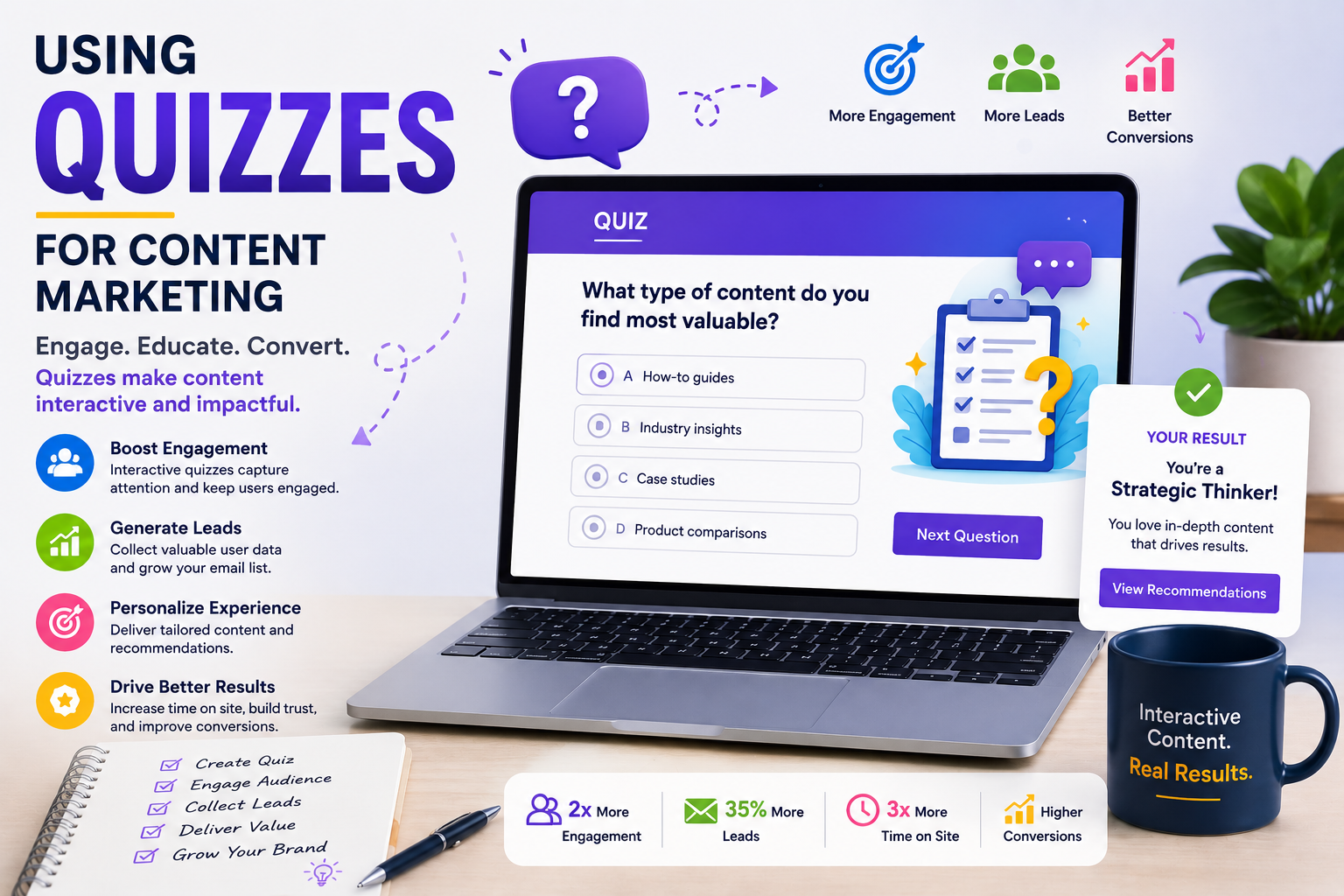
Recent digital marketing studies suggest that interactive content generates up to 2x more engagement than static content. Quizzes, in particular, have some of the highest completion rates among interactive formats because they feel light, personalized, and rewarding.
Unlike long-form content that requires passive reading, quizzes demand active participation. This small shift dramatically increases time spent on page, improves brand recall, and enhances user data collection.
For businesses operating in competitive markets, this is a major advantage. Every interaction becomes a data point, and every response reveals intent, preference, or pain points.
How Quizzes Drive Engagement and User Attention
Attention spans are shrinking, especially in digital environments. Users often decide within seconds whether they will stay on a page or leave.
Quizzes interrupt this pattern in a positive way.
Instead of presenting information upfront, they invite users into a conversation. This creates a sense of involvement and curiosity that keeps users engaged longer.
For example, a SaaS company offering project management software might create a quiz like:
“What Type of Project Manager Are You?”
As users answer questions, they become emotionally invested in the outcome. This emotional investment increases engagement far beyond what a traditional blog post could achieve.
The key psychological drivers behind quiz engagement include curiosity, personalization, and instant feedback. People enjoy seeing results immediately, especially when those results feel tailored to them.
The Role of Quizzes in Lead Generation
One of the biggest advantages of quizzes in content marketing is their ability to generate high-quality leads.
Unlike generic lead forms, quizzes feel natural and non-intrusive. Users willingly provide information because they receive value in return—personalized insights or recommendations.
A well-designed quiz can capture:
- Email addresses in exchange for results
- Business size or industry details
- Pain points or challenges
- Product preferences or buying intent
- Decision-making stage
These insights allow marketing teams to segment audiences more effectively and nurture them with highly relevant campaigns.
For example, a B2B cloud service provider might use a quiz titled “Is Your Infrastructure Ready for Scaling?” Based on responses, the company can identify whether a lead is early-stage, growth-stage, or enterprise-ready.
This level of precision improves conversion rates significantly compared to traditional forms of lead capture.
Personalization: The Real Power Behind Quiz Marketing
Modern marketing is no longer about broadcasting messages—it’s about delivering the right message to the right person at the right time.
Quizzes make this possible at scale.
When users complete a quiz, they voluntarily share insights about themselves. This data can be used to create highly personalized follow-ups, recommendations, and email campaigns.
For instance, an e-commerce brand selling skincare products can design a quiz like “Find Your Perfect Skincare Routine.” Based on answers, users might receive personalized product bundles.
This approach increases both trust and conversions because customers feel understood rather than sold to.
In fact, research shows that personalized marketing can improve conversion rates by up to 20% or more, depending on industry and execution quality.
Real-World Examples of Quiz Marketing Success
Many global brands have already integrated quizzes into their content marketing strategies with impressive results.
A well-known beauty brand created a “Skin Type Analyzer” quiz that helped users identify their skin concerns. The result was a significant increase in product recommendations and online sales because users received customized solutions instead of generic suggestions.
Similarly, a financial services company developed a “What’s Your Investment Style?” quiz. It helped them educate users while simultaneously segmenting them into risk profiles, leading to better-targeted investment product offers.
Even B2B companies are adopting this strategy. A cybersecurity firm used a “How Secure Is Your Business?” quiz to educate potential clients and identify weak security awareness among prospects. This created a natural entry point for sales conversations.
These examples highlight a key insight: quizzes work across industries because they focus on user understanding, not just promotion.
Designing High-Converting Quizzes
Creating a successful marketing quiz is not just about asking questions. It requires strategy, psychology, and alignment with business goals.
A good quiz should feel simple, relevant, and rewarding. If it becomes too long or complicated, users will drop off before completion.
The most effective quizzes follow a clear structure:
- Start with an engaging hook that sparks curiosity
- Ask questions that feel conversational, not interrogative
- Keep the flow logical and easy to follow
- Provide meaningful results that feel personalized
- End with a soft conversion opportunity
Each question should feel like it is guiding the user toward a valuable insight, not collecting data for the sake of it.
Another important aspect is tone. Quizzes that feel human and conversational perform significantly better than formal or robotic ones.
Technology Behind Quiz Marketing
Behind every successful quiz is a strong technology stack.
Modern quiz tools are integrated with CRM systems, email automation platforms, and analytics dashboards. This allows businesses to track user behavior, measure conversion rates, and refine quiz performance over time.
For startups, no-code quiz platforms make it easy to launch interactive experiences without heavy development costs. For enterprises, custom-built quiz engines can integrate deeply with internal data systems for advanced personalization.
AI is also transforming quiz marketing. Intelligent quiz systems can now adapt questions dynamically based on user responses, creating a more personalized and accurate experience.
As digital ecosystems become more complex, quizzes are evolving from simple engagement tools into intelligent marketing engines.
Common Mistakes Businesses Should Avoid
While quizzes are highly effective, poor execution can lead to weak results.
One common mistake is creating quizzes that are too long or irrelevant. Users quickly lose interest if they feel the quiz is wasting their time.
Another issue is over-promoting products too early. If a quiz feels like a disguised sales pitch, users are less likely to complete it.
Many businesses also fail to use quiz data effectively. Collecting responses without a follow-up strategy results in lost opportunities.
The key is balance—provide value first, and convert later.
The Future of Quizzes in Content Marketing
The future of quiz marketing is closely tied to personalization and AI-driven experiences.
As customer expectations continue to rise, static content will become less effective. Interactive and adaptive content will take center stage.
Quizzes will increasingly become part of omnichannel strategies, appearing not just on websites but also in messaging apps, social media, and even voice interfaces.
We are also likely to see more predictive quizzes that not only analyze user input but also suggest future actions based on behavior patterns.
Businesses that adopt these strategies early will gain a significant competitive advantage in audience engagement and lead generation.
Conclusion: Quizzes as a Strategic Growth Engine
Quizzes are no longer just a fun marketing experiment—they are a proven strategy for driving engagement, capturing leads, and delivering personalized customer experiences.
When executed correctly, they can transform passive website visitors into active participants and eventually into loyal customers.
For startups, quizzes offer a cost-effective way to stand out in crowded markets. For enterprises, they provide scalable personalization at depth. For all businesses, they create a bridge between engagement and conversion.
In a world where attention is limited and competition is intense, interactive content like quizzes is not optional—it is essential.
FAQs: Using Quizzes for Content Marketing
1. Are quizzes effective for B2B marketing?
Yes, quizzes work very well in B2B marketing by helping identify business needs, segment audiences, and generate qualified leads.
2. How long should a marketing quiz be?
Ideally, a quiz should have 6–12 questions. It should be long enough to provide value but short enough to maintain engagement.
3. Can quizzes improve conversion rates?
Yes, quizzes improve conversion rates by offering personalized recommendations and capturing high-intent leads in a non-intrusive way.
4. Do I need technical skills to create a quiz?
No. Many no-code tools allow businesses to create and deploy quizzes without technical expertise.
5. What industries benefit most from quiz marketing?
Industries like e-commerce, SaaS, education, finance, healthcare, and consulting benefit significantly from quiz-based engagement.