


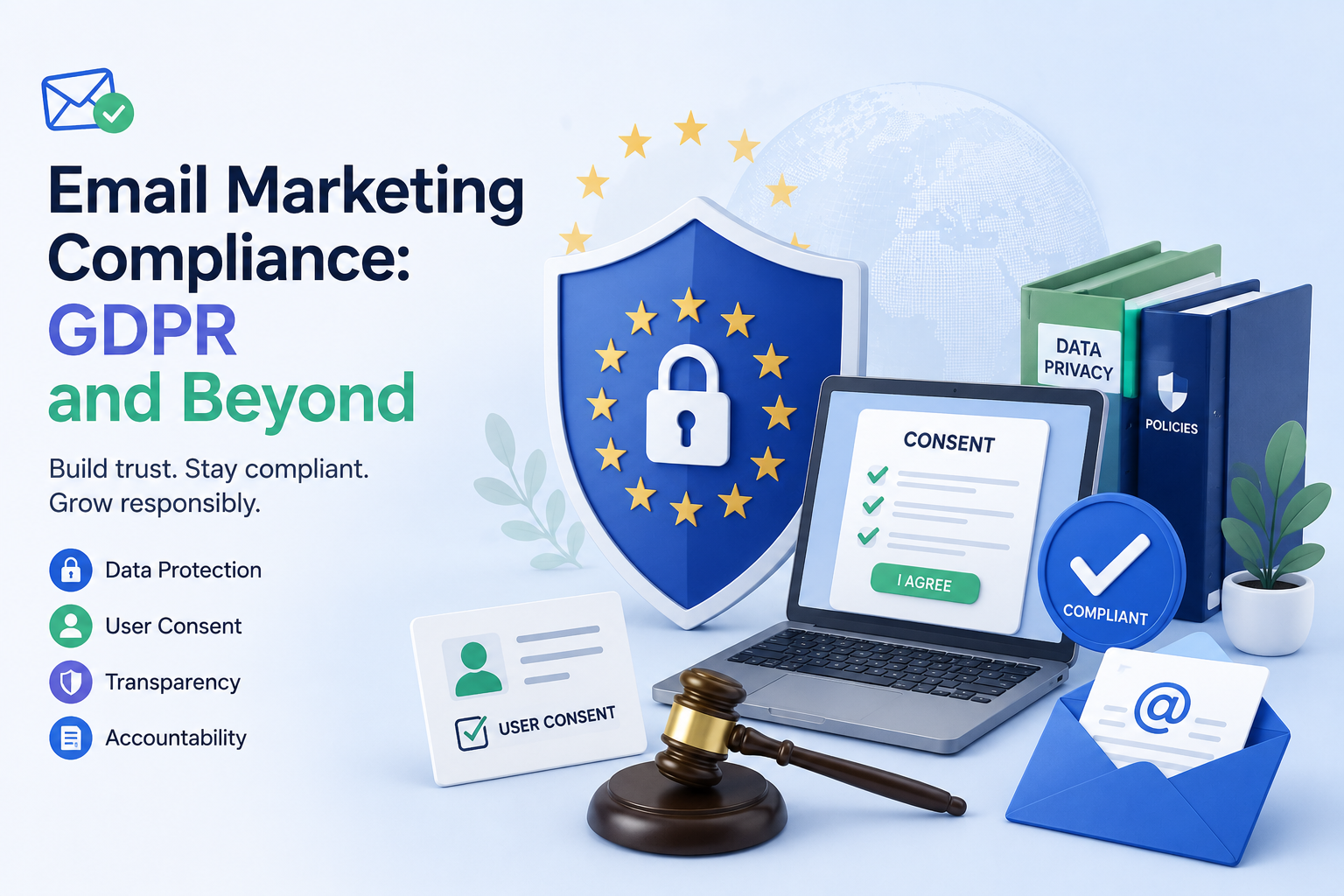
Email marketing remains one of the most effective digital marketing channels available today. Despite the rise of social media platforms, messaging apps, and AI-driven customer engagement tools, email continues to deliver exceptional ROI for businesses of all sizes. Studies consistently show that email marketing generates some of the highest returns among digital marketing investments, making it a critical component of modern growth strategies.
However, as businesses collect and process increasing amounts of customer data, regulatory scrutiny has intensified. Consumers are becoming more aware of how their personal information is used, and governments worldwide have responded by introducing stricter privacy laws and data protection regulations.
For organizations that rely on email campaigns to nurture leads, promote products, and maintain customer relationships, compliance is no longer optional. Regulations such as the General Data Protection Regulation (GDPR) have fundamentally changed how businesses collect consent, store customer information, and communicate with subscribers.
Today, compliance extends far beyond GDPR. Businesses operating globally must also navigate a growing landscape of privacy regulations, industry standards, and consumer expectations. Understanding these requirements is essential not only for avoiding penalties but also for building trust and strengthening customer relationships.
This guide explores email marketing compliance in depth, covering GDPR, emerging global regulations, best practices, and strategies that help organizations remain compliant while maximizing marketing performance.
Why Email Marketing Compliance Matters More Than Ever
Data privacy has become one of the defining business challenges of the digital era. Customers expect transparency regarding how their information is collected, stored, and used. At the same time, regulators are imposing significant fines on organizations that fail to protect personal data.
Email marketing sits at the center of this conversation because it relies heavily on personal information. Every email address, customer profile, behavioral insight, and engagement metric represents data that must be handled responsibly.
Non-compliance can lead to financial penalties, legal disputes, damaged brand reputation, and loss of customer trust. In contrast, businesses that prioritize privacy often experience stronger customer loyalty and improved engagement rates because subscribers feel confident that their information is being handled ethically.
Compliance is no longer simply a legal requirement. It has become a competitive advantage that demonstrates professionalism, transparency, and respect for customer privacy.
Understanding GDPR and Its Impact on Email Marketing
The General Data Protection Regulation (GDPR), introduced by the European Union in 2018, transformed global data privacy standards. Even organizations located outside Europe may be subject to GDPR if they collect or process data from EU residents.
The regulation places significant emphasis on obtaining valid consent before collecting personal data and using it for marketing purposes.
The Core Principles Behind GDPR
GDPR is built around several foundational principles that influence every aspect of email marketing.
These principles require organizations to be transparent about data collection practices and ensure personal information is only used for legitimate, clearly defined purposes.
For marketers, this means every subscriber should understand why they are providing their email address and how that information will be used.
Consent Under GDPR
One of the most significant changes introduced by GDPR involves consent requirements.
Pre-checked boxes, vague disclosures, and implied consent are generally insufficient. Instead, organizations must obtain clear and affirmative permission from individuals before sending marketing communications.
For example, an eCommerce company offering a downloadable guide cannot automatically subscribe users to promotional newsletters unless the user explicitly agrees. The consent request must be clear, separate from other terms, and easy to understand.
Equally important, users must have the ability to withdraw consent at any time.
Beyond GDPR: The Growing Global Compliance Landscape
While GDPR often dominates discussions about email marketing compliance, it is only one piece of a much larger regulatory framework.
Countries around the world have introduced privacy regulations that affect how organizations manage email communications.
Major Regulations Businesses Should Know
Although these regulations differ in scope and requirements, they share common objectives: protecting consumer privacy, increasing transparency, and giving individuals greater control over their personal information.
Businesses operating internationally must recognize that compliance strategies often need to accommodate multiple regulatory frameworks simultaneously.
The Business Risks of Non-Compliance
Many organizations underestimate the consequences of poor compliance practices until problems arise.
Financial penalties can be substantial. Regulatory authorities worldwide have issued millions of dollars in fines related to privacy violations, unlawful marketing practices, and inadequate data protection measures.
However, the financial impact is often only part of the problem.
When customers lose trust in a brand, recovery can be difficult. News of a data breach or regulatory investigation can spread quickly, affecting customer retention, investor confidence, and overall brand perception.
In highly competitive industries, even a small erosion of trust can result in significant revenue loss over time.
For startups and growing businesses, maintaining compliance from the beginning is usually far less expensive than addressing violations after they occur.
Building a Compliant Email Marketing Strategy
Compliance should be integrated into the foundation of every email marketing program rather than treated as a last-minute legal requirement.
Organizations that successfully balance compliance and performance typically focus on transparency throughout the customer journey.
Start with Permission-Based Marketing
Permission-based marketing remains one of the most effective approaches to both compliance and engagement.
Subscribers who willingly join an email list are more likely to open emails, click links, and convert into customers. They also generate fewer spam complaints and unsubscribe requests.
Instead of purchasing email lists or relying on questionable lead-generation tactics, organizations should focus on attracting subscribers through valuable content, resources, webinars, product updates, and exclusive offers.
This approach creates stronger relationships while reducing compliance risks.
Maintain Clear Documentation
Compliance requires more than obtaining consent. Businesses must also be able to demonstrate that consent was properly obtained.
Maintaining records of:
can provide critical evidence if regulatory questions arise.
Modern marketing automation platforms often include consent-tracking features that simplify this process.
Data Collection and Storage Best Practices
Compliance does not end when a user joins an email list. Organizations must also manage subscriber data responsibly throughout its lifecycle.
A common mistake involves collecting excessive information that is not necessary for marketing purposes. GDPR and similar regulations encourage data minimization, meaning businesses should only collect information that serves a legitimate purpose.
For instance, a newsletter signup form may only require an email address. Requesting extensive personal information without clear justification can create unnecessary compliance challenges.
Businesses should also establish data retention policies that define how long information will be stored and when outdated records will be deleted.
Regular database audits help ensure data remains accurate, relevant, and compliant.
The Role of Transparency in Modern Email Marketing
Transparency has become one of the most powerful trust-building tools available to marketers.
Consumers increasingly want to understand how organizations use their information. Clear communication regarding data collection, marketing practices, and privacy protections can significantly improve customer confidence.
Privacy policies should be written in straightforward language rather than complex legal jargon. Subscription forms should clearly explain what type of content subscribers will receive and how frequently communications will be sent.
When businesses are transparent from the beginning, they create realistic expectations and reduce the likelihood of complaints or regulatory concerns.
Email Marketing Automation and Compliance
Marketing automation platforms have transformed customer engagement by enabling personalized communication at scale.
However, automation introduces additional compliance considerations.
Automated workflows often rely on behavioral data such as website visits, purchase history, and engagement patterns. Organizations must ensure that these activities align with applicable privacy regulations and disclosed data practices.
Before implementing advanced automation strategies, businesses should verify that their data collection methods, consent mechanisms, and privacy notices adequately cover these activities.
Automation should enhance customer experiences without compromising privacy expectations.
Real-World Example: Compliance as a Competitive Advantage
Consider a software-as-a-service company expanding into European markets.
Rather than viewing GDPR as a regulatory burden, the company redesigned its entire customer onboarding process around transparency and privacy.
Signup forms clearly explained data usage practices. Subscribers could customize communication preferences. Privacy information was easily accessible, and consent records were automatically maintained.
As a result, the company not only achieved compliance but also improved engagement metrics. Open rates increased because subscribers better understood what communications to expect, and unsubscribe rates declined due to improved trust.
This example highlights an important reality: compliance and marketing performance are not mutually exclusive. In many cases, they reinforce one another.
Emerging Trends Shaping the Future of Compliance
The regulatory environment continues to evolve as governments respond to advances in technology, artificial intelligence, and data-driven marketing.
Several trends are likely to influence email marketing compliance in the coming years.
First, privacy regulations are becoming more widespread globally. More countries are adopting frameworks inspired by GDPR, creating a more complex compliance environment for international businesses.
Second, consumers are demanding greater control over their data. Preference centers, granular consent options, and transparent data management tools are becoming increasingly important.
Third, AI-powered marketing systems are attracting regulatory attention. Organizations using artificial intelligence for segmentation, personalization, and predictive analytics should expect increased scrutiny regarding data usage and transparency.
Forward-thinking businesses are already preparing for these developments by adopting privacy-first marketing strategies.
How to Stay Compliant Without Slowing Growth
Many organizations worry that stricter compliance requirements will reduce lead generation opportunities or limit marketing effectiveness.
In practice, the opposite is often true.
Businesses that focus on acquiring genuinely interested subscribers typically achieve better campaign performance than those relying on aggressive list-building tactics.
Quality consistently outperforms quantity in email marketing.
Organizations can maintain growth by focusing on valuable content, transparent communication, strong customer experiences, and ethical data practices. These elements not only support compliance but also contribute to long-term customer loyalty and sustainable revenue growth.
Conclusion
Email marketing compliance has evolved from a legal checkbox into a critical component of modern business strategy. Regulations such as GDPR have reshaped how organizations collect consent, manage customer information, and communicate with audiences.
Yet compliance extends far beyond GDPR. As privacy laws continue expanding worldwide, businesses must adopt comprehensive strategies that prioritize transparency, accountability, and customer trust.
Organizations that embrace compliance as part of their digital transformation journey are better positioned to build lasting relationships, protect their reputation, and achieve sustainable growth.
Rather than viewing regulations as obstacles, successful companies recognize them as opportunities to create more ethical, customer-centric marketing programs that deliver long-term value.
Frequently Asked Questions
What is GDPR in email marketing?
GDPR is a European data privacy regulation that requires organizations to obtain clear consent before collecting and using personal data for marketing purposes. It also gives individuals greater control over their personal information.
Does GDPR apply to companies outside Europe?
Yes. If a company collects or processes personal data from individuals located in the European Union, GDPR may apply regardless of where the company is based.
Can I buy email lists and remain compliant?
In most cases, purchasing email lists creates significant compliance risks because recipients have not directly consented to receive communications from your organization.
What should every marketing email include?
Marketing emails should typically include sender identification, contact information, an unsubscribe option, and content that aligns with the subscriber’s consent preferences.
How often should businesses review compliance practices?
Organizations should review compliance processes regularly, especially when launching new campaigns, entering new markets, implementing automation tools, or responding to regulatory changes.
Ready to Build a Compliant and Future-Proof Email Marketing Strategy?
Navigating GDPR, global privacy regulations, and evolving customer expectations requires more than basic compliance knowledge. Businesses need the right technology, processes, and expertise to create secure, scalable, and high-performing email marketing programs.
Partner with an experienced technology and digital transformation provider that understands modern compliance requirements, marketing automation, customer data management, and privacy-first growth strategies. The right partner can help your organization stay compliant, strengthen customer trust, and unlock the full potential of email marketing in a rapidly changing digital landscape.