


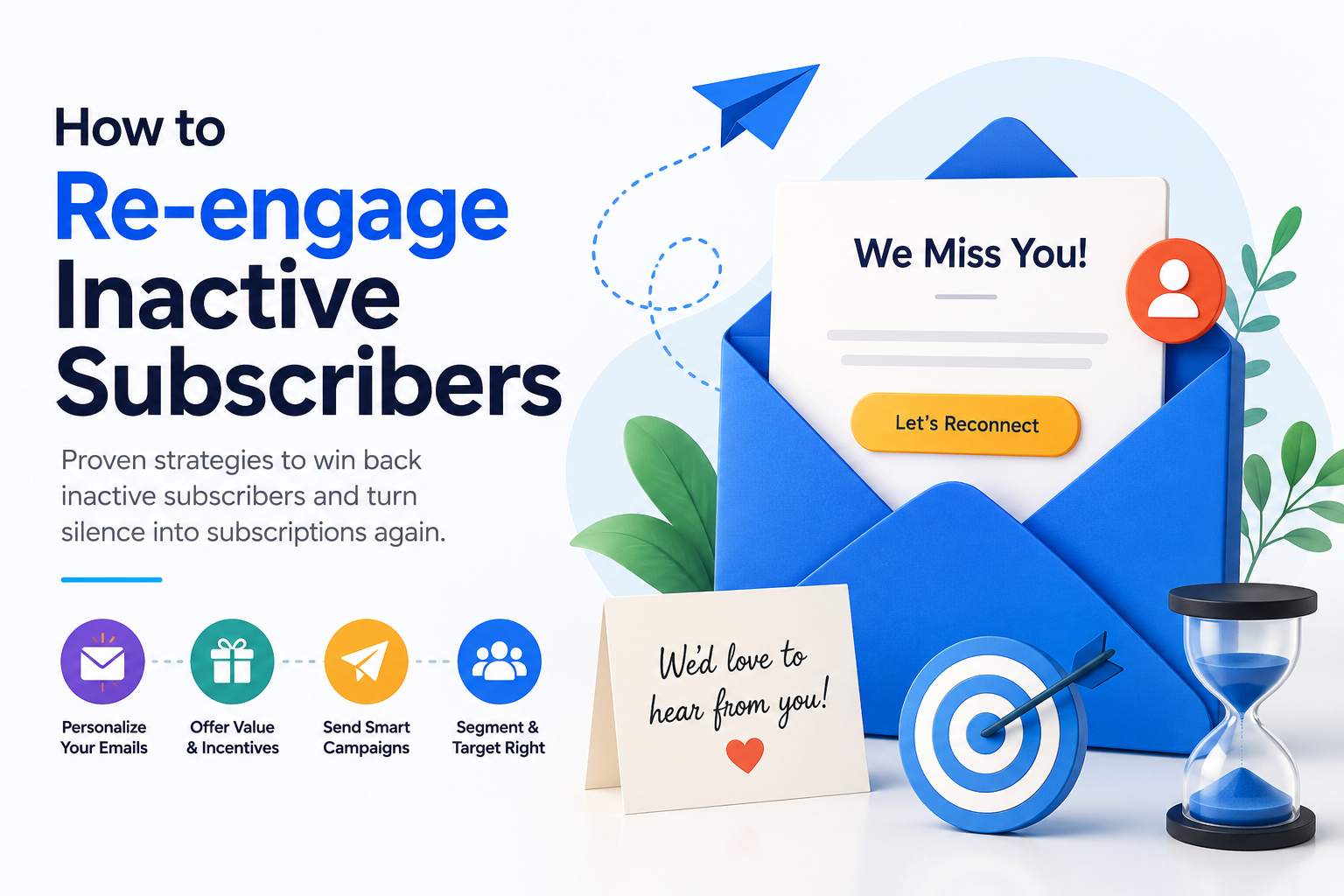
Email marketing remains one of the most effective digital marketing channels available today. Businesses invest significant time and resources into growing subscriber lists, creating valuable content, and nurturing customer relationships. However, even the healthiest email lists experience a common challenge: inactive subscribers.
Over time, some subscribers stop opening emails, clicking links, or engaging with marketing campaigns. They may have changed jobs, switched interests, become overwhelmed by inbox clutter, or simply forgotten why they subscribed in the first place.
For many businesses, inactive subscribers represent a hidden opportunity rather than a lost cause. Studies consistently show that acquiring a new customer costs significantly more than retaining an existing one. Re-engaging subscribers who already know your brand is often more cost-effective than continuously focusing only on new lead generation.
The good news is that inactive subscribers can often be brought back with the right strategy. By understanding why engagement declines and implementing targeted campaigns, businesses can improve open rates, increase conversions, and maximize the value of their email marketing efforts.
In this guide, we’ll explore proven strategies for re-engaging inactive subscribers and transforming dormant contacts into active, engaged customers once again.
Why Subscribers Become Inactive
Before launching any re-engagement campaign, it’s important to understand why subscribers disengage.
Modern consumers receive dozens, sometimes hundreds, of emails every day. Competition for attention is intense. Even customers who once actively engaged with your content may gradually lose interest if emails no longer feel relevant to their needs.
Several factors commonly contribute to subscriber inactivity.
Understanding these causes helps businesses create more effective re-engagement strategies rather than simply sending more emails and hoping for better results.
Identify and Segment Inactive Subscribers
The first step in any successful re-engagement strategy is identifying who qualifies as inactive.
Different businesses define inactivity differently. For some organizations, inactivity may mean no engagement within 30 days. For others, especially those with longer sales cycles, it may mean six months or even a year without interaction.
Segmentation allows marketers to categorize subscribers based on engagement history and behavior.
For example, someone who opened an email three months ago requires a different approach than someone who hasn’t engaged in over a year. Similarly, a customer who previously purchased products deserves a different message than a prospect who never converted.
Creating engagement-based segments allows businesses to personalize campaigns and improve response rates.
Build Engagement Tiers
Rather than treating all inactive subscribers the same, create multiple engagement categories.
A mildly inactive subscriber may simply need a reminder. A deeply inactive subscriber may require a stronger incentive to return. Segmenting based on engagement duration helps deliver more relevant messaging and improves campaign performance.
Analyze Historical Subscriber Behavior
One of the biggest mistakes marketers make is launching win-back campaigns without examining previous engagement patterns.
Historical data provides valuable insights into what originally attracted subscribers to your brand.
Look at past email performance and identify patterns such as:
These insights can help shape future campaigns and increase the likelihood of reconnecting with inactive contacts.
For example, a SaaS company may discover that educational content consistently outperforms promotional emails. In that case, a re-engagement campaign focused on helpful resources may generate stronger results than discount offers alone.
Create a Dedicated Re-engagement Campaign
A re-engagement campaign should not be treated as a regular newsletter.
Its purpose is specific: reminding subscribers of the value your brand provides and encouraging them to reconnect.
The most successful re-engagement campaigns acknowledge the subscriber’s absence without sounding accusatory. Instead of saying, “You haven’t opened our emails,” focus on what they may have missed and why returning could benefit them.
A simple message such as “We’ve added new resources you may find valuable” often performs better than aggressively pushing sales offers.
Use Personalized Messaging
Personalization goes beyond including a first name in the subject line.
Today’s subscribers expect relevant experiences. Businesses should leverage available customer data to create emails that feel tailored to individual interests.
A software company might recommend features based on previous usage patterns. An eCommerce retailer may highlight products related to past purchases. A consulting firm could share industry insights aligned with the subscriber’s professional role.
When subscribers feel understood, engagement naturally increases.
Refresh Your Value Proposition
Sometimes subscribers disengage because they no longer understand the value of remaining on your email list.
Over time, businesses evolve. Product offerings expand, services change, and customer needs shift. Subscribers who joined months or years ago may not be aware of everything your company now provides.
A re-engagement campaign presents an ideal opportunity to communicate your current value proposition.
Explain what makes your content worth reading today. Highlight new features, educational resources, industry expertise, or customer success stories that demonstrate ongoing relevance.
Real-world examples can be particularly effective. If a business customer achieved measurable results using your solution, sharing that story can remind inactive subscribers why they initially expressed interest.
Offer Meaningful Incentives
In some cases, subscribers need an additional reason to return.
Strategic incentives can motivate action and create renewed interest in your brand. However, incentives should support long-term engagement rather than attracting one-time interactions.
Common incentives include:
The key is ensuring the incentive aligns with subscriber interests and business goals.
For B2B companies, educational value often performs better than discounts. Decision-makers are frequently more interested in solving business challenges than saving a small percentage on a purchase.
Optimize Subject Lines for Re-engagement
Even the most compelling email won’t succeed if subscribers never open it.
Subject lines play a critical role in re-engagement campaigns. They should create curiosity, communicate value, and encourage action without appearing misleading.
Many successful brands use conversational subject lines that feel personal and authentic.
Questions, updates, exclusive opportunities, and personalized recommendations often generate stronger engagement than generic promotional language.
Testing multiple subject line variations is essential. A/B testing can reveal which messaging resonates most effectively with inactive audiences.
Small improvements in open rates can significantly impact overall campaign performance.
Give Subscribers Control Over Preferences
Not every inactive subscriber wants to completely unsubscribe.
Sometimes engagement drops because email frequency or content categories no longer match subscriber expectations.
Rather than forcing an all-or-nothing decision, allow subscribers to customize their experience.
A preference center enables users to choose:
Providing these options demonstrates respect for subscriber preferences while preserving valuable customer relationships.
Many subscribers who would otherwise unsubscribe choose instead to adjust their settings and remain engaged.
Leverage Automation for Consistent Re-engagement
Manual re-engagement efforts can become difficult to scale as subscriber lists grow.
Marketing automation helps businesses create structured workflows that automatically identify inactive subscribers and trigger appropriate campaigns.
For example, a subscriber who hasn’t opened emails in 90 days can automatically enter a re-engagement sequence. If they interact with an email, they can be moved back into active nurture campaigns.
Automation ensures that re-engagement becomes a continuous process rather than a one-time initiative.
For startups and growing companies, automated workflows provide efficiency while maintaining personalized experiences.
Test Different Content Formats
Sometimes the issue isn’t the message itself but the format used to deliver it.
Subscribers consume information differently. Some prefer articles and newsletters, while others engage more with videos, webinars, podcasts, case studies, or interactive content.
Experimenting with different formats can reveal new opportunities to capture attention.
For example, a technology company may discover that short educational videos generate significantly higher engagement than lengthy promotional emails. Similarly, an enterprise software provider might achieve better results through customer success stories and industry reports.
Testing multiple formats helps businesses adapt to evolving subscriber preferences.
Remove Subscribers Who Remain Unresponsive
While re-engagement campaigns can recover many inactive subscribers, not every contact can be revived.
Maintaining a large list filled with disengaged subscribers can negatively affect deliverability, sender reputation, and campaign performance.
After multiple re-engagement attempts, it may be necessary to remove persistently inactive contacts.
This process improves overall list quality and ensures marketing metrics accurately reflect audience engagement.
Many leading organizations conduct regular list hygiene programs to maintain healthy subscriber databases and optimize email performance.
Removing inactive subscribers may seem counterintuitive, but a smaller engaged audience is typically far more valuable than a larger inactive one.
Measuring Re-engagement Success
Effective re-engagement strategies require continuous measurement and optimization.
Businesses should track key performance indicators to understand campaign effectiveness and identify areas for improvement.
Important metrics include open rates, click-through rates, conversion rates, unsubscribe rates, reactivation rates, and overall revenue generated from recovered subscribers.
Analyzing these metrics helps marketing teams refine future campaigns and maximize long-term results.
Organizations that continuously optimize their email marketing programs often achieve significantly better engagement outcomes than those relying on static strategies.
The Future of Subscriber Re-engagement
As personalization technologies continue to evolve, re-engagement strategies are becoming increasingly sophisticated.
Artificial intelligence, predictive analytics, and behavioral segmentation are enabling businesses to identify disengagement patterns earlier and respond with highly relevant messaging.
Rather than waiting for subscribers to become inactive, companies can proactively intervene with personalized content before engagement declines.
This shift from reactive to predictive marketing is expected to become a major competitive advantage in the coming years.
Businesses that invest in data-driven engagement strategies today will be better positioned to maintain strong subscriber relationships tomorrow.
Conclusion
Inactive subscribers do not necessarily represent lost opportunities. In many cases, they are valuable contacts who simply need a compelling reason to reconnect with your brand.
Successful re-engagement begins with understanding why subscribers became inactive, segmenting audiences appropriately, and delivering personalized experiences that provide genuine value.
From optimized subject lines and automated workflows to preference management and targeted incentives, every element of a re-engagement strategy should focus on relevance and customer needs.
Businesses that consistently invest in subscriber engagement can improve retention, strengthen customer relationships, and maximize the return on their email marketing efforts.
As competition for inbox attention continues to grow, organizations that prioritize meaningful communication over volume will be best positioned to maintain long-term subscriber loyalty and drive sustainable business growth.
Frequently Asked Questions
What is an inactive subscriber?
An inactive subscriber is someone who has stopped engaging with your email campaigns. This typically means they have not opened emails, clicked links, or interacted with your content for a defined period.
How long should a subscriber be inactive before launching a re-engagement campaign?
The timeframe varies by industry and business model. Many organizations begin re-engagement efforts after 60 to 90 days of inactivity, while businesses with longer sales cycles may wait several months.
Why is re-engaging subscribers important?
Re-engaging subscribers is often more cost-effective than acquiring new leads. It helps improve customer retention, increase conversions, and maximize the value of your existing audience.
Should I remove inactive subscribers from my email list?
Yes, if subscribers remain unresponsive after multiple re-engagement attempts. Removing inactive contacts can improve deliverability, sender reputation, and overall campaign performance.
What is the most effective re-engagement strategy?
The most effective strategy combines segmentation, personalization, relevant content, automated workflows, and continuous testing. There is no single solution, but a data-driven approach typically produces the best results.
Ready to Strengthen Customer Engagement?
Re-engaging inactive subscribers requires more than sending a few reminder emails. It demands a strategic combination of data analysis, personalization, automation, and customer-focused communication.
Whether you’re a startup looking to improve retention, an SME aiming to increase marketing ROI, or an enterprise pursuing digital transformation, partnering with the right technology and marketing experts can accelerate results.
Choose a technology partner that understands modern customer engagement, marketing automation, analytics, and scalable digital solutions. The right expertise can help you transform inactive subscribers into loyal customers while building a stronger, more profitable marketing ecosystem for the future.