


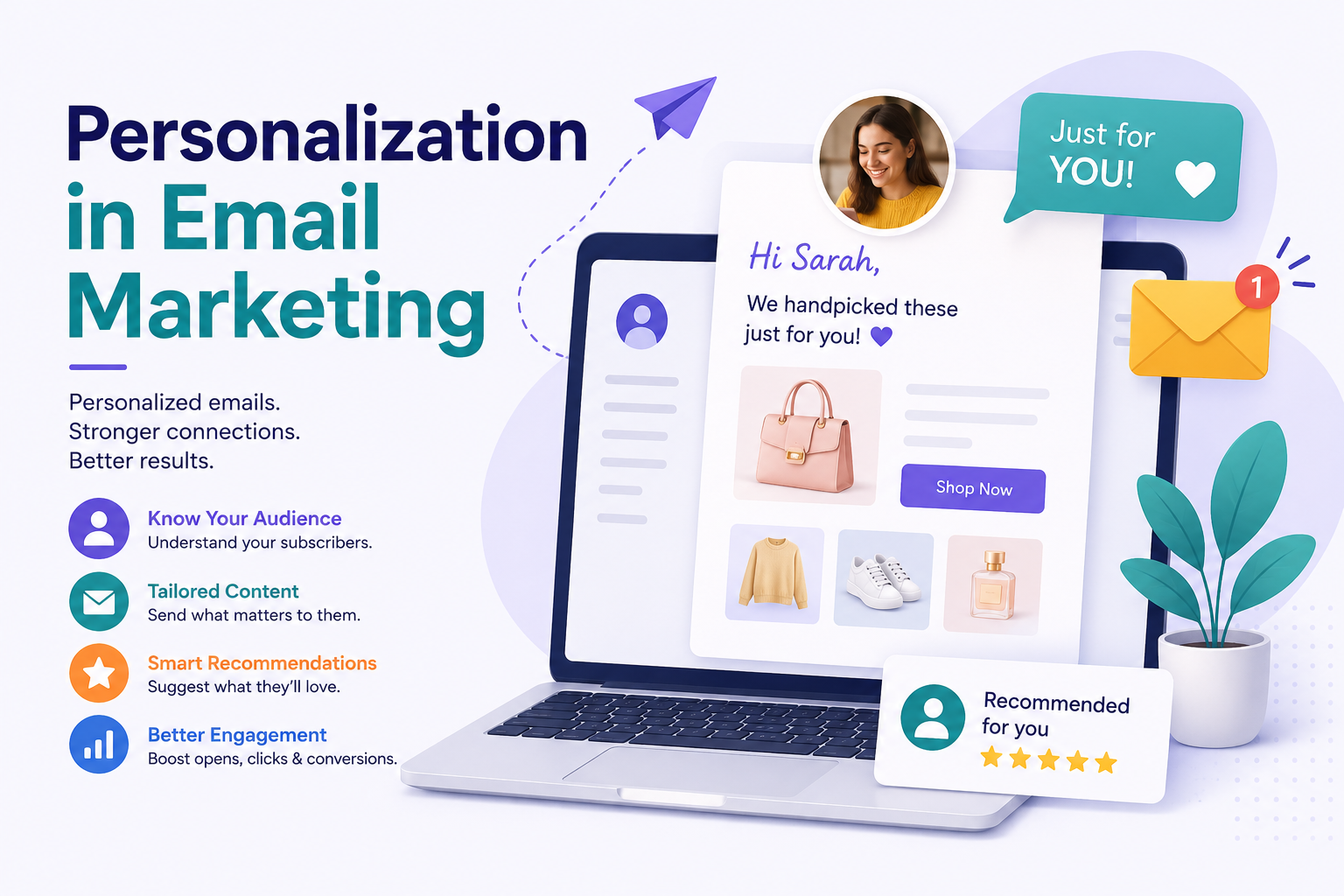
Inbox competition has never been higher. Every day, consumers receive dozens, sometimes hundreds, of promotional emails from brands competing for attention. As a result, generic email campaigns are becoming less effective, while personalized email marketing continues to deliver stronger engagement, better customer experiences, and higher conversion rates.
Modern customers expect brands to understand their preferences, behaviors, and needs. They no longer respond positively to one-size-fits-all messaging. Instead, they engage with businesses that deliver relevant content at the right time through personalized communication.
This shift has transformed email marketing from a mass communication channel into a powerful relationship-building tool. Businesses that embrace personalization are seeing significant improvements in open rates, click-through rates, customer retention, and overall revenue.
Whether you are a startup looking to build customer loyalty, an SME aiming to improve marketing ROI, or an enterprise undergoing digital transformation, personalization in email marketing can create meaningful competitive advantages.
In this guide, we’ll explore what email personalization is, why it matters, how leading companies use it successfully, and the best practices that can help your business achieve measurable results.
What Is Personalization in Email Marketing?
Personalization in email marketing refers to tailoring email content based on customer data, preferences, behavior, demographics, purchase history, and interactions with a brand.
Many businesses mistakenly believe personalization starts and ends with including a recipient’s first name in the subject line. While name personalization can help, modern personalization goes much deeper.
Today’s email personalization can include product recommendations, location-specific offers, personalized content blocks, behavioral triggers, and customer lifecycle messaging.
Instead of sending identical emails to every subscriber, businesses can create experiences that feel relevant and valuable to each individual customer.
For example, an online clothing retailer may send different emails to customers interested in sportswear than those who frequently purchase formal attire. Both groups receive communication from the same brand, but the content aligns with their preferences.
This level of relevance significantly improves engagement and customer satisfaction.
Why Personalization Matters More Than Ever
Customer expectations continue to evolve. Consumers interact with highly personalized experiences on streaming platforms, eCommerce websites, and social media channels every day. Naturally, they expect the same level of relevance from email communication.
According to multiple industry studies, personalized emails consistently outperform generic campaigns in terms of open rates, click-through rates, and revenue generation. Businesses that leverage customer data effectively often see substantial improvements in marketing performance.
Several factors contribute to the growing importance of personalization:
As organizations focus more on customer-centric strategies, personalized email marketing has become an essential component of digital growth.
The Business Benefits of Personalized Email Marketing
Higher Open Rates
The first challenge in email marketing is getting recipients to open the message. Personalized subject lines often attract more attention because they feel more relevant to the recipient.
When customers recognize that an email addresses their interests or recent activity, they are naturally more inclined to engage.
For example, a travel company sending “Special Flight Deals to Dubai” based on a customer’s previous searches will likely perform better than a generic promotional email sent to the entire database.
Increased Click-Through Rates
Opening an email is only the beginning. The real goal is encouraging recipients to take action.
Personalized content increases the likelihood that users will click links, explore products, register for events, or complete purchases because the information aligns with their needs.
Relevant recommendations and targeted offers help reduce decision fatigue while increasing customer engagement.
Better Customer Retention
Customer acquisition is often significantly more expensive than customer retention. Personalized email campaigns help businesses maintain ongoing relationships by delivering value consistently.
Customers who feel understood and appreciated are more likely to remain loyal to a brand over time.
Retention-focused personalization can include renewal reminders, loyalty rewards, exclusive offers, and milestone celebrations.
Stronger Revenue Growth
One of the biggest advantages of personalization is its impact on revenue.
By sending the right message to the right audience at the right moment, businesses can increase conversions while improving customer lifetime value.
Many organizations discover that personalized campaigns generate substantially more revenue than generic email broadcasts because relevance drives action.
Types of Email Personalization Businesses Should Use
Not all personalization strategies require advanced artificial intelligence or complex technology. Even simple approaches can generate impressive results.
Demographic Personalization
Demographic data such as age, gender, industry, company size, and job role can help businesses deliver more relevant content.
For example, a B2B software company may send different messages to CTOs, marketing leaders, and business owners because each audience has unique priorities and challenges.
Behavioral Personalization
Behavioral personalization focuses on how customers interact with a brand.
Actions such as website visits, product views, downloads, email engagement, and shopping cart activity provide valuable insights into customer interests.
When businesses respond to these behaviors with targeted communication, engagement often improves significantly.
Purchase-Based Personalization
Past purchases can reveal valuable information about customer preferences.
An eCommerce company can recommend complementary products, replenishment reminders, or upgraded versions based on previous transactions.
This strategy not only improves customer experience but also increases cross-selling and upselling opportunities.
Lifecycle-Based Personalization
Customers move through different stages of their journey with a brand.
A new subscriber requires different messaging than a long-term customer.
Lifecycle personalization ensures that communication aligns with each stage, from onboarding and nurturing to retention and re-engagement.
Real-World Examples of Email Personalization Success
Many successful brands have built their marketing strategies around personalization.
A global streaming platform recommends content based on viewing history and engagement patterns. These personalized recommendations encourage users to return regularly and consume more content.
Major eCommerce companies use browsing behavior and purchase history to deliver highly targeted product recommendations. Customers often receive suggestions that align closely with their interests, increasing the likelihood of future purchases.
Similarly, SaaS companies personalize onboarding emails based on product usage. New users receive educational content designed to help them achieve success quickly, improving adoption and retention rates.
These examples demonstrate how personalization creates value for both businesses and customers.
The Role of Data in Effective Email Personalization
Personalization is only as effective as the data supporting it.
Businesses must collect, organize, and manage customer information responsibly to create meaningful experiences.
Key data sources commonly used in email personalization include:
The goal is not simply to collect more data but to use available information intelligently.
Organizations that maintain accurate customer data are better positioned to deliver relevant experiences and achieve stronger marketing outcomes.
How Automation Powers Personalized Email Marketing
As customer databases grow, manual personalization becomes increasingly difficult.
Marketing automation platforms allow businesses to scale personalization efficiently while maintaining consistency.
Automation can trigger emails based on specific customer actions, such as account registration, product purchases, abandoned carts, or inactivity periods.
For example, if a customer adds items to a shopping cart but leaves without purchasing, an automated personalized reminder can encourage them to complete the transaction.
These automated workflows help businesses deliver timely and relevant communication without requiring constant manual effort.
AI and the Future of Email Personalization
Artificial intelligence is reshaping the future of email marketing.
AI-powered systems can analyze vast amounts of customer data, identify patterns, and predict future behavior with remarkable accuracy.
Modern AI capabilities include:
As AI technologies continue to evolve, businesses will gain even greater ability to create highly personalized customer experiences at scale.
Organizations investing in AI-driven marketing today are positioning themselves for long-term competitive advantages.
Common Personalization Mistakes to Avoid
While personalization offers significant benefits, poor execution can reduce effectiveness and even damage customer trust.
One common mistake is over-personalization. Customers appreciate relevance, but excessive use of personal information can feel intrusive.
Another issue is relying on outdated or inaccurate data. Incorrect recommendations or irrelevant content can create frustration rather than engagement.
Many businesses also focus solely on first-name personalization while ignoring deeper opportunities such as behavioral targeting and lifecycle segmentation.
Successful personalization requires balance, relevance, accuracy, and respect for customer privacy.
Measuring the Success of Personalized Email Campaigns
Like any marketing initiative, personalization should be measured using clear performance indicators.
Important metrics include open rates, click-through rates, conversion rates, revenue per email, unsubscribe rates, and customer retention levels.
Comparing personalized campaigns against non-personalized campaigns can reveal the true impact of personalization efforts.
Businesses should continuously test subject lines, content variations, segmentation strategies, and automation workflows to improve results over time.
Data-driven optimization ensures personalization remains effective as customer expectations evolve.
Building a Personalization Strategy for Long-Term Growth
A successful personalization strategy begins with understanding customer needs and aligning technology with business objectives.
Organizations should focus on creating a structured roadmap that combines customer data, automation tools, analytics, and continuous optimization.
Rather than attempting advanced personalization immediately, businesses can start with basic segmentation and gradually introduce more sophisticated capabilities.
The most effective strategies prioritize customer value over marketing complexity.
When personalization enhances customer experiences, business results naturally follow.
Conclusion
Personalization in email marketing is no longer a competitive advantage reserved for large enterprises. It has become an essential strategy for businesses of every size seeking stronger customer relationships, improved engagement, and sustainable growth.
Customers expect relevant experiences, and businesses that deliver personalized communication consistently outperform those relying on generic messaging.
From behavioral targeting and lifecycle segmentation to AI-powered recommendations and automated workflows, personalization enables organizations to connect with customers in more meaningful ways.
As digital transformation accelerates across industries, companies that invest in personalization will be better positioned to increase conversions, improve retention, and maximize marketing ROI.
The future of email marketing belongs to businesses that understand their customers and use data responsibly to create valuable, relevant experiences.
Frequently Asked Questions (FAQs)
What is personalization in email marketing?
Personalization in email marketing involves tailoring email content based on customer data, preferences, behavior, demographics, and interactions to deliver more relevant experiences.
Why is email personalization important?
Email personalization improves open rates, click-through rates, customer engagement, retention, and conversion rates by making communication more relevant to recipients.
How can small businesses use email personalization?
Small businesses can start with customer segmentation, personalized subject lines, behavioral triggers, and targeted offers without requiring large budgets or complex technology.
Does personalization increase email marketing ROI?
Yes. Personalized email campaigns typically generate higher engagement and conversion rates, leading to stronger returns on marketing investment.
How does AI improve email personalization?
AI analyzes customer behavior, predicts preferences, optimizes send times, recommends products, and helps businesses create highly relevant email experiences at scale.
Ready to Transform Your Email Marketing Strategy?
Personalization is no longer optional in today’s competitive digital landscape. Whether you’re a startup building customer relationships, an SME looking to increase conversions, or an enterprise pursuing digital transformation, the right technology strategy can unlock significant business value.
Partner with an experienced digital transformation and marketing technology provider that understands customer data, automation, AI, and scalable personalization solutions. The right technology partner can help your organization create smarter customer experiences, improve engagement, and drive sustainable business growth through personalized email marketing.