


Every day, consumers are exposed to thousands of advertisements across search engines, social media platforms, websites, mobile apps, and streaming services. In this crowded digital environment, grabbing attention has become more challenging than ever.
Many businesses invest significant budgets into advertising campaigns, only to see disappointing results. In most cases, the problem is not the advertising platform or even the audience targeting. The real issue is often the message itself.
Ad copy serves as the bridge between your business and your potential customer. It is the first impression, the value proposition, and the persuasive element that encourages someone to take action. Whether your goal is generating leads, increasing sales, driving website traffic, or building brand awareness, effective ad copy can dramatically improve campaign performance.
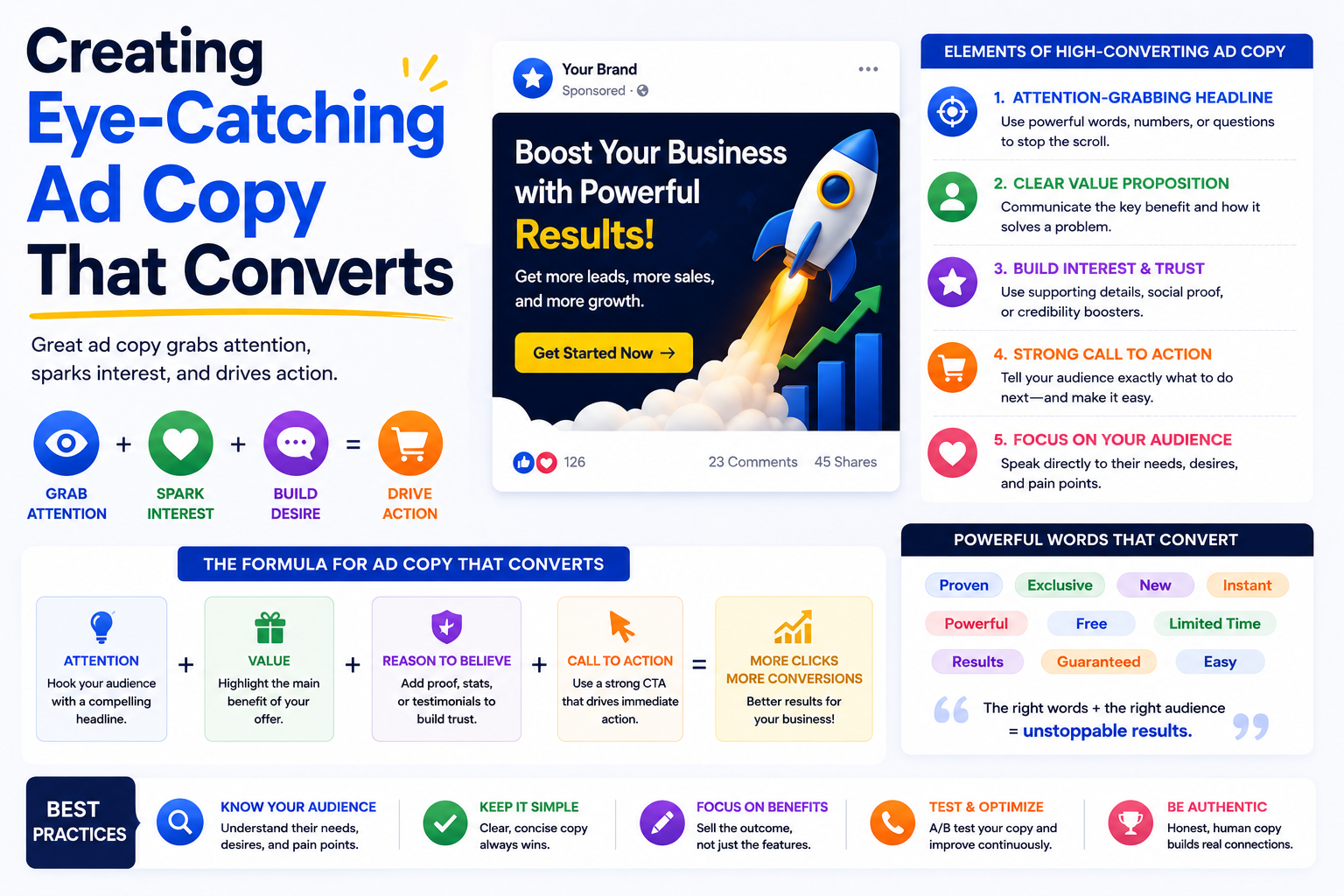
The difference between a successful campaign and an unsuccessful one often comes down to a few carefully chosen words. Strong ad copy captures attention, creates interest, builds trust, and motivates action.
This guide explores how businesses can create eye-catching ad copy that not only gets noticed but also converts prospects into customers.
Why Ad Copy Matters More Than Ever
Digital advertising has become increasingly competitive. Businesses of all sizes are competing for the same audience attention.
Research consistently shows that consumers make split-second decisions about whether to engage with an advertisement. Within a few moments, they determine whether the message is relevant to their needs or if they should continue scrolling.
This means your ad copy has a very limited window to:
-
Capture attention
-
Communicate value
-
Build interest
-
Encourage action
If your message fails at any one of these stages, potential customers may never engage with your brand.
Well-crafted ad copy not only improves click-through rates but also increases conversion rates, lowers customer acquisition costs, and maximizes return on advertising spend.
Understanding the Psychology Behind High-Converting Ad Copy
Before writing a single headline, it is important to understand why people respond to certain messages.
Consumers rarely buy products solely because of features. They buy because of outcomes, solutions, emotions, and benefits.
A startup founder searching for project management software is not looking for another tool. They want better team collaboration and increased productivity.
A business owner investing in cybersecurity services is not purchasing software licenses. They are buying protection, peace of mind, and business continuity.
The most effective ad copy focuses on the desired result rather than the product itself.
When businesses align their messaging with customer motivations, advertising performance improves significantly.
Start with a Deep Understanding of Your Audience
Great ad copy begins long before the writing process.
Many marketers make the mistake of creating ads based on what they want to say rather than what customers want to hear.
To write persuasive copy, you must understand:
Customer Pain Points
Every successful product or service solves a problem.
If you can clearly identify your audience’s frustrations, challenges, and obstacles, you can position your solution more effectively.
For example, a cloud migration company targeting enterprises may focus on reducing infrastructure costs, improving scalability, and enhancing security.
The more specific the problem, the more compelling the message becomes.
Customer Goals
People are motivated by aspirations as much as problems.
A business investing in automation wants faster workflows. A startup adopting AI solutions wants operational efficiency. An e-commerce company wants higher sales and customer retention.
When ad copy speaks directly to these goals, it becomes far more persuasive.
Customer Language
The most effective advertisements often mirror the language customers already use.
Review customer feedback, sales conversations, online forums, and social media discussions. These insights reveal how your audience describes their challenges and desired outcomes.
Using familiar language creates an immediate sense of relevance and connection.
Craft Headlines That Stop the Scroll
The headline is arguably the most important element of any advertisement.
Even the most persuasive body copy cannot perform if the headline fails to capture attention.
Strong headlines typically achieve one or more of the following objectives:
Highlight a Benefit
Customers immediately want to know what is in it for them.
Instead of saying:
“Advanced Marketing Automation Platform”
Try:
“Automate Your Marketing and Generate More Qualified Leads”
The second option focuses on outcomes rather than features.
Create Curiosity
Curiosity can be a powerful motivator when used appropriately.
For example:
“The Simple Strategy Helping Startups Scale Faster”
This creates intrigue while remaining relevant.
Address a Specific Problem
Problem-focused headlines resonate because they immediately feel relevant.
For example:
“Struggling to Reduce Customer Churn? Here’s the Solution.”
People naturally pay attention to messages that address their challenges.
Focus on Benefits, Not Features
One of the most common advertising mistakes is listing product features without explaining their value.
Features describe what a product does.
Benefits explain why customers should care.
Consider this example:
Feature:
“24/7 Customer Support”
Benefit:
“Get Expert Help Anytime to Keep Your Business Running Smoothly”
The benefit creates a stronger emotional connection because it emphasizes the outcome.
Every feature in your advertisement should ultimately answer one question:
“What does this mean for the customer?”
When benefits become the primary focus, conversion rates often improve significantly.
Use Emotional Triggers to Drive Action
Despite advances in technology and analytics, purchasing decisions remain heavily influenced by emotions.
People may justify decisions logically, but emotions often drive initial action.
Trust
Trust is particularly important for high-value purchases and B2B services.
Including customer success stories, testimonials, certifications, or industry recognition can strengthen credibility.
Fear of Missing Out
Limited-time offers and exclusive opportunities can encourage faster decision-making.
However, urgency should always be genuine rather than artificially created.
Achievement and Success
Business leaders are often motivated by growth, efficiency, profitability, and competitive advantage.
Ad copy that highlights these outcomes can resonate strongly with decision-makers.
For example:
“Help Your Team Deliver Projects 30% Faster.”
This focuses on success rather than simply promoting a software platform.
Create a Strong and Clear Call-to-Action
Even excellent ad copy can fail if the next step is unclear.
A call-to-action (CTA) tells users exactly what to do next.
Weak CTAs often create confusion and reduce conversions.
Instead of generic phrases like:
“Learn More”
Consider more action-oriented alternatives such as:
“Book Your Free Consultation”
“Start Your Free Trial Today”
“Schedule a Demo”
“Get Your Custom Quote”
The best CTAs align with the customer’s stage in the buying journey.
Someone exploring solutions may respond better to educational offers, while purchase-ready prospects may be prepared for direct sales actions.
Personalization Is Becoming a Competitive Advantage
Modern consumers expect personalized experiences.
As advertising platforms become more sophisticated, businesses can create highly targeted messages based on audience behavior, demographics, interests, and intent.
For example, a software company may create different advertisements for:
Startups looking to scale
Mid-sized businesses seeking efficiency
Large enterprises pursuing digital transformation
Although the product remains the same, the messaging changes based on audience priorities.
Personalized advertising consistently delivers stronger engagement and conversion rates because it feels more relevant.
Learning from Real-World Examples
Some of the world’s most successful brands excel at creating compelling ad copy because they understand customer motivations.
For example, companies like Apple often focus less on technical specifications and more on user experience, creativity, and innovation.
Similarly, Slack transformed workplace communication messaging by emphasizing collaboration and productivity rather than software functionality.
These examples demonstrate a valuable lesson: customers are interested in outcomes, not technical details.
Businesses that communicate value clearly often outperform competitors with similar products.
Testing and Optimization: The Secret to Long-Term Success
Even experienced marketers cannot predict with complete accuracy which advertisement will perform best.
This is why testing is essential.
Small changes can produce significant improvements in campaign performance.
Elements worth testing include:
-
Headlines
-
Value propositions
-
CTA wording
-
Ad descriptions
-
Emotional versus logical messaging
A/B testing allows businesses to compare variations and identify what resonates most effectively with their audience.
Over time, these incremental improvements can generate substantial gains in conversions and advertising ROI.
Common Ad Copy Mistakes to Avoid
Many campaigns underperform because of avoidable copywriting mistakes.
One common issue is trying to communicate too much information at once. When advertisements become cluttered, the core message gets lost.
Another mistake is using generic language. Phrases such as “best-in-class solution” or “industry-leading service” are overused and often lack credibility unless supported by evidence.
Businesses also frequently focus too heavily on themselves rather than their customers. Effective ad copy should prioritize customer needs, challenges, and desired outcomes.
Finally, weak calls-to-action can significantly reduce conversions, even when the rest of the advertisement performs well.
Avoiding these mistakes can dramatically improve advertising effectiveness.
The Future of Ad Copy in the AI Era
Artificial intelligence is changing how advertisements are created, tested, and optimized.
AI tools can generate multiple copy variations, analyze audience behavior, and identify patterns that improve performance.
However, human creativity remains essential.
Successful advertising still requires empathy, strategic thinking, and a deep understanding of customer psychology.
The most effective organizations combine AI-powered efficiency with human insight to create compelling, authentic messaging.
As competition continues to increase, businesses that master this balance will gain a significant advantage.
Conclusion
Creating eye-catching ad copy that converts is both an art and a science.
The most successful advertisements are not necessarily the most creative or the most complex. They are the most relevant.
When businesses understand their audience, focus on benefits, use persuasive headlines, create emotional connections, provide clear value, and include strong calls-to-action, advertising performance improves dramatically.
Whether you are a startup launching your first campaign, an SME looking to generate more leads, or an enterprise optimizing large-scale advertising efforts, investing in better ad copy can deliver measurable business results.
In an increasingly crowded digital marketplace, the ability to communicate value quickly and effectively may be one of the most important competitive advantages your business can develop.
Frequently Asked Questions (FAQs)
What makes ad copy effective?
Effective ad copy captures attention, addresses customer pain points, highlights benefits, creates emotional engagement, and includes a clear call-to-action that encourages users to take the next step.
How long should ad copy be?
The ideal length depends on the platform. Search ads typically require concise messaging, while social media and landing page advertisements may allow for more detailed storytelling.
Should ad copy focus on features or benefits?
Benefits should be the primary focus. Customers are more interested in outcomes and solutions than technical specifications or product features.
Why is A/B testing important for ad copy?
A/B testing helps businesses identify which headlines, messages, and calls-to-action perform best, leading to higher conversion rates and better advertising ROI.
Can AI help create better ad copy?
AI can assist with content generation, testing, and optimization. However, human creativity and customer understanding remain essential for creating truly persuasive and authentic advertising messages.
Ready to Improve Your Advertising Results?
The difference between average campaigns and high-performing campaigns often comes down to messaging. Partnering with the right digital marketing and technology experts can help your business create compelling ad copy, optimize campaign performance, leverage data-driven insights, and maximize return on investment.
If your organization is looking to accelerate growth, improve conversions, and build more effective advertising strategies, now is the time to work with a trusted technology and marketing partner that understands both customer psychology and modern digital transformation.