


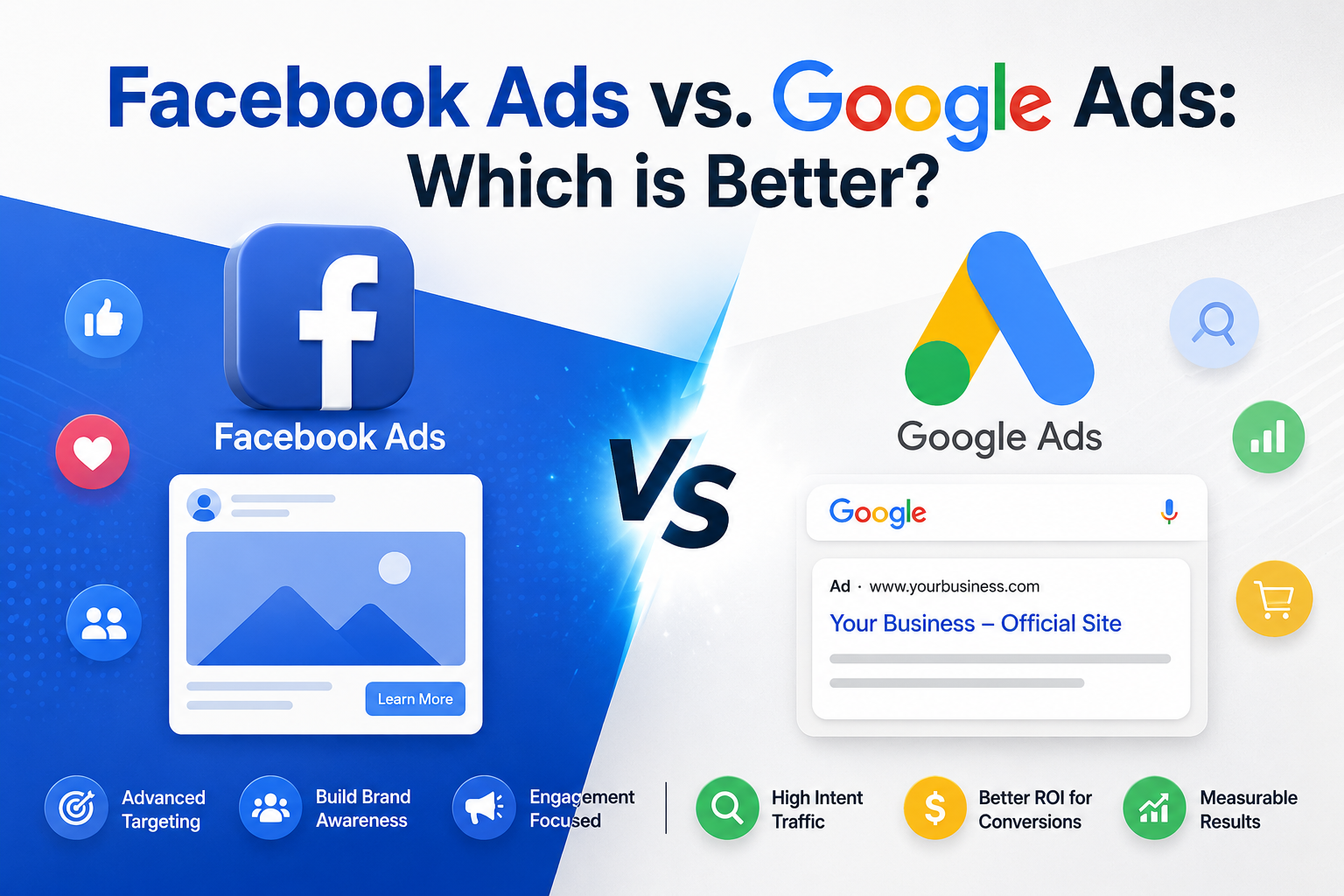
Digital advertising has become one of the most powerful growth engines for modern businesses. Whether you’re a startup trying to gain visibility, an SME looking to generate qualified leads, or an enterprise scaling customer acquisition, paid advertising can accelerate results far faster than organic channels alone.
However, one question continues to dominate marketing discussions:
Facebook Ads or Google Ads—which platform is better?
The answer is not as simple as choosing one over the other. Both platforms are industry leaders, both reach billions of users, and both can generate impressive returns when used correctly. Yet they operate very differently, target audiences in unique ways, and excel at different stages of the customer journey.
Understanding these differences is essential before investing your advertising budget.
In this comprehensive guide, we’ll compare Facebook Ads and Google Ads across targeting, costs, conversions, audience intent, ROI, and business use cases to help you determine which platform aligns best with your goals.
Understanding Facebook Ads and Google Ads
Before comparing performance, it’s important to understand how each platform works.
Facebook Ads, operated through Meta’s advertising ecosystem, allow businesses to promote products and services across Facebook, Instagram, Messenger, and the Audience Network. These ads appear while users are browsing social content, watching videos, engaging with friends, or discovering brands.
Google Ads, on the other hand, focus primarily on search intent. Businesses bid on keywords so their ads appear when users actively search for specific products, services, or solutions. Google also provides display, shopping, video, and remarketing advertising options across its extensive network.
The fundamental distinction is simple:
Facebook creates demand.
Google captures demand.
This difference influences almost every aspect of campaign performance.
The Power of Audience Intent
One of the biggest factors in determining advertising success is user intent.
When someone searches for “best CRM software for startups” on Google, they already have a need. They are actively looking for information or a solution. This makes Google Ads incredibly effective for capturing high-intent prospects who are closer to making a purchase decision.
Facebook users behave differently.
Most people are not visiting Facebook or Instagram to buy products. They are scrolling through content, interacting with friends, or consuming entertainment. Successful Facebook campaigns interrupt that experience with compelling offers and creative messaging.
This means Facebook excels at awareness and demand generation, while Google often performs better for direct response campaigns targeting users already in the buying cycle.
For businesses seeking immediate leads from existing demand, Google frequently has an advantage.
For brands trying to create awareness and introduce new products, Facebook can be exceptionally effective.
Targeting Capabilities: Which Platform Is More Advanced?
Both advertising platforms offer sophisticated targeting, but their strengths differ.
Facebook has built its reputation on audience targeting. Because Meta collects extensive demographic and behavioral data, advertisers can target users based on interests, lifestyle factors, purchase behavior, engagement history, and lookalike audiences.
Imagine a fitness equipment company launching a new home gym product. Facebook can target users interested in fitness, wellness, healthy living, workout content, and related brands.
This level of audience segmentation is one of Facebook’s strongest advantages.
Google’s targeting strategy focuses more on search behavior and intent signals. Instead of targeting who someone is, Google often targets what they are actively searching for.
For example, a cybersecurity company can show ads to users searching for “enterprise endpoint protection software” or “best cybersecurity solution for business.”
These searches indicate immediate interest and often higher purchase readiness.
In practical terms:
Cost Comparison: Which Platform Is More Affordable?
Advertising costs vary significantly depending on industry, competition, geography, and campaign quality.
Generally speaking, Facebook Ads tend to have lower cost-per-click compared to Google Search Ads.
This affordability makes Facebook attractive for startups and growing businesses with limited marketing budgets.
However, lower click costs do not automatically mean better ROI.
Google Ads often produce higher-quality traffic because users are actively searching for a solution. As a result, businesses frequently experience higher conversion rates despite paying more per click.
Consider a law firm advertising online.
A Google search for “business lawyer near me” demonstrates strong purchase intent. That click may cost significantly more than a Facebook click, but it may also convert into a valuable client.
Meanwhile, Facebook can generate large amounts of traffic at a lower cost but may require stronger nurturing before conversion.
The true measurement should not be cost per click but cost per acquisition and customer lifetime value.
Lead Generation Performance
For lead generation campaigns, the ideal platform depends heavily on the industry.
Google often performs exceptionally well for service-based businesses such as:
These industries benefit from users actively searching for solutions.
Facebook, meanwhile, can outperform Google when businesses have visually appealing offers or can generate interest through strong creative campaigns.
Real estate agencies, fitness brands, educational institutions, coaching businesses, and eCommerce stores frequently see excellent lead generation results from Facebook campaigns.
Many businesses discover that Facebook generates more leads, while Google generates fewer but more qualified leads.
The ideal balance depends on your sales process and conversion strategy.
Brand Awareness and Market Expansion
When the objective is increasing visibility and building market presence, Facebook has a clear advantage.
Social media advertising is designed for discovery.
Users can encounter products, services, and brands they were not actively searching for. This creates opportunities to expand into new audiences and educate potential customers.
For startups launching innovative products, Facebook can be particularly powerful because consumers cannot search for solutions they do not yet know exist.
Google struggles in these scenarios because search advertising depends on existing awareness and demand.
If your primary goal is market education, brand recognition, or audience growth, Facebook is often the stronger option.
Conversion Rates and Sales Performance
Conversion performance depends on multiple factors, including industry, offer quality, landing page experience, and audience targeting.
That said, Google Search Ads generally produce higher conversion rates because they target users with immediate intent.
Someone searching for “buy accounting software today” is much closer to making a purchase than someone casually browsing social media.
Facebook conversions often require more touchpoints.
Users may see an ad, visit a website, leave without purchasing, and return later after additional exposure. This longer customer journey makes attribution more complex.
However, Facebook’s advanced remarketing capabilities can significantly improve conversion performance by keeping brands visible throughout the decision-making process.
The most successful advertisers frequently combine both platforms to maximize results.
Creative Flexibility and Ad Formats
One area where Facebook shines is creative freedom.
Advertisers can use:
This flexibility enables brands to tell stories, demonstrate products, and engage audiences visually.
For example, a fashion retailer can showcase multiple products through carousel ads, display lifestyle videos, and create immersive shopping experiences.
Google Search Ads are inherently more text-focused, although Google Display, YouTube, and Performance Max campaigns offer additional visual opportunities.
If visual storytelling is central to your marketing strategy, Facebook often provides greater creative potential.
B2B Marketing: Facebook vs. Google
B2B organizations frequently ask which platform generates better business leads.
The answer depends on buying intent and sales cycle length.
Google performs exceptionally well when prospects are actively researching solutions. A company searching for enterprise software, cloud infrastructure, cybersecurity tools, or digital transformation services often represents a highly qualified lead.
Facebook, however, can play a crucial role in awareness and nurturing.
Many B2B companies use Facebook and Instagram to distribute thought leadership content, industry insights, webinars, and case studies.
This creates familiarity before prospects begin actively searching for solutions.
For high-value B2B sales, combining both platforms often delivers the strongest results.
eCommerce Advertising Performance
For online retailers, both platforms offer significant opportunities.
Google Shopping Ads are highly effective because users searching for products are often ready to buy.
Meanwhile, Facebook enables product discovery and impulse purchases through highly visual advertising experiences.
A customer may discover a new fashion brand through Instagram, then later search for the brand on Google before making a purchase.
This illustrates how both platforms contribute to the customer journey.
Modern eCommerce brands rarely choose one platform exclusively. Instead, they use Facebook for discovery and Google for conversion-focused campaigns.
When Facebook Ads Are the Better Choice
Facebook Ads may be the ideal solution when:
You are launching a new brand, introducing an innovative product, building awareness, targeting highly specific audience segments, or leveraging visual storytelling.
Businesses with compelling creative assets often achieve outstanding results on Facebook because the platform rewards engaging content.
It is particularly effective for consumer-focused brands looking to reach large audiences quickly and cost-effectively.
When Google Ads Are the Better Choice
Google Ads often become the preferred option when businesses need immediate leads, high-intent traffic, and measurable conversions.
Companies offering services with existing demand frequently see strong results because prospects are actively searching for solutions.
Industries such as legal services, healthcare, financial consulting, SaaS, and B2B technology often achieve excellent ROI through Google Search campaigns.
If your target customers already know what they need, Google can be remarkably effective.
The Best Strategy: Combining Facebook and Google Ads
Many businesses approach the debate as an either-or decision.
In reality, the highest-performing marketing strategies often use both platforms together.
Facebook generates awareness and introduces potential customers to your brand.
Google captures those same users later when they begin researching solutions.
This integrated approach creates a full-funnel marketing strategy that supports customers from initial discovery through final conversion.
Rather than competing against each other, Facebook Ads and Google Ads frequently work best as complementary channels.
Businesses that understand this relationship often achieve better ROI than those relying exclusively on a single platform.
Conclusion
So, which is better: Facebook Ads or Google Ads?
The truth is that neither platform is universally superior.
Google Ads excel at capturing existing demand and driving high-intent conversions. Facebook Ads excel at creating demand, expanding audience reach, and building brand awareness.
For startups and growing businesses, Facebook often provides a cost-effective way to build visibility and generate interest. For companies seeking immediate leads from users actively searching for solutions, Google Ads frequently delivers stronger intent-based traffic.
The best choice depends on your objectives, budget, industry, audience behavior, and growth strategy.
For many organizations, the most effective approach is not choosing one platform over the other—it is leveraging both strategically to create a seamless customer acquisition funnel.
As digital advertising continues evolving, businesses that align platform selection with customer intent will be best positioned to maximize marketing ROI and sustainable growth.
Frequently Asked Questions
Is Facebook Ads cheaper than Google Ads?
In many industries, Facebook Ads have a lower cost per click than Google Ads. However, lower costs do not always translate into better ROI. Conversion quality and customer value should be considered alongside advertising expenses.
Which platform generates more leads?
Facebook often generates a higher volume of leads, while Google typically generates higher-intent leads. The best platform depends on your industry and sales process.
Are Google Ads better for B2B companies?
Google Ads are highly effective for B2B businesses because buyers frequently search for solutions online. However, Facebook can support awareness, education, and lead nurturing efforts.
Which platform is better for eCommerce?
Both platforms are valuable. Facebook helps customers discover products, while Google captures users who are actively searching and ready to purchase.
Should small businesses use both Facebook and Google Ads?
If budget allows, using both platforms creates a more complete marketing funnel. Facebook builds awareness, while Google converts interested prospects into customers.
Ready to Maximize Your Advertising ROI?
Choosing between Facebook Ads and Google Ads is only the first step. Success depends on strategy, audience targeting, campaign optimization, analytics, and continuous improvement.
Whether you’re a startup launching your first campaign, an SME scaling lead generation, or an enterprise pursuing digital transformation, partnering with the right digital marketing and technology experts can significantly improve results.
Work with an experienced technology and marketing partner that understands performance advertising, data-driven decision-making, customer acquisition, and business growth. The right expertise can help you turn advertising spend into measurable revenue and long-term competitive advantage.