


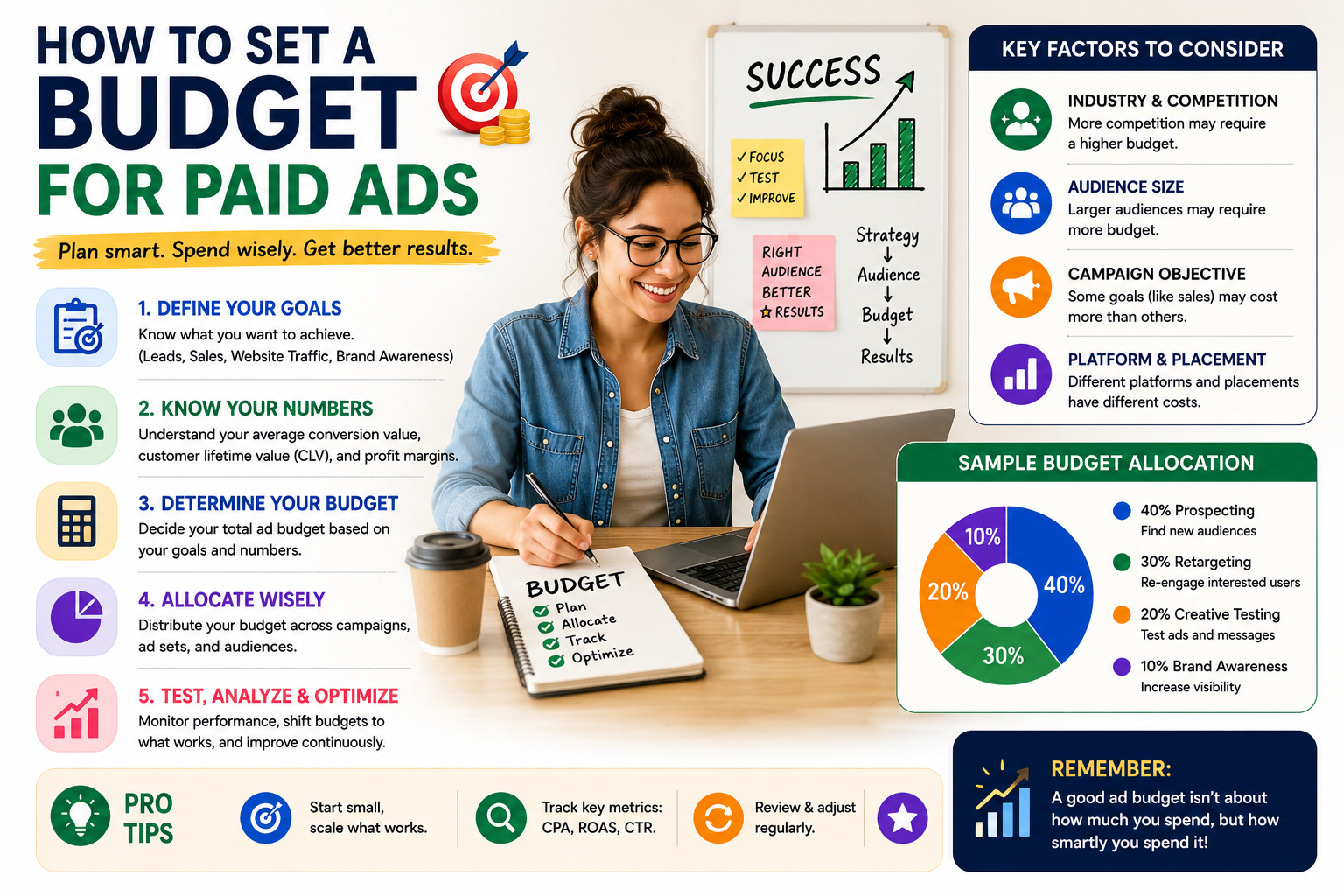
Paid advertising has become one of the fastest ways for businesses to generate visibility, leads, and revenue. Whether you’re running Google Ads, LinkedIn campaigns, Facebook promotions, or display advertising, paid ads can place your brand directly in front of potential customers at the exact moment they are searching for solutions.
However, many businesses struggle with one critical question: how much should they spend?
Some companies invest too little and never generate meaningful results. Others overspend without understanding whether their campaigns are actually profitable. In both situations, the issue isn’t necessarily the advertising platform—it’s the budgeting strategy behind it.
A well-planned advertising budget helps businesses control costs, maximize returns, and scale marketing efforts efficiently. Instead of guessing how much to spend, successful organizations use data, business objectives, customer acquisition costs, and expected returns to determine an appropriate advertising investment.
As digital advertising continues to grow globally, competition for attention is becoming more intense. Businesses that understand how to allocate their ad budgets strategically gain a significant advantage over competitors that rely on trial and error.
In this guide, you’ll learn how to set a realistic paid advertising budget, calculate expected returns, avoid common budgeting mistakes, and create a scalable framework that supports long-term growth.
Why Budget Planning Matters in Paid Advertising
Paid advertising is not simply about spending money to gain clicks. Every dollar invested should contribute toward a measurable business objective.
Without a budget strategy, companies often face challenges such as:
A structured budget ensures that marketing decisions are aligned with business goals rather than short-term assumptions. It also allows teams to make informed adjustments as campaigns evolve.
The most successful organizations view advertising budgets as investments rather than expenses. Their focus is on customer acquisition, revenue generation, and long-term profitability.
Start with Clear Business Goals
Before determining a budget, businesses must identify what they want their advertising campaigns to achieve.
Different objectives require different spending levels. A company seeking nationwide brand awareness will need a larger budget than a local business targeting a specific geographic area.
For example, a startup launching a new software product may prioritize lead generation and user acquisition. Meanwhile, an established enterprise may focus on increasing market share or promoting a new product line.
When setting advertising goals, consider factors such as:
Once objectives are clearly defined, budgeting decisions become significantly easier because spending can be tied directly to expected outcomes.
Understand Your Customer Acquisition Cost
One of the most important metrics in paid advertising is Customer Acquisition Cost (CAC).
CAC represents the amount spent to acquire one paying customer.
Understanding this metric helps businesses determine whether their advertising investment is sustainable and profitable.
Imagine a software company generates a customer worth $5,000 annually. If it costs $300 in advertising to acquire that customer, the campaign is likely profitable.
On the other hand, if acquiring that same customer costs $4,500, the business may need to rethink its strategy.
Calculating CAC allows decision-makers to establish realistic advertising budgets while maintaining healthy profit margins.
Many high-growth companies use CAC as their primary budgeting benchmark because it directly connects marketing investment to revenue generation.
Analyze Industry Benchmarks and Market Competition
Advertising costs vary significantly across industries.
Keywords in sectors such as legal services, financial technology, healthcare, and enterprise software often have much higher costs than industries with lower competition.
Businesses should research average cost-per-click (CPC), cost-per-lead (CPL), and conversion rates within their industry before setting a budget.
For example, a local restaurant may acquire customers with a relatively small advertising investment, while a B2B SaaS company competing for enterprise clients may require a substantially larger budget due to higher competition.
Market research provides valuable context and helps prevent unrealistic expectations regarding advertising performance.
Understanding competitor activity can also reveal opportunities for strategic budget allocation.
Calculate Your Revenue Goals First
A common mistake businesses make is starting with a budget and hoping for results.
A better approach is to start with revenue goals and work backward.
Let’s assume a company wants to generate $100,000 in new revenue through paid advertising.
If the average customer value is $2,000, the business needs approximately 50 new customers.
If historical data shows that every 20 leads produce one customer, the company needs 1,000 leads.
Once lead requirements are identified, businesses can estimate advertising costs based on expected cost-per-lead metrics.
This reverse-engineering approach creates a more strategic budgeting framework because spending is connected directly to measurable business outcomes.
Allocate Budget Across the Marketing Funnel
Not every advertising dollar should focus solely on immediate conversions.
Modern customer journeys involve multiple touchpoints before a purchase decision is made.
Successful advertisers distribute budgets across different stages of the marketing funnel.
This balanced approach creates a sustainable growth engine rather than relying exclusively on short-term conversion campaigns.
Businesses that invest only in bottom-funnel advertising often experience rising acquisition costs over time because they are not continuously building awareness among new audiences.
Determine a Testing Budget
Advertising success rarely happens immediately.
Even experienced marketing teams require testing to identify winning audiences, creatives, messaging, and campaign structures.
A portion of the advertising budget should always be reserved for experimentation.
For startups and growing businesses, testing is particularly important because audience behavior and market responses may not yet be fully understood.
Instead of expecting instant profitability, companies should allocate an initial learning budget that allows campaigns to gather meaningful performance data.
This testing phase often reveals valuable insights that improve long-term advertising efficiency.
Organizations that skip testing frequently waste larger amounts of money later because campaigns are launched without proper validation.
Consider Platform-Specific Costs
Every advertising platform operates differently.
Google Ads targets users actively searching for solutions, while social media platforms focus on audience targeting and engagement.
LinkedIn advertising often costs more than Facebook advertising but can deliver higher-quality B2B leads.
The ideal budget depends largely on where your target audience spends time online.
For example, a manufacturing company targeting executives may achieve better results through LinkedIn and Google Search campaigns than through consumer-focused social platforms.
A direct-to-consumer fashion brand may see stronger returns through Instagram and Facebook advertising.
Understanding platform economics allows businesses to allocate budgets where they are most likely to generate meaningful results.
Monitor Return on Ad Spend (ROAS)
Budget planning does not end when a campaign launches.
Continuous performance monitoring is essential for maximizing profitability.
Return on Ad Spend (ROAS) measures how much revenue is generated for every dollar spent on advertising.
For example, if a company spends $5,000 on advertising and generates $25,000 in revenue, the campaign achieves a 5:1 ROAS.
Tracking ROAS helps businesses identify:
Regular analysis ensures that advertising budgets remain aligned with business objectives and financial targets.
Common Budgeting Mistakes to Avoid
Many businesses fail to achieve advertising success because of avoidable budgeting errors.
One common mistake is allocating an insufficient budget. Small budgets often struggle to generate enough data for optimization, leading companies to conclude incorrectly that paid advertising does not work.
Another issue is focusing solely on clicks rather than conversions. High traffic numbers may look impressive, but they provide little value if visitors do not become customers.
Businesses also frequently underestimate the importance of creative testing. Strong targeting cannot compensate for weak messaging, poor visuals, or ineffective landing pages.
Finally, many organizations fail to account for customer lifetime value when evaluating campaign performance. A customer who generates recurring revenue may justify a higher acquisition cost than initially expected.
Avoiding these mistakes creates a stronger foundation for long-term advertising success.
How Startups, SMEs, and Enterprises Should Budget Differently
Different business sizes require different budgeting approaches.
Startups often prioritize validation and market testing. Their budgets are usually smaller, making efficient experimentation critical.
SMEs typically focus on consistent lead generation and predictable growth. They benefit from balancing testing with scalable acquisition strategies.
Large enterprises often manage multiple campaigns across regions, products, and customer segments. Their advertising budgets tend to emphasize optimization, automation, and market expansion.
Regardless of company size, the underlying principle remains the same: advertising budgets should be tied to measurable business outcomes rather than arbitrary spending limits.
A strategic budget is always more effective than a larger budget without direction.
The Future of Paid Advertising Budgeting
The digital advertising landscape continues to evolve rapidly.
Artificial intelligence, predictive analytics, automation, and advanced audience targeting are changing how organizations allocate advertising resources.
Businesses are increasingly using data-driven models to predict campaign performance before launching advertisements. This reduces waste and improves budget efficiency.
At the same time, privacy regulations and changes in consumer behavior are making accurate measurement more important than ever.
Companies that invest in analytics, attribution modeling, and performance tracking will be better positioned to maximize advertising returns in the years ahead.
The future belongs to organizations that combine strategic budgeting with continuous optimization.
Conclusion
Setting a budget for paid advertising is not about guessing how much money to spend. It is about aligning marketing investment with business goals, customer acquisition costs, revenue targets, and expected returns.
A well-structured budget provides clarity, improves decision-making, and increases the likelihood of achieving profitable growth. By understanding customer acquisition costs, analyzing market conditions, allocating resources across the funnel, and continuously monitoring performance, businesses can create advertising strategies that scale effectively.
Whether you’re a startup testing a new product, an SME looking to generate consistent leads, or an enterprise expanding into new markets, strategic budgeting remains one of the most important factors in advertising success.
Organizations that approach paid advertising with a data-driven mindset consistently outperform those that rely on assumptions. The right budget is not necessarily the biggest one—it is the one built around measurable business objectives and continuous optimization.
Frequently Asked Questions
How much should a small business spend on paid advertising?
The ideal budget depends on business goals, industry competition, and customer acquisition costs. Many small businesses begin with a testing budget and increase spending as profitable campaigns emerge.
What percentage of revenue should be allocated to advertising?
Many growing businesses invest between 5% and 15% of revenue into marketing activities, although the exact percentage varies based on growth objectives and market conditions.
How long should businesses test campaigns before increasing budgets?
Most campaigns require sufficient data before scaling decisions are made. Businesses should typically evaluate performance after generating enough clicks, leads, or conversions to identify meaningful trends.
Which advertising platform provides the best ROI?
There is no universal answer. The best platform depends on audience behavior, industry, business objectives, and campaign execution. Testing multiple platforms often reveals the most profitable channel.
How can companies reduce advertising costs?
Improving targeting, optimizing landing pages, refining ad creatives, increasing conversion rates, and continuously analyzing performance data can significantly improve advertising efficiency.
Ready to Maximize Your Advertising Investment?
A successful paid advertising strategy requires more than a budget—it requires the right technology, analytics, optimization framework, and digital expertise. Partnering with an experienced technology and digital transformation team can help your business build data-driven campaigns, improve ROI, and scale growth with confidence.
Choose a trusted technology partner that understands your business objectives, leverages modern marketing tools, and transforms advertising investments into measurable business outcomes.