


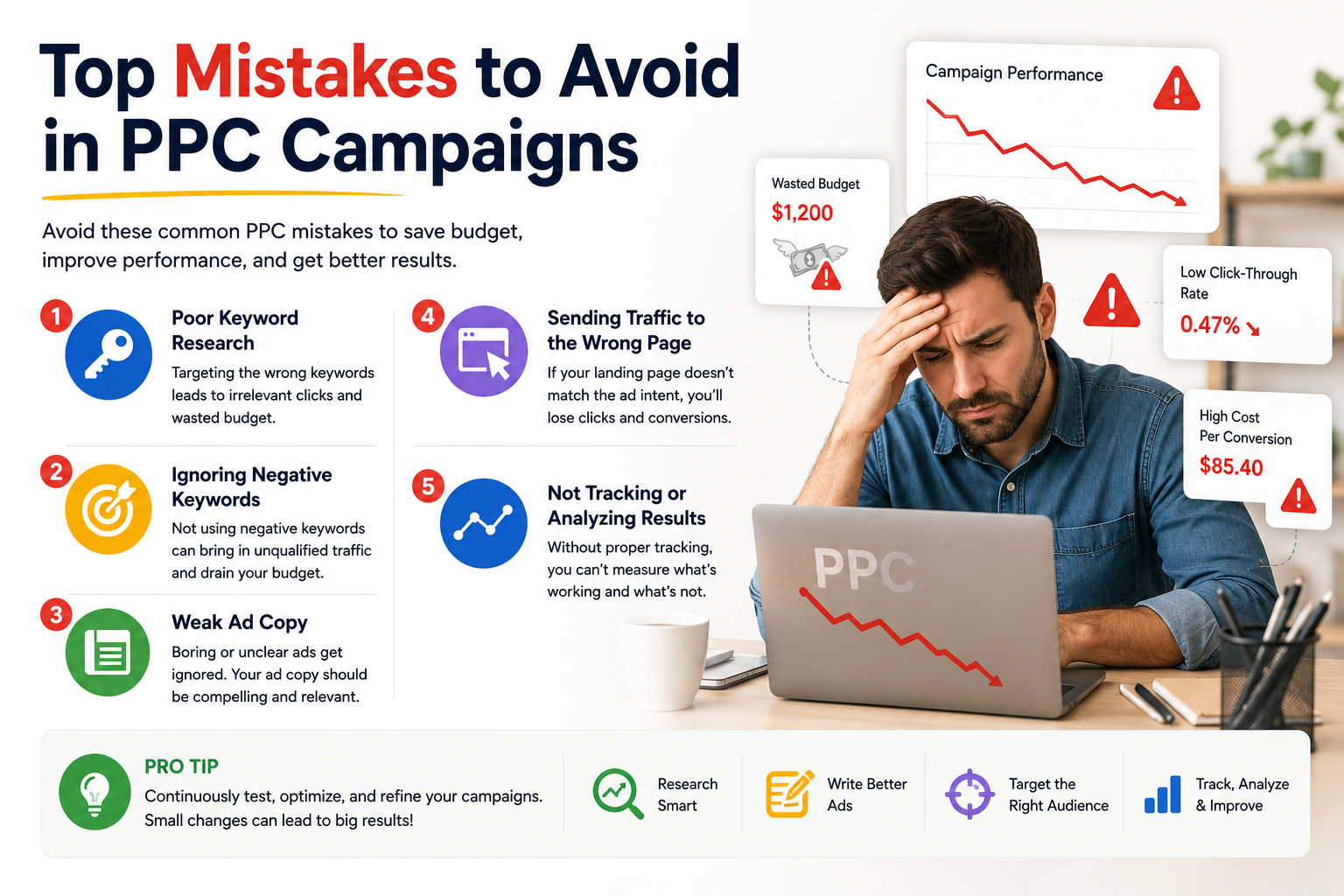
Pay-per-click (PPC) advertising has become one of the fastest ways for businesses to generate leads, drive traffic, and scale revenue. Whether you’re a startup trying to get your first customers or an enterprise optimizing millions in ad spend, PPC campaigns can deliver strong results when executed correctly.
But here’s the reality: many businesses waste a significant portion of their ad budget due to avoidable mistakes. According to industry research, businesses lose up to 25–40% of PPC spend due to poor optimization and targeting decisions. That’s not just inefficiency—it’s lost opportunity.
The good news? Most PPC mistakes are preventable. Once identified and corrected, they can significantly improve ROI, conversion rates, and overall campaign performance.
In this article, we’ll break down the most common PPC campaign mistakes, why they happen, and how to fix them with practical, real-world strategies.
Why PPC Campaigns Fail More Often Than They Should
PPC platforms like Google Ads and Microsoft Ads are powerful, but they are also complex. Success depends on balancing multiple factors—keywords, bidding strategy, ad relevance, landing pages, audience targeting, and conversion tracking.
Many businesses jump into PPC expecting instant results without a structured strategy. This leads to wasted impressions, irrelevant clicks, and low-quality leads.
A successful PPC campaign isn’t about spending more—it’s about spending smarter.
Mistake 1: Poor Keyword Strategy and Targeting
One of the biggest reasons PPC campaigns underperform is weak keyword selection. Businesses often target broad, high-traffic keywords without considering user intent.
For example, a SaaS startup targeting “CRM software” may attract thousands of clicks, but many users are just researching—not ready to buy. This results in high cost-per-click (CPC) and low conversions.
A better approach is focusing on intent-driven keywords such as “best CRM software for small business” or “affordable CRM tools for startups.” These users are closer to making a purchase decision.
Ignoring this balance often leads to wasted ad spend and poor-quality traffic.
Mistake 2: Ignoring Landing Page Optimization
Even the best PPC campaign will fail if the landing page doesn’t convert.
A common mistake businesses make is sending paid traffic to generic homepages instead of dedicated landing pages. This creates friction and confusion for the user.
For instance, an e-commerce brand running Google Ads for “buy running shoes online” should direct users to a curated shoe collection page—not the homepage.
Google also rewards landing page experience in its Quality Score system, meaning better pages can lower your CPC significantly.
Mistake 3: Weak Ad Copy and Irrelevant Messaging
Your ad copy is the first impression your audience gets. If it’s unclear or generic, users simply scroll past it.
Many businesses make the mistake of writing ads that focus on themselves instead of the customer’s needs. Phrases like “We are the best digital marketing company” rarely perform well compared to benefit-driven messaging.
For example, instead of saying “We sell project management software,” a stronger version would be “Manage Projects 2x Faster with Easy-to-Use Software.”
Real-world campaigns consistently show that improving ad copy can increase click-through rates (CTR) by 20–50%, depending on the industry.
Mistake 4: Not Tracking Conversions Properly
Running PPC without proper conversion tracking is like driving blindfolded. You may get clicks, but you won’t know what actually drives revenue.
Without conversion tracking, optimizing campaigns becomes guesswork.
A retail brand, for example, might discover that mobile ads generate more traffic but desktop users convert at a higher rate. Without tracking, such insights remain hidden.
Proper tracking ensures you optimize for what matters—revenue, not just traffic.
Mistake 5: Poor Budget Allocation and Bidding Strategy
Budget mismanagement is one of the fastest ways to burn through ad spend without results.
Many businesses either overspend on high-competition keywords or distribute budget evenly across all campaigns without prioritization.
Effective PPC budgeting should focus on performance data, not assumptions.
For example, a fintech startup running ads across multiple services may find that “business loan application” drives more qualified leads than “financial tools.” Budget should reflect this insight.
Google Ads automation has also evolved significantly, with machine learning now influencing over 80% of bidding decisions in large-scale campaigns. But automation only works well when fed with clean data.
Mistake 6: Ignoring Negative Keywords
Negative keywords are often overlooked, yet they are essential for improving ad efficiency.
Without them, your ads may appear for irrelevant searches, draining your budget.
For instance, a company selling premium software might accidentally show ads for searches like “free software tools.” These clicks are unlikely to convert and only increase costs.
Adding negative keywords helps refine targeting and improve ROI.
Regularly updating your negative keyword list ensures your ads reach the right audience.
Mistake 7: Not Running A/B Tests
PPC is not a one-time setup—it’s an ongoing optimization process. Yet many businesses fail to test different versions of ads.
A/B testing helps determine what actually works, whether it’s headlines, descriptions, visuals, or CTAs.
Even small changes can make a big difference. For example, changing a CTA from “Learn More” to “Get Started Today” can significantly impact conversion rates.
Businesses that consistently run A/B tests often see performance improvements of 15–30% over time.
Testing ensures decisions are driven by data rather than assumptions.
Mistake 8: Misreading PPC Data and Metrics
Data is powerful, but only when interpreted correctly. Many advertisers focus on vanity metrics like impressions and clicks instead of meaningful performance indicators.
A campaign may have thousands of clicks but still fail to generate revenue. That’s why metrics like Cost Per Acquisition (CPA) and Return on Ad Spend (ROAS) are far more important.
For example, an enterprise running multiple campaigns may realize that one channel delivers fewer clicks but significantly higher conversion value. Shifting budget accordingly can dramatically improve profitability.
Misreading data often leads to wrong decisions, such as scaling the wrong campaign or pausing a profitable one.
The Real Cost of PPC Mistakes in 2026’s Advertising Landscape
Digital advertising competition is increasing every year. Google Ads CPCs have risen in many industries due to higher demand and limited ad space.
At the same time, user behavior is becoming more selective. People expect faster, more relevant, and more personalized ad experiences.
This means businesses cannot afford inefficient PPC strategies anymore. Every click must be optimized for value.
Companies that fail to adapt often end up spending more while achieving less.
How to Build a High-Performing PPC Strategy
A successful PPC strategy is built on continuous improvement rather than one-time setup.
Businesses that consistently perform well in PPC usually follow a structured approach:
- Strong keyword research aligned with buyer intent
- Dedicated landing pages for each campaign
- Regular A/B testing and optimization
- Data-driven bidding and budget allocation
- Ongoing performance tracking and refinement
While the tools and platforms may change, the fundamentals remain the same—relevance, optimization, and measurement.
Conclusion: Smarter PPC Leads to Better Business Growth
PPC advertising remains one of the most powerful digital marketing channels for driving measurable business growth. However, success is not guaranteed by budget alone—it depends on strategy, execution, and continuous optimization.
The most common mistakes, from poor keyword targeting to weak landing pages and mismanaged budgets, can quietly drain thousands from your marketing spend.
On the other hand, businesses that actively optimize their PPC campaigns often see significantly higher ROI, improved lead quality, and stronger brand visibility.
In a competitive digital environment, every click matters. The difference between a profitable PPC campaign and a wasteful one often comes down to attention to detail.
Frequently Asked Questions (FAQ)
1. What is the most common mistake in PPC campaigns?
The most common mistake is poor keyword targeting, where businesses attract irrelevant traffic instead of high-intent users.
2. How can I improve my PPC conversion rate?
Improving landing page experience, refining ad copy, and using intent-based keywords can significantly boost conversion rates.
3. Is PPC still effective in 2026?
Yes, PPC remains highly effective, especially when combined with data-driven optimization and AI-powered bidding strategies.
4. How often should I optimize my PPC campaigns?
Ideally, campaigns should be reviewed weekly and optimized based on performance trends and conversion data.
5. What is a good ROAS for PPC campaigns?
A good ROAS varies by industry, but most businesses aim for at least 3:1 or higher depending on margins.