


In today’s digital-first marketplace, customers rarely make decisions instantly. Whether they are purchasing software, choosing a service provider, or investing in a long-term business solution, their journey is shaped by information, trust, and timing. This is where content plays a defining role.
Content is no longer just a marketing asset—it is the backbone of the entire buyer’s journey. From the moment a potential customer realizes they have a problem to the point where they choose a solution, content guides, educates, reassures, and influences every step.
For startups, SMEs, enterprises, and decision-makers navigating digital transformation, understanding this relationship is critical. Businesses that align content with buyer intent consistently see higher engagement, stronger trust, and improved conversion rates.
Let’s explore how content shapes each stage of the buyer’s journey and why it has become a non-negotiable part of modern marketing strategy.
Understanding the Buyer’s Journey in a Digital Economy
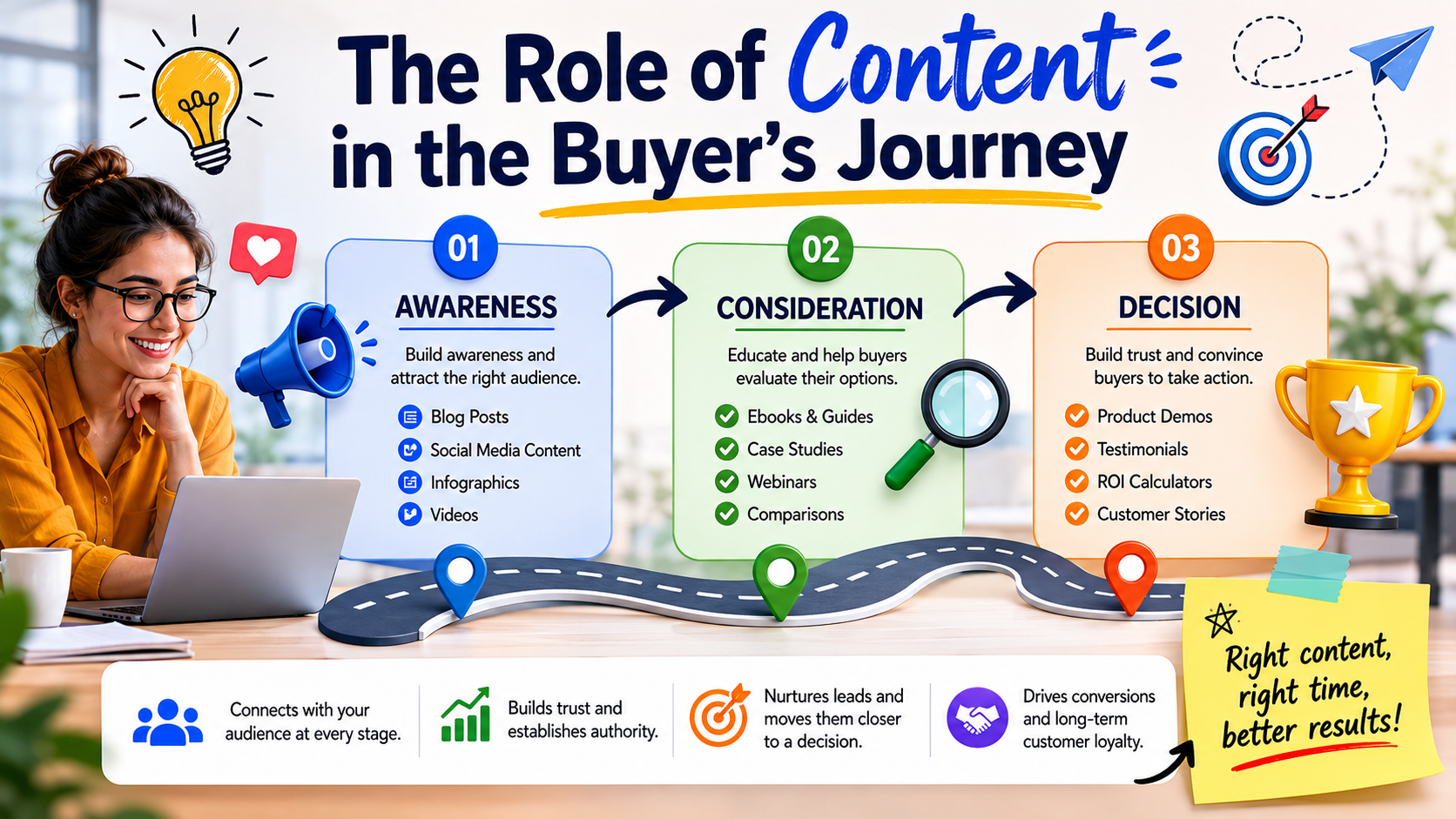
The buyer’s journey refers to the process a customer goes through before making a purchase decision. Traditionally, it includes three key stages:
- Awareness stage
- Consideration stage
- Decision stage
However, in the digital age, this journey is no longer linear. Buyers jump between research, comparisons, reviews, and social validation before making a final decision.
According to recent marketing insights, over 70% of the buyer’s journey is completed before a customer even speaks to a sales representative. This means content often makes the first and most important impression.
From Google searches to LinkedIn thought leadership posts, from YouTube tutorials to detailed case studies, content has become the silent salesperson that works 24/7.
Why Content is the Core Driver of Modern Buying Decisions
Today’s buyers are more informed than ever. They don’t want to be “sold to”—they want to be educated. This shift has made content the most powerful tool in digital marketing.
Businesses that consistently publish valuable content generate significantly more leads compared to those that don’t. Studies show that content marketing generates over three times as many leads as traditional outbound marketing while costing significantly less.
But beyond numbers, content plays a deeper role: it builds trust.
When a company consistently provides useful insights, practical solutions, and transparent information, it positions itself as a credible authority in the industry. That credibility directly influences buying decisions.
The Awareness Stage: Capturing Attention Through Educational Content
At the awareness stage, the buyer is just realizing they have a problem. They may not fully understand it yet, but they are actively searching for answers.
This is where content acts as an educator.
The goal is not to sell but to inform.
For example, a SaaS company offering CRM software might publish articles like “Why Customer Retention is Declining in Modern Businesses” or “Top Signs Your Sales Process Needs Automation.” These topics don’t promote the product directly—they address pain points.
At this stage, businesses often rely on:
- Blog articles that answer common questions
- Social media content that highlights industry problems
- Short videos that simplify complex topics
- Infographics that explain trends or data
A strong real-world example is HubSpot. Instead of pushing software aggressively, HubSpot built a massive inbound marketing ecosystem by educating users about marketing, sales, and customer behavior. As a result, they became a trusted authority long before customers even considered buying their tools.
The key here is visibility and trust-building. If your content appears when users are searching for answers, you win the first moment of attention.
The Consideration Stage: Building Trust and Comparison Value
Once buyers clearly understand their problem, they move into the consideration stage. Here, they start exploring solutions and comparing options.
This stage is where content becomes more strategic and persuasive.
- Buyers are asking questions like:
- Which solution is best for my business?
- What are the pros and cons of each option?
- Which company is more reliable?
Content must now guide decision-making without being overly promotional.
At this stage, effective content includes:
- Detailed comparison guides
- Expert-led webinars
- Case studies showcasing real business results
- In-depth whitepapers
- Email nurturing sequences
For example, a logistics company evaluating software providers might read a case study showing how a similar enterprise reduced operational costs by 30% using a specific platform. That real-world validation often carries more weight than any advertisement.
Amazon also excels in this stage through customer reviews and detailed product comparisons. Buyers rely heavily on peer feedback before finalizing decisions, demonstrating the importance of trust-driven content.
At this stage, businesses must focus on clarity and credibility. The goal is to position your solution as the most logical choice.
The Decision Stage: Converting Interest Into Action
The decision stage is where the buyer is ready to act. They have narrowed down their choices and are looking for final reassurance before making a purchase.
At this point, content becomes highly focused on conversion.
Buyers need confidence, not information overload.
Content that performs well in this stage includes:
- Product demos and walkthroughs
- Free trials or service previews
- Testimonials and success stories
- Pricing pages with clear value breakdown
- Consultation landing pages
A strong example is Salesforce. Their product pages are supported by customer success stories, ROI calculators, and live demos. This combination reduces hesitation and reinforces decision-making confidence.
It’s important to understand that even at this stage, buyers still seek validation. A well-crafted testimonial or a real customer story can often be the final push needed to close the deal.
Types of Content That Influence the Buyer’s Journey
Different types of content serve different purposes across the journey. A balanced content strategy ensures coverage at every stage.
Some of the most effective formats include educational blogs, which attract awareness-stage users. Ebooks and whitepapers provide deeper insights for consideration-stage buyers. Case studies build trust by showcasing proven results. Videos simplify complex solutions, making them accessible. Email campaigns nurture leads and maintain engagement throughout the journey.
A successful business does not rely on one type of content but builds a content ecosystem that supports every stage of decision-making.
The Role of Data and Personalization in Content Strategy
Modern content marketing is no longer guesswork. It is driven by data, analytics, and personalization.
Businesses today can track user behavior, content engagement, and conversion patterns in real time. This allows them to refine messaging based on actual customer behavior.
Personalized content experiences significantly increase engagement rates. When users see content tailored to their industry, role, or interest, they are more likely to take action.
For example, an enterprise CTO might receive technical whitepapers, while a startup founder might receive simplified guides and strategic insights. This level of personalization ensures relevance at every step.
Artificial intelligence has further strengthened this capability by enabling dynamic content recommendations and predictive customer journeys.
Common Mistakes Businesses Make with Content in the Buyer’s Journey
Despite its importance, many businesses still struggle to use content effectively. One of the most common mistakes is focusing too heavily on selling rather than educating. This often pushes potential buyers away during the awareness stage.
Another issue is ignoring the consideration stage. Many companies create awareness content but fail to guide users toward comparisons or deeper evaluation.
Inconsistent publishing is also a major challenge. Without regular content, businesses lose visibility and trust over time.
Lastly, many organizations fail to align sales and marketing teams, resulting in disconnected messaging that confuses potential buyers.
Avoiding these mistakes ensures a smoother and more effective buyer journey.
Building a High-Impact Content Strategy for the Buyer’s Journey
A successful content strategy starts with understanding your audience deeply. Businesses must identify customer pain points, decision-making triggers, and behavioral patterns.
Once this is clear, content should be mapped to each stage of the journey. Awareness content should focus on education. Consideration content should emphasize comparison and value. Decision content should eliminate doubt and encourage action.
Consistency is equally important. Content should be published regularly and optimized for search visibility to ensure long-term results.
Businesses that integrate SEO, storytelling, and customer insights into their content strategy often see sustainable growth in both traffic and conversions.
The Future of Content in the Buyer’s Journey
The future of content marketing is becoming increasingly interactive and intelligent. With the rise of AI-driven search, voice assistants, and personalized digital experiences, content will become even more tailored to individual users.
Video content, interactive tools, and immersive experiences will play a larger role in decision-making. At the same time, authenticity will remain a key differentiator as buyers continue to seek genuine, experience-driven insights.
Businesses that adapt early to these changes will gain a significant competitive advantage.
Conclusion
Content is no longer just a marketing function—it is the foundation of the entire buyer’s journey. From the first moment a potential customer recognizes a problem to the final purchase decision, content influences perception, builds trust, and drives action.
For modern businesses, the ability to create meaningful, relevant, and strategically aligned content is directly tied to growth and revenue. Companies that invest in understanding their buyers and delivering value-driven content at every stage will consistently outperform their competition.
Frequently Asked Questions (FAQ)
1. What is the role of content in the buyer’s journey?
Content guides potential customers through awareness, consideration, and decision stages by educating, building trust, and influencing purchasing decisions.
2. Why is content important in digital marketing?
Content helps businesses attract, engage, and convert customers while building long-term brand authority and visibility online.
3. What type of content works best for the awareness stage?
Educational blogs, social media posts, and explainer videos work best as they address problems and provide initial information.
4. How does content influence buying decisions?
Content builds trust, answers questions, provides comparisons, and reduces uncertainty, making it easier for buyers to choose a solution.
5. Can content marketing work for small businesses?
Yes, content marketing is highly effective for small businesses as it is cost-efficient and helps build organic visibility and credibility.