


Content marketing has evolved far beyond simply publishing blog posts and hoping for traffic. Today’s businesses operate in a highly competitive digital environment where attention spans are shorter, search algorithms change frequently, and consumer interests shift rapidly.
In this landscape, one question consistently arises for marketers, founders, and business leaders: Should you focus on evergreen content that generates traffic for years, or trending content that captures immediate attention?
The answer is not as simple as choosing one over the other.
Some businesses invest heavily in evergreen resources and miss opportunities to participate in industry conversations. Others chase trends relentlessly but struggle to build sustainable organic traffic. The most successful brands understand how to balance both approaches strategically.
Whether you’re a startup trying to build visibility, an SME looking to generate qualified leads, or an enterprise strengthening market authority, understanding when to use evergreen content and when to leverage trends can significantly impact your marketing results.
This guide explores the differences between evergreen and trending content, the advantages of each, and how businesses can create a balanced content strategy that delivers both immediate engagement and long-term growth.
Understanding Evergreen Content
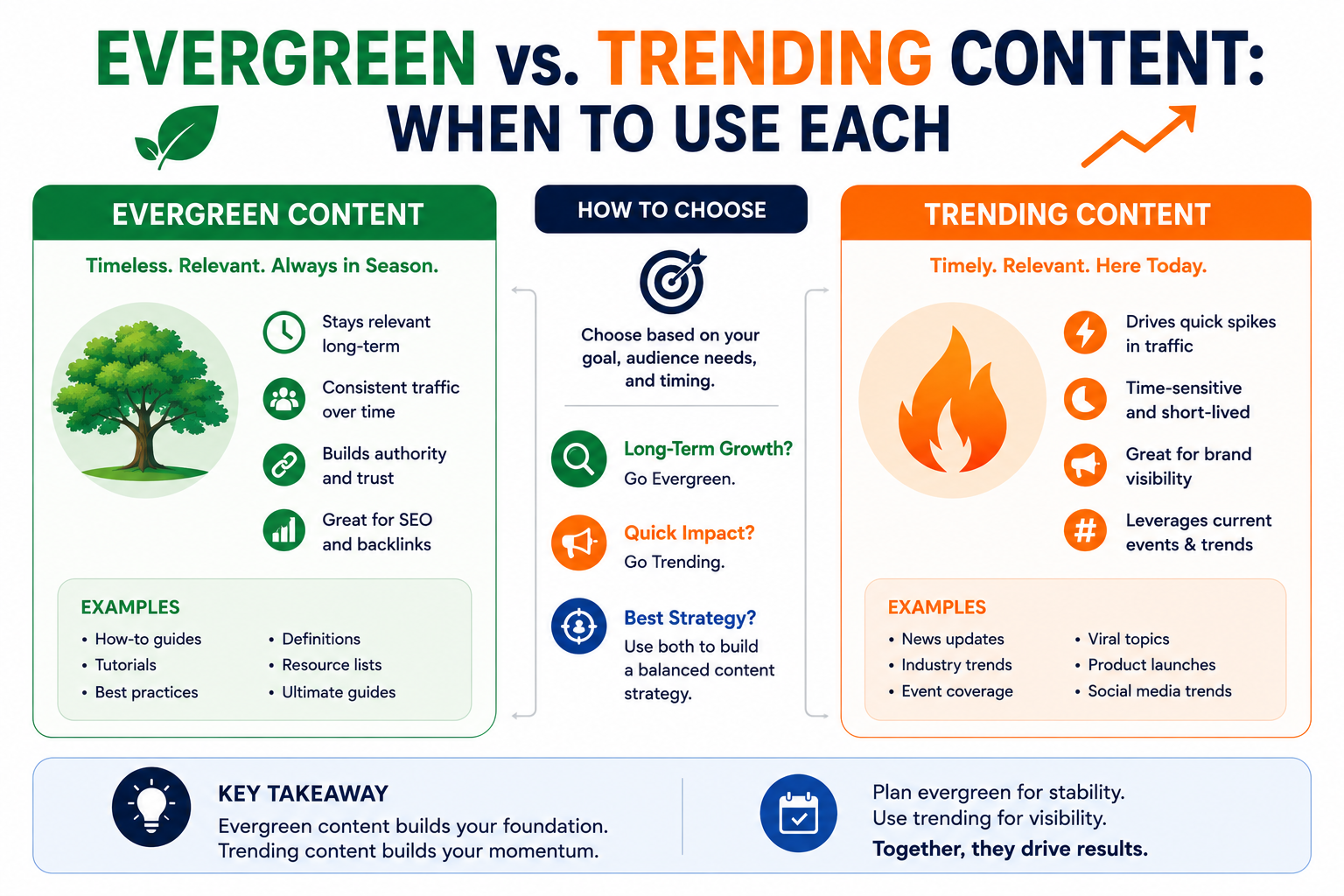
Evergreen content refers to content that remains relevant and valuable over an extended period. Like an evergreen tree that stays green throughout the year, this content continues attracting readers long after publication.
The primary goal of evergreen content is to answer ongoing questions, solve recurring problems, and provide information that does not become outdated quickly.
For example, topics such as “How to Build a Business Website,” “What Is Cloud Computing?” or “SEO Best Practices for Beginners” remain useful regardless of current events or temporary industry discussions.
Because people continue searching for these topics year after year, evergreen content often becomes a powerful source of consistent organic traffic.
Why Evergreen Content Matters
One of the biggest advantages of evergreen content is its ability to generate long-term returns on investment.
Unlike advertising campaigns that stop producing results when budgets end, evergreen content can continue attracting visitors, leads, and customers for months or even years.
Research consistently shows that organic search remains one of the highest-converting digital marketing channels. When evergreen articles rank well on search engines, they become ongoing assets for a business.
Additionally, evergreen content helps establish authority. When potential customers repeatedly find useful information from your brand, trust naturally develops over time.
Common Examples of Evergreen Content
These content formats address persistent user needs and continue delivering value regardless of changing market conversations.
What Is Trending Content?
Trending content focuses on current events, emerging topics, industry developments, and timely discussions that are generating significant interest at a particular moment.
This type of content capitalizes on what’s happening right now.
Examples include coverage of major technology announcements, algorithm updates, industry regulations, viral social media trends, market shifts, and breaking business news.
Trending content typically experiences a surge in attention shortly after publication but may lose relevance relatively quickly.
Despite its shorter lifespan, trending content plays an important role in modern content marketing strategies.
The Business Value of Trending Content
Trending content helps brands remain visible and relevant within their industries.
When a company provides insights on current developments, audiences perceive it as informed, active, and engaged.
For example, when generative AI tools began transforming business operations, companies that published timely analyses and implementation guides gained significant visibility and industry recognition.
Trending content can also generate rapid traffic spikes. Businesses often experience increased website visits, social shares, and media exposure when they successfully cover emerging topics before competitors.
This makes trending content particularly valuable for brand awareness campaigns and audience growth initiatives.
The Key Differences Between Evergreen and Trending Content
Although both content types contribute to marketing success, they serve different purposes.
Evergreen content focuses on long-term visibility, while trending content targets immediate attention.
Evergreen articles generally have a slower growth curve but provide consistent results over time. Trending articles often gain traction quickly but may experience declining traffic once interest fades.
Think of evergreen content as a long-term investment portfolio and trending content as a short-term growth opportunity. Both can generate returns, but they operate on different timelines.
Businesses that understand this distinction are better positioned to allocate content resources effectively.
When Should Businesses Prioritize Evergreen Content?
Not every content objective requires chasing the latest industry trend.
In many situations, evergreen content delivers greater value because it aligns with long-term business goals.
Building Sustainable Organic Traffic
For businesses investing in SEO, evergreen content should form the foundation of the content strategy.
Search engines prioritize content that consistently answers user questions and demonstrates expertise.
A comprehensive evergreen article can continue attracting traffic long after publication, making it a cost-effective marketing asset.
For startups with limited budgets, this approach is particularly beneficial because it creates lasting visibility without ongoing promotional expenses.
Establishing Industry Authority
Companies aiming to become trusted resources should prioritize evergreen educational content.
Detailed guides, industry frameworks, and practical resources help position brands as experts.
For example, a software company publishing extensive guides about digital transformation can gradually become a trusted source for decision-makers researching technology solutions.
Supporting Lead Generation
Many evergreen content pieces align naturally with customer buying journeys.
Potential customers often begin their research with foundational questions before evaluating products or services.
By answering these questions effectively, businesses can attract qualified prospects earlier in the decision-making process.
When Should Businesses Focus on Trending Content?
While evergreen content provides stability, there are times when trending content becomes essential.
Ignoring major industry developments can make a brand appear disconnected from current market realities.
Responding to Industry Changes
Industries such as technology, cybersecurity, artificial intelligence, finance, and digital marketing evolve rapidly.
When significant developments occur, audiences actively seek expert commentary and practical guidance.
Organizations that publish timely insights can attract attention from prospects, media outlets, and industry influencers.
Increasing Brand Visibility Quickly
Trending content can generate significant short-term exposure.
A well-timed article about a major industry announcement may receive social media shares, backlinks, and media mentions that would otherwise take months to achieve.
This increased visibility often introduces new audiences to a brand’s broader content ecosystem.
Demonstrating Thought Leadership
Business leaders are expected to understand emerging developments affecting their industries.
Publishing informed perspectives on relevant trends demonstrates awareness, expertise, and strategic thinking.
This is particularly important for B2B organizations targeting executives, CTOs, and decision-makers.
Why a Balanced Content Strategy Works Best
Many businesses mistakenly view evergreen and trending content as competing approaches.
In reality, they work best together.
The most successful content strategies combine the long-term value of evergreen assets with the immediate engagement potential of trending topics.
Evergreen content builds a strong foundation for consistent traffic and lead generation. Trending content adds relevance, visibility, and opportunities for audience expansion.
Together, they create a content ecosystem capable of delivering both short-term wins and long-term growth.
An Effective Content Mix
This integrated approach maximizes content performance across multiple channels.
How Leading Brands Combine Evergreen and Trending Content
Many successful companies already use this hybrid model.
For example, a cloud technology provider may publish evergreen guides about cloud migration, infrastructure management, and cybersecurity best practices.
At the same time, the company publishes trend-focused articles whenever major cloud platforms release new features or security regulations change.
The trending content generates immediate attention, while evergreen resources continue attracting prospects throughout the year.
Similarly, SaaS companies often create timeless educational content around productivity, workflow automation, and business efficiency while simultaneously publishing commentary on emerging technologies such as AI and machine learning.
This combination strengthens both search visibility and market relevance.
Updating Content: The Bridge Between Evergreen and Trending
An often-overlooked strategy is transforming trending content into evergreen assets.
A topic that begins as a trend can eventually become an industry standard.
For instance, remote work was once considered a trending topic. Today, it has become a permanent business consideration, creating opportunities for evergreen content around remote team management, collaboration tools, and hybrid workplace strategies.
Businesses should regularly review content libraries and identify opportunities to refresh, expand, and repurpose high-performing articles.
Signs That Content Should Be Updated
Regular updates help maintain relevance while preserving existing SEO value.
Measuring the Success of Evergreen and Trending Content
Success metrics should align with the purpose of each content type.
Evergreen content is often evaluated through long-term organic traffic, keyword rankings, lead generation, and conversion performance.
Trending content is typically measured using engagement metrics, social shares, referral traffic, media mentions, and short-term traffic spikes.
Because their objectives differ, comparing them directly can be misleading.
Instead, businesses should assess each content category according to its intended outcomes.
A trending article may outperform an evergreen guide in social engagement during its first week, while the evergreen guide generates substantially more traffic and leads over several years.
Both outcomes can be valuable when aligned with business objectives.
Common Mistakes Businesses Should Avoid
Many organizations struggle because they lean too heavily toward one content approach.
Some companies produce only evergreen content and miss opportunities to participate in industry conversations. Others become obsessed with trends and fail to build lasting search visibility.
The most common mistakes include:
Avoiding these mistakes can significantly improve overall content performance and marketing ROI.
The Future of Content Marketing
As search engines become increasingly sophisticated and audiences demand greater value, content quality will continue to outweigh content quantity.
Businesses that invest in both evergreen expertise and timely industry insights will be better positioned to attract, engage, and convert customers.
Artificial intelligence, evolving search behavior, and changing digital platforms may influence how content is distributed, but the need for valuable information remains constant.
Evergreen content satisfies ongoing needs, while trending content captures current interest. Together, they create a resilient content strategy capable of adapting to future market changes.
Conclusion
The debate between evergreen and trending content is not about choosing one over the other. It is about understanding the unique role each plays within a broader content marketing strategy.
Evergreen content provides the foundation for sustainable traffic, authority, and lead generation. Trending content helps brands stay relevant, participate in important conversations, and capture immediate attention.
For startups, SMEs, enterprises, and growing organizations, the most effective approach is a balanced one. Build a strong library of evergreen resources that answer core customer questions while using trending content to demonstrate expertise and respond to market developments.
When these strategies work together, businesses gain the best of both worlds: long-term growth and short-term momentum.
Ready to Build a Smarter Content Strategy?
Whether you’re creating an SEO-driven content engine, launching a digital transformation initiative, or looking to improve marketing ROI, choosing the right technology and marketing partner makes all the difference.
Work with experts who understand content strategy, SEO, analytics, and digital innovation to create a balanced approach that delivers measurable business outcomes today while building sustainable growth for tomorrow.
Frequently Asked Questions
What is the difference between evergreen and trending content?
Evergreen content remains relevant over long periods and continuously attracts traffic, while trending content focuses on current topics that generate immediate interest but may lose relevance over time.
Which content type is better for SEO?
Evergreen content generally provides stronger long-term SEO benefits because it targets consistent search demand. However, trending content can generate backlinks and visibility that indirectly support SEO efforts.
How much evergreen content should a business create?
Most businesses benefit from making evergreen content the majority of their strategy, with trending content used to capitalize on relevant industry developments and audience interests.
Can trending content become evergreen?
Yes. Many trending topics eventually evolve into long-term business subjects. Updating and expanding these articles can transform them into evergreen resources.
How often should evergreen content be updated?
Evergreen content should be reviewed regularly, ideally every six to twelve months, to ensure information remains accurate, relevant, and competitive in search results.