


In a digital landscape where content competition is growing every day, businesses are constantly searching for effective ways to expand their reach, improve search engine visibility, and establish industry authority. Among the many content marketing strategies available, guest blogging continues to be one of the most discussed and widely used approaches.
Guest blogging, also known as guest posting, involves writing and publishing content on another website within your industry or niche. The practice has evolved significantly over the years. What started primarily as a link-building tactic has now become a strategic marketing tool used by startups, SMEs, enterprises, founders, and digital marketing teams worldwide.
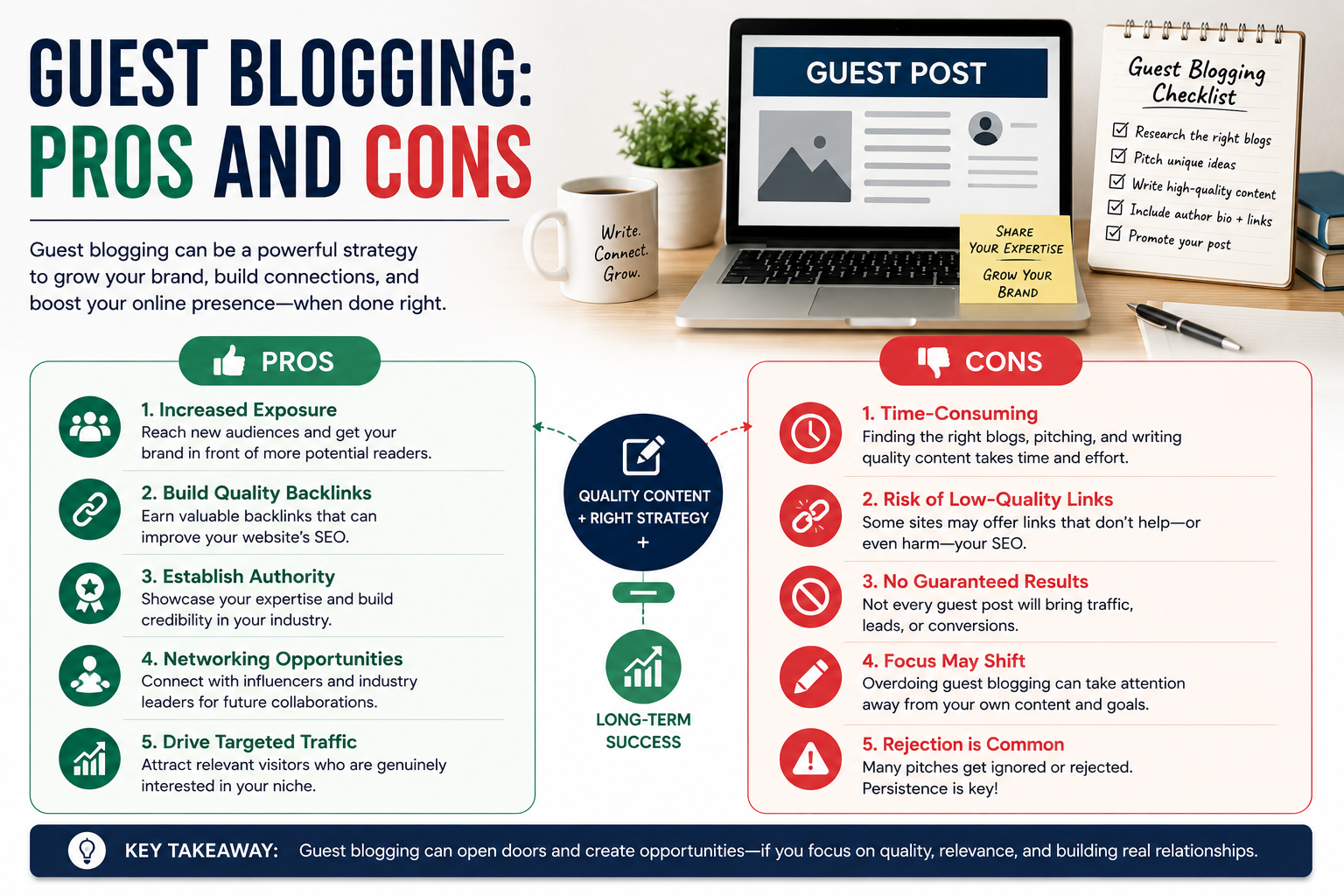
However, like any marketing strategy, guest blogging comes with both advantages and disadvantages. While it can help businesses build credibility and attract qualified audiences, it also requires considerable effort, relationship-building, and content investment.
For organizations planning long-term digital growth, understanding both sides of guest blogging is essential before allocating time and resources to the strategy.
This article explores the pros and cons of guest blogging, helping decision-makers determine whether it deserves a place in their content marketing strategy.
What Is Guest Blogging?
Guest blogging is the process of creating content for publication on a third-party website rather than your own company blog.
Typically, businesses contribute articles to industry publications, niche blogs, news websites, or partner platforms that already have an established audience. In exchange, the guest author often receives brand exposure, author recognition, website mentions, and sometimes backlinks.
For example, a SaaS startup specializing in project management software may publish an article on a leading technology publication discussing productivity trends. This allows the company to introduce its expertise to a broader audience while strengthening its online presence.
Today, guest blogging is commonly used for:
When executed strategically, guest blogging can become a powerful component of a company’s digital marketing ecosystem.
Why Guest Blogging Remains Relevant
Many marketers have questioned whether guest blogging is still effective in an era dominated by AI-generated content, social media marketing, and video platforms.
The answer is yes—but only when quality remains the priority.
Search engines continue to reward expertise, authority, and trustworthiness. Publishing insightful content on respected industry websites helps demonstrate all three factors. At the same time, decision-makers increasingly consume educational content before making purchasing decisions.
Recent content marketing studies consistently show that businesses investing in authority-building content strategies generate higher-quality leads and stronger brand recognition than those relying solely on advertising.
Guest blogging supports these goals by placing expert insights directly in front of relevant audiences.
The Pros of Guest Blogging
Builds Brand Authority and Credibility
One of the strongest advantages of guest blogging is its ability to position a business as an industry expert.
When your content appears on respected publications, readers automatically associate your brand with expertise and trustworthiness. This borrowed credibility can be especially valuable for startups and emerging companies trying to establish themselves in competitive markets.
Imagine a cybersecurity startup publishing expert commentary on a recognized technology website. The association immediately enhances the company’s professional reputation.
Over time, repeated guest contributions can transform business leaders into recognized voices within their industries.
Improves Search Engine Optimization
SEO remains one of the primary reasons businesses pursue guest blogging.
Quality guest posts can generate backlinks from authoritative websites. These backlinks continue to be an important ranking factor because they signal trust and relevance to search engines.
However, modern SEO success depends on quality rather than quantity. A single backlink from a respected industry publication often delivers more value than dozens of links from low-quality websites.
Guest blogging also creates opportunities to rank for additional keywords, expand content visibility, and strengthen overall domain authority.
For businesses pursuing long-term organic growth, guest blogging can complement broader SEO initiatives effectively.
Increases Website Traffic
Publishing content on websites with established audiences exposes your brand to potential customers who may never have discovered your business otherwise.
Readers who find value in your article often click through to learn more about your company, products, or services.
This referral traffic tends to be highly targeted because the audience is already interested in the topics your business specializes in.
For example, a cloud consulting firm contributing content to a digital transformation publication is likely to attract visitors specifically interested in cloud migration, infrastructure modernization, and enterprise technology solutions.
This targeted exposure often leads to higher engagement compared to general advertising campaigns.
Generates High-Quality Leads
Guest blogging can support lead generation when content is aligned with audience needs.
Unlike interruptive marketing methods, guest posts educate readers before presenting solutions. This creates trust early in the buyer journey.
Potential customers who discover your expertise through valuable content are often more qualified and informed by the time they contact your business.
Organizations offering B2B services particularly benefit from this approach because purchasing decisions typically involve extensive research and multiple stakeholders.
Guest blogging helps influence those decisions before competitors enter the conversation.
Expands Professional Networks
Business growth is often driven by relationships.
Guest blogging naturally creates opportunities to connect with editors, publishers, industry influencers, consultants, and other business leaders.
These relationships frequently lead to additional opportunities such as:
Over time, these connections can provide significant value beyond the original guest post itself.
Strengthens Thought Leadership
Thought leadership has become increasingly important in competitive industries.
Businesses that consistently share unique insights, research, and professional expertise gain greater visibility and influence.
Guest blogging provides a platform for executives, founders, CTOs, and subject matter experts to discuss emerging trends, industry challenges, and innovative solutions.
This visibility helps organizations stand out in crowded markets while creating trust among prospective clients and stakeholders.
For enterprises pursuing digital transformation initiatives, thought leadership often plays a crucial role in attracting strategic opportunities.
The Cons of Guest Blogging
It Requires Significant Time and Effort
One of the biggest drawbacks of guest blogging is the investment required.
Successful guest posts involve much more than writing an article. Teams must identify relevant publications, research audience expectations, pitch ideas, create high-quality content, manage revisions, and maintain publisher relationships.
For businesses with limited resources, this process can become time-consuming.
Results also rarely happen overnight. Guest blogging should be viewed as a long-term strategy rather than a quick growth tactic.
Organizations expecting immediate returns may become frustrated with the timeline required for meaningful outcomes.
Acceptance Is Not Guaranteed
Even exceptional content can be rejected.
Many high-authority websites receive hundreds of guest post submissions every month. Editors are selective and prioritize content that aligns with their audience’s interests and editorial standards.
This means businesses may spend considerable time developing pitches without securing publication opportunities.
Competition is especially intense in industries such as technology, finance, marketing, healthcare, and software development.
Companies must be prepared for rejection and remain committed to building relationships over time.
Results Can Be Difficult to Measure
While guest blogging contributes to brand awareness, SEO, and authority, measuring its direct business impact can sometimes be challenging.
Unlike paid advertising campaigns with immediate conversion tracking, guest blogging often influences buyers indirectly throughout the customer journey.
A prospect may discover your brand through a guest post, engage with multiple pieces of content over several months, and only then become a customer.
Attributing revenue to a specific guest article can therefore be complex.
Businesses should use comprehensive analytics frameworks to evaluate performance accurately.
Poor-Quality Guest Blogging Can Harm SEO
Not all guest blogging opportunities provide value.
Publishing content on irrelevant, low-quality, or spam-focused websites can negatively impact brand perception and potentially create SEO risks.
Search engines have become increasingly sophisticated in identifying manipulative link-building practices.
Businesses that focus solely on acquiring backlinks rather than delivering genuine value may see limited benefits or even experience penalties.
Quality should always outweigh volume.
Before contributing to any website, organizations should carefully assess audience relevance, domain credibility, editorial standards, and overall reputation.
Content Ownership Limitations
When publishing on another website, businesses generally surrender some control over content distribution and presentation.
Editors may modify headlines, adjust messaging, or update formatting to match publication guidelines.
In some cases, websites may remove content entirely in the future.
Unlike content published on your own website, guest posts remain subject to the publisher’s policies and decisions.
This limitation should be considered when planning long-term content strategies.
How to Make Guest Blogging Successful
Guest blogging delivers the best results when approached strategically rather than as a simple link-building exercise.
The most successful organizations focus on creating genuinely valuable content that addresses audience challenges and industry questions.
Consider the following best practices:
Businesses that consistently follow these principles are more likely to achieve sustainable returns from guest blogging efforts.
Real-World Example: Guest Blogging as a Growth Engine
Many SaaS companies have used guest blogging to accelerate market visibility.
In their early growth stages, numerous software startups contributed educational content to technology blogs, entrepreneurship websites, and business publications. Instead of directly promoting products, they focused on solving industry problems.
As audiences engaged with these insights, brand recognition increased naturally. This approach helped companies establish credibility before scaling larger marketing initiatives.
The lesson is clear: successful guest blogging focuses on expertise first and promotion second.
Is Guest Blogging Worth It in 2026?
For most businesses, the answer is yes—provided expectations are realistic.
Guest blogging remains one of the most effective methods for expanding visibility, strengthening authority, and supporting SEO objectives. However, it works best as part of a broader content marketing strategy rather than a standalone tactic.
Organizations that invest in high-quality content, strategic partnerships, and long-term relationship building often see meaningful returns.
Conversely, businesses seeking quick wins or purely transactional backlinks may find the approach less rewarding.
The value of guest blogging ultimately depends on execution quality.
Conclusion
Guest blogging continues to play an important role in modern digital marketing. It offers businesses opportunities to build authority, improve SEO performance, generate targeted traffic, and strengthen industry relationships.
At the same time, it requires patience, consistency, and a commitment to quality. Results are rarely immediate, and success depends heavily on selecting the right publications and delivering genuine value to readers.
For startups, SMEs, enterprises, founders, and technology leaders, guest blogging can be a highly effective investment when integrated into a comprehensive content marketing strategy.
Rather than viewing guest blogging solely as a backlink opportunity, businesses should approach it as a platform for education, thought leadership, and long-term brand growth.
Frequently Asked Questions
Is guest blogging good for SEO?
Yes. Guest blogging can improve SEO by earning relevant, high-quality backlinks, increasing brand visibility, and driving targeted referral traffic. The focus should always be on reputable websites and valuable content.
How many guest posts should a business publish each month?
There is no universal number. Consistency matters more than volume. Publishing a few high-quality guest posts on authoritative websites is generally more beneficial than publishing many low-quality articles.
Does guest blogging still work after AI-generated content became popular?
Yes. In fact, original expertise and authentic insights have become even more valuable. High-quality guest posts that demonstrate real experience continue to attract readers and perform well.
What industries benefit most from guest blogging?
Technology, SaaS, finance, healthcare, cybersecurity, consulting, professional services, education, and B2B sectors often see strong results because buyers actively research solutions before making decisions.
What is the biggest mistake businesses make with guest blogging?
The most common mistake is prioritizing backlinks over audience value. Successful guest blogging focuses on educating readers, building authority, and creating trust rather than simply acquiring links.
Ready to Build a Stronger Digital Presence?
Guest blogging is most effective when combined with a strategic SEO, content marketing, and digital growth plan. Whether you’re a startup looking to establish authority or an enterprise aiming to expand market reach, partnering with the right technology and marketing experts can accelerate results.
Work with a trusted digital transformation and content strategy partner that understands SEO, audience engagement, and long-term business growth. The right partner can help you turn content into measurable business outcomes while building a sustainable competitive advantage.