


In today’s digital-first world, attention is the most valuable asset a business can earn. Traditional advertising alone is no longer enough to build trust or drive sustainable growth. Customers are more informed, more skeptical, and more selective about the brands they engage with.
This is where content marketing has transformed the way businesses communicate, educate, and convert audiences.
Instead of pushing direct sales messages, content marketing focuses on delivering meaningful, relevant, and valuable information that attracts the right audience organically. Whether it’s a startup trying to gain visibility or an enterprise scaling its digital presence, content has become the backbone of modern marketing strategies.
Research consistently shows that businesses using content marketing generate significantly more leads at a lower cost compared to traditional outbound marketing. In fact, content marketing costs approximately 62% less than traditional marketing while generating about three times more leads, making it one of the most efficient growth strategies available today.
But what exactly is content marketing, and why has it become so essential for businesses of all sizes? Let’s break it down.
What is Content Marketing?
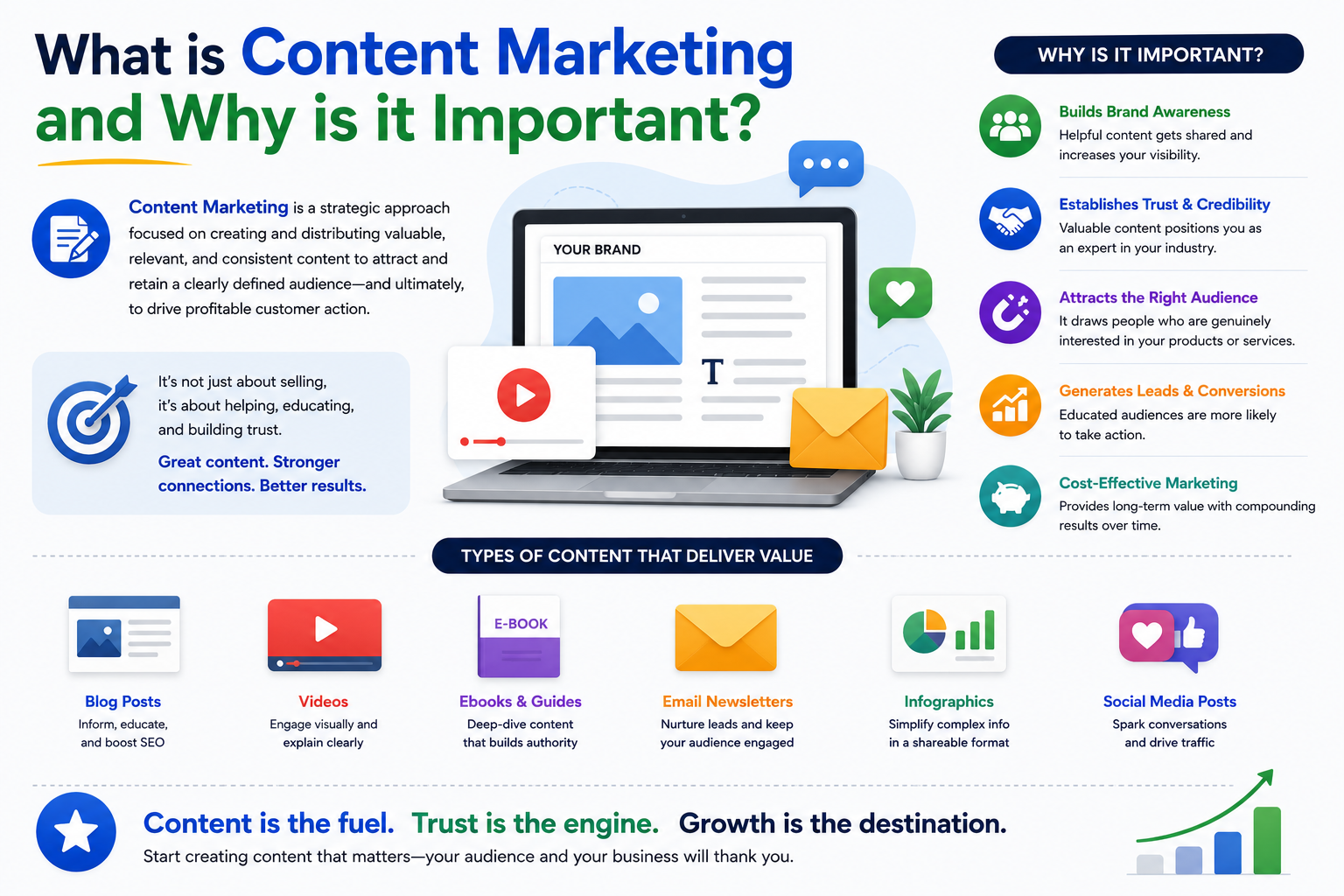
Content marketing is a strategic approach focused on creating and distributing valuable, relevant, and consistent content to attract and retain a clearly defined audience—and ultimately drive profitable customer action.
Unlike traditional advertising, which interrupts the audience, content marketing attracts them naturally by solving problems, answering questions, and building trust over time.
At its core, content marketing is not about selling directly. It is about educating, engaging, and nurturing potential customers so they eventually choose your brand when they are ready to make a decision.
What Makes Content Marketing Different?
Content marketing stands apart because it prioritizes value over promotion. Instead of saying “buy this product,” it answers questions like:
- What problem is the customer trying to solve?
- What information do they need before making a decision?
- How can the brand help them achieve better results?
By addressing these needs, businesses position themselves as trusted advisors rather than just service providers.
How Content Marketing Works in the Digital Ecosystem
Content marketing operates across multiple digital channels and touchpoints. It is not limited to blog posts or articles. Instead, it forms a complete ecosystem that includes websites, search engines, social media, email campaigns, and video platforms.
The process typically follows a simple but powerful flow:
First, businesses create high-quality content tailored to their target audience. This content is then distributed through various channels where potential customers are already active. Over time, as users engage with the content, they begin to trust the brand. Eventually, this trust leads to conversions, whether that means a purchase, a subscription, or a business inquiry.
Search engines like Google play a crucial role in this ecosystem. Businesses that consistently publish valuable content tend to rank higher in search results, which increases organic visibility and long-term traffic without ongoing advertising costs.
Social media platforms also amplify content reach, allowing brands to connect directly with audiences in a more conversational and interactive way.
Why Content Marketing is Important for Modern Businesses
Content marketing is no longer optional—it is a necessity for any business aiming to stay competitive in a digital-first economy. Its importance can be understood through several key business outcomes.
Builds Trust and Authority
Customers don’t buy from brands they don’t trust. Content marketing helps businesses establish authority by sharing knowledge, insights, and solutions that genuinely help their audience.
For example, a SaaS company publishing detailed guides on solving industry challenges naturally positions itself as an expert in that field. Over time, this authority translates into credibility and customer confidence.
Drives Organic Traffic and SEO Growth
Search engines prioritize high-quality content that answers user intent. Businesses that consistently publish optimized content tend to rank higher on Google, attracting steady organic traffic.
Unlike paid ads, which stop generating traffic once the budget ends, content marketing continues to deliver results long after publication.
Generates High-Quality Leads
Content marketing doesn’t just bring traffic—it brings the right traffic. People who engage with informative content are often already interested in a solution, making them more likely to convert into leads and customers.
Supports Long-Term Cost Efficiency
While content creation requires investment upfront, it becomes one of the most cost-effective marketing strategies over time. A single high-performing blog or video can generate leads for months or even years.
Strengthens Customer Relationships
Content is not just for acquisition—it is also for retention. Educational content, newsletters, and personalized updates help businesses stay connected with existing customers, improving loyalty and lifetime value.
Types of Content Marketing Businesses Use Today
Modern content marketing spans multiple formats, each serving a unique purpose in the customer journey.
Blog content remains one of the most powerful tools for SEO and education. It helps businesses rank on search engines and answer customer queries in detail.
Video content has rapidly gained importance, especially with platforms like YouTube, Instagram, and LinkedIn prioritizing visual storytelling. Videos are highly engaging and often easier for audiences to consume than long text-based content.
Social media content allows businesses to engage in real-time conversations, build communities, and humanize their brand identity.
Email content remains one of the highest ROI channels in digital marketing. Personalized email campaigns nurture leads and guide them through the buying journey.
Case studies and whitepapers are particularly effective for B2B businesses. They demonstrate real-world results and help decision-makers evaluate solutions with confidence.
How to Build a Strong Content Marketing Strategy
A successful content marketing strategy requires clarity, consistency, and customer understanding. Without a structured approach, even high-quality content may fail to deliver results.
Here are the foundational steps businesses typically follow:
- Define your target audience and understand their pain points
- Identify the type of content that resonates with your audience
- Develop a content calendar to maintain consistency
- Optimize all content for SEO and user intent
- Measure performance using analytics and continuously refine your strategy
The most successful businesses treat content marketing as a long-term investment rather than a short-term campaign.
Real-World Examples of Content Marketing Success
Some of the world’s most successful companies have built their growth engines around content marketing.
A well-known example is HubSpot, which transformed inbound marketing by creating extensive educational blogs, guides, and resources. Their content attracts millions of visitors every month and generates a significant portion of their leads organically.
Another example is Red Bull, which uses storytelling and high-energy video content rather than traditional advertising. By focusing on lifestyle and experiences, Red Bull has built a global media brand beyond just an energy drink company.
These examples show that content marketing is not limited to one industry—it works across SaaS, retail, entertainment, and even manufacturing.
Current Trends in Content Marketing
Content marketing continues to evolve rapidly with technology and consumer behavior. Several trends are shaping its future direction.
One major trend is the rise of AI-assisted content creation. Businesses are increasingly using AI tools to streamline research, generate ideas, and personalize content at scale.
Another trend is hyper-personalization. Customers now expect content tailored to their preferences, behavior, and stage in the buying journey.
Short-form video content is also dominating digital platforms, driven by attention spans and mobile-first consumption habits.
Voice search optimization is becoming important as more users rely on voice assistants to find information online.
Finally, interactive content such as quizzes, calculators, and dynamic web experiences is improving engagement rates significantly.
Common Mistakes Businesses Make in Content Marketing
While content marketing is powerful, many businesses fail to achieve results due to avoidable mistakes.
One common mistake is focusing too much on promotion rather than value. Content that feels overly sales-driven tends to lose audience trust quickly.
Another issue is inconsistency. Many businesses start strong but fail to maintain a consistent publishing schedule, which reduces long-term impact.
Some companies also ignore SEO fundamentals, making it difficult for their content to rank on search engines despite being high quality.
Lastly, failing to analyze performance data often leads to repeated efforts that don’t deliver results.
The Future of Content Marketing
The future of content marketing is deeply connected to technology, automation, and user experience. As digital ecosystems become more competitive, businesses will need to focus on quality, relevance, and personalization more than ever.
AI will play a major role in content ideation, optimization, and distribution. However, human creativity and storytelling will remain irreplaceable.
Brands that combine data-driven insights with authentic storytelling will stand out in an increasingly crowded digital landscape.
FAQ: Content Marketing Explained
1. What is content marketing in simple terms?
Content marketing is the process of creating valuable information like blogs, videos, and social media posts to attract and engage potential customers.
2. Why is content marketing important for businesses?
It helps build trust, increase visibility on search engines, generate leads, and reduce long-term marketing costs.
3. How long does content marketing take to show results?
Typically, businesses start seeing noticeable results within 3–6 months, depending on consistency and strategy.
4. Is content marketing better than paid advertising?
Both have their place, but content marketing provides long-term, sustainable results, while paid ads deliver immediate but short-lived traffic.
5. What types of businesses need content marketing?
Every business—from startups to large enterprises—can benefit from content marketing, regardless of industry.
Conclusion
Content marketing has evolved from a supporting tactic into a core business strategy. It drives visibility, builds trust, and creates meaningful connections between brands and their audiences.
In a digital world where attention is limited and competition is intense, businesses that invest in high-quality content consistently outperform those that rely solely on traditional advertising.
Whether you are a startup looking to build awareness or an enterprise scaling globally, content marketing offers a sustainable path to long-term growth.