


Email marketing is still one of the most powerful digital channels for businesses—but only when it’s done right. Inboxes are more crowded than ever, and customers are more selective about what they open, read, and engage with. This is where email list segmentation becomes a game-changer.
Instead of sending the same message to your entire audience, segmentation allows you to deliver the right message to the right person at the right time. The result is not just better engagement, but stronger relationships, higher conversions, and improved return on investment.
In fact, research consistently shows that segmented email campaigns can generate significantly higher revenue compared to non-segmented campaigns. Some studies report up to a 760% increase in revenue from segmented email marketing. That alone highlights why businesses—from startups to large enterprises—are prioritizing segmentation as part of their marketing strategy.
Let’s explore how segmentation works, why it matters, and how your business can implement it effectively.
What is Email List Segmentation?
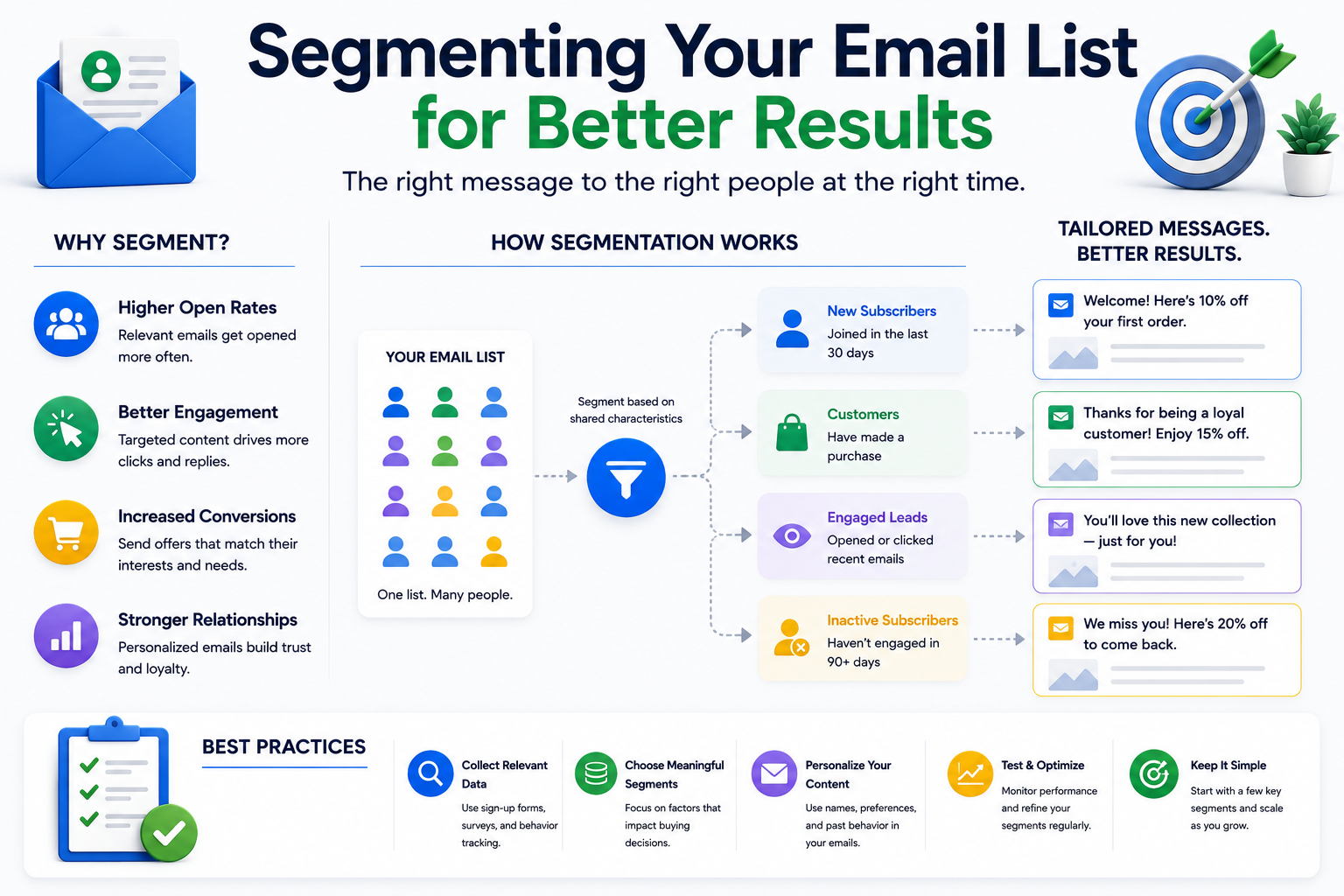
Email list segmentation is the process of dividing your email subscribers into smaller, more targeted groups based on shared characteristics. These characteristics can include behavior, demographics, purchase history, engagement level, or even geographic location.
Instead of treating your audience as a single large group, segmentation helps you understand that not all subscribers are the same. A first-time visitor, a loyal customer, and a dormant subscriber all require different communication strategies.
For example, a SaaS company might send onboarding emails to new users, while offering advanced feature updates to long-term customers. This level of personalization creates relevance, and relevance drives action.
Why Segmentation Matters in Modern Email Marketing
Modern consumers expect personalization. They no longer respond to generic, one-size-fits-all messaging. When emails feel irrelevant, they are quickly ignored—or worse, marked as spam.
Segmentation helps businesses move from mass communication to meaningful interaction.
One of the biggest reasons segmentation is critical today is the rise of customer expectations. People now interact with brands across multiple touchpoints—websites, apps, social media, and email. They expect consistency and personalization across all channels.
Another reason is data accessibility. Businesses today have access to more customer data than ever before. From browsing behavior to purchase patterns, this data can be used to create highly targeted email campaigns that feel personal and timely.
Ultimately, segmentation improves three key metrics:
higher open rates, improved click-through rates, and increased conversions.
Types of Email List Segmentation
To implement segmentation effectively, businesses must understand the different ways they can categorize their audience.
Here are the most commonly used segmentation types:
- Demographic segmentation (age, gender, income, job role)
- Geographic segmentation (country, city, time zone)
- Behavioral segmentation (website activity, email engagement, purchase behavior)
- Psychographic segmentation (interests, values, lifestyle)
- Lifecycle segmentation (new leads, active customers, inactive users)
Each type offers unique insights, and many successful businesses combine multiple segmentation strategies for better accuracy.
For instance, an e-commerce brand might target young professionals in urban areas (demographic + geographic) who frequently browse premium products (behavioral).
Benefits of Email List Segmentation
Email segmentation is not just a marketing tactic—it is a revenue-driving strategy. Businesses that adopt segmentation consistently report stronger marketing performance across multiple areas.
Here are some of the most impactful benefits:
- Higher email open rates due to increased relevance
- Improved click-through rates as content matches user intent
- Better conversion rates driven by personalized messaging
- Reduced unsubscribe rates because emails feel more useful
- Stronger customer loyalty through tailored communication
Beyond these metrics, segmentation also improves brand perception. When customers consistently receive relevant and helpful content, they are more likely to trust and engage with the brand over time.
For startups and SMEs, this can mean faster growth with limited budgets. For enterprises, it enables scalable personalization across large customer bases.
How Businesses Can Use Segmentation Effectively
Implementing segmentation is not just about dividing lists—it’s about understanding customer behavior and designing communication around it.
The most successful businesses start by analyzing their customer data. This includes purchase history, website interactions, email engagement, and even support interactions.
Once this data is collected, it becomes easier to create targeted campaigns that align with user intent.
For example, a travel company might send destination deals based on past bookings. A user who recently searched for beach vacations will receive different content compared to someone interested in mountain adventures.
This level of personalization increases the chances of engagement because it feels tailored rather than generic.
Real-World Examples of Segmentation in Action
Many global brands use email segmentation to drive massive results.
Amazon is a classic example. Its recommendation emails are heavily based on browsing and purchase behavior. If a customer buys a smartphone, they may receive emails about accessories, warranties, or related electronics.
Netflix also uses behavioral segmentation effectively. Instead of sending generic updates, it sends recommendations based on viewing history, ensuring each user receives personalized content suggestions.
Even B2B companies use segmentation strategically. For instance, a SaaS platform may segment users based on subscription tier, sending different feature updates to free users versus enterprise clients.
These examples show that segmentation is not limited to one industry—it is a universal strategy that improves communication across sectors.
Best Practices for Email List Segmentation
To get the most out of segmentation, businesses should follow proven practices that ensure accuracy and consistency.
- Keep your data clean and regularly updated to avoid outdated segments
- Start simple and gradually introduce advanced segmentation models
- Use automation tools to manage dynamic segmentation in real time
- Continuously test and optimize campaigns for better performance
- Align segmentation strategy with overall marketing goals
A key mistake many businesses make is over-segmenting too early. While segmentation is powerful, too many micro-segments can become difficult to manage without proper tools or strategy.
Instead, it’s better to start with broad categories and refine them over time as more data becomes available.
Common Mistakes Businesses Should Avoid
While segmentation offers powerful benefits, improper execution can lead to poor results.
One common mistake is relying on incomplete or outdated data. If customer information is inaccurate, segmentation becomes ineffective.
Another issue is sending too many emails to highly specific segments. This can overwhelm users and lead to disengagement.
Businesses also often fail to update their segmentation strategy regularly. Customer behavior changes over time, and segmentation must evolve accordingly.
Finally, ignoring analytics is a missed opportunity. Without tracking performance, it becomes impossible to understand what is working and what needs improvement.
The Future of Email Segmentation
Email segmentation is evolving rapidly with advancements in artificial intelligence and machine learning. Modern email marketing platforms are now capable of real-time segmentation based on user behavior.
AI-driven segmentation can predict customer intent and automatically adjust email content accordingly. This means businesses can deliver hyper-personalized experiences without manual effort.
Another emerging trend is predictive segmentation, where systems analyze past behavior to forecast future actions. For example, identifying customers who are likely to churn and targeting them with retention campaigns.
As data becomes more sophisticated, segmentation will continue to play a central role in marketing automation and customer experience strategies.
Conclusion
Email list segmentation is no longer optional—it is essential for businesses that want to stay competitive in a digital-first world. By dividing your audience into meaningful groups and delivering personalized content, you can dramatically improve engagement, conversions, and customer loyalty.
Whether you are a startup building your first email list or an enterprise managing millions of subscribers, segmentation allows you to communicate with precision and purpose.
In a world where attention is limited, relevance is everything. And segmentation ensures your message is always relevant.
Frequently Asked Questions (FAQ)
1. What is email list segmentation in simple terms?
Email list segmentation is the process of dividing your email subscribers into smaller groups based on shared characteristics so you can send more relevant messages.
2. Why is segmentation important in email marketing?
It improves engagement, increases open rates, boosts conversions, and helps businesses deliver more personalized and effective communication.
3. How many segments should a business create?
There is no fixed number. Businesses should start with a few key segments and expand gradually based on customer data and marketing needs.
4. Can small businesses benefit from email segmentation?
Yes, even small businesses can see significant improvements in engagement and sales by using simple segmentation strategies.
5. What tools are used for email segmentation?
Most email marketing platforms like Mailchimp, HubSpot, and ActiveCampaign offer built-in segmentation and automation features.