


In today’s digital-first world, social media is no longer just a branding tool—it is a powerful revenue engine. Yet, despite heavy investments in platforms like LinkedIn, Instagram, Facebook, and X (Twitter), many businesses still struggle with one critical question: Is our social media actually delivering ROI?
For startups trying to scale fast, SMEs optimizing limited budgets, or enterprises managing large-scale digital ecosystems, tracking social media ROI has become essential—not optional. Without clear measurement, even the most creative campaigns risk becoming expensive experiments.
The challenge is not whether social media works. The real challenge is understanding how much it works, where it works, and why it works.
This guide breaks down everything business leaders need to know about tracking social media ROI in a practical, modern, and business-focused way.
Understanding Social Media ROI in a Business Context
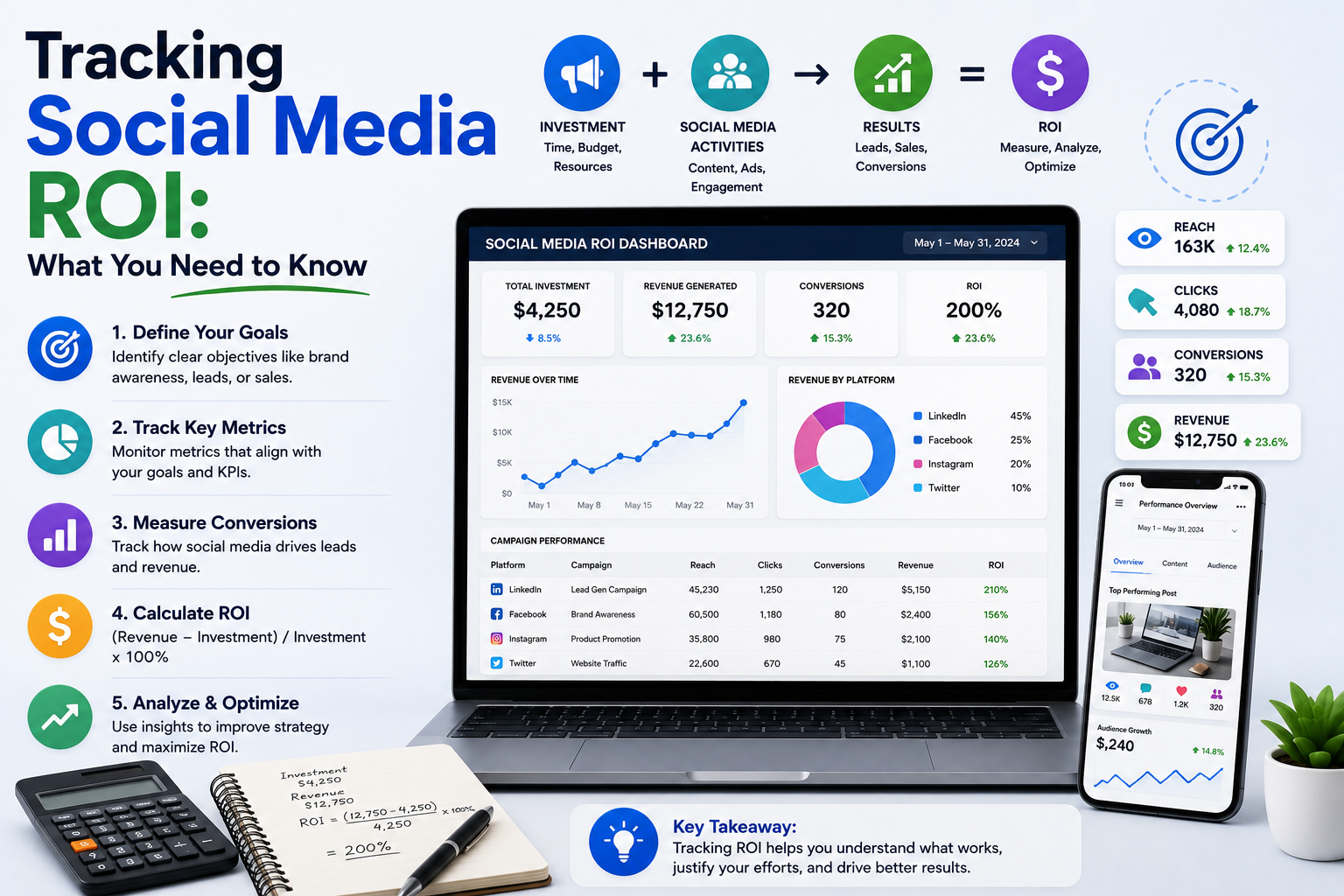
Social media ROI (Return on Investment) refers to the value a business earns from its social media activities compared to what it spends on them. While this sounds simple in theory, in practice it involves multiple layers of data, attribution models, and customer behavior tracking.
ROI is not just about direct sales. It includes brand awareness, lead generation, customer engagement, retention, and even customer service efficiency. For example, a SaaS startup may not see immediate conversions from LinkedIn campaigns, but it might experience increased demo requests, improved brand authority, and higher-quality leads over time.
According to recent digital marketing trends, over 73% of marketers now consider social media marketing either “somewhat effective” or “very effective” for business growth. However, only a fraction confidently measure ROI accurately, which highlights a major gap in analytics maturity.
Understanding ROI in social media requires shifting from vanity metrics like likes and followers to meaningful business outcomes.
Why Tracking Social Media ROI Matters More Than Ever
The digital landscape is becoming increasingly competitive. Paid advertising costs are rising, organic reach is declining on several platforms, and customer attention spans are shorter than ever. In such an environment, businesses cannot afford to run campaigns blindly.
Tracking ROI helps organizations:
- Identify which platforms generate the highest revenue impact
- Allocate marketing budgets more efficiently
- Optimize content strategies based on real performance
- Improve customer acquisition cost (CAC)
- Strengthen long-term brand positioning
For example, an e-commerce brand running campaigns across Instagram and Facebook might discover that Instagram drives higher engagement, but Facebook generates more conversions. Without ROI tracking, this insight would remain hidden, leading to inefficient spending.
In enterprise environments, ROI tracking also plays a critical role in aligning marketing teams with sales outcomes, ensuring that every campaign contributes to business objectives.
The Core Metrics That Define Social Media ROI
To measure ROI effectively, businesses need to go beyond surface-level data. The key lies in identifying metrics that directly connect to revenue and growth.
1. Conversion Metrics
Conversions remain the most direct indicator of ROI. These include purchases, sign-ups, downloads, or demo requests. Tracking conversion rates from social media traffic helps businesses understand which platforms actually drive action.
For instance, a fintech startup running LinkedIn ads for a new investment product may track how many users complete onboarding after clicking the ad. This provides a clear link between spend and revenue impact.
2. Customer Acquisition Cost (CAC)
CAC measures how much a business spends to acquire a new customer through social media campaigns. Lower CAC with higher-quality leads indicates strong ROI performance.
3. Engagement Quality
Likes and comments are useful, but deeper engagement metrics such as shares, saves, and meaningful comments reveal how well your content resonates with your audience. High engagement often leads to stronger conversion potential.
4. Customer Lifetime Value (CLV)
CLV helps businesses understand the long-term value of customers acquired through social media. If customers from Instagram ads tend to stay longer and spend more, that channel becomes highly valuable even if initial acquisition costs are higher.
5. Assisted Conversions
Social media often plays a supporting role in the customer journey. Assisted conversion tracking helps identify how social platforms contribute to conversions that happen later through other channels like search or direct traffic.
How to Track Social Media ROI Effectively
Tracking ROI is not just about tools—it is about building a structured measurement framework.
A strong ROI tracking system typically includes three layers: data collection, attribution modeling, and performance analysis.
Modern businesses rely heavily on tools such as Google Analytics 4, Meta Business Suite, HubSpot, and CRM systems like Salesforce to connect social media interactions with actual revenue outcomes.
However, tools alone are not enough. What matters is how data is interpreted.
For example, a B2B enterprise running thought leadership campaigns on LinkedIn may use UTM parameters to track traffic sources. Over time, they can analyze which content types generate the most qualified leads, not just traffic.
Attribution modeling also plays a critical role. Instead of crediting the last click, advanced models distribute value across multiple touchpoints. This is essential because modern customer journeys are rarely linear.
Real-World Example: How Brands Measure Social Media ROI
Consider a mid-sized D2C skincare brand expanding across India. Initially, the company focused heavily on Instagram influencers and paid ads but struggled to understand which campaigns actually generated revenue.
After implementing proper ROI tracking using analytics and CRM integration, the brand discovered something surprising. While influencer campaigns drove high engagement, Google-driven retargeting campaigns converted at a significantly higher rate.
This insight helped the company reallocate its budget, reducing influencer spend and increasing investment in performance marketing. Within six months, overall ROI improved by over 35%.
Similarly, SaaS companies often find that LinkedIn drives fewer leads compared to Facebook, but the quality and deal size of LinkedIn leads are significantly higher. Without ROI tracking, such strategic insights remain hidden.
Common Challenges in Measuring Social Media ROI
Despite advanced tools, many businesses still struggle with accurate ROI tracking. One of the biggest challenges is attribution complexity. A customer may see a Facebook ad, read a blog, click a LinkedIn post, and finally convert via email. Determining which channel deserves credit becomes complicated.
Another challenge is data fragmentation. Many organizations use multiple tools that do not integrate seamlessly, leading to inconsistent reporting.
Additionally, businesses often over-focus on short-term metrics. Social media is a long-term investment, and brand-building efforts may not show immediate financial returns.
Privacy changes and cookie restrictions have also made tracking more difficult, pushing businesses toward first-party data strategies and CRM-based attribution models.
The Role of Technology in Improving ROI Tracking
Technology has transformed how businesses measure marketing effectiveness. Artificial intelligence and automation are now playing a major role in analyzing social media performance.
AI-powered analytics tools can predict which campaigns are likely to convert, identify audience behavior patterns, and even recommend optimal posting times. Meanwhile, automation platforms help unify data from multiple social channels into a single dashboard.
Cloud-based CRM systems further enhance visibility by connecting marketing data with sales outcomes, enabling end-to-end ROI tracking.
As digital ecosystems evolve, businesses that invest in integrated martech stacks gain a significant competitive advantage.
Best Practices for Improving Social Media ROI
Improving ROI is not just about tracking—it is about optimization. Businesses that consistently improve performance follow a few key principles.
First, they align social media goals with business objectives. Instead of focusing on engagement alone, they prioritize leads, conversions, and revenue impact.
Second, they continuously test and refine campaigns. A/B testing creatives, messaging, and targeting helps identify what works best.
Third, they invest in high-quality content rather than high-volume posting. In today’s competitive landscape, relevance matters more than frequency.
Finally, they ensure seamless integration between marketing and sales teams. When both functions work together, ROI visibility improves significantly.
The Future of Social Media ROI Tracking
The future of ROI tracking is moving toward predictive analytics and real-time attribution. Instead of analyzing past performance, businesses will increasingly rely on systems that forecast campaign outcomes before full execution.
With advancements in AI, machine learning, and behavioral analytics, social media platforms will offer deeper insights into customer intent and buying patterns.
We are also seeing a shift toward privacy-first analytics, where businesses rely more on first-party data and consent-based tracking models.
In the coming years, companies that embrace these changes early will gain a significant advantage in digital competitiveness.
Conclusion
Tracking social media ROI is no longer a marketing luxury—it is a business necessity. In a digital ecosystem where every rupee spent must justify its value, understanding what works and what doesn’t is critical for sustainable growth.
From startups trying to validate their marketing strategy to enterprises managing global campaigns, ROI tracking provides the clarity needed to make smarter, data-driven decisions.
However, success does not come from tools alone. It comes from a strategic mindset that combines analytics, technology, creativity, and continuous optimization.
Businesses that master this balance will not only improve their marketing efficiency but also unlock long-term revenue growth.
Frequently Asked Questions (FAQ)
1. What is social media ROI?
Social media ROI is the return a business gets from its social media marketing efforts compared to the amount invested in those efforts.
2. Why is it difficult to measure social media ROI?
It is difficult due to multi-channel customer journeys, attribution challenges, and fragmented data across platforms and tools.
3. Which tools are best for tracking social media ROI?
Common tools include Google Analytics 4, Meta Business Suite, HubSpot, Salesforce, and various AI-powered marketing dashboards.
4. What is the most important metric for ROI?
Conversions and revenue-related metrics are the most important indicators of true ROI.
5. How can businesses improve social media ROI?
Businesses can improve ROI by aligning campaigns with business goals, optimizing content strategy, using proper attribution models, and integrating marketing with sales data.