


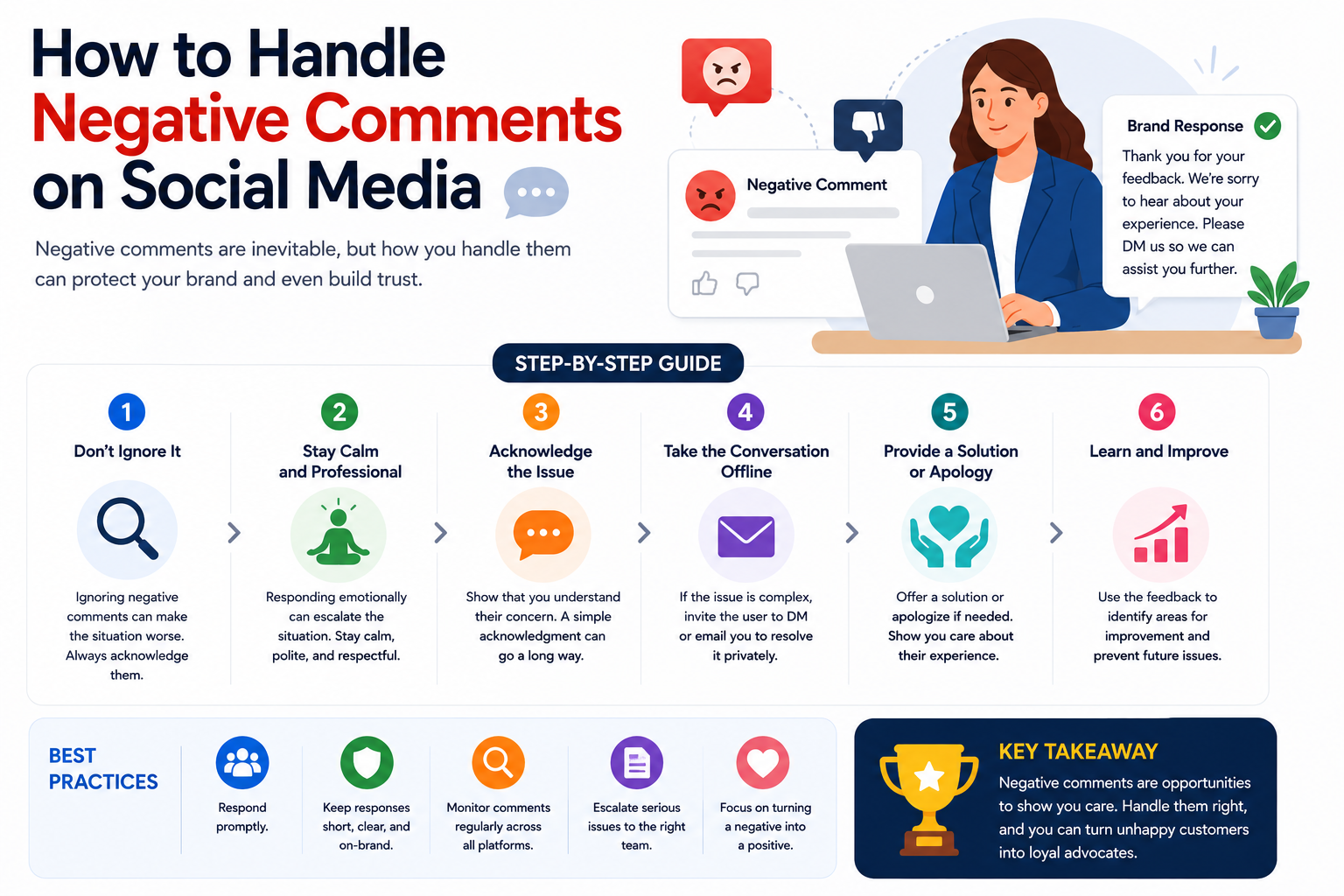
Social media has transformed the way businesses communicate with customers. Platforms such as Facebook, Instagram, LinkedIn, X, and TikTok have created direct channels where brands can engage with audiences in real time. While this presents incredible opportunities for growth, visibility, and customer loyalty, it also comes with challenges—one of the biggest being negative comments.
No matter how strong your products, services, or customer support may be, negative feedback is inevitable. A delayed delivery, a misunderstanding, a product issue, or even an unhappy customer having a bad day can result in criticism appearing publicly on your social media pages.
For many business owners and startups, negative comments can feel alarming. However, the way your company responds often matters more than the complaint itself. In fact, studies consistently show that customers are more likely to trust brands that respond professionally to criticism than brands that appear to ignore it.
The reality is that negative comments are not always a threat. When managed correctly, they can become opportunities to demonstrate transparency, customer commitment, and professionalism. Businesses that handle online criticism effectively often strengthen their reputation and build deeper customer trust.
In this guide, we will explore practical strategies for handling negative comments on social media while protecting your brand image and maintaining positive customer relationships.
Why Negative Comments Matter More Than Ever
Social media conversations are public. Unlike private customer support interactions, every response your business posts can be viewed by hundreds or even thousands of potential customers.
Research shows that a significant percentage of consumers read online reviews and social media interactions before making purchasing decisions. Prospective customers often evaluate how a company responds to complaints rather than focusing solely on the complaint itself.
A thoughtful response can demonstrate:
- Professionalism
- Accountability
- Customer-centric values
- Transparency
- Brand credibility
On the other hand, ignoring criticism or responding emotionally can damage trust and amplify negative sentiment.
For startups and growing businesses especially, every public interaction contributes to overall brand perception.
Understanding Different Types of Negative Comments
Before responding, it is important to identify the nature of the comment. Not all criticism should be handled the same way.
Some comments come from genuinely dissatisfied customers seeking help. Others may stem from misunderstandings, incorrect information, or unrealistic expectations. In some cases, businesses encounter internet trolls whose primary goal is to provoke reactions rather than solve problems.
Understanding the motivation behind a comment helps determine the most effective response strategy.
A customer reporting a service issue deserves immediate attention and empathy. A user spreading misinformation may require clarification. A spam account posting irrelevant content may need moderation rather than engagement.
When businesses classify comments correctly, they can respond with greater confidence and consistency.
Stay Calm and Avoid Emotional Responses
One of the most common mistakes businesses make is responding emotionally.
Negative comments can feel personal, especially for founders, entrepreneurs, and small business owners who have invested significant time and effort into building their companies. However, reacting defensively rarely improves the situation.
Instead, pause and evaluate the comment objectively.
Ask yourself:
Is the criticism valid?
Is the customer experiencing a real issue?
What outcome would resolve the concern?
By focusing on solutions rather than emotions, businesses can maintain professionalism and avoid escalating conflicts.
Remember that your response is not only for the individual who posted the comment. It is also for every current and future customer who may read the interaction.
Respond Quickly but Thoughtfully
Speed matters on social media.
Modern consumers expect brands to respond quickly, especially when they raise concerns publicly. Delayed responses can create the impression that a business is unresponsive or unconcerned.
However, responding quickly does not mean responding impulsively.
A well-considered reply that addresses the customer’s concern is far more effective than a rushed message that lacks empathy or accuracy.
Many successful brands establish internal response guidelines to ensure that customer concerns are acknowledged promptly while maintaining consistent communication standards.
For businesses receiving large volumes of comments, social media management tools can help monitor conversations and improve response times.
Acknowledge the Customer’s Concern
Customers want to feel heard.
One of the most effective ways to de-escalate a negative situation is simply acknowledging the customer’s experience.
Even if the business is not directly at fault, recognizing the customer’s frustration demonstrates empathy and professionalism.
For example, instead of saying:
“We did nothing wrong.”
A more effective response would be:
“We’re sorry to hear about your experience and appreciate you bringing this to our attention.”
This approach creates a constructive starting point for resolving the issue.
Acknowledgment does not necessarily mean accepting blame. It means recognizing the customer’s perspective and showing willingness to help.
Move Complex Conversations to Private Channels
Public responses are important, but lengthy disputes rarely belong in comment sections.
When a complaint requires account details, order information, or in-depth troubleshooting, it is usually best to continue the conversation through private messages, email, or customer support channels.
A public response can acknowledge the issue while inviting the customer to continue the discussion privately.
For example:
“Thank you for sharing your feedback. We’d like to understand this better and help resolve the issue. Please send us a direct message with your details.”
This approach demonstrates responsiveness while protecting customer privacy.
It also prevents long public exchanges that may distract from your brand’s broader messaging.
Apologize When Appropriate
Businesses sometimes avoid apologies because they fear admitting fault.
In reality, a sincere apology often strengthens customer relationships.
If your company made a mistake, acknowledge it openly and explain how you plan to address the issue.
Consumers value authenticity and accountability. Attempting to avoid responsibility can often create greater frustration than the original problem itself.
A thoughtful apology should focus on the customer’s experience rather than making excuses.
When combined with corrective action, apologies can transform dissatisfied customers into loyal advocates.
Use Negative Feedback to Improve Your Business
Every complaint contains information.
While some criticism may be unreasonable, recurring complaints often reveal genuine opportunities for improvement.
For example, if multiple customers consistently mention delayed deliveries, confusing onboarding processes, or poor communication, these patterns deserve attention.
Forwarding customer feedback to relevant teams can help identify operational gaps and improve overall customer experiences.
Many successful organizations actively analyze social media comments to uncover trends and improve products, services, and support processes.
Negative feedback, when viewed constructively, becomes a valuable source of business intelligence.
Learn from Real-World Brand Examples
Some of the world’s most respected brands have faced public criticism on social media.
Companies such as Netflix, Airbnb, and Starbucks have all encountered customer complaints online. What often distinguishes successful responses is their commitment to transparency and timely communication.
When service disruptions occur, leading brands frequently acknowledge the issue publicly, provide updates, and communicate resolution timelines.
This proactive communication helps reduce frustration and reassures customers that the company is actively working on a solution.
Businesses of any size can adopt the same principles.
You do not need a global customer service team to communicate honestly and professionally.
Know When to Delete or Hide Comments
While transparency is important, not every comment deserves visibility.
Businesses should have clear moderation policies covering:
- Spam content
- Hate speech
- Harassment
- Offensive language
- Fraudulent activity
- Repeated abusive behavior
Comments that violate community guidelines may be hidden, removed, or reported according to platform policies.
However, businesses should avoid deleting legitimate customer complaints simply because they are negative.
Removing valid criticism can create perceptions of censorship and may encourage customers to voice frustrations elsewhere.
A balanced moderation strategy protects both the community and the brand’s credibility.
Create a Social Media Response Framework
Consistency is essential, especially for organizations with multiple employees managing social accounts.
A documented response framework helps teams handle criticism effectively while maintaining brand voice and professionalism.
A strong framework typically includes response timelines, escalation procedures, approval workflows, and communication guidelines.
This ensures that customers receive consistent experiences regardless of which team member handles the interaction.
For growing businesses and enterprises, a structured social media governance strategy becomes increasingly important as audience size expands.
Turning Negative Comments Into Positive Marketing Opportunities
One overlooked benefit of handling criticism well is the opportunity to showcase customer service excellence.
When prospective customers see a business responding professionally, solving problems, and treating customers respectfully, it creates confidence.
Many consumers understand that no company is perfect.
What they want to know is how a company behaves when problems arise.
Brands that consistently demonstrate empathy, accountability, and responsiveness often earn stronger customer loyalty than brands that never receive public criticism at all.
In many cases, a well-managed complaint becomes a public example of outstanding customer service.
The Role of Social Listening in Reputation Management
Modern businesses cannot afford to monitor only direct mentions.
Customers frequently discuss brands without tagging official accounts.
Social listening tools help organizations track conversations across multiple platforms, identify emerging issues, and respond proactively before concerns escalate.
As digital conversations continue to grow, social listening is becoming a critical component of reputation management strategies.
For startups and enterprises pursuing digital transformation, investing in monitoring capabilities can provide valuable insights into customer sentiment and market perception.
The earlier a business identifies potential issues, the easier they are to resolve.
Building a Long-Term Reputation Strategy
Handling negative comments effectively is not just about crisis management.
It is about building a reputation for reliability, transparency, and customer care.
Businesses that consistently engage with customers, respond respectfully, and demonstrate accountability develop stronger relationships over time.
Reputation management should be viewed as an ongoing process rather than a reactive activity.
Every interaction contributes to the overall perception of your brand.
Organizations that prioritize customer communication are often better positioned to attract new customers, retain existing ones, and strengthen market credibility.
Conclusion
Negative comments on social media are an unavoidable part of doing business in the digital age. However, they do not have to damage your brand.
When handled professionally, criticism can become an opportunity to demonstrate responsiveness, build trust, and improve customer experiences.
The key is to remain calm, respond thoughtfully, acknowledge concerns, and focus on solutions rather than arguments. Customers appreciate businesses that listen, communicate openly, and take action when problems arise.
In today’s highly connected world, your response to a complaint may influence far more people than the original comment itself. By developing a clear social media response strategy, businesses can protect their reputation while creating stronger relationships with their audiences.
Ultimately, successful brands are not defined by the absence of negative feedback. They are defined by how effectively they respond to it.
Frequently Asked Questions (FAQs)
How should businesses respond to negative comments on social media?
Businesses should respond promptly, professionally, and empathetically. Acknowledge the customer’s concern, provide assistance, and move complex discussions to private channels when necessary.
Is it okay to delete negative comments?
Legitimate customer complaints should generally remain visible and be addressed professionally. However, spam, abusive language, hate speech, and fraudulent content may be removed according to community guidelines.
How quickly should companies respond to social media complaints?
Ideally, businesses should acknowledge complaints as quickly as possible. Fast responses demonstrate attentiveness and can prevent issues from escalating.
Can negative comments actually benefit a business?
Yes. Negative comments can reveal valuable insights about customer experiences and operational weaknesses. Properly addressing criticism can also demonstrate strong customer service and build trust.
What is the biggest mistake businesses make when handling criticism online?
The most common mistake is responding emotionally or defensively. Professional, solution-focused communication is far more effective in protecting brand reputation.
Ready to Strengthen Your Digital Presence?
Managing social media conversations effectively requires the right strategy, technology, and expertise. Whether you’re a startup scaling rapidly, an SME improving customer engagement, or an enterprise undergoing digital transformation, partnering with an experienced technology and digital marketing team can help you build a stronger online reputation.
Choose a trusted technology partner that understands social media management, customer experience optimization, reputation monitoring, and digital growth strategies. The right expertise can help turn every customer interaction into an opportunity for long-term business success.