


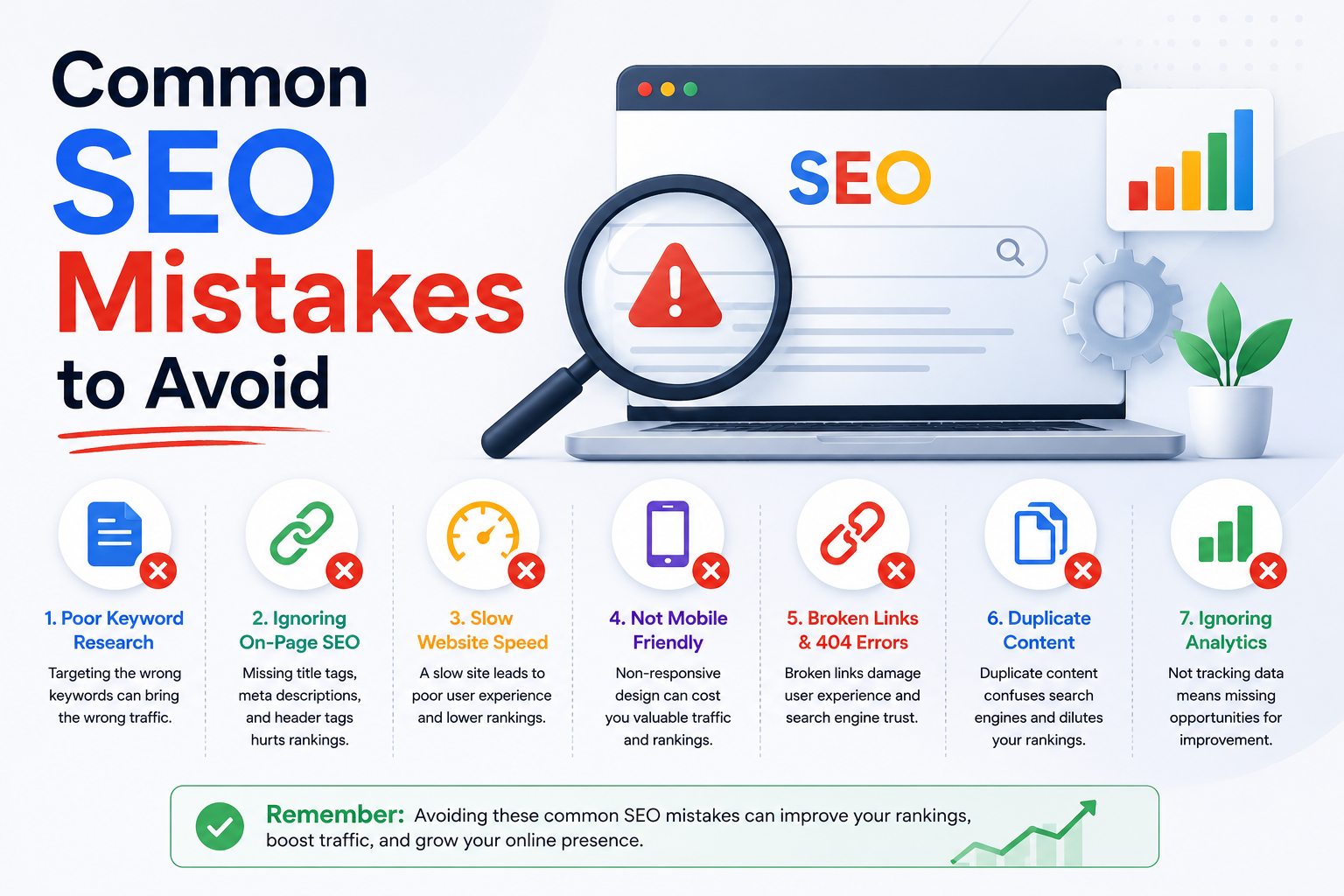
Search Engine Optimization (SEO) remains one of the most effective digital marketing strategies for businesses looking to increase online visibility, generate qualified leads, and build long-term brand authority. Yet despite investing significant resources into SEO campaigns, many companies fail to achieve the results they expect.
The reason is often not a lack of effort. Instead, businesses frequently make critical SEO mistakes that limit search visibility, reduce website traffic, and negatively impact conversions.
As search engines become smarter and user expectations continue to evolve, outdated SEO practices can do more harm than good. Google’s algorithms now prioritize user experience, content quality, technical performance, and search intent more than ever before. Businesses that ignore these factors often struggle to compete, regardless of their marketing budget.
Whether you’re a startup launching a new website, an SME trying to increase organic traffic, or an enterprise managing a large digital presence, understanding common SEO mistakes can help you build a stronger and more sustainable online strategy.
In this guide, we’ll explore the most common SEO mistakes businesses make and explain how to avoid them.
Why SEO Mistakes Can Be Costly
Many business owners assume that SEO errors only affect rankings. In reality, the consequences go much further.
A poorly optimized website can lead to lower traffic, reduced lead generation, poor user engagement, and ultimately lost revenue. According to various industry studies, organic search continues to drive a significant percentage of website traffic across industries. This means even small SEO mistakes can impact thousands of potential visitors over time.
The challenge is that SEO issues are often invisible. A website may look attractive to users while still suffering from technical problems, content gaps, or optimization issues that prevent search engines from properly understanding and ranking its pages.
Let’s examine the mistakes that most frequently hold businesses back.
Ignoring Search Intent
One of the biggest SEO mistakes today is focusing solely on keywords while ignoring search intent.
Modern search engines are designed to understand why users perform searches. Simply inserting target keywords into content is no longer enough.
For example, a software company targeting the keyword “CRM software” may create a product page optimized around that term. However, if users searching for that phrase are looking for comparisons, reviews, or educational content, a sales-focused page may struggle to rank.
Businesses should create content that aligns with the user’s goals. Understanding whether a search is informational, navigational, commercial, or transactional can significantly improve content performance.
When content satisfies search intent, users spend more time on the page, engage more deeply, and are more likely to convert.
Publishing Low-Quality or Thin Content
Content remains one of the strongest ranking factors in SEO.
Unfortunately, many businesses still publish content simply to maintain a publishing schedule rather than provide genuine value.
Thin content often includes short articles with little information, repetitive content, poorly researched topics, or pages created solely for search engines.
Google increasingly rewards content that demonstrates expertise, experience, authority, and trustworthiness. Businesses that publish comprehensive, helpful, and well-researched content typically achieve better rankings and stronger audience engagement.
Rather than focusing on quantity, organizations should prioritize quality. One highly valuable article can often outperform dozens of low-quality pages.
Keyword Stuffing
Years ago, repeating keywords throughout a page could improve rankings. Today, keyword stuffing is one of the fastest ways to damage content quality.
Keyword stuffing occurs when businesses unnaturally force keywords into headings, paragraphs, meta descriptions, or image tags.
Consider a sentence like:
“Looking for the best SEO company? Our SEO company provides SEO services for businesses needing an SEO company.”
This type of writing creates a poor user experience and signals low-quality content to search engines.
Instead, businesses should focus on natural language, topic relevance, and semantic optimization. Search engines now understand context, synonyms, and related terms, making excessive keyword repetition unnecessary.
Neglecting Technical SEO
Many organizations invest heavily in content marketing while overlooking technical SEO.
Technical SEO forms the foundation of website performance. Even exceptional content may struggle to rank if technical issues prevent search engines from crawling and indexing pages effectively.
Common technical SEO issues include:
- Regular technical audits help identify and resolve these issues before they impact rankings.
- For enterprises managing large websites, technical SEO becomes even more important because small errors can affect thousands of pages simultaneously.
Poor Website Speed and Performance
Website speed directly affects both SEO and user experience.
Research consistently shows that users expect websites to load quickly. Even a few seconds of delay can increase bounce rates and reduce conversions.
Google has also incorporated page experience and Core Web Vitals into its ranking considerations, making performance optimization essential.
Common causes of slow websites include oversized images, excessive scripts, poor hosting infrastructure, and unoptimized code.
Businesses should regularly monitor website performance and implement optimization strategies that improve loading speed across desktop and mobile devices.
Fast websites not only rank better but also create stronger customer experiences.
Forgetting Mobile Optimization
Mobile devices now account for the majority of internet traffic worldwide.
Despite this trend, many organizations still prioritize desktop experiences while neglecting mobile usability.
Google’s mobile-first indexing means the mobile version of a website is primarily used for indexing and ranking purposes.
A website that performs poorly on mobile devices may experience reduced visibility even if the desktop version functions perfectly.
Mobile optimization should focus on responsive design, readable text, intuitive navigation, fast loading speeds, and touch-friendly interfaces.
Businesses that provide seamless mobile experiences are better positioned to compete in today’s digital landscape.
Overlooking On-Page SEO Elements
Strong content alone is not enough.
Search engines rely on various on-page SEO elements to understand page relevance and context.
Some of the most overlooked elements include:
- These components help search engines interpret content while also improving click-through rates and user navigation.
- Businesses should ensure every important page includes properly optimized on-page elements that accurately reflect the content’s purpose.
Ignoring Internal Linking Opportunities
Internal linking is often underestimated, yet it plays a crucial role in SEO success.
A well-structured internal linking strategy helps search engines discover content, understand topic relationships, and distribute authority across the website.
For example, a company publishing a guide about digital transformation can internally link to related pages discussing cloud migration, cybersecurity, software development, and data analytics.
These connections strengthen topical relevance while encouraging visitors to explore additional content.
Without effective internal linking, valuable pages may remain isolated and struggle to achieve strong visibility.
Building Low-Quality Backlinks
Backlinks remain an important ranking signal, but not all links provide value.
Some businesses attempt to accelerate SEO results by purchasing links or participating in questionable link-building schemes.
While these tactics may generate short-term gains, they often create long-term risks.
Search engines have become increasingly sophisticated at identifying manipulative link practices. Low-quality backlinks can reduce credibility and even result in ranking penalties.
A sustainable backlink strategy focuses on earning links through valuable content, industry partnerships, thought leadership, digital PR, and genuine authority building.
Quality always outweighs quantity when it comes to backlinks.
Failing to Update Existing Content
Many businesses focus exclusively on creating new content while neglecting older pages.
Over time, information becomes outdated, industry trends change, and competitors publish more comprehensive resources.
Refreshing existing content can often generate faster SEO improvements than creating entirely new pages.
Content updates may include:
Regular content maintenance signals freshness to search engines and ensures users continue receiving accurate information.
Not Measuring SEO Performance Correctly
SEO success cannot be evaluated based solely on rankings.
Many organizations become overly focused on keyword positions while ignoring metrics that directly impact business growth.
Effective SEO measurement should consider traffic quality, user engagement, lead generation, conversion rates, and revenue contribution.
For example, ranking first for a keyword that generates no leads provides little business value. Conversely, ranking third for a highly targeted commercial keyword may produce substantial revenue.
Business leaders should align SEO objectives with broader organizational goals rather than chasing vanity metrics.
Creating Duplicate Content
Duplicate content remains a common issue, particularly for large websites and e-commerce businesses.
Duplicate pages can confuse search engines by making it difficult to determine which version should rank.
This issue frequently occurs through product variations, printer-friendly pages, URL parameters, and content copied across multiple pages.
While duplicate content does not always result in penalties, it can dilute ranking signals and reduce overall SEO effectiveness.
Implementing proper canonical tags and maintaining unique content across important pages helps avoid these challenges.
Ignoring Local SEO Opportunities
For businesses serving specific geographic markets, local SEO is essential.
Yet many companies fail to optimize for local searches, missing opportunities to attract nearby customers actively looking for their products or services.
Local SEO involves optimizing business profiles, location pages, local citations, customer reviews, and geographically relevant content.
When executed correctly, local SEO helps businesses appear in map results, local search listings, and location-based queries.
For service providers, consultants, healthcare organizations, and retail businesses, local visibility can significantly influence revenue growth.
Treating SEO as a One-Time Project
Perhaps the most damaging SEO mistake is viewing optimization as a one-time initiative.
SEO is an ongoing process. Search algorithms evolve, competitors improve their strategies, customer behavior changes, and new technologies emerge.
Businesses that achieve long-term SEO success continuously monitor performance, refine content, improve technical infrastructure, and adapt to market changes.
Organizations that stop investing in SEO often find themselves gradually losing visibility to more proactive competitors.
The most successful companies treat SEO as a long-term business asset rather than a short-term marketing tactic.
The Future of SEO: What Businesses Should Focus On
As artificial intelligence, voice search, and user experience continue shaping search behavior, SEO is becoming increasingly sophisticated.
Businesses should focus on creating exceptional user experiences, publishing authoritative content, improving website performance, and building genuine trust with audiences.
Future SEO success will depend less on manipulating algorithms and more on delivering value to users.
Companies that embrace this mindset will be better positioned for sustainable growth.
Conclusion
SEO can be one of the highest-return digital marketing investments available to businesses. However, achieving meaningful results requires more than simply targeting keywords and publishing content.
Common SEO mistakes such as ignoring search intent, neglecting technical optimization, publishing thin content, overlooking mobile usability, and failing to update existing pages can significantly limit performance.
The good news is that most SEO issues are preventable. By adopting a strategic approach focused on quality, user experience, and continuous improvement, businesses can build stronger search visibility and generate long-term organic growth.
Whether you’re a startup seeking brand awareness, an SME aiming to increase leads, or an enterprise pursuing digital transformation, avoiding these SEO mistakes can help maximize your online success and create a sustainable competitive advantage.
Frequently Asked Questions (FAQs)
What is the most common SEO mistake businesses make?
One of the most common SEO mistakes is creating content without understanding search intent. Even well-written content may fail to rank if it does not address what users are actually searching for.
Does keyword stuffing still work in SEO?
No. Modern search engines prioritize content quality and user experience. Keyword stuffing can harm readability and negatively affect rankings.
How often should SEO content be updated?
Businesses should review important content at least every few months. Updating statistics, examples, links, and industry insights helps maintain relevance and competitiveness.
Why is technical SEO important?
Technical SEO ensures search engines can efficiently crawl, index, and understand website content. Without a strong technical foundation, even excellent content may struggle to rank.
How long does it take to see SEO results?
SEO is a long-term strategy. Most businesses begin seeing measurable improvements within three to six months, although competitive industries may require more time.
Ready to Improve Your SEO Performance?
Avoiding SEO mistakes is only the first step. Sustainable growth requires a strategy built on technical excellence, high-quality content, data-driven optimization, and ongoing performance monitoring.
If your business is planning digital transformation, scaling online visibility, or looking to generate more qualified leads through search, partnering with an experienced SEO and technology team can accelerate results.
Choose a technology partner that understands both business objectives and modern search engine requirements. The right expertise can help transform your website into a powerful growth engine that drives traffic, leads, and revenue for years to come.