


Every day, millions of people turn to search engines to find products, services, and solutions. Whether someone is searching for a software provider, a local business, or industry expertise, the companies that appear at the top of search results often gain the most visibility, traffic, and opportunities.
This is where Search Engine Optimization (SEO) becomes essential.
While SEO consists of many different strategies, on-page SEO is one of the most effective places for beginners to start. Unlike technical SEO or link-building campaigns that may require specialized expertise, on-page SEO focuses on optimizing the content and structure of individual web pages so search engines can better understand and rank them.
According to multiple industry studies, organic search continues to drive more website traffic than most other digital marketing channels. Businesses that invest in SEO often experience stronger online visibility, lower customer acquisition costs, and more sustainable long-term growth.
The good news is that improving on-page SEO does not require a massive budget or a large marketing team. Even small adjustments can significantly improve how search engines interpret your content and how users engage with your website.
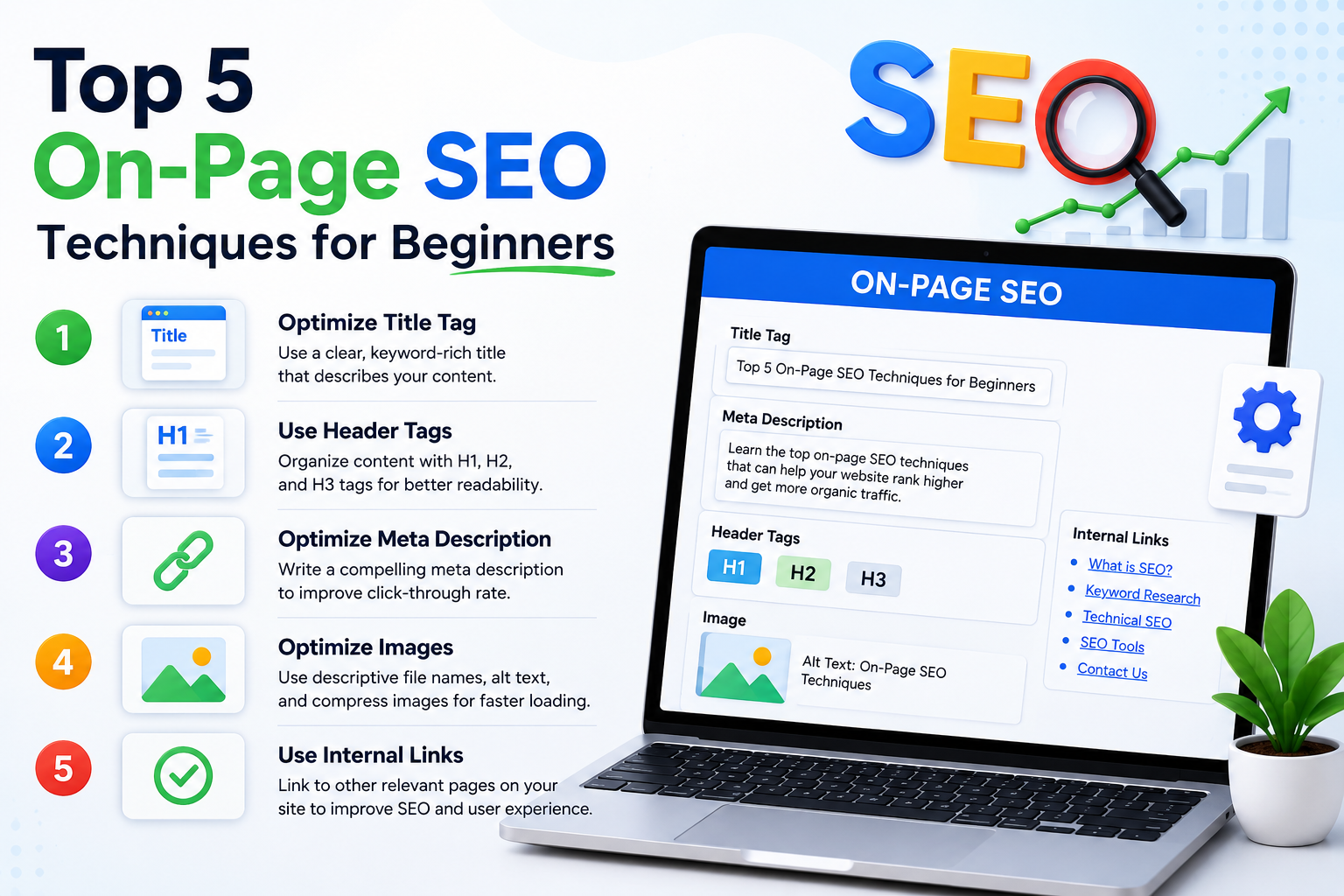
In this guide, we will explore five fundamental on-page SEO techniques that every beginner should understand and implement.
What Is On-Page SEO?
On-page SEO refers to the process of optimizing elements directly on a webpage to improve its visibility in search engine results.
These elements include:
- Page titles
- Meta descriptions
- Headings
- Content quality
- Keyword placement
- Internal links
- Images
- URL structure
- User experience factors
The goal is simple: help search engines understand your content while providing a better experience for visitors.
For example, if a startup publishes an article about cloud migration services, proper on-page optimization helps search engines identify the topic and determine when it should appear for relevant searches.
Without on-page SEO, even excellent content may struggle to rank.
1. Optimize Title Tags and Meta Descriptions
One of the simplest and most impactful SEO improvements beginners can make is optimizing title tags and meta descriptions.
The title tag is typically the clickable headline users see in search results. It provides search engines with important information about the page topic.
Meta descriptions, while not a direct ranking factor, influence click-through rates by encouraging users to visit your website.
Why It Matters
Imagine two websites ranking side by side for the same keyword.
One result simply says:
“Home – Company Name”
The other says:
“Cloud Migration Services for Growing Businesses | Reduce Costs & Improve Performance”
Which one would you click?
Most users choose the second option because it clearly communicates value.
Best Practices
Include your primary keyword naturally near the beginning of the title.
Keep title tags under approximately 60 characters to avoid truncation.
Write compelling meta descriptions between 150 and 160 characters.
Focus on benefits, outcomes, and relevance rather than stuffing keywords.
Business Example
A digital transformation consultancy targeting manufacturing companies could optimize its page title from:
“Services”
to:
“Digital Transformation Consulting for Manufacturing Companies”
This immediately improves relevance for both users and search engines.
2. Create High-Quality Content That Matches Search Intent
Content remains one of the strongest ranking factors in modern SEO.
However, successful content is no longer about repeating keywords. Search engines have become significantly more sophisticated and prioritize content that satisfies user intent.
Search intent refers to the reason behind a search query.
For example, someone searching for:
“what is cloud computing”
is seeking educational information.
Someone searching for:
“best cloud migration company”
is likely evaluating service providers.
Your content must align with the user’s objective.
Why Search Intent Matters
Many businesses create content based solely on keywords without understanding what users actually want.
As a result, their pages fail to engage visitors, leading to higher bounce rates and lower rankings.
Google increasingly rewards content that answers questions thoroughly, solves problems, and delivers a positive user experience.
Creating Content That Performs
Start by identifying the primary question your audience wants answered.
Provide comprehensive explanations rather than surface-level information.
Use clear headings to improve readability.
Include examples, data, and practical insights.
Write for humans first and search engines second.
Real-World Example
A software company targeting enterprise clients may create an article titled:
“ERP Implementation Challenges and How to Overcome Them”
Rather than focusing solely on the keyword “ERP implementation,” the article addresses actual concerns decision-makers face during deployment.
This creates more value and often leads to stronger rankings.
3. Use Proper Heading Structure (H1, H2, and H3)
Headings help both users and search engines understand the structure of your content.
A well-organized page improves readability, keeps visitors engaged, and allows search engines to identify key topics.
Understanding Heading Hierarchy
The H1 tag should represent the main topic of the page.
H2 headings divide major sections.
H3 headings support subtopics within those sections.
Think of headings as a roadmap guiding readers through your content.
Why It Matters
Users rarely read every word on a webpage.
Instead, they scan content to find relevant information.
Clear headings improve navigation and encourage visitors to stay longer.
Search engines also use headings to better understand content relevance.
Example Structure
H1: Top 5 On-Page SEO Techniques for Beginners
H2: Optimize Title Tags and Meta Descriptions
H2: Create High-Quality Content
H3: Understanding Search Intent
H3: Content Optimization Strategies
This structure makes content easier to consume while improving SEO signals.
Common Mistake
Many websites skip heading levels or use headings purely for design purposes.
Maintaining a logical hierarchy improves both accessibility and search performance.
4. Optimize Images for SEO and User Experience
Images enhance content, improve engagement, and make pages more visually appealing.
However, improperly optimized images can slow down websites and negatively impact rankings.
Page speed has become increasingly important because users expect websites to load quickly.
Research consistently shows that visitors abandon websites that take too long to load.
Key Image Optimization Techniques
Use descriptive file names before uploading images.
Compress images to reduce file size without sacrificing quality.
Add meaningful alt text describing the image.
Choose modern formats such as WebP when possible.
Ensure images are responsive across devices.
Why Alt Text Matters
Alt text helps search engines understand image content and improves accessibility for users who rely on screen readers.
For example:
Instead of:
“image123.jpg”
Use:
“on-page-seo-strategy-dashboard.jpg”
And write alt text such as:
“SEO dashboard showing keyword rankings and organic traffic growth”
Business Impact
An eCommerce company with hundreds of product images can significantly improve search visibility through image optimization while also enhancing page speed and user experience.
5. Build a Strong Internal Linking Structure
Internal links connect pages within your website.
They help users discover related content and assist search engines in understanding your site’s architecture.
Despite being one of the most overlooked SEO techniques, internal linking can have a substantial impact on rankings.
Why Internal Links Matter
Search engines use internal links to discover and index pages.
They also distribute authority throughout your website.
A strong internal linking strategy can help important pages gain visibility more quickly.
Example
Suppose your company publishes a blog post about:
“Benefits of Cloud Computing”
Within that article, you could naturally link to:
- Cloud Migration Services
- Digital Transformation Solutions
- Cloud Security Best Practices
This creates a connected content ecosystem that benefits both users and search engines.
Best Practices
Use descriptive anchor text.
Link to relevant pages naturally.
Avoid excessive linking that distracts readers.
Regularly update older content with links to newer resources.
Real-World Benefit
Many enterprise websites see ranking improvements simply by strengthening internal connections between related pages.
This approach often requires no additional content creation yet delivers measurable SEO gains.
Common On-Page SEO Mistakes Beginners Should Avoid
While implementing SEO best practices is important, avoiding common mistakes is equally valuable.
One frequent issue is keyword stuffing. Repeating keywords excessively creates a poor reading experience and may negatively affect rankings.
Another mistake is publishing thin content that lacks depth or practical value.
Businesses also often overlook mobile optimization despite mobile devices accounting for a large portion of global web traffic.
Duplicate content, missing title tags, broken internal links, and slow-loading pages can further reduce SEO performance.
Successful SEO focuses on creating useful experiences rather than attempting to manipulate search algorithms.
The Future of On-Page SEO
SEO continues to evolve as search engines become more advanced.
Artificial intelligence, machine learning, and user behavior signals increasingly influence rankings.
However, the fundamentals remain consistent.
Businesses that create valuable content, optimize user experience, and structure their websites effectively continue to perform well.
As digital competition increases across industries, on-page SEO will remain one of the most cost-effective methods for attracting qualified traffic and generating leads.
Organizations that establish strong SEO foundations today will be better positioned to compete tomorrow.
Conclusion
On-page SEO is one of the most accessible and impactful areas of search engine optimization for beginners.
By focusing on title tags, content quality, heading structure, image optimization, and internal linking, businesses can significantly improve their search visibility and user experience.
The best part is that these techniques do not require extensive technical expertise or large marketing budgets. Small improvements implemented consistently can produce meaningful long-term results.
Whether you are a startup building brand awareness, an SME looking to generate leads, or an enterprise pursuing digital transformation, mastering on-page SEO can help create sustainable online growth.
The businesses that win in search are often the ones that make it easiest for both users and search engines to understand their content.
Start with these five techniques, measure your results, and continue refining your strategy over time.
Frequently Asked Questions (FAQs)
What is on-page SEO?
On-page SEO is the practice of optimizing individual webpages, including content, headings, title tags, images, and internal links, to improve search engine rankings and user experience.
How long does on-page SEO take to show results?
Results vary depending on competition, website authority, and content quality. Many businesses begin seeing improvements within a few weeks to several months after implementing SEO best practices.
Is on-page SEO enough to rank on Google?
On-page SEO is essential, but rankings also depend on factors such as backlinks, technical SEO, website performance, and overall domain authority.
How often should I update my content?
Regular updates help maintain relevance and accuracy. Many businesses review important pages every three to six months to ensure content remains current and competitive.
Why are internal links important for SEO?
Internal links help search engines discover pages, distribute authority throughout a website, improve navigation, and increase user engagement.
Ready to Improve Your Website’s SEO Performance?
Effective SEO is not just about rankings—it is about creating a stronger digital presence, attracting qualified leads, and supporting long-term business growth.
Whether you are launching a startup, scaling an SME, or leading enterprise-level digital transformation initiatives, partnering with the right technology and digital marketing experts can accelerate your results.
Work with an experienced SEO and technology partner that understands your business goals, develops data-driven strategies, and helps you build sustainable online visibility that drives measurable outcomes.