


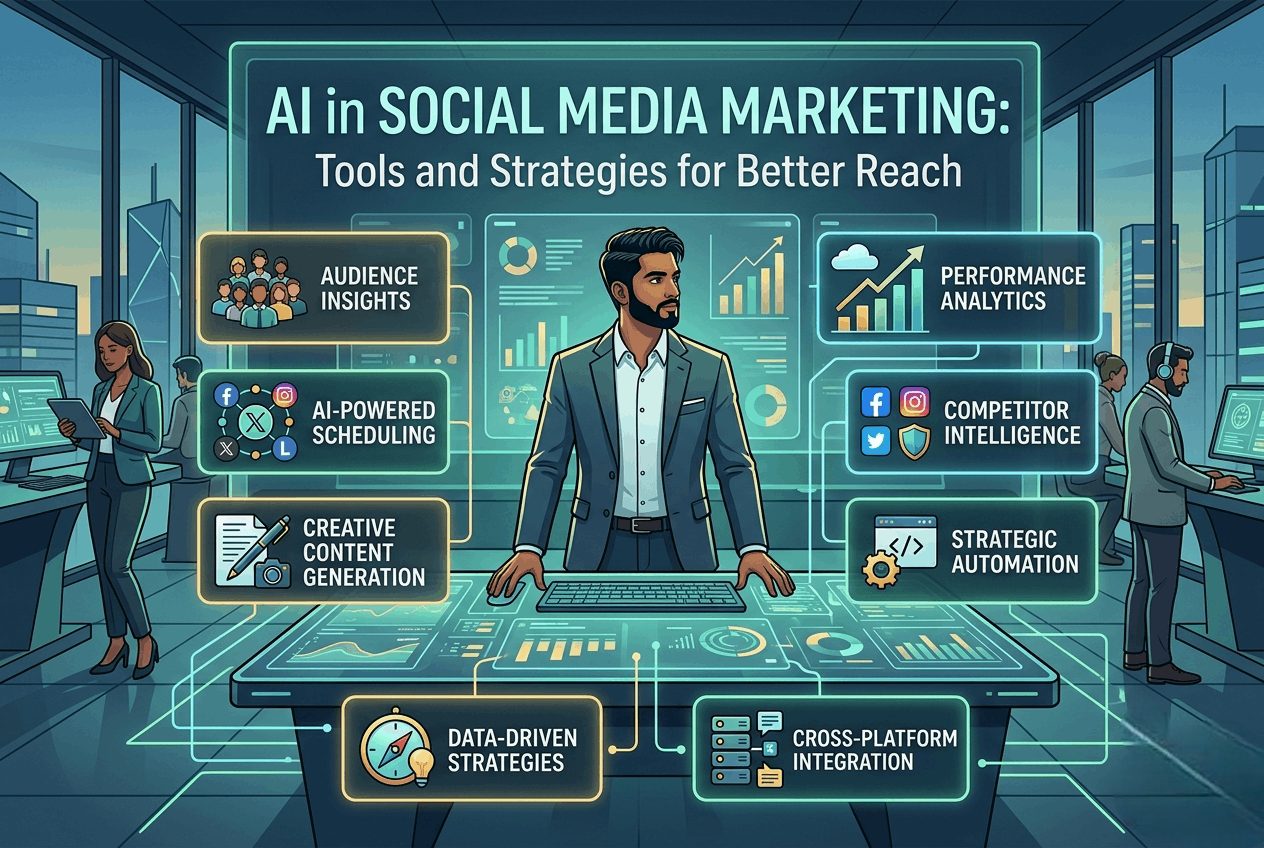
Social media has become one of the most powerful marketing channels for businesses of every size. Millions of people spend hours each day on platforms like Facebook, Instagram, LinkedIn, TikTok, and X, making these networks valuable spaces for brands to connect with potential customers. However, managing multiple platforms, creating engaging content, responding to customers, and measuring campaign performance can quickly become overwhelming without the right support.
Artificial Intelligence (AI) is changing the way businesses approach social media marketing. Instead of relying only on manual work, companies can now use intelligent tools to automate repetitive tasks, understand customer behavior, generate creative ideas, and optimize campaigns in real time. AI allows marketers to spend less time on routine activities and more time building meaningful relationships with their audience.
As AI technology continues to evolve, businesses that understand how to use it effectively can gain a significant competitive advantage. From personalized recommendations and automated content creation to advanced analytics and customer engagement, AI is helping organizations achieve better marketing results while reducing costs and improving efficiency. Understanding these tools and strategies has become essential for businesses that want to stay ahead in today’s digital marketplace.
Understanding AI in Social Media Marketing
Artificial Intelligence in social media marketing refers to the use of intelligent software and machine learning technologies to improve marketing activities across social platforms. These technologies analyze large amounts of data, identify patterns, predict user behavior, and automate tasks that previously required significant human effort. Rather than replacing marketers, AI acts as a smart assistant that helps teams make better decisions faster.
One of the biggest advantages of AI is its ability to process information much faster than humans. Every like, comment, share, click, and purchase generates valuable data. AI systems analyze this information to understand what audiences enjoy, when they are most active, and which types of content produce the highest engagement. These insights help businesses create more effective social media strategies.
AI also supports marketers throughout the entire content lifecycle. It can suggest content ideas, generate captions, recommend hashtags, schedule posts for optimal times, and even monitor audience reactions after publication. This level of automation saves valuable time while maintaining consistency across multiple social media channels.
Businesses across different industries are already seeing the benefits of AI-powered social media marketing. Retail brands use AI to recommend products, restaurants personalize promotions based on customer preferences, financial companies provide instant support through chatbots, and healthcare organizations share educational content tailored to specific audience interests. These practical applications demonstrate how AI delivers measurable value across various sectors.
Why AI is Transforming Social Media Marketing
Traditional social media marketing often depends on manual planning, creative brainstorming, and constant monitoring. As businesses expand across multiple platforms, these tasks become increasingly complex. AI simplifies this complexity by automating repetitive processes while providing valuable insights that help marketers make smarter decisions with greater confidence.
Customer expectations have also changed dramatically. People now expect personalized experiences, fast responses, and relevant content whenever they interact with brands online. AI helps businesses meet these expectations by analyzing user behavior and delivering customized recommendations, targeted advertisements, and personalized messaging based on individual interests and online activities.
Another important reason for AI’s growing popularity is its ability to improve marketing efficiency. Instead of spending hours reviewing campaign reports, marketers receive instant performance insights, predictive recommendations, and optimization suggestions. AI identifies successful strategies, highlights underperforming campaigns, and recommends adjustments that improve overall marketing performance.
Many successful companies already integrate AI into their social media strategies to strengthen customer relationships and improve return on investment. Global brands use AI to monitor customer sentiment, identify emerging trends, and respond quickly to market changes. Even small businesses benefit from affordable AI-powered tools that help them compete more effectively without requiring large marketing teams.
Core AI Technologies Behind Social Media Marketing
Several advanced technologies work together to make AI-powered social media marketing possible. One of the most important is machine learning, which allows systems to learn from historical data and improve recommendations over time. As more data becomes available, machine learning algorithms become increasingly accurate in predicting customer behavior and campaign performance.
Natural Language Processing (NLP) enables AI to understand, analyze, and generate human language. This technology powers AI writing assistants, chatbot conversations, sentiment analysis, and automated responses across social media platforms. Businesses use NLP to understand customer opinions, identify common questions, and communicate more naturally with their audience.
Computer vision is another important AI technology that analyzes images and videos shared on social media. It can recognize products, logos, facial expressions, objects, and visual trends. Brands use computer vision to measure campaign effectiveness, monitor brand visibility, and discover how customers interact with visual content online.
Predictive analytics combines historical data with AI algorithms to forecast future outcomes. Instead of simply reporting past performance, predictive systems estimate future engagement, identify promising audience segments, recommend the best posting schedules, and forecast campaign success. These insights allow businesses to make proactive marketing decisions rather than reacting after results appear.
Benefits of Using AI in Social Media Marketing
Businesses adopting AI in their social media strategy often experience noticeable improvements in productivity and marketing effectiveness. AI reduces manual work by automating repetitive activities such as content scheduling, audience segmentation, reporting, and customer support. This allows marketing teams to focus on creativity, strategy, and relationship building instead of spending excessive time on routine tasks.
AI also improves content quality by analyzing audience preferences and identifying the types of posts that generate higher engagement. Rather than relying on guesswork, marketers can create content based on data-driven insights. This increases the likelihood of attracting attention, encouraging interaction, and achieving stronger campaign results across different social platforms.
Another major advantage is improved decision-making. AI provides real-time analytics, identifies emerging trends, and highlights opportunities that may otherwise go unnoticed. Marketers can quickly adjust campaigns, optimize budgets, and respond to changing customer behavior without waiting for lengthy performance reports. This flexibility helps businesses stay competitive in a rapidly changing digital environment.
Perhaps the greatest benefit is scalability. Whether a business manages one social media account or dozens across multiple regions, AI tools help maintain consistency while handling larger workloads efficiently. As organizations grow, AI enables marketing operations to expand without requiring proportional increases in staff or resources.
Best AI Tools That Strengthen Social Media Marketing
Selecting the right AI tools is one of the most important decisions for businesses looking to improve their social media performance. Different tools are designed for different purposes, including content creation, scheduling, analytics, customer engagement, and advertising. Rather than replacing marketing professionals, these tools support daily activities and help teams work more efficiently while maintaining consistent quality across multiple platforms.
AI-powered content generation tools assist marketers in creating engaging captions, blog snippets, video scripts, social media posts, and creative ideas within minutes. They can also suggest different writing styles depending on the target audience and marketing objective. This helps businesses maintain an active online presence even when marketing resources are limited or campaign deadlines are tight.
Social media management platforms have also integrated AI features that recommend the best times to publish content, monitor engagement levels, identify trending topics, and provide performance insights. Instead of manually analyzing every campaign, marketers receive automated recommendations that improve scheduling, audience reach, and overall campaign effectiveness.
Analytics and listening tools represent another valuable category of AI solutions. These platforms monitor online conversations, track brand mentions, measure customer sentiment, and identify emerging industry trends. Businesses can use these insights to understand customer opinions, improve brand reputation, and respond quickly to opportunities or potential issues before they grow into larger problems.
Creating Better Content with AI
Content remains the foundation of every successful social media strategy, and AI has become a valuable partner throughout the content creation process. Instead of beginning every campaign with a blank page, marketers can use AI to generate ideas, organize content calendars, and develop creative concepts that match their business goals. This accelerates planning while encouraging fresh and engaging content.
AI writing assistants help create captions, promotional messages, product descriptions, and educational posts that maintain a consistent tone. Marketing teams can edit and personalize the generated content to reflect their brand identity while saving considerable time during the writing process. Human review remains important to ensure accuracy, originality, and authenticity before publication.
Visual content creation has also improved significantly with AI. Modern design platforms help businesses create social media graphics, resize images for different platforms, remove backgrounds, generate design suggestions, and even produce short marketing videos. These capabilities allow businesses without dedicated design teams to create professional-looking content that attracts audience attention.
AI also supports content optimization by analyzing previous campaign performance. It identifies which headlines, visuals, posting times, and content formats perform best among different audience groups. Businesses can continuously refine their content strategy based on actual engagement data rather than relying on assumptions or outdated marketing practices.
Improving Audience Targeting Through AI
Understanding the right audience is essential for achieving success on social media. AI analyzes customer behavior, browsing patterns, purchase history, demographic information, and engagement activity to identify the people most likely to interact with specific content. This level of analysis enables businesses to deliver highly relevant marketing messages to the right users at the right time.
Traditional audience segmentation often groups customers using broad categories such as age or location. AI goes much further by identifying behavioral patterns, interests, purchasing habits, and content preferences. These detailed audience profiles help marketers create personalized campaigns that feel more relevant and valuable to individual users.
Personalization has become one of the strongest competitive advantages in digital marketing. AI recommends products, suggests personalized content, and delivers customized advertisements based on each customer’s previous interactions. When audiences receive information that matches their interests, they are more likely to engage with the brand and complete desired actions.
Businesses also benefit from predictive audience analysis. AI can identify customers who may be ready to make a purchase, users who are becoming less engaged, or audiences that show growing interest in specific products or services. These insights help marketers act proactively, improving customer retention while increasing conversion opportunities.
AI-Powered Social Media Advertising
Paid advertising has become increasingly competitive as more businesses invest in social media platforms. AI helps marketers maximize advertising performance by analyzing campaign data, optimizing audience targeting, adjusting bidding strategies, and recommending budget allocation based on expected results. These improvements allow businesses to achieve better outcomes without increasing advertising costs unnecessarily.
One of AI’s greatest strengths is continuous campaign optimization. Instead of waiting until a campaign ends to evaluate performance, AI monitors advertisements in real time. If certain ads receive low engagement or poor conversion rates, the system can recommend changes to targeting, creative assets, or spending distribution while campaigns remain active.
AI also improves advertisement personalization. Different audience groups respond to different messages, images, and offers. AI automatically identifies which combinations perform best for each customer segment, allowing businesses to deliver more relevant advertisements that generate higher click-through rates and stronger returns on investment.
Another valuable advantage is predictive advertising. AI uses historical performance data to forecast campaign outcomes before significant budgets are invested. Marketers can estimate potential reach, engagement, conversions, and costs while making informed adjustments early in the planning process. This reduces financial risk and improves confidence in advertising decisions.
Enhancing Customer Engagement with AI
Customer engagement is one of the most important measures of social media success. AI helps businesses build stronger relationships by responding to customer questions quickly, identifying meaningful conversations, and creating more personalized interactions. Faster communication improves customer satisfaction while strengthening trust in the brand.
AI-powered chatbots have become a common feature across many social media platforms. These virtual assistants answer frequently asked questions, provide product recommendations, assist with bookings, and guide customers through simple purchasing processes at any time of day. Businesses benefit from continuous customer support without requiring large service teams to remain available around the clock.
Sentiment analysis is another powerful AI capability that improves customer engagement. By examining comments, reviews, and social media conversations, AI determines whether public opinion is positive, negative, or neutral. Marketing teams can identify customer concerns early, respond appropriately, and protect their brand reputation before small issues become larger challenges.
AI also encourages ongoing engagement by recommending follow-up content based on previous customer interactions. Users who regularly engage with educational posts may receive additional learning resources, while customers interested in products can be shown demonstrations, testimonials, or special offers. This personalized approach keeps audiences interested while increasing long-term loyalty.
Key Factors for Successfully Using AI in Social Media Marketing
Successfully implementing AI in social media marketing requires more than simply purchasing the latest software. Businesses should begin by identifying clear marketing objectives before selecting AI tools. Whether the goal is increasing brand awareness, generating leads, improving customer service, or boosting sales, having a defined strategy ensures that AI supports meaningful business outcomes rather than becoming an unnecessary expense.
High-quality data is another essential factor for success. AI systems rely on accurate and relevant information to produce useful insights and recommendations. Businesses should regularly update customer data, monitor campaign performance, and remove outdated or inaccurate information. Better data leads to better predictions, more personalized marketing, and stronger decision-making.
Human creativity should always remain part of the marketing process. While AI can generate ideas, automate tasks, and analyze performance, it cannot fully understand a brand’s personality, emotions, or long-term vision. Marketing professionals should review AI-generated content, add creativity, and ensure that every campaign reflects the company’s values and communication style.
Businesses should also continuously measure AI performance and refine their strategies. Social media trends, customer preferences, and platform algorithms change frequently. Regularly evaluating campaign results, testing different approaches, and updating AI settings help organizations maintain consistent improvements while adapting to new market conditions.
Important Factors to Consider
- Define clear business and marketing goals before adopting AI.
- Use clean, accurate, and regularly updated customer data.
- Combine AI automation with human creativity and oversight.
- Monitor campaign performance and adjust strategies continuously.
- Train marketing teams to use AI tools effectively and responsibly.
Common Mistakes Businesses Should Avoid
Although AI offers significant advantages, businesses sometimes make avoidable mistakes that reduce its effectiveness. One common error is relying entirely on automation without human review. Automatically generated posts, replies, or advertisements may occasionally contain inaccurate information or fail to match the brand’s tone. Human oversight ensures quality, authenticity, and consistency.
Another frequent mistake is ignoring audience feedback. AI provides valuable analytics, but customer comments, reviews, and conversations remain equally important. Businesses should combine AI insights with direct customer interaction to better understand audience needs and continuously improve marketing strategies.
Some organizations also invest in multiple AI tools without developing a clear implementation plan. Using too many disconnected platforms can create confusion, duplicate work, and increase costs. Selecting a small number of well-integrated solutions often delivers better results than adopting numerous tools with overlapping features.
Finally, many businesses focus only on automation while overlooking ethical considerations such as transparency, privacy, and responsible data usage. Customers increasingly value brands that communicate openly about how their data is used. Responsible AI practices help build trust while ensuring compliance with privacy regulations and industry standards.
Mistakes to Avoid
- Depending completely on AI without human review.
- Using poor-quality or outdated customer data.
- Ignoring customer feedback and engagement.
- Implementing too many AI tools without a clear strategy.
- Neglecting privacy, transparency, and ethical AI practices.
The Future of AI in Social Media Marketing
The future of AI in social media marketing is expected to become even more intelligent, personalized, and interactive. As AI models continue to improve, businesses will gain access to tools capable of creating higher-quality content, predicting customer behavior with greater accuracy, and delivering highly customized experiences across every stage of the customer journey. These advancements will help marketers make faster and more informed decisions.
Voice technology, visual search, and AI-powered video creation are likely to play increasingly important roles in future social media strategies. Businesses will be able to create personalized videos, interactive advertisements, and conversational experiences with much less manual effort. This will allow brands to engage audiences in more creative and meaningful ways while improving overall campaign effectiveness.
Generative AI will continue transforming content production by assisting with writing, design, video editing, and campaign planning. However, businesses that combine AI efficiency with genuine human creativity will stand out from competitors. Authentic storytelling, emotional connection, and strong brand identity will remain essential for building lasting customer relationships.
As AI becomes more widely adopted, organizations will also place greater emphasis on responsible AI practices. Transparency, fairness, data privacy, and ethical decision-making will become central to successful marketing strategies. Businesses that use AI responsibly while delivering personalized customer experiences will be better positioned to earn trust and achieve sustainable growth in an increasingly competitive digital environment.
Conclusion
Artificial Intelligence has transformed social media marketing from a time-consuming process into a smarter, more efficient, and data-driven strategy. By automating repetitive tasks, improving audience targeting, enhancing customer engagement, and providing valuable insights, AI enables businesses to achieve stronger marketing results while making better use of their resources. Companies of every size can benefit from AI by choosing the right tools and integrating them thoughtfully into their existing marketing efforts.
The future of social media marketing will be shaped by businesses that successfully combine AI capabilities with human creativity and strategic thinking. Rather than replacing marketers, AI serves as a powerful partner that helps organizations deliver personalized experiences, respond quickly to changing trends, and build stronger customer relationships. Businesses that embrace AI responsibly today will be better prepared to compete, innovate, and grow in the rapidly evolving digital landscape.