


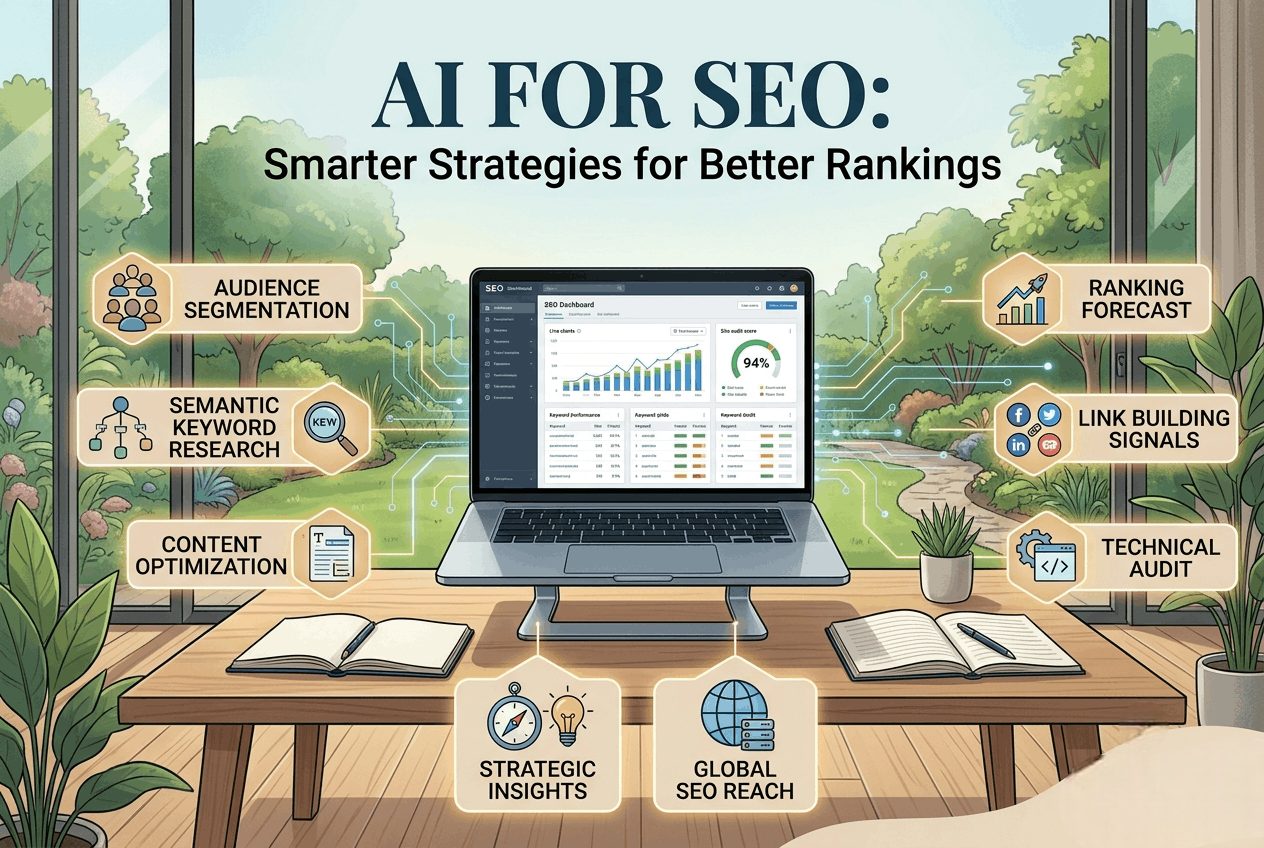
Search engine optimization (SEO) has become one of the most valuable digital marketing strategies for businesses of all sizes. Whether a company wants to attract new customers, increase website traffic, or improve brand awareness, appearing on the first page of search engine results is essential. However, SEO has grown more complex over the years as search engines continue to update their algorithms and prioritize high-quality, user-focused content. Businesses now need smarter ways to stay competitive without spending excessive time on manual optimization.
Artificial Intelligence (AI) is changing the way businesses approach SEO by making many tasks faster, more accurate, and more data-driven. Instead of manually researching keywords, analyzing competitors, or reviewing thousands of pages, AI-powered tools can process large amounts of information within minutes. These insights help marketers make informed decisions while improving efficiency across every stage of an SEO strategy.
AI is not replacing SEO professionals but empowering them to work more effectively. It supports content planning, keyword discovery, technical SEO, performance analysis, and user experience improvements. Businesses that combine human expertise with AI-driven insights can create stronger SEO strategies, improve search rankings, and deliver better experiences for their audiences. Understanding how AI fits into modern SEO is becoming increasingly important for organizations that want sustainable online growth.
Understanding AI in Modern SEO
Artificial Intelligence refers to computer systems that can analyze information, recognize patterns, and make recommendations based on data. Within SEO, AI helps automate repetitive tasks while identifying opportunities that might be difficult for humans to find manually. Instead of relying only on guesswork, marketers can use AI-generated insights to make better optimization decisions supported by real data.
Modern search engines themselves rely heavily on AI to understand user intent and evaluate content quality. Search engines no longer rank pages simply because they contain specific keywords. They evaluate context, relevance, authority, readability, user engagement, and overall usefulness. This shift means businesses must create valuable content that answers user questions rather than focusing solely on keyword density.
AI-powered SEO tools analyze massive amounts of search data, competitor strategies, and website performance metrics simultaneously. These platforms help businesses discover keyword opportunities, identify technical issues, suggest content improvements, and monitor ranking changes more efficiently. Instead of replacing strategic thinking, AI provides valuable information that allows SEO professionals to focus on planning and creativity.
Businesses of every size can benefit from AI-powered SEO solutions. Small companies can compete with larger organizations by using AI to identify niche opportunities and optimize limited resources effectively. Larger enterprises can automate repetitive tasks across thousands of pages while maintaining consistency throughout their websites.
Why AI Has Become Essential for SEO Success
SEO continues to evolve as search engines introduce new ranking factors and user expectations change. Manual SEO processes often struggle to keep pace with these changes, especially for businesses managing large websites. AI provides faster analysis and continuous monitoring, allowing businesses to respond quickly to new opportunities and challenges.
One of the biggest advantages of AI is its ability to analyze enormous datasets within seconds. It can examine competitor websites, keyword trends, user behavior, backlink profiles, and search performance simultaneously. This level of analysis would require many hours of manual work, making AI an essential productivity tool for modern SEO teams.
AI also improves decision-making by reducing assumptions. Instead of selecting keywords based solely on search volume, AI considers search intent, competition levels, seasonal trends, and user engagement. This helps businesses prioritize keywords that are more likely to generate meaningful traffic and conversions rather than simply attracting visitors.
Another reason AI has become important is its ability to continuously learn from new data. As search behavior changes, AI systems update recommendations based on current trends rather than outdated assumptions. Businesses using AI-driven insights can adapt their SEO strategies more quickly, maintaining visibility even as search engine algorithms evolve.
How AI Improves Keyword Research
Keyword research forms the foundation of every successful SEO strategy. Selecting the right keywords ensures that businesses create content matching what their target audience is actively searching for. Traditional keyword research often required marketers to manually compare search volumes, competition levels, and keyword relevance across multiple tools.
AI simplifies this entire process by analyzing search patterns more intelligently. Instead of generating simple keyword lists, AI identifies related topics, semantic keywords, question-based searches, and long-tail opportunities that align with user intent. These recommendations help businesses create comprehensive content that answers multiple user queries within a single article.
Another major advantage is predictive analysis. AI can identify emerging search trends before they become highly competitive. For example, if consumer interest in a new technology or product begins increasing, AI tools may recognize the trend early and recommend creating content before competitors dominate search results. This gives businesses an opportunity to build authority ahead of rapidly growing topics.
AI also groups keywords based on search intent rather than treating every keyword individually. Informational, transactional, navigational, and commercial searches require different types of content. By understanding these differences, businesses can develop content strategies that better satisfy user expectations while improving search rankings and conversion opportunities.
AI-Powered Content Creation and Optimization
Creating valuable content remains one of the strongest ranking factors in SEO. AI assists content creators by generating ideas, identifying content gaps, suggesting outlines, and recommending improvements based on top-performing pages. Instead of starting from a blank page, writers receive structured guidance that speeds up the content creation process.
AI tools also analyze existing content to identify opportunities for improvement. They may recommend adding missing topics, improving readability, strengthening keyword relevance, or expanding sections that lack sufficient detail. These recommendations help businesses continuously improve their content without completely rewriting every page.
Content optimization goes beyond inserting keywords naturally. AI evaluates sentence structure, readability, heading organization, internal linking opportunities, image optimization, and content depth. This comprehensive approach ensures that content satisfies both search engine requirements and user expectations, leading to better engagement and stronger search performance.
Despite these capabilities, human expertise remains essential. AI can assist with research and optimization, but businesses should always review and refine AI-generated content to ensure accuracy, originality, and alignment with their brand voice. Combining AI efficiency with human creativity produces content that is both informative and engaging.
Using AI for Competitor Analysis
Understanding competitor strategies has always been an important part of SEO. Businesses need to know which keywords competitors rank for, what type of content performs well, and where new opportunities exist. AI makes competitor analysis faster and more comprehensive by automatically collecting and organizing competitive insights.
Instead of manually reviewing dozens of websites, AI tools identify competitors’ highest-performing pages, strongest backlinks, keyword rankings, and content strategies. This information helps businesses understand why certain competitors perform well in search results and how they can improve their own strategies without copying content directly.
AI also identifies content gaps that competitors have overlooked. For example, if several leading websites cover similar topics but fail to answer specific customer questions, businesses can create detailed resources addressing those missing areas. Filling these content gaps often improves search visibility while providing additional value to users.
Competitive monitoring is another valuable AI capability. Rather than performing occasional competitor reviews, AI continuously tracks ranking changes, new content publications, backlink growth, and keyword movements. This allows businesses to respond quickly whenever competitors introduce new SEO strategies or capitalize on emerging search trends.
Enhancing Technical SEO with Artificial Intelligence
Technical SEO forms the backbone of a website’s search performance. Even the best content may struggle to rank if search engines cannot properly crawl, understand, or index the website. AI simplifies technical SEO by identifying issues automatically and recommending improvements before they negatively affect rankings. This saves businesses valuable time while ensuring their websites remain search engine friendly.
AI-powered SEO platforms can scan thousands of web pages within minutes to detect broken links, duplicate content, missing metadata, slow-loading pages, crawl errors, and indexing problems. Instead of manually reviewing every page, website owners receive detailed reports that prioritize the most critical issues. This allows technical teams to focus on improvements that deliver the greatest SEO impact.
Website speed has become an increasingly important ranking factor because users expect fast-loading pages across all devices. AI helps identify performance bottlenecks such as oversized images, unnecessary scripts, inefficient code, and server response delays. By addressing these recommendations, businesses improve both user experience and search engine rankings without relying solely on manual testing.
AI also supports continuous technical monitoring rather than one-time audits. As websites grow with new pages, products, and blog posts, technical issues naturally emerge over time. AI automatically detects these changes and alerts businesses before they become larger problems. This proactive approach helps maintain a healthy website that consistently performs well in search results.
Improving User Experience Through AI Insights
Search engines increasingly evaluate how users interact with websites when determining rankings. If visitors quickly leave a page or struggle to find information, search engines may interpret this as a poor user experience. AI helps businesses understand user behavior and make improvements that encourage longer visits, greater engagement, and higher conversion rates.
AI analyzes visitor interactions such as page views, scrolling behavior, click patterns, navigation paths, and session duration. These insights reveal where users lose interest or encounter obstacles. Businesses can then redesign layouts, simplify navigation, improve content organization, or enhance calls to action based on real user behavior rather than assumptions.
Personalization is another area where AI contributes significantly to SEO success. AI can recommend relevant products, articles, or services based on visitor interests and browsing history. Personalized experiences encourage users to explore additional pages, increasing session duration and reducing bounce rates. These positive engagement signals may indirectly support stronger search performance.
AI also assists in improving website accessibility by identifying usability concerns that affect different groups of users. Better accessibility creates a more inclusive experience while helping search engines understand website content more effectively. Businesses that prioritize user experience often achieve stronger SEO performance alongside increased customer satisfaction.
AI and Voice Search Optimization
Voice search continues to grow as more people use smartphones, smart speakers, and virtual assistants to find information online. Unlike traditional text searches, voice searches are often longer, more conversational, and based on complete questions. AI helps businesses adapt their SEO strategies to meet these changing search behaviors.
AI identifies common conversational phrases and question-based keywords that people naturally use during voice searches. Instead of focusing only on short keywords, businesses can optimize content around complete questions and detailed answers. This approach increases the likelihood of appearing in voice search results while also improving overall content relevance.
Featured snippets and direct answers play an important role in voice search optimization. AI analyzes search results to determine which types of content frequently appear as featured snippets. Businesses can then structure their content with clear headings, concise explanations, and well-organized information that increases the chances of being selected for these valuable search positions.
Voice search also emphasizes local intent. Many users ask questions such as “Where is the nearest coffee shop?” or “Which digital marketing agency is open today?” AI helps businesses optimize local SEO by identifying location-based search trends, improving business listings, and ensuring website content aligns with local customer needs.
AI for Local SEO Growth
Local SEO is essential for businesses serving customers within specific cities or regions. Whether operating a retail store, healthcare clinic, restaurant, or professional service, appearing in local search results increases visibility among nearby customers who are ready to make purchasing decisions. AI provides valuable insights that strengthen local search performance.
AI analyzes location-based search patterns, customer reviews, competitor activity, and regional keyword trends. Businesses can use this information to optimize local landing pages, create location-specific content, and target the keywords most relevant to their communities. This targeted approach often generates higher-quality traffic than broader national campaigns.
Managing online business profiles is another area where AI improves efficiency. AI tools can monitor business information across multiple directories, identify inconsistencies, and recommend updates to maintain accurate listings. Consistent business information improves trust with both customers and search engines, supporting stronger local rankings.
Customer reviews also influence local SEO success. AI helps businesses analyze review sentiment, identify recurring customer concerns, and recognize opportunities for service improvement. Responding effectively to reviews while continuously enhancing customer experiences strengthens online reputation and contributes to improved visibility in local search results.
Measuring SEO Performance with AI Analytics
Successful SEO requires continuous measurement and improvement rather than one-time optimization. AI transforms SEO reporting by converting large volumes of performance data into clear insights that support better decision-making. Businesses can understand what is working, identify weaknesses, and adjust strategies based on measurable results.
AI tracks essential metrics including organic traffic, keyword rankings, click-through rates, conversion rates, bounce rates, and user engagement. Instead of presenting only raw numbers, AI identifies patterns and explains which changes contributed to improved or declining performance. These insights allow marketers to make informed adjustments more quickly.
Predictive analytics is another valuable feature of AI-powered reporting. Based on historical performance and current trends, AI can forecast future traffic, identify seasonal opportunities, and estimate the potential impact of optimization efforts. This helps businesses allocate marketing resources more effectively while setting realistic performance expectations.
Automated reporting also saves considerable time. Rather than manually preparing weekly or monthly SEO reports, AI generates detailed dashboards that highlight important trends and recommendations. Decision-makers receive clear summaries that simplify performance evaluation without requiring extensive technical expertise.
The Role of AI in Link Building
Backlinks remain one of the strongest signals of website authority in search engine rankings. However, building high-quality backlinks has traditionally been a time-consuming process involving extensive research and outreach. AI simplifies many aspects of link-building while helping businesses focus on opportunities that offer genuine value.
AI analyzes competitor backlink profiles to identify websites that regularly link to similar content. This allows businesses to discover relevant publishers, industry blogs, online magazines, and resource websites that may also be interested in linking to their content. Such targeted outreach often produces better results than contacting random websites.
AI also evaluates backlink quality by examining domain authority, topical relevance, traffic levels, and potential spam indicators. This helps businesses avoid low-quality links that may harm SEO performance while focusing on building relationships with trustworthy websites that enhance long-term search visibility.
Content plays a major role in successful link building, and AI helps identify topics with high linking potential. Comprehensive guides, original research, case studies, industry reports, and useful tools naturally attract backlinks because they provide valuable information. AI helps businesses identify these opportunities while ensuring content remains relevant to their target audience.
Key Factors for Successfully Using AI in SEO
Businesses can achieve excellent SEO results with AI when they combine technology with a well-planned strategy. AI provides recommendations based on data, but long-term success depends on how effectively those insights are applied. Organizations should focus on creating value for users while using AI to improve efficiency rather than replacing strategic thinking.
The following factors help businesses maximize the benefits of AI-driven SEO:
- Create high-quality content: Use AI to support research and optimization, but ensure every article provides original insights, practical value, and accurate information.
- Understand user intent: Focus on answering customer questions instead of targeting keywords alone. AI can identify what users truly want to find.
- Maintain technical website health: Regularly monitor website speed, mobile responsiveness, security, structured data, and crawlability using AI-powered tools.
- Review AI-generated recommendations: Always validate suggestions with human expertise to ensure accuracy, brand consistency, and relevance.
- Track performance continuously: Use AI analytics to measure rankings, traffic, engagement, and conversions so strategies can be refined over time.
Businesses that combine these best practices with consistent optimization are more likely to build sustainable search visibility rather than relying on short-term ranking improvements.
Common Mistakes Businesses Should Avoid
Although AI offers significant advantages, relying on it without proper oversight can create new challenges. Some organizations assume AI can completely automate SEO, but successful optimization still requires human judgment, creativity, and strategic planning. Avoiding common mistakes helps businesses achieve better long-term results.
One of the most common mistakes is publishing AI-generated content without reviewing it. While AI can produce well-structured drafts, it may occasionally include outdated information, repetitive wording, or statements that lack sufficient context. Every piece of content should be fact-checked, edited, and aligned with the company’s voice before publication.
Another mistake is focusing only on keywords instead of overall content quality. Modern search engines evaluate user satisfaction, expertise, relevance, and helpfulness rather than simply counting keyword usage. Businesses that over-optimize keywords often create unnatural content that performs poorly with both readers and search engines.
Some organizations also ignore technical SEO because AI-generated content receives most of the attention. Slow websites, broken pages, poor mobile experiences, and indexing issues can limit ranking potential regardless of content quality. A balanced strategy that includes technical optimization remains essential for sustainable SEO success.
Finally, businesses should avoid using AI as a replacement for understanding their audience. AI can identify trends and patterns, but it cannot fully replace customer conversations, market research, or industry experience. Combining AI insights with real customer knowledge produces stronger SEO strategies and more meaningful business results.
Practical Examples of AI Improving SEO Performance
Businesses across many industries are already using AI to strengthen their SEO efforts. While the specific strategies vary, the common goal is to create better user experiences while improving search visibility through smarter decision-making.
An online retail company, for example, may use AI to analyze customer searches and discover frequently asked questions about its products. Based on these insights, the business creates detailed buying guides, comparison articles, and product FAQs that answer customer concerns before purchase. As these pages begin ranking for valuable search terms, the company experiences increased organic traffic and improved conversion rates.
A professional services firm, such as a law office or accounting practice, can use AI to identify location-based search opportunities. By creating optimized content for each service area and improving local SEO, the business attracts more qualified leads from nearby customers actively searching for professional assistance.
A software company may rely on AI to monitor competitor content and identify emerging industry topics. Instead of reacting after competitors publish new articles, the company creates informative content early, establishing authority before search competition becomes more intense. This proactive approach helps maintain strong search visibility within a rapidly changing market.
Even small businesses benefit from AI-powered SEO tools. Local restaurants, healthcare clinics, educational institutions, and home service providers can use AI to improve online reviews, optimize business listings, and create content that answers common customer questions. These improvements often lead to better local search rankings and increased customer inquiries.
The Future of AI in SEO
Artificial Intelligence will continue transforming SEO as search engines become even more advanced in understanding language, context, and user behavior. Future AI systems will provide deeper insights into customer intent, making it easier for businesses to create highly personalized and relevant content that satisfies searchers’ needs.
Generative AI is expected to play a greater role in content planning, but quality standards will also become stricter. Search engines are increasingly rewarding content that demonstrates real expertise, practical experience, and genuine value. Businesses will need to combine AI-generated efficiency with human knowledge, original research, and authentic perspectives to remain competitive.
Predictive SEO is another area likely to grow. Instead of simply analyzing current performance, AI will forecast future search trends, identify emerging customer interests, and recommend optimization strategies before market demand peaks. This proactive approach will help businesses stay ahead of competitors and capture new opportunities earlier.
Automation will also become more intelligent. AI will continuously monitor websites, detect technical issues, recommend content updates, identify declining rankings, and even suggest internal linking improvements without requiring constant manual intervention. These capabilities will allow SEO professionals to spend more time on strategy, creativity, and business growth.
Despite these advancements, human expertise will remain essential. Businesses that use AI responsibly—as a decision-support tool rather than a complete replacement for skilled professionals—will be best positioned for long-term SEO success. The future belongs to organizations that combine technology with experience, creativity, and a strong understanding of their customers.
Conclusion
Artificial Intelligence has become a valuable partner in modern SEO by helping businesses make faster, smarter, and more informed decisions. From keyword research and content optimization to technical SEO, competitor analysis, and performance tracking, AI improves efficiency while allowing marketing teams to focus on strategy and creativity. When used thoughtfully, AI enables businesses to deliver higher-quality content, improve user experiences, and achieve stronger search engine rankings.
The most successful SEO strategies will continue to balance AI-powered insights with human expertise. Businesses that prioritize valuable content, understand customer needs, maintain technically sound websites, and continuously adapt to changing search trends will build lasting online visibility. AI is not simply a shortcut to better rankings—it is a powerful tool that helps organizations create smarter, more sustainable SEO strategies for long-term digital success.