


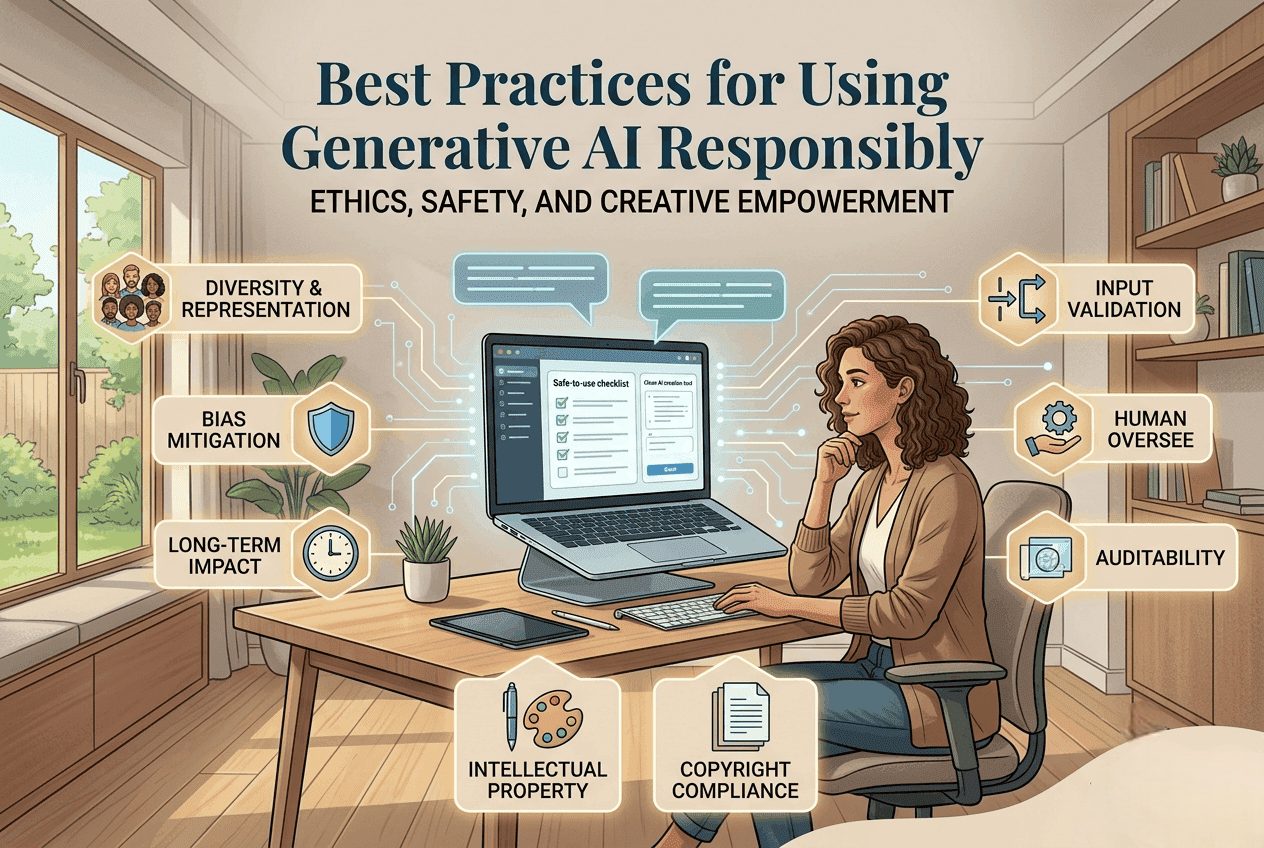
Generative AI has rapidly become one of the most influential technologies in today’s business landscape. From creating marketing content and generating reports to assisting customer support and improving product development, AI-powered tools are helping organizations work faster and more efficiently. Businesses of all sizes are discovering new ways to improve productivity while reducing repetitive manual work. As adoption continues to grow, responsible AI usage has become an important part of long-term business success.
While generative AI offers impressive capabilities, it also introduces new responsibilities. AI-generated content may contain inaccurate information, biased outputs, or privacy risks if organizations fail to use the technology carefully. Business leaders must understand that AI is a support tool rather than a replacement for human judgment. Establishing responsible practices ensures that AI delivers value without creating unnecessary legal, ethical, or operational challenges.
Organizations that implement responsible AI practices gain more than just compliance with regulations. They build stronger customer trust, improve decision-making, protect sensitive information, and encourage employees to use AI confidently and effectively. By creating clear policies and maintaining human oversight, businesses can maximize AI’s benefits while minimizing potential risks. This guide explains the best practices every organization should follow when using generative AI responsibly.
Understanding Responsible Generative AI
Generative AI refers to artificial intelligence systems capable of producing new content such as text, images, code, videos, presentations, and even music. Unlike traditional software that follows predefined rules, generative AI learns from large amounts of existing data to generate responses based on user prompts. This flexibility makes it highly valuable across industries including healthcare, finance, retail, education, manufacturing, and marketing.
Responsible use means ensuring that AI is applied ethically, transparently, securely, and fairly. Organizations should consider not only what AI can do but also how its outputs affect customers, employees, partners, and society. Responsible AI emphasizes accountability and encourages organizations to verify results before relying on them for important business decisions.
For example, a marketing team may use AI to generate social media posts or product descriptions. While AI can save hours of work, the content should still be reviewed for factual accuracy, brand consistency, and compliance with company policies. Human review prevents misleading information from reaching customers.
Similarly, customer service teams may use AI-generated responses to answer frequently asked questions. However, sensitive customer concerns should still be handled by trained representatives who can apply empathy and professional judgment. Responsible AI complements human expertise instead of replacing it entirely.
Why Responsible AI Matters for Businesses
Businesses increasingly rely on AI to improve efficiency, reduce costs, and accelerate innovation. However, irresponsible AI usage can lead to financial losses, reputational damage, regulatory penalties, and customer distrust. Organizations must therefore develop structured AI governance rather than allowing unrestricted use.
Customers today expect companies to handle their personal information responsibly. If AI systems misuse customer data or generate misleading recommendations, trust can disappear quickly. Responsible AI practices demonstrate that the organization values privacy, fairness, and transparency.
Employees also benefit from responsible AI policies. Clear guidelines reduce uncertainty about when AI should be used, how outputs should be verified, and what information can safely be shared with AI platforms. This creates confidence while reducing misuse.
Investors, business partners, and regulators increasingly evaluate how organizations manage AI risks. Companies that prioritize ethical AI adoption often strengthen their reputation and improve long-term sustainability, making responsible AI both a competitive advantage and a business necessity.
Key Best Practices for Using Generative AI Responsibly
Establish Clear AI Usage Policies
Every organization should create documented policies explaining how employees may use generative AI. These policies should define approved AI tools, acceptable use cases, prohibited activities, security requirements, and review processes. Without clear guidance, employees may unknowingly expose confidential information or rely too heavily on AI-generated outputs.
Policies should also specify ownership of AI-generated content, intellectual property considerations, and approval requirements for customer-facing materials. Regular updates ensure policies remain relevant as AI technologies evolve rapidly.
Leadership should communicate these guidelines clearly across departments through training sessions, documentation, and practical examples. Employees are more likely to follow policies when they understand both the benefits and the potential risks of AI.
Finally, organizations should periodically review policy effectiveness by collecting employee feedback, monitoring AI usage patterns, and adapting governance frameworks based on new regulations and emerging best practices.
Always Keep Humans in the Decision Loop
Generative AI should support decision-making rather than replace human expertise. AI can generate recommendations, summaries, forecasts, or creative ideas, but important business decisions should always involve qualified professionals.
For example, an AI-generated financial analysis should be reviewed by finance experts before investment decisions are made. Likewise, HR departments should never rely solely on AI when evaluating job candidates or employee performance.
Human oversight helps identify factual errors, misleading recommendations, biased outputs, and context that AI may overlook. This significantly reduces business risks while maintaining accountability.
Organizations that combine AI efficiency with human judgment often achieve better outcomes than relying entirely on either humans or machines alone.
Protect Sensitive Data
Protecting confidential information should be a top priority when using generative AI. Employees should avoid entering sensitive customer information, financial records, passwords, legal documents, or proprietary business data into public AI platforms unless approved security measures are in place.
Organizations should classify sensitive information and educate employees about which types of data should never be shared with AI systems. Secure enterprise AI platforms often provide stronger privacy protections than public services.
Businesses should also implement access controls, encryption, authentication measures, and monitoring systems to reduce the risk of unauthorized access or accidental data exposure.
Regular security audits help identify vulnerabilities and ensure AI systems comply with data protection regulations while maintaining customer trust.
Verify AI-Generated Content
Although generative AI produces impressive results, it is not always accurate. AI may confidently generate incorrect facts, outdated information, fabricated references, or misleading conclusions. Businesses should therefore treat AI outputs as drafts requiring careful verification.
Teams should establish review procedures before publishing AI-generated content, sharing reports, or making strategic decisions based on AI recommendations. Subject matter experts play an essential role in validating important information.
Fact-checking is especially critical in industries such as healthcare, finance, law, education, and government, where incorrect information may have significant consequences.
Organizations that consistently verify AI outputs maintain higher quality standards while reducing reputational and legal risks.
Essential Factors That Support Responsible AI Adoption
Several factors contribute to responsible AI implementation across organizations:
- Develop regular employee AI training programs.
- Monitor AI performance and accuracy continuously.
- Ensure transparency when AI assists customers.
- Maintain compliance with industry regulations.
- Review and improve governance policies regularly.
These practices create a culture where AI is used thoughtfully rather than automatically. Responsible adoption depends on continuous improvement rather than one-time implementation.
Employees should also be encouraged to report concerns, unexpected AI behavior, or ethical issues without fear of criticism. Open communication strengthens organizational learning and helps identify emerging risks early.
Cross-functional collaboration between IT, legal, HR, marketing, and executive leadership ensures that AI governance addresses multiple business perspectives instead of focusing solely on technology.
Over time, organizations that continuously refine these practices become better prepared to adapt to evolving AI capabilities and regulatory requirements.
Common Mistakes Businesses Should Avoid
Many organizations adopt generative AI quickly without establishing proper safeguards. One common mistake is assuming AI-generated content is always correct. This can result in inaccurate reports, misleading marketing materials, or poor business decisions.
Another frequent mistake involves sharing confidential information with public AI systems. Employees may unintentionally expose sensitive customer or company data without realizing the associated security risks.
Some organizations also fail to train employees properly before introducing AI tools. Without guidance, staff may misuse AI, overdepend on automated outputs, or ignore important review processes that ensure quality.
Finally, businesses sometimes overlook ethical considerations such as bias, fairness, and transparency. Ignoring these issues can reduce customer trust and create long-term reputational challenges that are difficult to reverse.
Building a Responsible AI Culture
Creating responsible AI practices requires more than technology—it requires the right organizational culture. Leaders should encourage employees to view AI as a productivity partner while emphasizing accountability and ethical decision-making.
Regular education sessions help employees understand evolving AI capabilities, limitations, and company expectations. Practical workshops often improve AI adoption more effectively than theoretical discussions because employees learn through real business scenarios.
Organizations should celebrate successful examples of responsible AI use while openly discussing lessons learned from mistakes. This balanced approach encourages continuous improvement rather than fear of experimentation.
When responsibility becomes part of everyday workflows, employees naturally develop better judgment about when AI should assist and when human expertise should take priority.
The Future of Responsible Generative AI
Generative AI will continue transforming business operations over the coming years. Future AI systems are expected to become more accurate, personalized, secure, and capable of supporting increasingly complex business tasks. However, growing capabilities will also increase expectations for responsible governance.
Governments around the world are introducing new AI regulations designed to improve transparency, accountability, privacy, and fairness. Businesses that establish responsible practices today will be better prepared to comply with future legal requirements without major operational disruption.
Advances in explainable AI, automated risk monitoring, and enterprise governance platforms will help organizations better understand how AI reaches conclusions. Improved transparency will strengthen trust among customers, employees, regulators, and business partners.
Ultimately, the organizations that achieve long-term success with generative AI will not necessarily be those using the most advanced tools. Instead, they will be those that combine innovation with strong ethics, effective governance, continuous learning, and responsible decision-making.
Conclusion
Generative AI has enormous potential to improve productivity, innovation, customer experiences, and operational efficiency across every industry. However, realizing these benefits requires businesses to use AI thoughtfully, responsibly, and with appropriate human oversight. Responsible AI is not about limiting innovation—it is about ensuring that innovation creates lasting value while protecting people, data, and organizational reputation.
By establishing clear policies, protecting sensitive information, verifying AI-generated content, maintaining transparency, and encouraging continuous learning, organizations can confidently embrace generative AI while minimizing risks. Businesses that prioritize responsible AI today will be better positioned to earn customer trust, adapt to future regulations, and achieve sustainable success in the rapidly evolving digital economy.