


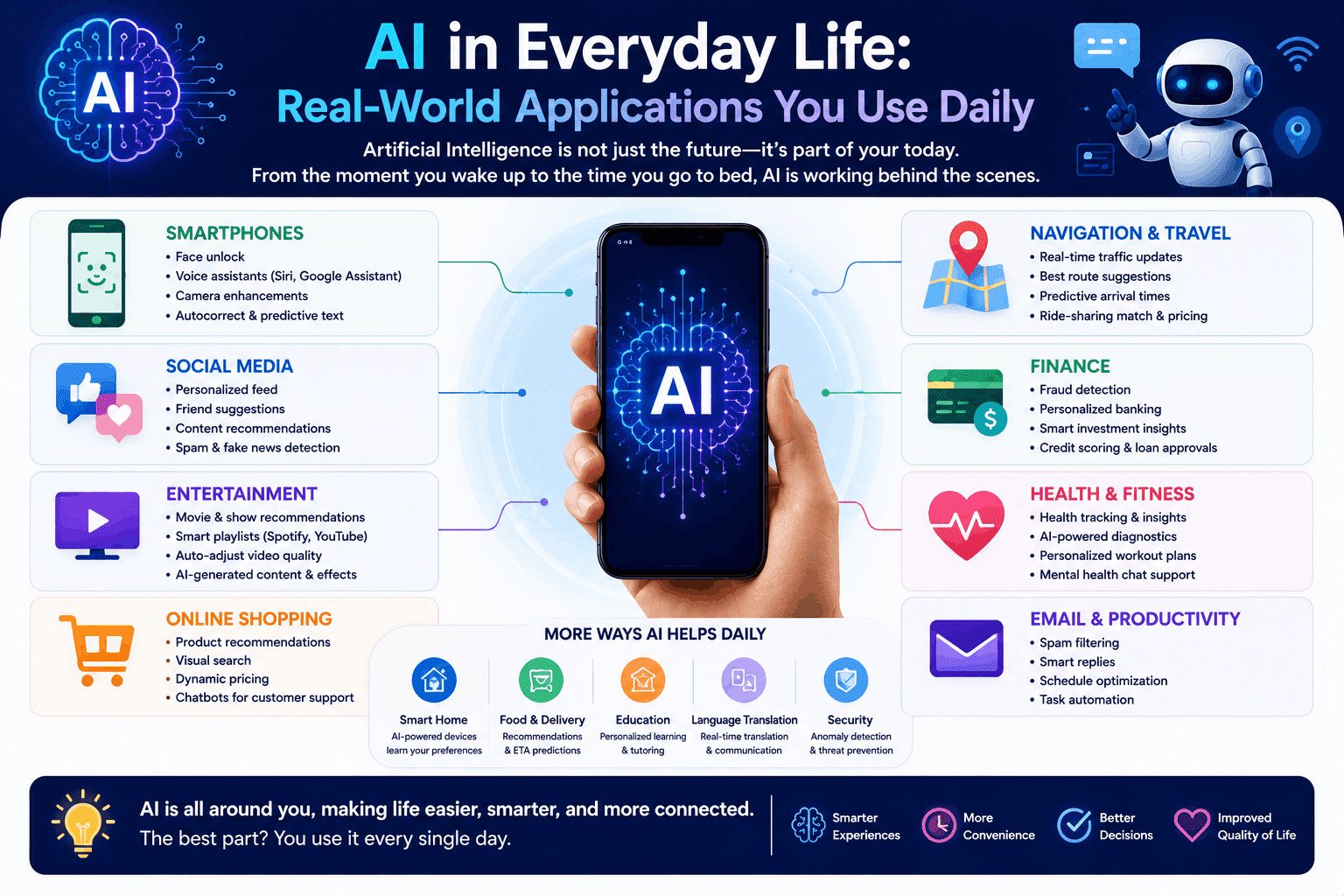
Artificial Intelligence (AI) is no longer a futuristic concept that exists only in science fiction movies or advanced research laboratories. Today, AI has become a natural part of everyday life, helping people perform routine tasks more efficiently and businesses deliver better services. Whether someone realizes it or not, AI works behind the scenes in many of the digital tools and platforms used every day.
From unlocking smartphones with facial recognition to receiving personalized shopping recommendations online, AI is quietly improving convenience and saving time. Businesses across industries are also using AI to understand customer behavior, automate repetitive work, and make smarter decisions based on data. These improvements allow organizations to provide better experiences while increasing productivity and reducing operational costs.
As AI technology continues to evolve, its role in daily life will only become more significant. Understanding where AI is used and how it benefits both consumers and businesses helps decision-makers recognize new opportunities for innovation. This article explores the most common real-world AI applications that people interact with every day and explains why they have become essential in modern living.
How AI Has Become Part of Daily Life
Artificial Intelligence has gradually integrated itself into daily routines through smartphones, websites, smart devices, vehicles, banking systems, and digital entertainment platforms. Instead of replacing people, AI supports users by simplifying tasks, providing recommendations, and improving accuracy. Many AI-powered systems operate automatically, making interactions faster and more personalized without requiring technical knowledge from users.
One reason AI has become so widespread is the enormous amount of digital information generated every day. AI systems analyze this information to identify patterns, predict outcomes, and offer relevant suggestions. This capability helps businesses improve customer experiences while making services more efficient and responsive. Consumers benefit from quicker searches, customized content, and faster support whenever they need assistance.
Businesses also use AI to automate repetitive processes that previously required significant manual effort. Customer inquiries, inventory management, fraud detection, scheduling, and document processing are just a few examples where AI saves valuable time. Employees can then focus on strategic tasks that require creativity, communication, and decision-making instead of repetitive administrative work.
As technology becomes more connected through cloud computing and smart devices, AI continues to expand into new areas of daily life. From homes and workplaces to healthcare and transportation, intelligent systems are becoming trusted assistants that improve convenience while helping organizations operate more efficiently.
AI in Smartphones and Personal Devices
Smartphones are among the most common examples of AI in everyday life. Most people use AI-powered features several times a day without even noticing them. Facial recognition, voice assistants, predictive text, automatic photo enhancement, and spam call detection all rely on AI technologies working in the background to improve user experience.
Voice assistants allow users to set reminders, search the internet, play music, control smart home devices, and answer questions using natural speech. These assistants continue learning user preferences over time, making interactions faster and more accurate. Predictive keyboards also analyze writing patterns to suggest words and complete sentences, helping users communicate more efficiently.
Modern smartphone cameras use AI to recognize scenes, adjust lighting, improve focus, reduce image noise, and create professional-looking photos automatically. Even users without photography skills can capture high-quality images because AI continuously optimizes camera settings based on the environment. These improvements have transformed smartphone photography into a highly intelligent experience.
Security has also improved significantly through AI. Facial recognition, fingerprint authentication, suspicious app detection, and intelligent battery optimization help users protect personal information while extending device performance. Businesses developing mobile applications increasingly rely on AI to create safer, faster, and more personalized experiences for customers.
How AI Improves Online Shopping Experiences
Online shopping platforms have changed dramatically with the help of Artificial Intelligence. Instead of showing the same products to every visitor, AI analyzes browsing history, purchase behavior, search activity, and customer preferences to recommend products that are most likely to match individual interests. This personalization increases customer satisfaction while helping businesses improve sales.
Recommendation engines are one of the strongest examples of AI in e-commerce. When customers receive suggestions for products similar to previous purchases or recently viewed items, AI algorithms are analyzing large amounts of behavioral data in real time. These personalized recommendations encourage customers to discover products they may not have searched for directly.
AI also helps businesses optimize pricing, manage inventory, and forecast future demand. Retailers can identify purchasing trends, predict seasonal demand, and maintain appropriate stock levels without relying solely on manual planning. This reduces inventory costs while ensuring popular products remain available for customers.
Customer service has also improved through AI-powered chatbots that answer common questions, track orders, recommend products, and provide instant support throughout the shopping journey. Instead of waiting for human representatives, customers receive immediate assistance at any time of the day, creating a smoother shopping experience and reducing operational costs for businesses.
Artificial Intelligence in Digital Payments and Banking
Financial institutions increasingly depend on AI to improve security, customer service, and operational efficiency. Every time customers make online payments, transfer money, or use mobile banking applications, AI systems help monitor transactions and identify unusual activity that could indicate fraud or unauthorized access.
Fraud detection is one of AI’s most valuable contributions to banking. Intelligent algorithms analyze transaction patterns, spending behavior, geographic locations, and account activity in real time. If suspicious behavior is detected, the system can alert customers or temporarily block transactions before financial losses occur. This proactive approach strengthens trust in digital financial services.
Banks also use AI-powered virtual assistants to answer customer questions, guide users through financial services, and help resolve simple issues without requiring human support. Customers receive faster responses while employees focus on more complex financial consultations and relationship management activities.
Beyond customer service, AI assists financial organizations in credit assessment, loan processing, investment analysis, and risk management. Automated systems evaluate large datasets much faster than manual methods, helping institutions make informed decisions while reducing processing times. As digital banking continues to expand, AI will remain a critical technology supporting secure and efficient financial services.
AI in Social Media and Content Recommendations
Social media platforms have become an important part of everyday communication, and Artificial Intelligence plays a major role in making these platforms engaging. Every time users scroll through their feeds, AI analyzes their interests, interactions, watch history, and engagement patterns to display content that is most relevant to them. This personalized experience keeps users connected with topics, creators, and communities they are likely to enjoy.
AI recommendation systems work continuously to understand changing user preferences. If someone frequently watches travel videos or interacts with technology-related posts, the platform gradually prioritizes similar content. This intelligent filtering saves users time while helping businesses and content creators reach audiences that are genuinely interested in their products or services.
Businesses benefit significantly from AI-powered social media marketing. AI helps analyze audience behavior, identify the best posting times, measure campaign performance, and recommend improvements. Marketing teams can create more targeted advertisements that reach the right customers, improving return on investment while reducing unnecessary advertising expenses.
AI also improves platform safety by detecting spam, fake accounts, harmful content, and suspicious activities. Although human moderation remains important, AI helps social media companies review millions of posts every day, making online communities safer and more reliable for users around the world.
Artificial Intelligence in Navigation and Transportation
Navigation has become easier than ever because AI helps drivers and travelers reach destinations quickly and efficiently. Modern navigation applications analyze live traffic conditions, accidents, road closures, weather updates, and historical travel patterns to recommend the fastest routes. Instead of simply providing directions, AI continuously updates routes based on changing road conditions.
Ride-sharing services also depend heavily on AI to connect passengers with nearby drivers. Intelligent algorithms calculate estimated arrival times, determine pricing based on demand, optimize driver routes, and improve overall service efficiency. These systems allow transportation companies to manage millions of trips every day with remarkable accuracy.
Public transportation systems are also adopting AI to improve scheduling and passenger experiences. Transit operators use predictive analytics to estimate passenger demand, reduce delays, and optimize vehicle allocation. These improvements help reduce congestion while making public transport more dependable for daily commuters.
The future of transportation will include even greater AI integration through autonomous vehicles, intelligent traffic management systems, and connected infrastructure. While fully self-driving cars are still evolving, AI is already making roads safer by supporting driver assistance features such as lane detection, collision warnings, adaptive cruise control, and automatic emergency braking.
How AI is Transforming Healthcare
Healthcare is one of the industries experiencing remarkable improvements through Artificial Intelligence. Although doctors and healthcare professionals remain responsible for patient care, AI assists them by analyzing medical information, identifying patterns, and supporting faster diagnosis. These technologies help improve treatment quality while reducing administrative workloads.
Many hospitals use AI to analyze medical images such as X-rays, CT scans, and MRI scans. AI systems can detect abnormalities that may require closer examination, helping doctors identify potential health issues more quickly. Early detection often improves treatment outcomes and enables healthcare providers to make more informed clinical decisions.
Patients also benefit from AI through wearable health devices that monitor heart rate, physical activity, sleep quality, and other health indicators. These devices provide users with useful insights that encourage healthier lifestyles while allowing healthcare providers to monitor long-term wellness more effectively.
Healthcare organizations also rely on AI to automate appointment scheduling, manage electronic medical records, and answer common patient questions through virtual assistants. These improvements reduce waiting times, improve operational efficiency, and allow healthcare professionals to spend more time focusing directly on patient care.
Smart Homes Powered by Artificial Intelligence
Smart home technology has become increasingly popular because AI makes everyday household tasks more convenient and efficient. Smart speakers, lighting systems, thermostats, security cameras, and home appliances learn user preferences over time and automatically adjust settings to match daily routines. This creates a more comfortable living environment while reducing unnecessary energy consumption.
Voice-controlled assistants allow homeowners to manage multiple devices using simple spoken commands. Users can adjust room temperatures, turn lights on or off, lock doors, play music, or check weather updates without touching a single switch. AI continues learning user habits, making these interactions more natural and personalized over time.
Home security has also improved with AI-powered surveillance systems. Intelligent cameras can recognize familiar faces, detect unusual movements, identify package deliveries, and send instant notifications when suspicious activity occurs. This advanced monitoring provides homeowners with greater peace of mind while improving property protection.
Energy management is another important advantage of AI-enabled homes. Smart thermostats automatically adjust heating and cooling based on occupancy and weather conditions, while intelligent appliances optimize electricity usage during off-peak hours. These features help reduce utility costs while supporting environmentally responsible living.
AI in Education and Online Learning
Education has become more accessible and personalized through Artificial Intelligence. Educational platforms use AI to understand individual learning styles, identify knowledge gaps, and recommend customized lessons that match each student’s progress. Instead of providing identical learning experiences for everyone, AI creates personalized educational journeys.
Students receive instant feedback through AI-powered learning systems that evaluate quizzes, assignments, and practice exercises. Immediate feedback allows learners to correct mistakes quickly and strengthen their understanding before moving to more advanced topics. Teachers also gain valuable insights into student performance, enabling more effective classroom support.
Language learning applications use AI to improve pronunciation, grammar, vocabulary, and conversational skills. By analyzing speech patterns and learning behavior, these platforms create engaging experiences that help learners develop language proficiency at their own pace. This flexibility has made online education increasingly popular among professionals and lifelong learners.
Educational institutions also use AI to automate administrative tasks such as attendance tracking, scheduling, and student support services. By reducing routine workloads, educators can dedicate more time to teaching, mentoring, and helping students achieve better academic outcomes.
Artificial Intelligence in Entertainment and Streaming Services
Entertainment platforms have changed significantly because AI helps users discover content they genuinely enjoy. Streaming services analyze viewing history, ratings, search behavior, and watch time to recommend movies, television shows, documentaries, and music that match individual preferences. These personalized suggestions improve user satisfaction while increasing engagement.
Music streaming platforms use AI to generate personalized playlists based on listening habits, favorite artists, and current moods. Instead of manually searching for songs, users receive carefully selected recommendations that evolve as their tastes change. This intelligent personalization keeps audiences engaged while introducing them to new content.
Video streaming platforms also use AI to improve streaming quality by adjusting video resolution according to internet speed. This reduces buffering and creates a smoother viewing experience even when network conditions fluctuate. AI additionally supports subtitle generation, language translation, and accessibility features that make entertainment available to wider audiences.
Content creators and media companies also benefit from AI by analyzing audience preferences and identifying popular trends. These insights help creators develop content that better meets viewer expectations while enabling businesses to make informed decisions about future productions and marketing strategies.
How AI Boosts Workplace Productivity
Artificial Intelligence has become an essential productivity tool in modern workplaces. Employees use AI-powered applications for writing assistance, meeting scheduling, document organization, data analysis, customer communication, and workflow automation. These tools reduce repetitive tasks and allow professionals to focus on strategic and creative responsibilities.
Email platforms use AI to filter spam, prioritize important messages, suggest replies, and organize inboxes automatically. These intelligent features help professionals manage communication more efficiently while reducing time spent sorting through unnecessary emails. AI also assists with grammar correction and writing suggestions, improving the quality of business communication.
Project management software increasingly includes AI features that predict project timelines, allocate resources, identify potential delays, and recommend workflow improvements. Teams gain better visibility into project progress while managers make more informed decisions based on real-time insights.
Businesses are also adopting AI-powered assistants to summarize meetings, generate reports, organize notes, and automate repetitive office tasks. These capabilities improve collaboration, reduce administrative workloads, and help organizations increase overall productivity without significantly increasing operational costs.
Key Factors Driving the Adoption of AI in Everyday Life
The rapid adoption of Artificial Intelligence is not happening by chance. Several important factors have made AI more accessible, affordable, and practical for both individuals and businesses. As technology continues to improve, these factors will play an even greater role in expanding AI applications across industries.
One of the biggest drivers is the availability of large amounts of digital data. Every online search, purchase, social media interaction, and mobile app activity generates valuable information. AI systems use this data to recognize patterns, predict user preferences, and deliver personalized experiences. The more relevant data available, the more accurate and useful AI becomes.
Cloud computing has also accelerated AI adoption by providing businesses with access to powerful computing resources without requiring expensive infrastructure. Organizations of all sizes can now use AI-powered software through cloud-based platforms, making advanced technology available even to small and medium-sized businesses.
Another important factor is the increasing demand for automation. Businesses are under constant pressure to improve efficiency, reduce costs, and deliver better customer experiences. AI helps automate repetitive tasks while allowing employees to focus on work that requires creativity, problem-solving, and human interaction. This balance between technology and human expertise creates significant value for organizations.
Key Factors at a Glance
- Growing availability of digital data
- Affordable cloud computing services
- Increased demand for business automation
- Better customer experience expectations
- Continuous improvements in AI technology
Common Mistakes Businesses Make When Using AI
Although AI offers many advantages, businesses sometimes make mistakes that reduce its effectiveness. Understanding these challenges helps organizations implement AI more successfully and achieve better long-term results.
One common mistake is adopting AI without having clear business objectives. Some companies invest in AI simply because it is popular, rather than identifying specific problems they want to solve. Without measurable goals, businesses often struggle to evaluate whether their AI investments are delivering meaningful results.
Another mistake is relying too heavily on AI while overlooking the importance of human judgment. AI can process information quickly and identify patterns, but strategic decisions, relationship building, and creative thinking still require human expertise. Organizations achieve the best outcomes when AI supports employees rather than replacing them entirely.
Poor-quality data is another significant challenge. AI systems learn from available information, so inaccurate, outdated, or incomplete data can produce unreliable results. Businesses should prioritize data quality and regular updates to ensure AI systems continue delivering accurate insights and recommendations.
Many organizations also underestimate the importance of employee training. Introducing AI without helping employees understand how to use new tools can reduce adoption and productivity. Providing proper training encourages staff to work confidently alongside AI technologies while maximizing business benefits.
Common AI Implementation Mistakes
- Implementing AI without clear business goals
- Ignoring data quality and accuracy
- Expecting AI to replace all human decision-making
- Neglecting employee training
- Failing to monitor and improve AI systems regularly
The Future of AI in Everyday Life
Artificial Intelligence will become even more integrated into everyday activities during the coming years. Instead of being viewed as a separate technology, AI will become a natural part of digital experiences across homes, workplaces, healthcare, education, transportation, and customer service. Users will interact with AI more naturally through voice, images, and personalized digital assistants.
Businesses will increasingly use AI to improve customer engagement, optimize operations, and develop innovative products and services. Intelligent automation will continue reducing repetitive work, allowing employees to focus on strategic planning, relationship management, and creative problem-solving. Companies that adopt AI responsibly will likely gain stronger competitive advantages in rapidly changing markets.
Consumers can also expect smarter devices that better understand individual preferences. Homes will become more energy efficient, healthcare monitoring will become more personalized, and transportation systems will continue improving safety and convenience. AI-powered recommendations will become increasingly accurate, making digital experiences more relevant and efficient without requiring extra effort from users.
Responsible AI development will also become a major priority. Businesses, governments, and technology providers will continue focusing on privacy, transparency, security, and ethical AI practices. Building trust will be essential as AI becomes more deeply integrated into everyday life and business operations.
Practical Tips for Businesses Looking to Adopt AI
For organizations planning to introduce AI into their operations, a thoughtful approach can lead to better outcomes and a smoother transition. Rather than attempting to automate everything at once, businesses should begin with processes where AI can deliver immediate and measurable value.
Start by identifying repetitive tasks that consume significant employee time. Customer support, data entry, appointment scheduling, inventory management, and report generation are common areas where AI can improve efficiency without disrupting core business operations. Small, successful implementations often build confidence for larger AI projects.
Businesses should also invest in employee education. Helping teams understand how AI works and how it supports their daily responsibilities encourages acceptance and improves collaboration between people and technology. Employees who understand AI are more likely to use it effectively and identify additional opportunities for innovation.
Finally, businesses should continuously monitor AI performance and gather feedback from both employees and customers. Regular evaluation ensures AI systems remain accurate, relevant, and aligned with business goals. As technology evolves, organizations that adapt and improve their AI strategies will continue gaining long-term benefits.
Conclusion
Artificial Intelligence has already become an essential part of everyday life, influencing how people communicate, shop, travel, learn, work, and manage their daily routines. While many AI-powered systems operate quietly in the background, their impact is significant. They help individuals save time, improve convenience, strengthen security, and enjoy more personalized digital experiences. For businesses, AI offers opportunities to enhance customer satisfaction, increase operational efficiency, and make smarter decisions based on data.
As AI technology continues to advance, its role in both personal and professional life will expand even further. Organizations that embrace AI thoughtfully, invest in quality data, and combine intelligent automation with human expertise will be well-positioned for future success. Rather than replacing people, AI is becoming a valuable partner that empowers businesses and consumers to work smarter, solve problems faster, and unlock new possibilities in an increasingly digital world.